


Delay Condoned: Court Prioritizes Justice Over Procedural Lapses




Full News

Delay Condoned: Court Prioritizes Justice Over Procedural Lapses
Delay Condoned: Court Prioritizes Justice Over Procedural Lapses
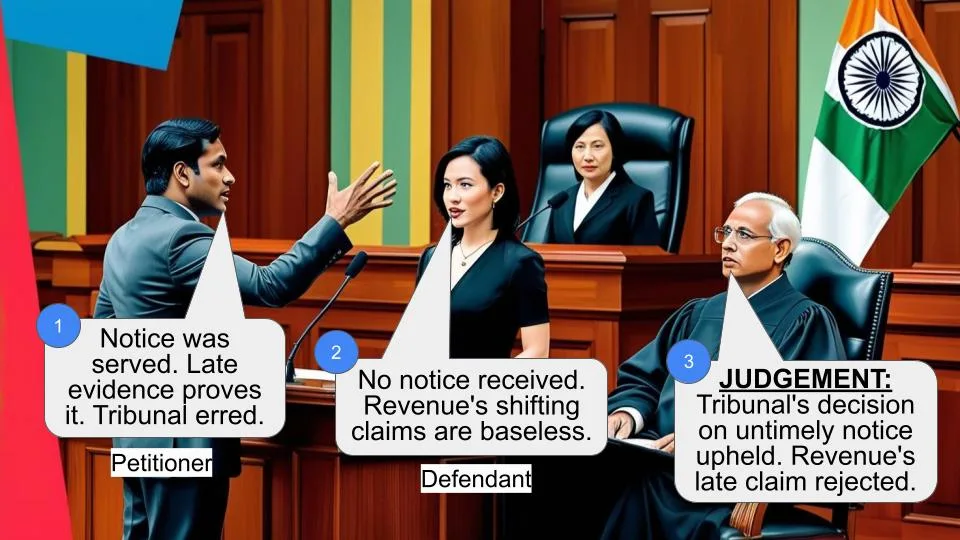
In the case of HL Malhotra and Company Pvt. Ltd. vs. Deputy Commissioner of Income Tax, the court addressed a delay in filing an appeal due to pending rectification proceedings. The court decided to condone the delay, emphasizing the importance of substantial justice over procedural technicalities. The decision allows the appellant to pursue benefits under the Vivad se Vishwas Scheme.
Get the full picture - access the original judgement of the court order here
Case Name:
HL Malhotra and Company Pvt. Ltd. vs. Deputy Commissioner of Income Tax (High Court of Delhi)
ITA 211/2020 & CM APPLs.32045-32047/2020
Date: 22nd December 2020
Key Takeaways:
- The court condoned a 498-day delay in filing an appeal, highlighting the principle that justice should not be hindered by procedural delays unless there is evidence of mala fide intent.
- The decision underscores the court’s role in promoting substantial justice, especially when procedural delays are not deliberate.
- The case illustrates the distinct scopes of Sections 254(2) and 260A (of Income Tax Act, 1961), affirming that they are separate remedies.
Issue
Did the court err in condoning the delay in filing the appeal due to pending rectification proceedings under Section 254(2) (of Income Tax Act, 1961)?
Facts
- The appellant, HL Malhotra and Company Pvt. Ltd., filed a rectification application under Section 254(2) (of Income Tax Act, 1961) on May 8, 2019.
- The Tribunal reserved the order on this application on November 8, 2019, and again on October 9, 2020, but no decision was made.
- The appellant filed an appeal under Section 260A (of Income Tax Act, 1961) to avail benefits under the Vivad se Vishwas Scheme before the deadline of December 31, 2020.
- The appeal was delayed by 498 days due to the pending rectification application.
Arguments
- Appellant’s Argument: The delay should be condoned as it was not deliberate, and the appeal was necessary to avoid prejudice due to the pending rectification application. The appellant also argued that the Tribunal failed to consider additional evidence submitted under Rule 29 of the ITAT Rules.
- Respondent’s Argument: The delay should not be condoned as the rectification application was still pending. The respondent argued that the appeal and rectification proceedings were overlapping and that the additional evidence was not admissible under Rule 29 (of Income Tax Rules, 1962).
Key Legal Precedents
- Collector, Land Acquisition, Anantnag & Anr v. Mst. Katiji and Others (1987) 2 SCC 107
- N. Balakrishnan Vs. M. Krishnamurthy: 1998 (7) SCC 123
- These cases establish that delays should be condoned in the absence of mala fide intent to promote substantial justice.
Judgement
The court condoned the delay in filing the appeal, emphasizing that the intent of the court is to promote substantial justice. The court recognized the distinct scopes of Sections 254(2) and 260A, allowing the appellant to pursue the appeal independently of the pending rectification application. The Tribunal’s order was set aside, and the case was remanded for de novo hearing.
FAQs
Q1: Why was the delay condoned?
A1: The court condoned the delay because there was no evidence of mala fide intent, and the delay was not a deliberate tactic. The court prioritized substantial justice over procedural technicalities.
Q2: What is the significance of the Vivad se Vishwas Scheme in this case?
A2: The appellant sought to avail benefits under the Vivad se Vishwas Scheme, which provides waivers of penalties and interest. The deadline for filing declarations under this scheme was a factor in the urgency of the appeal.
Q3: How does this case affect the interpretation of Sections 254(2) and 260A?
A3: The case clarifies that Sections 254(2) and 260A are separate remedies and can be pursued independently, even if there is some overlap in the issues they address.

1. The petition has been heard by way of video conferencing.
2. On 17 December, 2020, this Court had admitted the appeal on the following question of law:-
"Whether the Tribunal erred in law in failing to adjudicate upon the admissibility and consider the additional evidence furnished by the appellant under Rule 29 of the ITAT Rules?"
3. As learned standing counsel for the respondent, on the last date of hearing, had stated that this Court
cannot decide the aforesaid issue without examining the record of the Tribunal in appellant's statutory
appeal being ITA No. 3613/Del/2015, we had summoned the said record.
RELEVANT FACTS
4. A perusal of the Tribunal record reveals that the appellant had filed an application for admission of
additional evidence in terms of Rule 29 of the Income-Tax (Appellate Tribunal) Rules, 1963
(hereinafter referred to as the 'ITAT Rules') on 14 January, 2019 after serving a copy of the same on th
the counsel for the Revenue, i.e., prior to commencement of final hearing before the Tribunal. On 17 th
January, 2019, the Tribunal concluded its hearing in the said appeal. Thereafter, on 22 January, nd
2019, the appellant filed its synopsis/written submissions. On 28 February, 2019, the Tribunal th
passed the impugned order without dealing with the application filed by the appellant for admission of
additional evidence under Rule 29 of the ITAT rules.
5. After the impugned order had been passed by the Tribunal, the appellant preferred an application for
rectification dated 8 May, 2019 under Section 254(2) (of Income Tax Act, 1961) (hereinafter th
referred to as the 'Act'). The said application was heard and reserved for orders on 08 November, th
2019. Thereafter, the matter was listed for clarification by the Tribunal and the order on the said
application was again reserved on 09 October, 2020. However till date no order has been th
pronounced by the Tribunal on the application filed by the appellant under Section 254(2) (of Income Tax Act, 1961).
6. In the present appeal, it has been averred that since the appellant was awaiting the final outcome of
the aforesaid miscellaneous application filed before the Tribunal, the impugned order dated 28.02.2019
was not challenged in appeal before this court within the prescribed period of limitation, and hence the
present appeal is barred by limitation by 498 days.
ARGUMENTS ON BEHALF OF THE APPELLANT
7. Mr. Ajay Vohra, learned senior counsel for the appellant states that the appellant has been
constrained to file the present appeal under Section 260A (of Income Tax Act, 1961) without waiting for a final order in
the rectification application filed by it, as the appellant wishes to avail the benefit of waiver of interest
and penalty under the amnesty scheme being ' Vivad se Vishwas Scheme', for which declarations have
to be filed latest by 31 December, 2020. st
8. Mr Ajay Vohra, learned senior counsel for appellant submits that the Tribunal erred in failing to
adjudicate upon and consider the additional evidence furnished by the appellant under Rule 29 (of Income Tax Rules, 1962) of the
ITAT Rules before passing the impugned order. He further submits that the Tribunal erred in recording
self-contradictory reasoning in the impugned order, inasmuch as, on the one hand, the Tribunal has
recorded the failure on the part of the appellant to furnish necessary evidence following the order of the
CIT(A), while on the other hand, failed to even consider the additional evidence furnished by the
appellant.
ARGUMENTS ON BEHALF OF THE RESPONDENT
9. Per contra, Mr. Raghvendra Singh, learned senior standing counsel for the respondent submits that
as the appellant's application for rectification under Section 254(2) (of Income Tax Act, 1961) is pending consideration,
this Court should not condone the delay in the present case. He states that condonation of delay in
filing the appeal would amount to allowing the appellant to midway abandon its application under
Section 254(2) (of Income Tax Act, 1961). He submits that as the grounds urged by the appellant in support of the
question framed by this Court are the same on which rectification application has been filed under
Section 254(2) (of Income Tax Act, 1961), it would not be proper for this Court to hear and decide the present appeal
till the Tribunal decides the rectification application.
10. He further submits that the appellant's application for production of additional evidence before the
Tribunal was not maintainable as the conditions precedent mentioned in Rule 29 of the ITAT Rules are
not attracted to the facts of the present case. In support of his submission, he relies upon the judgment
of the Rajasthan High Court in Commissioner of Income Tax vs. Rao Raja Hanut Singh, 2001 252ITR
528 Raj, wherein it has been held as under:-
"Thus, the only question which at best can be said to be raised for consideration before this
court is whether for allowance or disallowance of a request for additional evidence to be
produced before the Income-tax Appellate Tribunal is a question of law.
Having given our thoughtful consideration, we are of the opinion that the law is well settled by
a catena of decisions of the Supreme Court that production of additional evidence at the
appellate stage is not matter of right to the litigating party but within the discretion of the court
which is to be exercised judiciously. The question whether the discretion has been exercised
judiciously or not cannot obviously be ordinarily a question of law unless it can be disputed or
found that in exercising that discretion, the Tribunal has ignored some well settled legal
principles in the matter of exercise of such discretion or has acted so grossly or arbitrarily that
no authority trained and disposed to adjudicate the rights of the litigating parties as a judicial
or quasi-judicial Tribunal would exercise such discretion in that manner."
11. He lastly contends that the additional evidence filed by the appellant vide application dated 14 th
January, 2019, had in all probability, been considered by the Tribunal. In support of his contention, he
refers to the Index of Additional Documents mentioned in the application for admission of additional
evidence and points out that the additional documents mentioned therein had been referred in the
written submissions filed by the appellant with the Tribunal after the conclusion of the hearing on 22
January, 2019. He states that the Tribunal would surely have examined and taken into account the nd
written submissions filed by the appellant before passing the impugned order.
REJOINDER ARGUMENTS
12. In rejoinder, learned senior counsel for the appellant states that it is the appellant's case that neither
the appellant's application for additional documents nor the synopsis filed by the appellant had been
considered by the Tribunal before passing the impugned order.
13. As far as condonation of delay is concerned, he submits that this Court has been adopting a liberal
approach on the ground that the procedure is handmaid of justice and the Court must always promote
the cause of substantial justice.
COURT'S REASONING
THE DELAY IN FILING THE APPEAL IS CONDONED AS IT IS SETTLED LAW THAT IN THE
ABSENCE OF ANYTHING SHOWING MALA FIDE OR DELIBERATE DELAY AS A DILATORY
TACTIC, THE COURT SHOULD NORMALLY CONDONE THE DELAY AS THE INTENT OF THE
COURT IS ALWAYS TO PROMOTE SUBSTANTIAL JUSTICE
14. He lastly submits that the scope of Sections 254(2) and 260A (of Income Tax Act, 1961) are entirely different and
therefore the appeal and rectification application are separate and independent remedies.
15. Having heard learned counsel for the parties, this Court is of the view that the delay in filing the
present appeal is liable to be condoned as the appellant had within the limitation period prescribed
under Section 254(2) (of Income Tax Act, 1961), filed the rectification application on 8 May, 2019. In the said application for th
rectification order had been reserved by the Tribunal on 8 November, 2019 and thereafter again on 9 th
October, 2020. However, as no order has been pronounced till date and the last date for filing the th
declaration under the amnesty scheme being Vivad se Vishwas Scheme (under which the appellant
may get waiver of penalty and interest) is 31 December, 2020, the appellant, in order to avoid being st
prejudiced, has filed the present appeal.
16. It is settled law that in the absence of anything showing mala fide or deliberate delay as a dilatory
tactic, the court should normally condone the delay as the intent of the court is always to promote
substantial justice. [See: Collector, Land Acquisition, Anantnag & Anr v. Mst. Katiji and Others (1987)
2 SCC 107 & N. Balakrishnan Vs. M. Krishnamurthy: 1998 (7) SCC 123].
17. Consequently, the delay in filing the appeal is condoned.
SCOPE OF SECTIONS 254(2) AND 260A (of Income Tax Act, 1961) ARE ENTIRELY DIFFERENT AND IT
CANNOT BE SAID IN LAW THAT THEY ARE PARALLEL OR MUTUALLY EXCLUSIVE
PROCEEDINGS
18. This Court is also in agreement with the submission of learned senior counsel for the appellant that
the scope of Sections 254(2) and 260A (of Income Tax Act, 1961) are entirely different and it cannot be said in law that
they are parallel or mutually exclusive proceedings, i.e., if a party invokes Section 254(2) (of Income Tax Act, 1961), it is barred
in law from invoking Section 260A (of Income Tax Act, 1961).
19. Normally speaking this Court would not entertain an appeal under Section 260A (of Income Tax Act, 1961) if an
application for rectification under Section 254(2) (of Income Tax Act, 1961) is pending consideration as there is some
overlap and if the order is recalled by the Tribunal, then the initial appeal would become infructuous.
But in the present case, as the last date for availing the benefit of amnesty scheme being 'Vivad se
Vishwas Scheme' is 31 December, 2020 and despite all efforts, the Tribunal is not deciding the st
application for rectification under Section 254(2) (of Income Tax Act, 1961) and learned counsel for respondent has
stoutly opposed passing of any order in the present appeal to expedite disposal of the application filed
by the appellant under section 254(2) (of Income Tax Act, 1961) before the Tribunal, this Court is of the opinion that if the present
appeal is not entertained, it would gravely prejudice the appellant.
THIS COURT IS OF THE VIEW THAT IT CANNOT SECOND GUESS WHAT ORDER THE
TRIBUNAL WOULD PASS AS IT IS NOT FOR THIS COURT BUT FOR THE TRIBUNAL TO
DECIDE THE SAID APPLICATION.
20. As far as the argument that the appellant's application under Rule 29 of ITAT Rules is liable to be
dismissed as the conditions mentioned therein are not attracted, this Court is of the view that it cannot
second guess what order the Tribunal would pass as it is not for this Court but for the Tribunal to
decide the said application. In fact, it has been so held by the Supreme Court in the case of Jyotsna Suri
Vs. ITAT; 179 CTR 265 (SC). Accordingly, the respondent reliance on the judgment of the Rajasthan
High Court in CIT vs. Rao Raja Hanut Singh (supra) is misconceived on facts.
TO HOLD THAT THE ADDITIONAL EVIDENCE FILED BY THE APPELLANT HAD BEEN
CONSIDERED BY THE TRIBUNAL WOULD BE TO PRESUME AND ASSUME CERTAIN FACTS
WHICH ARE NOT APPARENT FROM THE RECORD.
21. This Court is not impressed by the submission of learned standing counsel for the respondent that
the additional evidence filed by the appellant had in all probability been considered by the Tribunal. In
the impugned order passed by the Tribunal, there is no reference to either the additional documents
placed on record by the appellant or to the written submissions/synopsis filed by the appellant. To hold
that the additional evidence filed by the appellant had been considered by the Tribunal would be to
presume and assume certain facts which are not apparent from the record.
AS THE APPELLANT HAD ADMITTEDLY FILED AN APPLICATION FOR ADMISSION OF
ADDITIONAL EVIDENCE IN TERMS OF RULE 29 OF THE ITAT RULES PRIOR TO THE DATE
OF FINAL HEARING, IT WAS INCUMBENT UPON THE TRIBUNAL TO CONSIDER THE SAID
APPLICATION BEFORE PROCEEDING AHEAD WITH THE FINAL HEARING
22. This Court is further of the opinion that as the appellant had admittedly filed an application for
admission of additional evidence in terms of Rule 29 of the ITAT Rules prior to the date of final
hearing, it was incumbent upon the Tribunal to consider the said application before proceeding ahead
with the final hearing.
23. The Supreme Court in the case of Jyotsna Suri Vs. ITAT (supra) set aside the order of the High
Court and remanded the matter back to the file of the Tribunal to decide the application under Rule 29 (of Income Tax Rules, 1962)
of ITAT Rules and thereafter to dispose of the appeal on merits. The relevant observations of the Apex
Court are reproduced hereinbelow:-
"The Tribunal has disposed of the appeal by its order of 3rd Jan., 1997, without considering the
pending application under Rule 29 of the ITAT Rules, 1963, for adducing additional evidence.
Obviously, that application was required to be disposed of first before the Tribunal heard the
appeal on merits. The appellant also undertakes to withdraw the pending application before the
Tribunal for making a reference under Section 256(1) (of Income Tax Act, 1961) for the above purpose. In
view thereof, we direct that the Tribunal should first dispose of the application under Rule 29 (of Income Tax Rules, 1962)
on merits and thereafter proceed to dispose of the appeal on merits. The order dated 3-1-1997,
is, therefore, set aside and the matter is remitted to the Tribunal for disposal on merit in
accordance with law. The order of the High Court is set aside as above and the appeal is
disposed of accordingly.
RELIEF
24. For the aforesaid reasons, the present appeal is allowed and the order of the Tribunal dated 28 th
February, 2019 is set aside; the appeal of the appellant is restored to the file of the Tribunal for de novo
hearing in accordance with the judgment of the Supreme Court in Jyotsna Suri Vs. ITAT (supra).
25. However, this Court clarifies that it has not expressed any opinion on the merits of the application
to be filed by the appellant under the amnesty scheme being ' Vivad se Vishwas Scheme'.
26. The order be uploaded on the website forthwith. Copy of the order be also forwarded to the learned
counsel through e-mail.
27. The original record of ITAT requisitioned vide order dated 17 December, 2020 be sent back.
MANMOHAN, J
SANJEEV NARULA, J
DECEMBER 22, 2020
×
Similar Ripples
Questions
Delay Condoned: Court Prioritizes Justice Over Procedural Lapses
Write your CommentSimilar Posts


Generic
- Reportdata/6382.pdf
