Full News
Google India ordered to maintain 20% balance pending tax appeal decision.
Google India ordered to maintain 20% balance pending tax appeal decision.
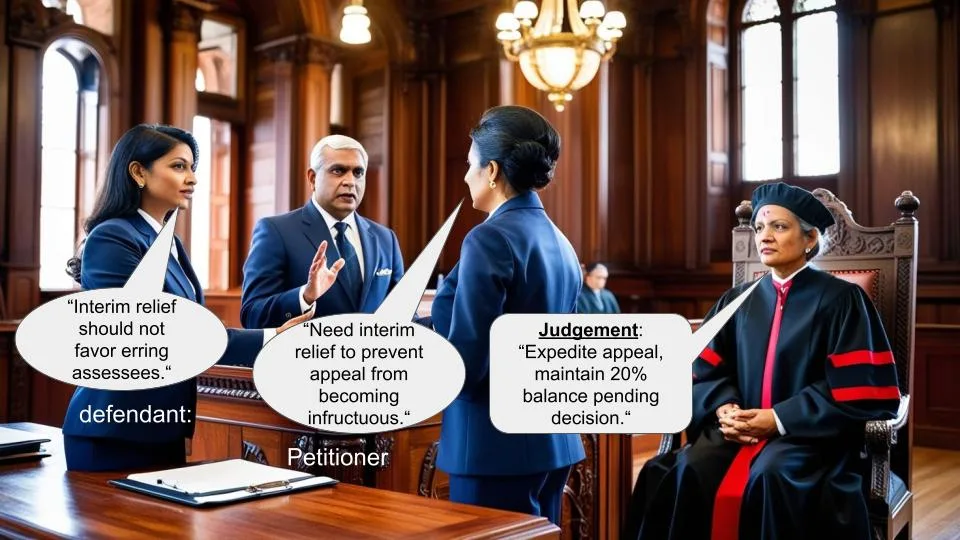
In the case of Google India (P) Ltd. vs Deputy Commissioner of Income Tax (International Taxation) & Anr., the High Court directed the Income Tax Appellate Tribunal to expedite the disposal of Google's appeal by January 31, 2018. Google India was instructed to maintain a balance of 20% of the outstanding tax demand in its bank account, while the revenue was restrained from taking further steps until the appeal's resolution.
Get the full picture - access the original judgement of the court order here.
Case Name:
Google India (P) Ltd. vs Deputy Commissioner of Income Tax (International Taxation) & Anr.
Writ Petition Nos.52358-52359/2017 (T-IT)
Key Takeaways:
- The High Court directed the Appellate Tribunal to expedite the appeal process.
- Google India must maintain a balance of 20% of the outstanding tax demand in its bank account.
- The revenue is restrained from taking further steps until the appeal is resolved.
- The case highlights the balance between protecting the revenue's interest and the taxpayer's rights.
Issue
Should the High Court grant interim relief to Google India by restraining the revenue from taking further steps until the appeal is resolved?
Facts
- Google India, a private limited company, is contesting a tax demand of Rs.
129 crore.
- Google had already deposited Rs. 70 crore, about 55% of the demand.
- The Appellate Tribunal initially granted a stay on the demand, which was not extended later.
- Google argued that without interim relief, the appeal would become infructuous.
- The revenue argued against granting interim relief, citing a Supreme Court
judgment.
Arguments
- Petitioner (Google India):
- The appeal has been pending since 2014.
- The Appellate Tribunal's refusal to extend the stay would render the appeal infructuous.
- The Division Bench's order should protect Google until the appeal is heard on its merits.
- Respondent (Revenue):
- Cited the Supreme Court judgment in Assistant Collector of Central Excise, Chandan Nagar, West Bengal vs. Dunlop India Ltd. & others [(1985)2 SCC 260].
- Argued that interim orders should not favor erring assessees.
- The High Court should not substitute its discretion for that of the Appellate Tribunal.
Key Legal Precedents
- Assistant Collector of Central Excise, Chandan Nagar, West Bengal vs. Dunlop India Ltd. & others [(1985)2 SCC 260]:
The Supreme Court held that interim orders should not be made in favor of erring assessees against the revenue.
Judgement
The High Court directed the Appellate Tribunal to expedite the disposal of the appeal by January 31, 2018. Google India was instructed to maintain a balance of 20% of the outstanding tax demand in its bank account. The revenue was restrained from taking further steps until the appeal's resolution.
FAQs
Q1: What was the main issue in this case?
A1: The main issue was whether the High Court should grant interim relief to Google India by restraining the revenue from taking further steps until the appeal is resolved.
Q2: What did the High Court decide?
A2: The High Court directed the Appellate Tribunal to expedite the appeal process and instructed Google India to maintain a balance of 20% of the outstanding tax demand in its bank account. The revenue was restrained from taking further steps until the appeal is resolved
Q3: Why did Google India seek interim relief?
A3: Google India sought interim relief to prevent the revenue from recovering the balance amount, which would render the appeal infructuous.
Q4: What was the revenue's argument against granting interim relief?
A4: The revenue argued that interim orders should not favor erring assessees and cited a Supreme Court judgment to support their position.
Q5: What is the significance of this case?
A5: The case highlights the balance between protecting the revenue's interest and the taxpayer's rights, and the importance of expeditious disposal of appeals in tax matters.
Q6: What was the amount Google India was required to maintain in its bank account?
A6: Google India was required to maintain a balance of Rs. 26 crore, which is 20% of the outstanding tax demand.

1. Though these writ petitions are listed for hearing on maintainability, on holding that these writ petitions are maintainable, with the consent of learned counsel on both sides, they are heard finally and are disposed by this order.
2. Petitioner is stated to be a private limited company, incorporated under the provisions of the Companies Act, 1956. Being aggrieved by the interlocutory order dated 15/11/2017 (Annexure-H to the writ petitions), passed by respondent No.1, directing payment of the balance tax demand and also, pursuant to order dated 07/11/2017 (Annexure-F), passed by the Income Tax Appellate Tribunal, ‘C’ Bench, Bengaluru (“Appellate Tribunal” for short), in Stay Petition No.229/Bang/2017 in ITA.No.1190/Bang/2014, pertaining to Assessment Year 2013-14, the petitioner has presented these writ petitions.
3. Learned counsel for the petitioner submits that the appeal before the Appellate Tribunal was filed in the year 2014. He draws my attention to paragraph No.3 of the impugned order to contend that since 31/10/2014, petitioner had the benefit of an interim order of stay subject to deposit of Rs.70,00,00,000/- (Rupees seventy crore only) out of a total demand of Rs.129, 42, 20,422/- (Rupees one hundred twenty nine crore forty two lakh twenty thousand four hundred and twenty two only), which is about 55% of the demand. He submits that the order of stay was extended from time to time, but when an application for further extension of stay was made by the petitioner, the Appellate Tribunal held that there was no prima facie case, financial hardship or irreparable injury so as to grant any further extension of stay. Learned counsel submits that the Appellate Tribunal was not right in not extending the stay and by holding that the assessee/company had not made out a case for stay of the demand and thereby dismissing the application. As a result, the appeal itself would be rendereed infructuous.
4. Drawing my attention to an order passed by the Division Bench of this Court, on 16/11/2017, in ITA No.879/2017, learned counsel for the petitioner submits that despite earlier orders passed by the Appellate Tribunal against the petitioner herein, the Division Bench has categorically observed that ITA.No.1190/Bang/2014, out of which these petitions arise, be disposed of in accordance with law and without in anyway being influenced by order dated 23/10/2017 passed earlier by the Appellate Tribunal. Learned counsel contends that possibly, the Appellate Tribunal was influenced by the earlier order passed by it on 23/10/2017 and had passed the impugned order dated 07/11/2017 whereas, the order of the Division Bench is dated 16/11/2017, which is subsequent thereto. He submits that having regard to the observations made by the Division Bench of this Court, the appeal (out of which these writ petitions arise) would have to be heard on its merits and therefore, the petitioner would have to be protected by certain interim orders pending disposal of the appeal as the respondent is seeking to recover the balance amount as the interim stay is not continued by the Appellate Tribunal.
5. It is submitted at the Bar that the appeal is slated for final hearing tomorrow (23/11/2017) and this Court may put the parties to terms for expeditious disposal of the appeal. Petitioner’s counsel submits that in the interregnum petitioner’s rights cannot be jeopardized by the revenue by precipitating the matter on account of non- extension of stay by the Tribunal on 07/11/2017. He therefore, submits that interim arrangements may be made pending disposal of the appeals.
6. Learned counsel for the revenue draws my attention to the judgment of the Hon’ble Supreme Court in the case of Assistant Collector of Central Excise, Chandan Nagar, West Bengal vs. Dunlop India Ltd. & others [(1985)2 SCC 260] to contend that in a petition under Article 226, interim orders cannot be made nor can any protective orders be made in favour of erring assessees and against the revenue and that this Court may not entertain any submission made by the petitioner seeking protective orders. He submits that once the Appellate Tribunal has exercised its discretion to discontinue the interim stay granted by it earlier, this Court cannot substitute its discretion and grant protective orders in favour of the petitioner. He would also submit that the appeal before the Appellate Tribunal has to be heard on merits, and that the petitioner has no case on merits. Therefore, directions may be issued to the petitioner to make good the balance amount due to the revenue and that the appeal could be disposed in terms of the directions issued by this Court.
7. In response, learned counsel for petitioner would submit that pursuant to the impugned order dated 07/11/2017 (Annexure-F), order dated 15/11/2017 (Annexure-H) has been issued by respondent No.1 attaching the bank account of the petitioner. The petitioner is unable to carry on its financial transactions and if protective orders are not granted, then the revenue would inevitably recover the amount and the appeals of the petitioner would become infructuous.
8. Having heard learned counsel for the respective parties at length, I find that granting of any interim order in these writ petitions and keeping the writ petitions pending before this Court would not serve any purpose particularly, when the matter is set down for final arguments before the Appellate Tribunal tomorrow (23/11/2017). In the circumstances, a direction is issued to the Tribunal to dispose of the appeal in an expeditious manner i.e., on or before 31/01/2018. It is needless to observe that in view of the specific direction issued by this Court for expeditious disposal of the appeal by the Appellate Tribunal, both parties are directed to co-operate with the Tribunal.
9. It is noted that the demand is about Rs.129,00,00,000/- (Rupees one hundred and twenty nine crore only). It is an admitted fact that a sum of Rs.70,00,00,000/- (Rupees seventy crore only) is deposited by the petitioner which amounts to about 55% of the outstanding demand. In order to further protect the interest of the revenue and keeping in mind the fact that the appeal is slated for final arguments before the Appellate Tribunal and balancing the equities on both sides, the petitioner is directed to retain a balance of another 20% in Account No.0037238007 maintained with CITI Bank, M.G.Road Branch, Bengaluru-560 001. The said balance is rounded off to Rs.26,00,00,000/- (Rupees twenty six crore only) shall be maintained pending disposal of the appeal by the Appellate Tribunal. It is directed that the respondent shall not take further steps pursuant to order dated 15/11/2017 (Annexure-H) and notice dated 20/11/2017 till the disposal of the appeal by the Appellate Tribunal.
10. With the aforesaid observations and directions, the writ petitions are disposed.
Sd/-
JUDGE
×