


High Court Appeal Limits: Relevant Evidence and Inadmissible Evidence Key Facto…



Full News
High Court Appeal Limits: Relevant Evidence and Inadmissible Evidence Key Factors
High Court Appeal Limits: Relevant Evidence and Inadmissible Evidence Key Factors
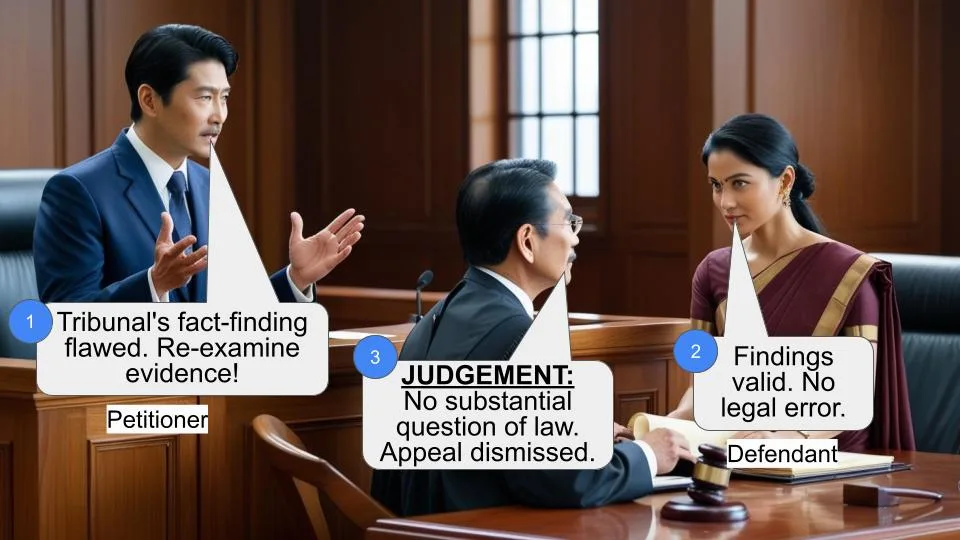
This case involves an appeal under Section 260A (of Income Tax Act, 1961), arising from a judgment by the Income Tax Appellate Tribunal, Lucknow Bench 'B'. The appeal was dismissed as no substantial question of law was found to have arisen in the matter. The court clarified the circumstances under which interference with findings of fact is permissible in appeals.
Get the full picture - access the original judgement of the court order here
Case Name:
Income Tax Officer Vs Shri Ram Lallan Shukla (High Court of Allahabad)
Income Tax Appeal No.78 of 2015
Date: 3rd February 2017
Key Takeaways:
1. Appeals to the High Court are limited to substantial questions of law.
2. Interference with findings of fact is permissible in two specific situations.
3. The court emphasized the importance of properly framing substantial questions of law in appeals.
Issue:
Under what circumstances can the High Court interfere with findings of fact in an appeal under Section 260A (of Income Tax Act, 1961)?
Facts:
- The case originated from a judgment dated 12.02.2015 passed by the Income Tax Appellate Tribunal, Lucknow Bench 'B'.
- The appeal related to the Assessment Year 2009-10.
- Initially, three questions were framed as substantial questions of law for admission of the appeal.
- During arguments, it became clear that the issues raised were primarily questions of fact, not law.
Arguments:
The appellant's counsel attempted to justify the formulation of the questions as substantial questions of law but ultimately couldn't dispute that they were primarily questions of fact.
Key Legal Precedents:
1. Dilbagrai Punjabi Vs. Sharad Chandra, AIR 1988 SC 1858: First Appellate Court must examine all relevant evidence
2. Jagdish Singh Vs. Nathu Singh, AIR 1992 SC 1604: High Court can record proper findings if lower court's approach was erroneous
3. Ishwar Dass Jain (Dead) through Lrs. Vs. Sohan Lal (Dead) through Lrs., 2000(1) SCC 434: Clearly outlined two situations for interfering with findings of fact
4. Santosh Hazari Vs. Purushottam Tiwari, 2001(3) SCC 179: Defined "substantial question of law"
5. Sir Chunilal Mehta and Sons Ltd. Vs. The Century Spinning and Manufacturing Company Ltd. AIR 1962 SC 1314: Affirmed the definition of substantial question of law
Judgement:
The court dismissed the appeal, stating that no substantial question of law had arisen in the matter. The court outlined two situations where interference with findings of fact is permissible:
1. When material or relevant evidence is not considered, which if considered, would have led to an opposite conclusion.
2. Where a finding has been arrived at by placing reliance on inadmissible evidence, which if omitted, an opposite conclusion would have been possible.
FAQs:
1. Q: What is a "substantial question of law"?
A: A substantial question of law is one that is debatable, not previously settled by law or binding precedent, and has a material bearing on the case's outcome. It must be necessary to decide for a just and proper decision of the case.
2. Q: Can new points be raised as substantial questions of law in the High Court?
A: Generally, no. An entirely new point raised for the first time before the High Court is not considered a question involved in the case unless it goes to the root of the matter.
3. Q: Can the High Court frame additional substantial questions of law during the hearing?
A: Yes, the High Court can frame additional substantial questions of law if the need arises during the final hearing of the appeal.
4. Q: What is the purpose of Section 260A (of Income Tax Act, 1961)?
A: Section 260A (of Income Tax Act, 1961) provides for appeals to the High Court against orders passed by the Income Tax Appellate Tribunal.
5. Q: How does the court balance the need for justice with avoiding prolonged litigation?
A: The court aims to strike a judicious balance between the indispensable obligation to do justice at all stages and the impelling necessity of avoiding prolongation in the life of any legal dispute.

1. Heard Sri Siddharth Dhaon, learned counsel for appellant and Sri Namit Sharma, Advocate for respondent.
2. This appeal under Section 260A (of Income Tax Act, 1961) (hereinafter referred to as the "Act, 1961") has arisen from judgment and order dated 12.02.2015 passed by Income Tax Appellate Tribunal, Lucknow Bench 'B', Lucknow (hereinafter referred to as the "Tribunal") in I.T.A. No. 594/Lkw/2012, relating to Assessment Year 200910.
3. The appeal was admitted on following substantial questions of law:
"(a) The Hon'ble ITAT has erred in law and on facts by restoring the turnover of Rs. 1,84,32,508/ purportedly recorded in the books of assessee instead of turnover of Rs. 30 crores estimated by AO despite the fact that the true and full extent of sales was not reflected in the audited books of accounts and the documents and was thus not fully disclosed.
(b) The Hon'ble ITAT has erred in law and on facts confirming the order of the Ld. CIT(A) who quantified the relief as of Rs. 70,70,800/ without appreciating the fact that in this process the addition of Rs. 31,611/ made on account of income from other sources, which was not contested by the assessee in appeal before the Ld. CIT(A), also got deleted.
(c) The Hon'ble Tribunal did not give any finding for accepting the total turnover of Rs. 1,84,32,508/ as declared by the assessee and thereby upholding the relief of Rs. 70,70,610/ relying solely on the order of the Ld. CIT(A) without appreciating the fact that the action of the AO in rejecting the books of the assessee has been confirming by the CIT(A) and during the assessment proceedings the assessee did not furnish the copies of the 6R forms giving details of the Mandi Tax paid amounting to Rs. 4,26,600/ or any evidence in order to verify the purchase of wheat during the year."
4. However, during course of argument learned counsel for Revenue could not dispute that questions formulated in this appeal cannot be said to be substantial questions of law since issues raised therein are pure questions of fact on which finding of fact has been recorded by Courts below and in absence of anything to show that same is perverse, it cannot be said that any substantial questions of law has arisen in this appeal.
5. Sri Siddharth Dhaon, learned counsel appearing for appellant, though attempted to justify formulation of aforesaid questions but after some argument could not dispute that actual dispute raised in these questions is nothing but a question of fact. In any case it cannot be said that any substantial question of law has arisen in this case.
6. There are two situations in which, ordinarily, interference with findings of fact is permissible, namely, (a) when material or relevant evidence is not considered, which if considered, would have led to opposite conclusion, and (b) where a finding has been arrived at by court below by placing reliance on inadmissible evidence, which if would have been omitted, an opposite conclusion would have been possible. We derive these principles from some of the authorities of Apex Court and, briefly, it would be appropriate to refer the same.
7. In Dilbagrai Punjabi Vs. Sharad Chandra, AIR 1988 SC 1858, the Court affirmed the observations of High Court that First Appellate Court is under a duty to examine entire relevant evidence on record and if it refuses to consider important evidence having direct bearing on the disputed issue, and the error which arises is of magnitude that it gives birth to a substantial question of law, the High Court would be entitled to set aside the finding.
8. In Jagdish Singh Vs. Nathu Singh, AIR 1992 SC 1604, it was said, where finding by court of facts is vitiated by non consideration of relevant evidence or by an essentially erroneous approach to the matter, the High Court is not precluded from recording proper finding.
9. In Sri Chand Gupta Vs. Gulzar Singh, AIR 1992 SC 123 the Court upheld interference by High Court in second appeal where the Lower Appellate Court relied an admission of third party treating it as binding on the defendant though it was inadmissible against the said defendant.
10. In Sundra Naicka Vadiyar Vs. Ramaswami Ayyar, AIR 1994 SC 532 the Court said where certain vital documents for deciding the question of possession were ignored, such as compromise, an order of revenue Court relying on oral evidence was unjustified.
11. In Ishwar Dass Jain (Dead) through Lrs. Vs. Sohan Lal (Dead) through Lrs., 2000(1) SCC 434 the Court in paras 11 and 13 of the judgment clearly mentioned two situations in which inference with findings of fact is permissible. It is said:
“11. There are two situations in which interference with findings of fact is permissible. The first one is when material or relevant evidence is not considered which, if considered would have led to an opposite conclusion. . . . .”
“13. The second situation in which interference with findings of fact is permissible is where a finding has been arrived at by the appellate Court by placing reliance on inadmissible evidence which if it was omitted, an opposite conclusion was possible. . . .”
12. In Govindaraju Vs. Mariamman, 2005(2) SCC 500 the Court said that existence of substantial question of law is the sine qua non for exercise of jurisdiction under Section 100 of the Code. If a second appeal is entertained under Section 100 (of Income Tax Act, 1961) without framing substantial questions of law then it would be illegal and would amount to failure or abdication of duty cast on the Court. The Court relied on its earlier decisions in Kshitish Chandra Purkait Vs. Santosh Kumar Purkait & Ors., 1997(5) SCC 438; Panchugopal Barua Vs. Umesh Chandra Goswami 1997(4) SCC 413; and, Kondiba Dagadu Kadam Vs. Savitribai Sopan Gujar 1999(3) SCC 722.
13. In Santosh Hazari Vs. Purushottam Tiwari, 2001(3) SCC 179 the Court considered what the phrase “substantial question of law” means. It says that the phrase is not defined in the Code. The word “substantial”, as qualifying question of law, meansof having substance, essential, real, of sound worth, important or considerable. It is to be understood as something in contradistinction withtechnical, of no substances or consequence, or academic merely.
14. A Full Bench of Madras High Court in Rimmalapudi Subba Rao Vs. Noony Veeraju, AIR 1951 Madras 969 considered this term and said, “when a question of law is fairly arguable, where there is room for difference of opinion or where the Court thought it necessary to deal with that question at some length and discuss an alternative view, then the question would be a substantial question of law. On the other hand, if the question was practically covered by decision of highest Court or if general principles to be applied in determining the question are well settled and the only question was of applying those principles to the particular fact of case, it could not be a substantial question of law.”
15. The above observations were affirmed and concurred by a Constitution Bench in Sir Chunilal Mehta and Sons Ltd. Vs. The Century Spinning and Manufacturing Company Ltd. AIR 1962 SC 1314. Referring to above authorities, the Court in Santosh Hazari (supra) said:
“A point of law which admits of no two opinions may be a proposition of law but cannot be a substantial question of law. To be substantial, a question of law must be debatable, not previously settled by law of the land or a binding precedent, and must have a material bearing on the decision of the case, if answered either way, in so far as the rights of the parties before it are concerned. To be a question of law involving in the case there must be first a foundation for it laid in the pleadings and the question should emerge from the sustainable findings of fact arrived at by court of facts and it must be necessary to decide that question of law for a just and proper decision of the case. An entirely new point raised for the first time before the High Court is not a question involved in the case unless it goes to the root of the matter. It will, therefore, depend on the facts and circumstance of each case whether a question of law is a substantial one and involved in the case, or not; the paramount overall consideration being the need for striking a judicious balance between the indispensable obligation to do justice at all stages and impelling necessity of avoiding prolongation in the life of any lis.”
16. The decision in Santosh Hazari (supra) has been followed in Govindaraju (supra) and Thiagarajan and others Vs. Sri Venugopalswamay B. Koll and others, AIR 2004 SC 1913.
17. In Union of India Vs. Ibrahim Uddin and another (2012) 8 SCC 148, the Court said:
"There may be exceptional circumstances where the High Court is compelled to interfere, notwithstanding the limitation imposed by the wording of Section 100 (of Income Tax Act, 1961) CPC. It may be necessary to do so for the reason that after all the purpose of the establishment of Courts of justice is to render justice between the parties, though the High Court is bound to act with circumspection while exercising such urisdiction. In second appeal the court frames the substantial question of law at the time of admission of the appeal and the Court is required to answer all the said questions unless the appeal is finally decided on one or two of those questions or the court comes to the conclusion that the question(s) framed could not be the substantial question(s) of law. There is no prohibition in law to frame the additional substantial question of law if the need so arises at the time of the final hearing of the appeal."
18. We are, therefore, of the view that no substantial question of law has arisen in this matter. Appeal is accordingly dismissed.
Order Date : 3.2.2017
×
Similar Ripples
Questions
High Court Appeal Limits: Relevant Evidence and Inadmissible Evidence Key Factors
Write your CommentSimilar Posts
Generic
- Reportdata/2047_ZMTHTGl.pdf
