


Full News

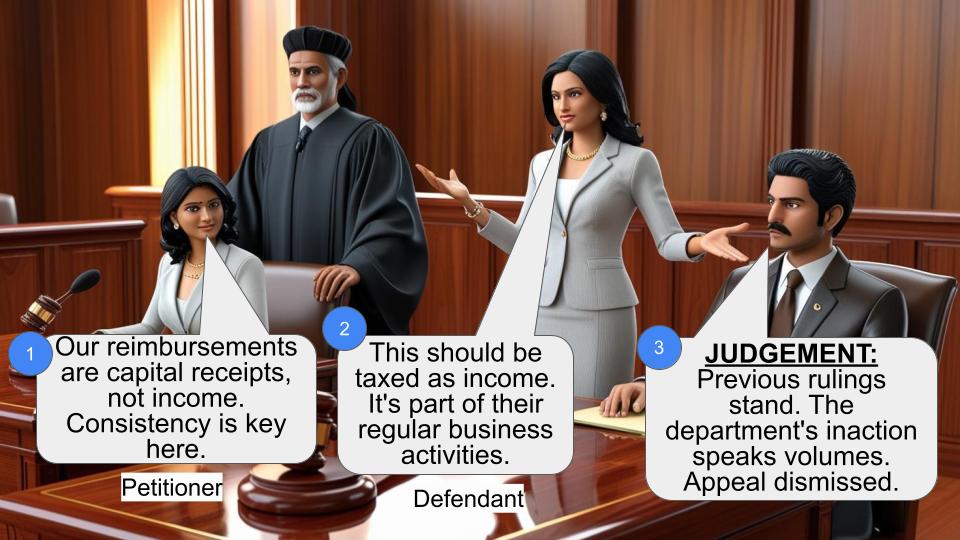
High Court dismisses Revenue's appeal on unexplained cash credits, upholds Tribunal's decision.
High Court dismisses Revenue's appeal on unexplained cash credits, upholds Tribunal's decision.
The case involves the Commissioner of Income Tax (Appeals) and the Income Tax Appellate Tribunal verifying and confirming the genuineness of payments made by the assessee, K. Thirumoorthy, through banking transactions. The High Court dismissed the Revenue's appeal, finding no substantial question of law.
Get the full picture - access the original judgement of the court order here.
Case Name:
Commissioner of Income Tax vs. K. Thirumoorthy (High Court of Madras)
T.C.(A).No.424 of 2014
Date: 22nd December 2014
Key Takeaways
- The High Court upheld the decisions of the Commissioner of Income Tax (Appeals) and the Income Tax Appellate Tribunal, which had verified and confirmed the genuineness of the payments made by the assessee.
- The case was dismissed as it involved a pure question of fact, with no substantial question of law arising for consideration.
- The decision reinforces the principle that higher courts should not interfere in matters of fact that have been thoroughly verified by lower authorities.
Issue
Whether the Tribunal was correct in confirming the order of the Commissioner of Income Tax (Appeals) to delete the addition made towards unexplained cash credit to the extent of Rs.41,38,474/- based on the material available.
Facts
- The respondent, K. Thirumoorthy, is an individual trading in old bottles.
- For the assessment year 2008-09, the Assessing Officer added Rs.47,58,616/- as unexplained credits.
- The Commissioner of Income Tax (Appeals) directed the deletion of Rs.41,38,474/- after verifying payments made through NEFT/RTGS.
- The Revenue appealed to the Income Tax Appellate Tribunal, which confirmed the Commissioner’s order.
- The Revenue then appealed to the High Court.
Arguments
- Revenue's Argument:
The Tribunal erred in confirming the deletion of the addition towards unexplained cash credits and questioned the genuineness of the payments.
- Assessee's Argument:
The payments were genuine and made through banking channels, as verified by both the Commissioner of Income Tax (Appeals) and the Tribunal.
Key Legal Precedents
- The case did not explicitly cite other legal precedents but focused on the verification of facts by the Commissioner of Income Tax (Appeals) and the Tribunal.
Judgement
The High Court dismissed the Revenue's appeal, stating that the case involved a pure question of fact, which had been verified and confirmed by both the Commissioner of Income Tax (Appeals) and the Tribunal. No substantial question of law arose for consideration.
FAQs
Q1: What was the main issue in this case?
A1: The main issue was whether the Tribunal was correct in confirming the deletion of the addition made towards unexplained cash credits based on the material available.
Q2: Why did the High Court dismiss the appeal?
A2: The High Court dismissed the appeal because it involved a pure question of fact, which had been thoroughly verified by the Commissioner of Income Tax (Appeals) and the Tribunal, leaving no substantial question of law for consideration.
Q3: What does this decision mean for the parties involved?
A3: The decision means that the assessee, K. Thirumoorthy, is not liable for the addition of Rs.41,38,474/- as unexplained cash credits, as the payments were verified and found to be genuine.
Q4: What is the significance of this case?
A4: The case underscores the principle that higher courts should not interfere in matters of fact that have been thoroughly verified by lower authorities, unless there is a substantial question of law involved.
Q5: Did the High Court find any procedural errors in the lower authorities' decisions?
A5: No, the High Court did not find any procedural errors and noted that the issue of procedural compliance under Rule 46A (of Income Tax Rules, 1962) was not raised in the appeal before the Tribunal.

1. This Tax Case (Appeal) is filed by the Revenue challenging the order of
the Income Tax Appellate Tribunal for the assessment year 2009-10, raising
the following substantial questions of law:
(i) Whether under the facts and circumstances of the
case, the Tribunal was right in confirming the order of
the CIT(A) directing the assessing officer to delete the
addition made towards unexplained cash credit to the
extent of Rs.41,38,474/-?
(ii) Whether based on the material available before it, the
Tribunal could have arrived at a conclusion that the
assessee had made payments to the creditors in the
subsequent year and that the credits are genuine?"
2. The respondent/assessee is an individual trading in old bottles. In
completing the assessment of income for the assessment year 2008-09
under Section 143(3) (of Income Tax Act, 1961), the Assessing Officer added a
sum of Rs.47,58,616/- as unexplained credits holding that the credits
appearing in the name of various parties as unconfirmed balances.
Aggrieved by the said order of the Assessing Officer, the assessee preferred
an appeal before the Commissioner of Income Tax (Appeals), who partly
allowed the appeal directing the Assessing Officer to delete the addition to
the extent of Rs.41,38,474/-. While doing so, the Commissioner of Income
Tax (Appeals) took note of the payments made by the assessee to the
creditors by NEFT/RTGS through the State Bank of India,
Narasimhanaickenpalayam branch, the details of which are set out in
paragraph 7 of the order of the Commissioner of Income Tax (Appeals).
Aggrieved by the said order of the Commissioner of Income Tax (Appeals),
the Revenue preferred an appeal before the Income Tax Appellate Tribunal.
3. The Tribunal extracted the details of the trade creditors, which was
extracted by the Commissioner of Income Tax (Appeals). For better clarity,
the same is reproduced below:
"6. I have gone through the submissions made by the
appellant and also the order of the Assessing Officer. During the
course of assessment proceedings, the Assessing Officer verified
the balances of sundry creditors. The Assessing Officer issued
letters to the parties as per the addresses mentioned in the
confirmation letter. The confirmations were received from
Sri.Karpaga Vinayaga Bottle Co., Salem, M/s.Vijay Krishnan
Enterprises, Chennai and Supreme Bottle Suppliers, Coimbatore.
Some of the parties did not respond to the letters issued by the
Assessing Officer. The Assessing Officer asked the assessee to
prove the genuineness of these credits by furnishing the bank
statements to subsequent year reflecting the payments. The
appellant submitted the bank statement of subsequent year and
A.O. on verification stated in the order "Though there are fund
transfer from these accounts, there is no clear indication as to
whom these funds were transferred. The A.O. also received
confirmation letters from M/s.Varsha Bottle Suppliers, ARavind
Traders, Kubera Trading Service and Shajid Traders. On
observing these confirmation letters the A.O. doubted the
genuineness of these confirmation letters. The A.O. after
verification of all the details summarized the unconfirmed balance
of 14 creditors amounting to Rs.47,58,616/- and made the
addition.
7. During the course of appellate proceedings, the AR submitted
the details creditor wise showing the payments made to the trade
creditors by NEFT/RTGS through the SBI,
Narasinhanaickenpalayam branch.
(i) Aravind Traders: In this case, the amount disallowed by
Assessing Officer is Rs.7,54,572/-. The appellant furnished the
details of payments made to the creditor in the subsequent year
2009-10. Copies of paid cheque with bank stamp and also the
bank statements showing the debits were furnished. From all
these details, it is clear that the outstanding balances were paid
by the appellant. Hence, the addition has to be deleted.
(ii) Balaji Enterprise: The amount disallowed by the Assessing
Officer as outstanding balance was Rs.6,17,169/-. The appellant
on 26.6.2009 has paid Balaji Enterprise through RTGS transfer,
an amount of Rs.7,00,050/-. Since these payments are reflected
in the banks statements, the addition is to be deleted.
(iii) Dharshini Bottles: The addition on account of outstanding
balance is Rs.1,01,397/-. In this case also, the appellant paid the
trade creditor on 26.6.2009 by RTGS transfer. The addition has
to be deleted.
(iv) Jayarahava Traders: The addition made in this case was
Rs.56,272. The appellant submitted that on 30.12.2009, an
amount of Rs.31,200/- was paid through banking channels.
Similarly, the appellant submitted that an amount of Rs.18,000/-
was paid by cash on 5.1.2010 and 16.1.2010. However, in the
ledger extracts, these cash deleted and the balance amount
added is confirmed.
v) Kubera Trading Service: The addition made was
Rs.11,42,776/-. The appellant submitted the details of bank
account reflecting the RTGS transfer during the financial year
2009-10. On verification of these details, the addition made by
the Assessing Officer needs to be deleted.
vi) Pandian Bottle Stores: In this case, the addition made was
Rs.64,816/-. The appellant furnished cheque details for payment
of these amount on 13.4.2009. Hence, the addition is to be
deleted.
vii) R.B.I. Bottles: The addition made by the Assessing Officer
was Rs.57,200/-. The appellant submitted that the amounts were
paid by cash on 6.4.2009, 17.4.2009 and 4.5.2009. However,
the ledger copy furnished did not show the payments on these
dues. Hence, genuineness could not be proved by the AR. The
addition is confirmed.
viii) Shajith Traders: The addition made was for Rs.7,19,166/-.
The appellant filed the details of payments made by RTGS
transfer along with the bank statement. The appellant paid on
various dates through banking channels in the financial year
2009-10. Hence, the addition made by the Assessing Officer is to
be deleted.
ix) In the case of Southern Bottle Suppliers and Sapthagiri Bottle
Suppliers, the appellant could not prove with sufficient proof
regarding the cash payments made by him to the traders. The
addition of Rs.60,320/- and 72,301/- is confirmed.
x) Bottle Suppliers: The addition made on account of sundry
creditors was Rs.4,05,248/-. The appellant submitted that during
the financial year 2010 and 2011, the payments were made by
cash. However, the appellant could not produce further
evidences to prove the genuineness of these transactions.
Hence, the addition of Rs.4,05,248/- is confirmed.
xi) Supreme Bottles: In the case of Supreme Bottles, the
addition made was Rs.97,520/-. The appellant filed reconciliation
statement along with account copies.
xii) Varsha Bottle Suppliers: The AR submitted that the appellant
is buying one type of bottle from Varsha Bottle Suppliers and
selling them another type of bottles. These transactions were
mutually netted off in the subsequent year. Copies of purchase
and sales invoices were produced for verification. The addition of
Rs.6,09,856/- is to be deleted."
4. After considering the details of the trade creditors, the Tribunal
confirmed the order of the Commissioner of Income Tax (Appeals).
Aggrieved by the said order, the Revenue is before this Court raising the
above-mentioned substantial questions of law.
5. Heard Mr.T.R.Senthil Kumar, learned Standing Counsel appearing
for the Revenue and perused the materials placed before this Court.
6. A faint plea was made that the Commissioner of Income Tax
(Appeals) has failed to follow the procedure under Rule 46A (of Income Tax Rules, 1962). We find that the Department has raised six grounds in the appeal
before the Tribunal, but this issue does not appear to figure therein. They
were primarily on merits of the claim of the assessee on unexplained credit
balance.
7. We find that the Commissioner of Income Tax (Appeals) has gone
into the individual transaction on merits holding that payments were made
through banking transactions and deleted the addition. The Tribunal has also
once again verified the same and held in favour of the assessee.
8. Being pure question of fact, which was verified by the
Commissioner of Income Tax (Appeals) and again verified by the Tribunal
and confirmed the same, we find no question of law much less any
substantial question of law arises for consideration in this appeal.
9. In the result, this Tax Case (Appeal) stands dismissed. No costs.
R.SUDHAKAR,J.
and
R.KARUPPIAH,J.
×
Similar Ripples
Questions
High Court dismisses Revenue's appeal on unexplained cash credits, upholds Tribunal's decision.
Write your CommentSimilar Posts


Generic
- Reportdata/4203.pdf
