


Full News

High Court Remands Case to Tribunal for Fresh Adjudication in Income Tax Dispute
High Court Remands Case to Tribunal for Fresh Adjudication in Income Tax Dispute
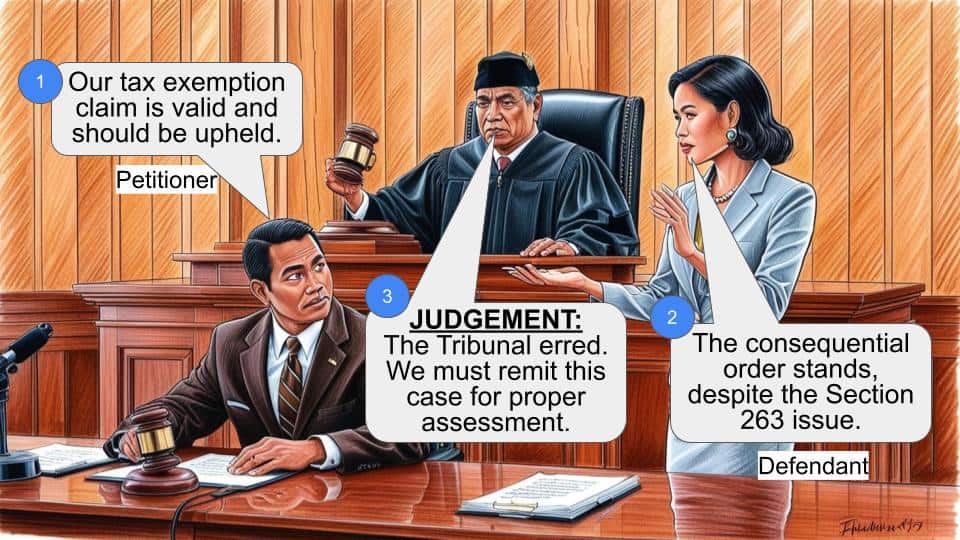
The High Court remanded a case back to the Income Tax Appellate Tribunal for fresh adjudication in a dispute between the Commissioner of Income Tax and Indra Sen Aggarwal. The case revolves around the adequacy of examination conducted by the Assessing Officer regarding unexplained bank deposits and the Commissioner's power to direct reassessment under Section 263 (of Income Tax Act, 1961).
Get the full picture - access the original judgement of the court order here.
Case Name:
Commissioner of Income Tax Vs Indra Sen Aggarwal (High Court of Punjab and Harayana)
ITA No. 40 of 2013 (O&M)
Key Takeaways:
1. The High Court emphasized the importance of reasoned orders in judicial and quasi-judicial decisions.
2. The court clarified that the Commissioner of Income Tax cannot direct the Assessing Officer to rewrite an order or conduct a new inquiry solely based on inadequate examination.
3. The Tribunal, as the final fact-finding authority, is required to consider all aspects of the factual matrix before making a decision.
Issue:
Whether the Income Tax Appellate Tribunal was justified in setting aside the Commissioner of Income Tax's order under Section 263 (of Income Tax Act, 1961), which had directed a reassessment of the assessee's income?
Facts:
1. The assessee, Indra Sen Aggarwal, filed a return for the assessment year 2007-08 showing a loss of ₹1,23,39,833.
2. The Assessing Officer framed an assessment on 26.5.2009.
3. The Commissioner of Income Tax-II, Amritsar, cancelled the assessment on 9.3.2012 under Section 263 (of Income Tax Act, 1961), deeming it erroneous and prejudicial to the revenue's interests.
4. The Commissioner directed the Assessing Officer to complete the assessment de novo after giving the assessee a fresh opportunity.
5. The assessee appealed to the Income Tax Appellate Tribunal, which set aside the Commissioner's order on 30.7.2012.
6. The revenue department then appealed to the High Court.
Arguments:
Revenue's Arguments:
1. The Tribunal did not pass a reasoned speaking order as mandated by the Supreme Court.
2. The Tribunal failed to consider that no inquiries were made to verify the genuineness of deposits and withdrawals in the assessee's bank accounts.
Assessee's Arguments:
The assessee supported the Tribunal's order and cited several judgments to back their position.
Key Legal Precedents:
1. M/s Kranti Associates Pvt. Ltd. and another v. Sh. Masood Ahmed Khan and others, (2010) 9 SCC 496 - Emphasized the importance of reasoned orders in judicial and quasi-judicial decisions.
2. Malabar Industrial Co. Ltd. v. Commissioner of Income Tax (2000) 243 ITR 83 (SC)
3. Commissioner of Income Tax v. Max India Ltd. (2007) 295 ITR 282 (SC)
4. Commissioner of Income Tax v. Munjal Castings (2008) 2 DTR Judgments 20 (P&H)
5. Commissioner of Income Tax v. Unique Autofelts (P) Ltd. (2009) 30 DTR Judgments 231 (P&H)
6. Commissioner of Income Tax v. Ratlam Coal Ash Company (1988) 171 ITR 141 (MP)
7. Commissioner of Income-Tax v. Gabriel India Ltd. (1993) 203 ITR 108 (Bom.)
8. Commissioner of Income Tax v. R.K. Metal Works (1978) 112 ITR 445 (P&H)
Judgement:
1. The High Court found that the Tribunal's order did not satisfy the requirements of a reasoned order as established by the Supreme Court in M/s Kranti Associates Pvt. Ltd's case.
2. The court set aside the Tribunal's order dated 30.7.2012 and remanded the matter back to the Tribunal for fresh adjudication.
3. The Tribunal was directed to provide an opportunity of hearing to both parties and decide the case in accordance with the law.
FAQs:
Q1: What was the main issue in this case?
A1: The main issue was whether the Income Tax Appellate Tribunal was justified in setting aside the Commissioner of Income Tax's order for reassessment under Section 263 (of Income Tax Act, 1961).
Q2: Why did the High Court remand the case back to the Tribunal?
A2: The High Court remanded the case because the Tribunal's order lacked detailed reasoning and did not meet the standards of a speaking order as required by Supreme Court precedents.
Q3: Can the Commissioner of Income Tax direct the Assessing Officer to rewrite an order or conduct a new inquiry?
A3: According to the judgment, the Commissioner cannot direct the Assessing Officer to rewrite an order or conduct a new inquiry solely based on inadequate examination or enquiry.
Q4: What is the significance of this judgment for future tax cases?
A4: This judgment emphasizes the importance of reasoned orders in judicial and quasi-judicial decisions, particularly in tax matters. It also clarifies the limits of the Commissioner's powers under Section 263 (of Income Tax Act, 1961).
Q5: What should the Tribunal do when the case is reheard?
A5: The Tribunal should consider all aspects of the factual matrix, provide an opportunity of hearing to both parties, and give a detailed, reasoned order in accordance with the law.

1. This appeal has been preferred by the revenue under Section 260A (of Income Tax Act, 1961) (in short “the Act”) against the order dated 30.7.2012 (Annexure A-3) passed by the Income Tax Appellate Tribunal, Amritsar Bench, Amritsar (hereinafter referred to as “the Tribunal”) in ITA No. 186(Asr)/2012 for the assessment year 2007-08, claiming the following substantial question of law:-
On the facts and in the circumstances of the case, Hon'ble ITATpassed the order without considering the facts available on the record that no enquiries were made to verify the genuineness of the deposits and withdrawals made by the assessee in his bank accounts.
2. The facts, in brief, necessary for adjudication of the instant appeal as narrated therein are that the assessee filed his return on 6.11.2007 for the assessment year 2007-08 in the status of individual showing loss of 1,23,39,833/-. The said return was processed under Section 143(1) (of Income Tax Act, 1961) on 30.3.2009. The Assessing Officer framed an assessment vide order dated 26.5.2009 (Annexure A-1). The Commissioner of Income Tax-II (CIT), Amritsar vide order dated 9.3.2012 (Annexure A-2) under Section 263 (of Income Tax Act, 1961) cancelled the assessment holding the same to be erroneous and prejudicial to the interest of the revenue and directed the Assessing Officer to complete the assessment de novo after affording fresh opportunity to the assessee. Feeling aggrieved, the assessee filed an appeal before the Tribunal who vide order dated 30.7.2012 (Annexure A-3) allowed the appeal and set aside the order of the CIT passed under Section 263 (of Income Tax Act, 1961). Hence, the present appeal by the revenue.
3. We have heard learned counsel for the parties.
4. Learned counsel for the revenue submitted that the Tribunal while reversing the findings of the CIT had not passed the reasoned speaking order which is the mandate as laid down by the Hon'ble Apex Court. It was further submitted that the Tribunal had failed to consider the fact that no enquiries were made to verify the genuineness of the deposits and withdrawals made by the assessee in his bank accounts. Support was gathered from the judgments of this Court in Kandi Friends Educational Trust v. CIT-II, Chandigarh, ITA No. 191 of 2012 decided on 4.4.2013 and Commissioner of Income Tax v. Raja Industries (2012) 340 ITR 344 (P&H).
5. On the other hand, learned counsel for the assessee supported the order passed by the Tribunal and prayed for dismissal of the appeal. The learned counsel has placed reliance upon the following judgments:-
I. Malabar Industrial Co. Ltd. v. Commissioner of Income Tax (2000) 243 ITR 83 (SC);
II. Commissioner of Income Tax v. Max India Ltd. (2007) 295 ITR 282 (SC);
III. Commissioner of Income Tax v. Munjal Castings (2008) 2 DTR Judgments 20 (P&H);
IV. Commissioner of Income Tax v. Unique Autofelts (P) Ltd. (2009) 30 DTR Judgments 231 (P&H);
V. Commissioner of Income Tax v. Ratlam Coal Ash Company (1988) 171 ITR 141 (MP);
VI. Commissioner of Income-Tax v. Gabriel India Ltd. (1993) 203 ITR 108 (Bom.);
VII. Commissioner of Income Tax v. R.K. Metal Works (1978) 112 ITR 445 (P&H).
6. The Hon'ble Apex Court in M/s Kranti Associates Pvt. Ltd. and another v. Sh. Masood Ahmed Khan and others, (2010) 9 SCC 496 while dealing with the requirement of passing a reasoned order by an authority whether administrative, quasi judicial or judicial, had laid down as under:-
“17. The expression 'speaking order' was first coined by Lord Chancellor Earl Cairns in a rather strange context. The Lord Chancellor, while explaining the ambit of Writ of Certiorari, referred to orders with errors on the face of the record and pointed out that an order with errors on its face, is a speaking order. (See 1878-97 Vol. 4 Appeal Cases 30 at 40 of the report).
18. This Court always opined that the face of an order passed by a quasi-judicial authority or even an administrative authority affecting the rights of parties, must speak. It must not be like the 'inscrutable face of a Sphinx'.
51. Summarizing the above discussion, this Court holds:
(a) In India the judicial trend has always been to record reasons, even in administrative decisions, if such decisions affect anyone prejudicially.
(b) A quasi-judicial authority must record reasons in support of its conclusions.
(c) Insistence on recording of reasons is meant to serve the wider principle of justice that justice must not only be done it must also appear to be done as well.
(d) Recording of reasons also operates as a valid restraint on any possible arbitrary exercise of judicial and quasi-judicial or even administrative power.
(e) Reasons reassure that discretion has been exercised by the decision maker on relevant grounds and by disregarding extraneous considerations.
(f) Reasons have virtually become as indispensable component of a decision making process as observing principles of natural justice by judicial, quasi-judicial and even by administrative bodies.
(g) Reasons facilitate the process of judicial review by superior Courts.
(h) The ongoing judicial trend in all countries committed to rule of law and constitutional governance is in favour of reasoned decisions based on relevant facts. This is virtually the life blood of judicial decision making justifying the principle that reason is the soul of justice.
(i) Judicial or even quasi-judicial opinions these days can be as different as the judges and authorities who deliver them. All these decisions serve one common purpose which is to demonstrate by reason that the relevant factors have been objectively considered. This is important for sustaining the litigants' faith in the justice delivery system.
(j) Insistence on reason is a requirement for both judicial accountability and transparency.
(k) If a Judge or a quasi-judicial authority is not candid enough about his/her decision making process then it is impossible to know whether the person deciding is faithful to the doctrine of precedent or to principles of incrementalism.
(l) Reasons in support of decisions must be cogent, clear and succinct. A pretence of reasons or 'rubber-stamp reasons' is not to be equated with a valid decision making process.
(m) It cannot be doubted that transparency is the sine qua non of restraint on abuse of judicial powers. Transparency in decision making not only makes the judges and decision makers less prone to errors but also makes them subject to broader scrutiny. (See David Shapiro in Defence of Judicial Candor (1987) 100 Harward Law Review 731-737).
(n) Since the requirement to record reasons emanates from the broad doctrine of fairness in decision making, the said requirement is now virtually a component of human rights and was considered part of Strasbourg Jurisprudence. See (1994) 19EHRR 553, at 562 para 29 and Anya vs. University of Oxford, 2001 EWCA Civ 405, wherein the Court referred to Article 6 of European Convention of Human Rights which requires, "adequate and intelligent reasons must be given for judicial decisions".
(o) In all common law jurisdictions judgments play a vital role in setting up precedents for the future. Therefore, for development of law, requirement of giving reasons for the decision is of the essence and is virtually a part of "Due Process".
7. According to the revenue, the assessee had declared short term capital loss of 1,83,68,197/- on the sale of equity shares and long term capital loss amounting to 22,77,400/- on sale of long term investment in equity shares. The assessee had made deposits to the tune of 97.50 lacs and withdrawals amounting to ` 94,96,560/- from account No. 006601508908 on different dates. The source of credit entries in the bank account was not explained by the assessee and no enquiry whatsoever was made by the Assessing Officer to find out the genuineness of the deposits. The CIT held the assessment proceedings to be prejudicial and erroneous to the interest of the revenue and cancelled the same by directing the Assessing Officer to complete the assessment de novo after affording fresh opportunity to the assessee. The Tribunal set aside the order of the CIT by observing that he was not justified in cancelling the assessment made by the Assessing Officer under Section 143(3) (of Income Tax Act, 1961). The entirety of the facts were required to be gone before upsetting the order of the CIT by the Tribunal. Further, the order dated 30.7.2012 (Annexure A-3) passed by the Tribunal is not a speaking order giving detailed reasons allowing the appeal of the assessee except mentioning that once having examined the source of deposits, the CIT cannot be given power to give his opinion and direct the Assessing Officer to write the order as per the desires of the CIT. It was also noticed that even if inadequate examination or enquiry had been conducted by the Assessing Officer, the CIT cannot direct the Assessing Officer to re-write the order or to make the enquiry again. The Tribunal being final fact finding authority was required to deal with all aspects of factual matrix and then record its conclusions based thereon.
8. Suffice it to notice that the judgments relied upon by the learned counsel for the assessee, the principle of law enunciated therein, is well recognized. Since, we are remitting the matter back to the Tribunal for fresh adjudication, they would be of no help to the case of the assessee at this stage.
9. In view of the above, the order dated 30.7.2012 (Annexure A-3) does not satisfy the requirements of being a reasoned order as enunciated by the Apex Court in M/s Kranti Associates Pvt. Ltd's case (supra), noticed herein above. Thus, the substantial question of law stands answered accordingly. Consequently, after setting aside the order of the Tribunal dated 30.7.2012 (Annexure A-3), the matter is remanded to the Tribunal for fresh adjudication after affording an opportunity of hearing to the parties, in accordance with law. The appeal stands disposed of.
(AJAY KUMAR MITTAL)
JUDGE
August 27, 2015 (RAMENDRA JAIN)
gbs JUDGE
×
Similar Ripples
Questions
High Court Remands Case to Tribunal for Fresh Adjudication in Income Tax Dispute
Write your CommentSimilar Posts


Generic
- Reportdata/3493.pdf
