


High Court Upholds Deduction of Full Legal Fees in Capital Gains Calculation



Full News
High Court Upholds Deduction of Full Legal Fees in Capital Gains Calculation
High Court Upholds Deduction of Full Legal Fees in Capital Gains Calculation
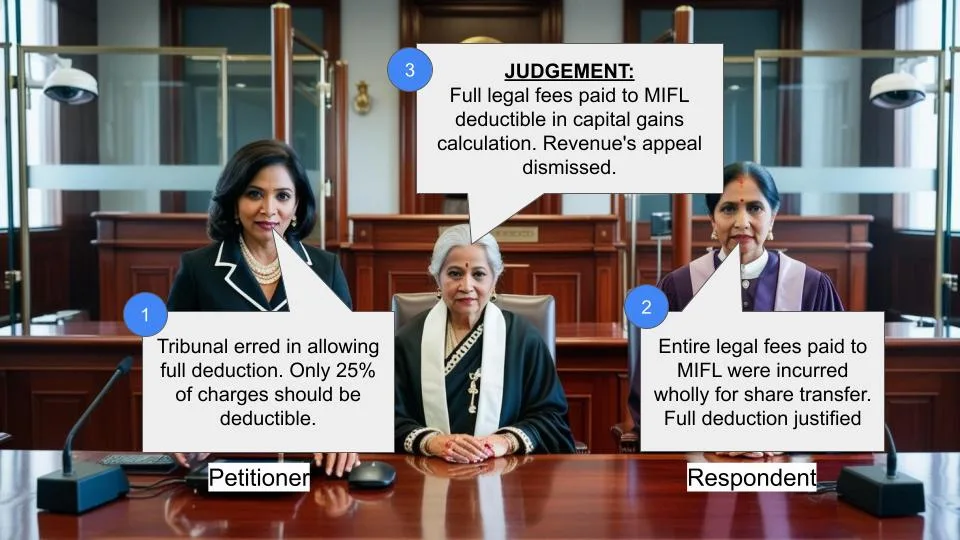
In the case of Commissioner of Income Tax and Another vs. Venkata Rajendran, the High Court ruled in favor of the assessee, allowing the full deduction of legal and professional charges paid to MIFL when calculating capital gains from the sale of shares. The court found that these expenses were wholly and exclusively incurred in connection with the transfer of shares.
Get the full picture - access the original judgement of the court order here.
Case Name:
Commissioner of Income Tax and Another vs. Venkata Rajendran (High Court of Karnataka)
Income Tax Appeal No.384 of 2009
Key Takeaways
- The court upheld the deduction of the entire legal and professional fees paid by the assessee to MIFL.
- The decision emphasized that expenses incurred wholly and exclusively in connection with the transfer of a capital asset are deductible under Section 48 (of Income Tax Act, 1961).
- The ruling clarified that the statute does not distinguish between amounts agreed upon in an agreement and amounts paid outside the agreement.
Issue
Was the Tribunal correct in allowing the entire legal and professional charges paid by the assessee to MIFL as a deduction when calculating capital gains, despite the acquisition agreement stipulating a different fee structure?
Facts
- The assessee, a major shareholder and director of M/s. Deccannet Designs Limited (DDL), sold his shares to M/s. Flextronix International Asia Pacific Ltd.
- The assessee's shares were valued higher than those of other shareholders, resulting in an additional amount received.
- The assessee paid Rs.2,00,84,088/- to MIFL for their services, which he claimed as a deduction.
- The Assessing Authority restricted the deduction to 25% of the consultancy charges, which was upheld by the Commissioner of Income-Tax (Appeals).
- The Tribunal allowed the full deduction, leading to the revenue's appeal.
Arguments
Revenue's Arguments:
- The revenue contended that the Tribunal erred in allowing the full deduction based on a letter written prior to the agreement, which stipulated only 25% as professional charges.
Assessee's Arguments:
- The assessee argued that the entire amount paid to MIFL was incurred wholly and exclusively in connection with the transfer of shares and should be deductible under Section 48 (of Income Tax Act, 1961).
Key Legal Precedents
- Section 48 (of Income Tax Act, 1961):
This section deals with the mode of computation of capital gains, allowing deductions for expenses incurred wholly and exclusively in connection with the transfer of a capital asset.
Judgement
The High Court dismissed the revenue's appeal, upholding the Tribunal's decision to allow the full deduction of legal and professional charges paid by the assessee to MIFL. The court found that these expenses were incurred wholly and exclusively in connection with the transfer of shares and did not suffer from any legal infirmity.
FAQs
Q1: What was the main legal question in this case?
A1: The main legal question was whether the Tribunal was correct in allowing the entire legal and professional charges paid by the assessee to MIFL as a deduction when calculating capital gains.
Q2: What did the court decide regarding the deduction of legal fees?
A2: The court decided that the entire legal and professional charges paid by the assessee to MIFL were deductible under Section 48 (of Income Tax Act, 1961).
Q3: Why did the revenue appeal the Tribunal's decision?
A3: The revenue appealed the Tribunal's decision because they believed the Tribunal erred in allowing the full deduction based on a letter written prior to the agreement, which stipulated only 25% as professional charges.
Q4: What is the significance of this ruling?
A4: The ruling clarifies that expenses incurred wholly and exclusively in connection with the transfer of a capital asset are deductible, regardless of whether they were agreed upon in an official agreement or paid outside of it.

1. The revenue has preferred this appeal against the order passed by the Tribunal allowing the entire legal and professional charges paid by the assessee to MIFL, in calculating the capital gains arising from the transaction in question.
2. The assessee is an individual, carrying on the profession of technical consultancy under the field of design and development of telecom products. This appeal relates to the assessment year 2005-2006. The assessee declared the capital gains of Rs.13,41,19,572/- in the returns of income after claiming deduction of Rs.2,00,84,088/- which represented legal and professional charges paid to M/s. Marchmont International Finance Limited (hereinafter referred to as ‘MIFL’). The assessee was a shareholder in M/s. Deccannet Designs Limited (hereinafter referred to as ‘DDL’). He holds 9,01,080 shares out of the total shares of 30,73,299. Thus, he was the major shareholder in the company of which he was a director. There were six other substantial shareholders who between themselves held 19,90,746 shares but none of them individually holds as many shares as the assessee did. There were several other individual shareholders who together held 1,81,473 shares. On 28.07.2004 an agreement was entered into between DDL, the assessee and the six major shareholders on the one hand and M/s. Flextronix International Asia Pacific Ltd., under which the Flextronix decided to acquire the shares of these seven persons in DDL for consideration. The assessee’s shareholding was valued at USD 5,090,115/- and the price per share came to USD 5.65. The shares of other six major shareholders was valued at USD 9,814,356/- which gave per share the value of USD 4.93. Thus, the shares held by the assessee were valued at 72 cents more than the shares held by the other six major shareholders. Under the agreement, the fees payable to MIFL by the assessee and the other shareholders was USD 600,000 to be shared pro rata by the assessee and the other shareholders. However, the assessee has entered into a separate agreement with MIFL on 25.11.2003 which listed services rendered by MIFL in relation to the acquisition agreement. This agreement also prescribes the scale of fees payable to MIFL. A subsequent agreement was entered on 25.03.2004 where the assessee agreed to pay and compensate in his individual capacity the difference of the fee based on the percentage of the purchase consideration. In terms of the aforesaid agreement the assessee received Rs.2,98,11,303/- more for his shares than he would have got at the rate of 4.93 per share. Under the agreement dated 25.03.2004 he had to pay MIFL the difference of the fee based on the percentage of the purchase consideration and accordingly he paid Rs.2,00,84,088/- to MIFL as their charges. He claims the same as deduction while computing capital gains on the sale of shares. The Assessing Authority restricted consultancy charges to 25% and disallowed the remaining 75%. The said order was upheld by the Commissioner of Income-Tax (Appeals).
3. In the appeal preferred by the assessee against the said order before the Tribunal it was held that they do not see any reason why the entire legal and professional charges paid to MIFL cannot be allowed when there is no dispute regarding the services rendered by the MIFL to the assessee and there is no objection by the department of this score. Accordingly, appeal was allowed directing the Assessing Officer to allow the entire legal and professional charges paid by the assessee to the MIFL. Aggrieved by the said order, revenue has preferred this appeal.
4. The appeal is admitted to consider the following substantial questions of law:
“1. Whether the Tribunal was correct in not considering the acquisition agreement dated 28.07.2004 entered into between M/s. Flextronics and the assessee and six other parties from whom the shares of M/s. Deccannet were acquired, wherein the acquisition agreement stipulates that fees payable to the investment Bankers is to be shared pro-rate by the assessee and other share holders and the acquisition agreement was recognized by all the share holders and approved by the RBI?
2. Whether the Tribunal was justified in allowing the entire consultancy charges paid for transfer of shares by violating the provisions of Section 48 (of Income Tax Act, 1961)?
3. Whether the Tribunal was correct in allowing the entire consultancy charges paid, when what was transferred is only the share capital held by the assessee and the entire consultancy charges cannot be claimed as deduction?”
5. The learned counsel appearing for the revenue assailed the impugned order contending that when the sale transaction has taken place in pursuance of the written agreement and in the said agreement what is stipulated is 25% as the professional charges, the Tribunal was not justified in allowing remaining 75% based on the letter written prior to the date of the agreement. Therefore, he submits the impugned order requires interference.
6. Per contra, learned counsel appearing for the assessee supported the impugned order.
7. Section 48 (of Income Tax Act, 1961) deals with the mode of computation of the capital gains. It provides, the income chargeable under the head capital gains shall be computed by deducting from the full value of the consideration received or accruing as a result of the transfer of the capital asset the following amounts, namely:-
(i) expenditure incurred wholly and exclusively in connection with such transfer; and
(ii) the cost of acquisition of the asset and the cost of any improvement thereto.
8. Therefore, wholly and exclusively in connection with such transfer should establish the expenditure incurred by him. The statute did not make any distinction between amount agreed under the agreement and amount paid outside the agreement. In the instant case facts are not in dispute.
9. The sale of shares took place on the account of the legal and professional assistance given by MIFL. The agreement entered into between the shareholders and MIFL clearly setout the pro rata of charges chargelable by each of the shareholders depending upon their shareholding. Insofar as the assessee is concerned, he is a major shareholder. Prior to the entering into the agreement the assessee had written a letter agreeing to pay an additional amount in the event MIFL gets him a good price for his shares. The evidence on record shows the assessee got 72% cents extra when compared to other shareholders. Under the letter dated 25.03.2004 entered prior to the agreement he had agreed to bear the extra charges. Therefore, he being the major shareholder and a director of the company who is a person who was actively involved and interested in selling the shares. He wanted additional amount to be paid to his shares and therefore, he has agreed to pay the additional charges also on the basis of such amount which he would get. It is not in dispute that the assesseee got a sum of Rs.2,98,11,303/- more than for his shares than what he would not get at the rate of USD 4.93 that the other shareholders were paid. It is out of the said additional amount he received, he paid a sum of Rs.2,84,898,000/- to MIFL as their charges. The payment is not in dispute. Therefore, that is the amount which the assessee incurred as expenditure for sale of shares. That is the amount which is wholly and exclusively incurred by the assessee in connection with such transfer. Under these circumstances the order passed by the Tribunal is in accordance with law and does not suffer from any legal infirmity which calls for interference. Accordingly, the substantial questions are answered in favour of the assessee and against the revenue. Hence, we pass the following:
ORDER
No merits.
Appeal is dismissed.
Sd/-
JUDGE
Sd/-
JUDGE
×
Similar Ripples
Questions
High Court Upholds Deduction of Full Legal Fees in Capital Gains Calculation
Write your CommentSimilar Posts


Generic
- Reportdata/4092.pdf
