


High Court Upholds ITAT Decision Allowing Section 80-IC (of Income Tax Act, 196…


Full News
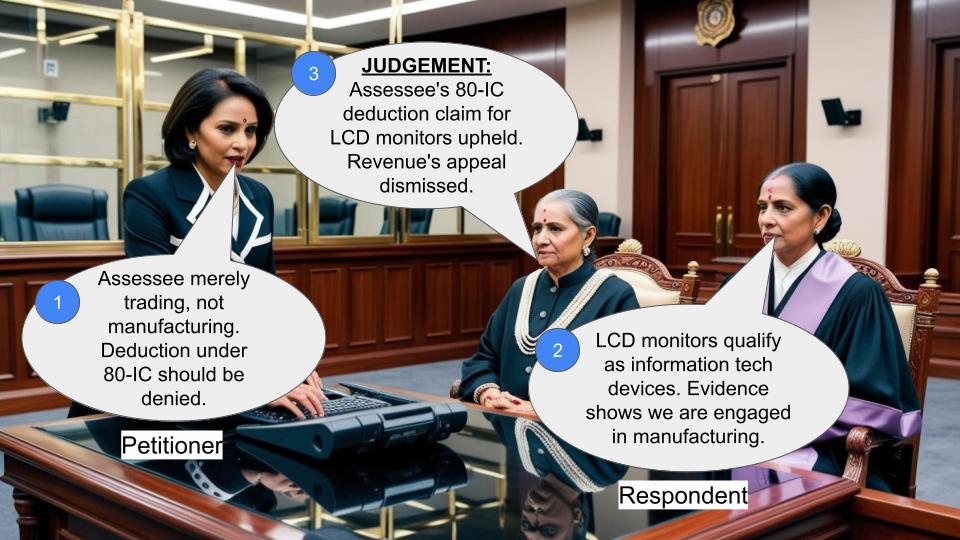
High Court Upholds ITAT Decision Allowing Section 80-IC (of Income Tax Act, 1961) Deduction for LCD Monitor Manufacturer
High Court Upholds ITAT Decision Allowing Section 80-IC (of Income Tax Act, 1961) Deduction for LCD Monitor M…
The case involves the Commissioner of Income Tax (CIT) appealing against Tej Pal Singh Kohli, a proprietor of M/s Concept Industries, who claimed a deduction under Section 80-IC (of Income Tax Act, 1961) for the Assessment Year 2009-10. The High Court upheld the Income Tax Appellate Tribunal's (ITAT) decision, which supported the assessee's claim for the deduction, dismissing the Revenue's appeal.
Get the full picture - access the original judgement of the court order here.
Case Name:
Commissioner of Income Tax vs. Tej Pal Singh Kohli (High Court of Delhi)
ITA 2/2015
Key Takeaways
- The High Court upheld the ITAT's decision, allowing the assessee's claim for deduction under Section 80-IC (of Income Tax Act, 1961).
- The court found that the Assessing Officer (A.O.) had based his decision on doubts rather than concrete evidence.
- The court emphasized that the LCD Monitors manufactured by the assessee fall under the category of information and communication technology devices, qualifying for the deduction under Section 80-IC (of Income Tax Act, 1961).
Issue
Did the assessee, Tej Pal Singh Kohli, qualify for a deduction under Section 80-IC (of Income Tax Act, 1961) for the manufacturing of LCD Monitors?
Facts
- Tej Pal Singh Kohli is the proprietor of M/s Concept Industries, engaged in manufacturing electronic goods, specifically LCD Monitors.
- The assessee claimed a deduction under Section 80-IC (of Income Tax Act, 1961) for the Assessment Year 2009-10.
- The A.O. denied the deduction, arguing that the assessee was not engaged in manufacturing but merely trading under the brand name "NACVOX."
- The CIT(A) and ITAT both ruled in favor of the assessee, allowing the deduction.
Arguments
For the Appellant (Revenue):
- The A.O. argued that the assessee was not engaged in manufacturing activities but was merely trading.
- The A.O. also contended that the assessee did not employ an adequate number of local workers and lacked the necessary infrastructure for manufacturing.
For the Respondent (Assessee):
- The assessee provided evidence of importing components and assembling them in a factory in Himachal Pradesh.
- The assessee argued that the LCD Monitors fall under the category of information and communication technology devices, qualifying for the deduction under Section 80-IC (of Income Tax Act, 1961).
Key Legal Precedents
- Section 80-IC (of Income Tax Act, 1961):
Provides deductions for certain businesses in specified areas.
- Schedule XIV, Part (C), Sl.No. 13:
Lists "information and communication technology industry, computer hardware, call centres" as eligible for deductions under Section 80-IC (of Income Tax Act, 1961).
Judgement
The High Court dismissed the Revenue's appeal, upholding the ITAT's decision. The court found that the A.O. had based his decision on doubts rather than concrete evidence and that the LCD Monitors manufactured by the assessee qualify for the deduction under Section 80-IC (of Income Tax Act, 1961). The court also noted that the A.O. did not inspect the manufacturing unit or find any discrepancies in the books of accounts.
FAQs
Q1: What was the main issue in this case?
A1: The main issue was whether the assessee qualified for a deduction under Section 80-IC (of Income Tax Act, 1961) for manufacturing LCD Monitors.
Q2: What was the court's decision?
A2: The court upheld the ITAT's decision, allowing the assessee's claim for the deduction and dismissing the Revenue's appeal.
Q3: Why did the A.O. deny the deduction?
A3: The A.O. denied the deduction on the grounds that the assessee was not engaged in manufacturing but merely trading and did not employ an adequate number of local workers.
Q4: What evidence did the assessee provide?
A4: The assessee provided import bills, assembly flow charts, and other related documents to prove that they were engaged in manufacturing activities.
Q5: What did the court say about the A.O.'s decision?
A5: The court found that the A.O. had based his decision on doubts rather than concrete evidence and had not inspected the manufacturing unit or found any discrepancies in the books of accounts.

1. This appeal by the Revenue prays that the order dated 11.07.2014 of Income Tax Tribunal (ITAT) passed in appeal No.362/DEL/2013 respecting the respondent/assessee for the Assessment Year 2009-10 be set aside. The impugned order was passed by ITAT dismissing the appeal of the Revenue against the order dated 31.10.2012 rendered by the Commissioner of Income Tax (Appeals) [CIT(A)] allowing the appeal of the respondent/assessee thereby setting aside the order dated 28.11.2011 passed by the Assessing Officer (A.O) under Section 143(3) (of Income Tax Act, 1961) assessing the income of the respondent at ₹71,99,590/- charging interest under Sections 234 (of Income Tax Act, 1961)-B and 234-C of Income Tax Act and initiating penalty proceedings under Section 271-IC (of Income Tax Act, 1961).
2. The assessee is proprietor of entity carrying on the business in the name and style of M/s Concept Industries engaged in the manufacturing of electronic goods. The assessee had claimed deduction under Section 80-IC (of Income Tax Act, 1961) in the return filed for the relevant year. A notice under Section 143(2) (of Income Tax Act, 1961) was issued and served on him. The assessment order was passed by the A.O.under Section 143(3) (of Income Tax Act, 1961). The A.O. had deleted the claim of deduction in the sum of ₹71,99,594/- under Section 80-IC (of Income Tax Act, 1961) on the ground that assessee was engaged in the business of manufacture of electronic goods in the industrial area of Himachal Pradesh. The A.O. recorded the view that no manufacturing activities are being carried out and in fact the business involves only trading under the brand name of the parent company “ NACVOX”. The A.O. found that there was no adequate plant or machinery or infrastructure to carry out the manufacturing activities. In his view, the LCD Monitor claimed to be manufactured by the assessee is not covered under Schedule XIV to the Income Tax Act.
3. It may be mentioned here that reference has been made in above context to Sl.No. 13 in part (C) of the Schedule XIV relevant for purposes of Section 80-IC(2) (of Income Tax Act, 1961), the activity or article or operation having been described therein as “information and communication technology industry, computer hardware, call centres”. It has been the contention of the assessee that the item produced (LCD Monitors) falls under the category of information and communication technology devices.
4. The A.O. further observed in his order that the assessee had not employed adequate number of local workers as was requisite under the relevant permission by the local authorities.
5. In the appeal preferred by the assessee, the CIT (A), inter alia, noted the facts as under:-
"5.2 On perusal of the material on record, it is found that the appellant is engaged in the manufacture of electronic goods specifically various models LCD monitors. In order to carry on this business, he entered into a technical collaboration with M/s. Punch Video Inc (Taiwan). As per the terms of collaboration ,the appellant was allowed to manufacture and sell its products under the brand name "NOCVOX". For this purpose, he imported different components from various sellers in Singapore, Taiwan, Hongkong etc. and then assembled them in the factory located in Himachal Pradesh. In support of such activity the appellant submitted bills of import, airway bill, entry bill and other related documents. On perusal of these bills, it is noted that various parts like casing part, metal plate, fuseboard, cable connector, control PCB, switch assembling etc. which are the components used in electronic industry are being imported. The appellant also furnished flow chart showing the various stages of assembling of components' and also the work instructions. These are also on record but the Assessing Officer did not consider them, but reproduced, the process of manufacture in this order...........”
6. The CIT (A) did not accept the conclusion reached by the A.O. as to there being no manufacturing process undertaken on the ground that product was sold under the brand name of the parent company. He observed, and rightly so, that selling the product in the brand name is no bar to claim the benefit on account of manufacturing activity of assembling components.
The adverse conclusions reached on the basis of work force employed, the wages paid, or the electricity expenditure incurred were also repelled as untenable. The CIT(A) concluded that the appellant had shown that he has been running a unit in a notified area which was periodically inspected by the various statutory authorities of the State Government, who had not pointed out any discrepancy. It also observed that the A.O. had checked the books of accounts but had not pointed out any defect or discrepancy therein.
7. Summing up its conclusions, the CIT(A) further observed that the assessee had filed the return under Section 139(1) (of Income Tax Act, 1961) within the specified time alongwith audit report in the appropriate form under Section 44 (of Income Tax Act, 1961) AB of Income Tax Act. In the views of the CIT(A), the assessment had been made merely on doubts or surmises, which was not permissible as no adverse material contrary to the claim of the assessee had been brought on record by the A.O. Thus, the appeal was allowed and the assessment order was set aside.
8. In second appeal by the Revenue before the ITAT, the same very contentions were reiterated but without any success. The ITAT concurred with the findings of the CIT(A) that the assessee was eligible to claim deduction under Section 80-IC (of Income Tax Act, 1961) but the same had been wrongly denied by the A.O. Consequently, order accepting the claim of the assessee was upheld.
9. Having heard both sides we are not persuaded to accept the contentions raised by the Revenue in this third appeal which are nothing but reiteration of what have already been agitated and correctly rejected by the two appellate authorities below. Aside from the reasons cited by the ITAT affirming the conclusions reached by the CIT (A), which we uphold, we must add that the plea that the LCD Monitor would not fall within the description of items at sl. No. 13 in part (c) of XIV Schedule is also not correct. The LCD Monitors do subscribe to the description of information and communication technology devices and, therefore, would attract,provided other statutory conditions are fulfilled, the benefit of exemption under Section 80-IC (of Income Tax Act, 1961) of Income Tax. We concur with the conclusion that A.O. had proceeded more on the basis of doubts entertained by him as to the genuineness of the claim rather than some concrete material. If he had any reasons to disbelieve the correctness of the claim about the manufacturing activity (on the basis of considerations such as wages paid, electricity bills generated, the nature of the plant and machinery etc.,), the least that could have been done by him was to have the manufacturing unit of the assessee inspected. For such purposes, he only had to take recourse to his statutory powers under the law. Without having undertaken any such exercise, as observed by the authorities below or rejecting the accuracy of the books of accounts, adverse conclusions on facts as reached could not have been drawn.
10. In the facts and circumstances, we do not find any question of law arising for consideration.
11. For the foregoing reasons, the appeal under Section 260-A (of Income Tax Act, 1961) of Income Tax does not deserve to be entertained. It is, therefore, dismissed.
R.K.GAUBA
(JUDGE)
S. RAVINDRA BHAT
(JUDGE)
JANUARY 12, 2015
×
Questions
High Court Upholds ITAT Decision Allowing Section 80-IC (of Income Tax Act, 1961) Deduction for LCD Monitor Manufacturer
Write your CommentSimilar Posts


Generic
- Reportdata/4139.pdf
