


High Court Upholds Tribunal's Deduction Calculation for Securities Transactions


Full News

High Court Upholds Tribunal's Deduction Calculation for Securities Transactions
High Court Upholds Tribunal's Deduction Calculation for Securities Transactions
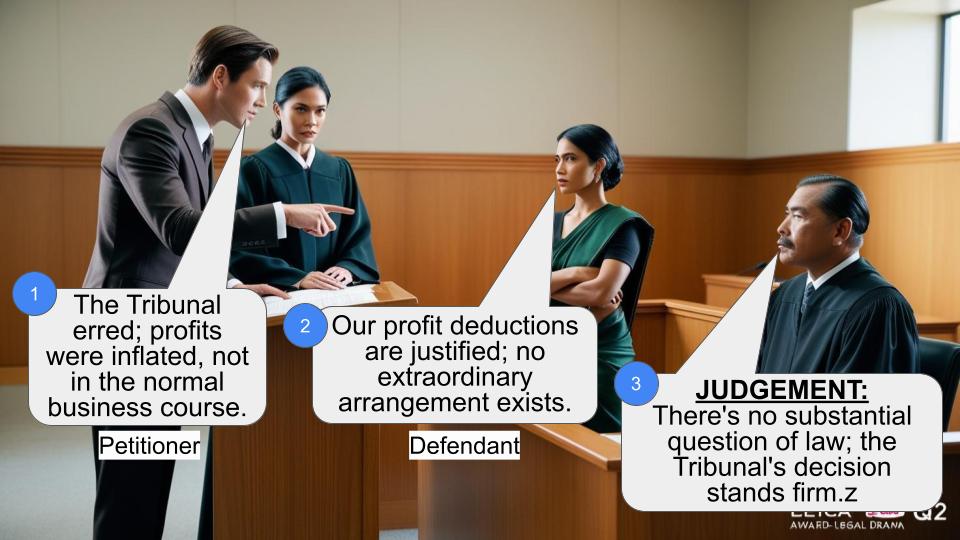
The case involves the Commissioner of Income Tax challenging the Tribunal's decision to allow a higher rebate under Section 88E (of Income Tax Act, 1961), to Manish D. Innani. The Tribunal's decision was upheld by the High Court, which found no error in the Tribunal's computation of the deduction.
Get the full picture - access the original judgement of the court order here.
Case Name:
Commissioner of Income Tax vs. Manish D. Innani (High Court of Bombay)
Income Tax Appeal No.250 of 2013
Date: 9th January 2015
Key Takeaways
- The High Court upheld the Tribunal's decision to allow a rebate of Rs. 1.01 crores under Section 88E (of Income Tax Act, 1961), as opposed to the Rs. 75.07 lakhs allowed by the Assessing Officer.
- The court emphasized that the deduction under Section 88E (of Income Tax Act, 1961) should be computed based on the income from taxable securities transactions without considering brought forward losses.
- The decision clarifies the application of Section 88E (of Income Tax Act, 1961), ensuring that the rebate is calculated correctly according to the average rate of income tax on such transactions.
Issue
Was the Tribunal justified in allowing a rebate of Rs. 1.01 crores under Section 88E (of Income Tax Act, 1961), against the Rs. 75.07 lakhs allowed by the Assessing Officer?
Facts
- The assessment year in question is 2008-09.
- Manish D. Innani, the Assessee, is engaged in derivative trade in shares and investment.
- The Assessee filed a return declaring a total income of Rs.5,94,71,620 and claimed a rebate under Section 88E (of Income Tax Act, 1961) amounting to Rs.1,01,87,300.
- The Assessing Officer allowed a rebate of only Rs.75,07,274, considering brought forward losses from the previous year.
- The Tribunal corrected this computation, allowing the full rebate claimed by the Assessee.
Arguments
- Revenue's Argument:
The Tribunal erred in allowing a higher rebate and should have upheld the Assessing Officer's calculation, which considered brought forward losses.
- Assessee's Argument:
The rebate should be calculated based on the income from taxable securities transactions without considering brought forward losses, as per Section 88E (of Income Tax Act, 1961).
Key Legal Precedents
- Oasis Securities Ltd.:
The Tribunal referenced this case to support its decision.
- Ashika Stock Broking Ltd. (44 SOT 556):
Another case cited by the Tribunal to justify its computation method.
Judgement
The High Court dismissed the Revenue's appeal, upholding the Tribunal's decision. The court found that the Tribunal correctly applied Section 88E (of Income Tax Act, 1961), which does not require considering brought forward losses when calculating the rebate. The Tribunal's order was deemed to have no error or perversity.
FAQs
Q1: What is Section 88E (of Income Tax Act, 1961)?
A1: Section 88E (of Income Tax Act, 1961) allows a deduction from the amount of income tax on income arising from taxable securities transactions, calculated by applying the average rate of income tax on such income.
Q2: Why did the Assessing Officer reduce the rebate?
A2: The Assessing Officer reduced the rebate by considering brought forward losses from the previous year, which the Tribunal and High Court found to be incorrect.
Q3: What was the final decision of the High Court?
A3: The High Court upheld the Tribunal's decision to allow a rebate of Rs.1.01 crores, dismissing the Revenue's appeal.
Q4: Does this case set a precedent for future cases?
A4: Yes, it clarifies the correct method for calculating deductions under Section 88E (of Income Tax Act, 1961), ensuring that brought forward losses are not considered.
Q5: What impact does this decision have on the Assessee?
A5: The Assessee benefits from a higher rebate, reducing their taxable income for the assessment year 2008-09.

1) The Tribunal's order dated 1st August, 2012 in Income Tax Appeal No. 861/Mum/2012 is challenged by the Revenue in this Appeal. The Assessment year is 2008-09.
2) Mr. Malhotra appearing for the Revenue submits that the substantial question of law is that the Tribunal was not justified in allowing the rebate of Rs.1.01 crores under section 88E (of Income Tax Act, 1961) against the rebate of Rs.75.07 lacs allowed by the Assessing Officer.
3) The facts pertaining to this ground and question have been
noted in both, the Memo of Appeals before the Commissioner of Income
Tax and the Tribunal as also in this Court. The Assessee is individually
engaged in the business of derivative trade in shares and investment.
The return of income was filed by the Assessee for the previous year
ended on 31st March, 2008. The Assessee declared total income at
Rs.5,94,71,620/. He claimed rebate under section 88E (of Income Tax Act, 1961) at
Rs.1,01,87,300/. He also furnished the working of disallowance under
section 14A (of Income Tax Act, 1961) during the assessment proceedings. The assessment was
completed under section 143(3) (of Income Tax Act, 1961) by order
dated 28th December, 2010 determining total income at
Rs.27,17,31,090/.
4) The Assessing Officer made addition and we are concerned
in this case with the calculation of the rebate under section 88E (of Income Tax Act, 1961) of the
Income Tax Act, 1961 at Rs.75,07,274/. The argument of the Assessee
before the Commissioner as also the Tribunal was that the rebate in
respect of securities transaction tax and admissible under section 88E (of Income Tax Act, 1961)
has not been granted in terms of the section and the entitlement of the
Assessee thereunder. The Assessee's representative contended that the
deduction under section 88E (of Income Tax Act, 1961) in accordance with the formula prescribed
under subsection (2) of section 88E (of Income Tax Act, 1961) does not rule out brought forward
loss of Rs.1,62,36,858/ from assessment year 200708. That is set off
against the income from taxable securities of Rs.4,95,93,132/ earned
during the assessment year 200809. It was submitted that the taxable
securities transactions, meaning thereby the tax on the securities
transactions, which are taxable, will have to be computed on this entire
figure. Therefore, the benefit in terms of section 88E (of Income Tax Act, 1961) ought to be
granted in full and there was no warrant for taking into consideration
the brought forward loss for the earlier assessment year. The Assessing
Officer erroneously took that into account and consideration and
reduced the rebate accordingly. The Commissioner dealt with this
argument and in para 5.4 held that the Assessing Officer has rightly
worked the average rate of tax as per section 88E (of Income Tax Act, 1961). He upheld the
working by the Assessing Officer and dismissed the Assessee's Appeal.
5) The matter was carried to the Tribunal and in paras 5 and 6
of the Tribunal's order, a reference was made to the decision of the
Tribunal in the case of Oasis Securities Ltd. in Income Tax Appeal No.
2534/Mum/2009 for assessment year 200607 rendered on 30th
September, 2010. The other order relied upon was in the case of Ashika
Stock Broking Ltd. (44 SOT 556).
6) Mr. Malhotra submits that when the Tribunal distinguished
its coordinate Bench decision in the case of Oasis Securities Ltd.
(supra), then, the calculations made by the Assessing Officer and his
order deserve to be upheld, and there was no scope for allowing partly
the ground, which was raised by the Assessee. He therefore submits
that para 7 of the Tribunal's order contains reasons, which cannot be
sustained in the light of the clear language of section 88E (of Income Tax Act, 1961). He has faulted the Tribunal for having held that the surplus from share dealing of market segment/future and option
segments is not there but there is net income after setting off of losses.
He submits that the Tribunal's order contains something which is not
subject matter of section 88E (of Income Tax Act, 1961).
Consequently, the Appeal be admitted.
7) On the other hand, Mr. Shah appearing for the Respondent
would submit that the language of section 88E (of Income Tax Act, 1961) is clear and
unambiguous. It does not warrant any interpretation. Subsection (1)
thereof states that where the total income of the Assessee in a previous
years includes any income, chargeable under the head “profit and gains
of business or profession” arising from taxable securities transactions,
he shall be entitled to a deduction from the amount of income tax on
such income arising from such transactions, namely taxable securities
transactions and the deduction is to be computed in terms of sub-
section (2). Mr. Shah would submit that the Tribunal has done nothing
but applied the language of this section and granted the necessary
deduction. The Appeal therefore does not raise any substantial question
of law. There was no warrant for bringing down the quantum of the
deduction or the figure concerned by relying upon some lossess, which
have been brought forward by the Assessee from the prior assessment
year. Mr. Shah would submit that it is the income from the taxable
securities transactions in the previous year relevant to the assessment
year, which enables the deduction to be claimed. If it is claimed in that manner and its computation is in terms of subsection (2) of section
88E, then, the present Appeal does not raise any substantial question of
law. The Tribunal's order cannot be said to be erroneous or vitiated by
perversity either. He therefore submits that the Appeal be dismissed.
8) The Tribunal had before it a ground relating to rebate in
respect of securities transaction tax under section 88E (of Income Tax Act, 1961). The
working of the rebate was a matter before the Assessing Officer. The
Assessee was asked to submit the working of rebate claimed in respect
of securities transaction tax amounting to Rs.1,01,87,300/. The
Assessing Officer found that though the Assessee had applied average
rate on income but the average rate was adopted before setting off
business loss of earlier years. The assessing Officer held that the total income of the Assessee is Rs.5,94,71,620/, which includes
Rs.3,34,49,474/ (after setting of business loss of Rs.1,62,36,858/
brought forward from the year 200708), which is chargeable under the
head “profits and gains of business or profession” arising from taxable
securities transactions. He therefore held that the Assessee is entitled to get rebate under section 88E (of Income Tax Act, 1961) on the income of Rs.3,34,49,474/, but not on Rs.4,95,93,132.
9) To our mind, all that the Tribunal has done is to take into
account the volume of the securities transactions and which were
taxable. The total income of the Assessee in the previous year included
the income from taxable security transactions. The requirement under
subsection (1) of section 88E (of Income Tax Act, 1961) on this count was fully satisfied. The
only issue was how this deduction and in terms of the provision has to
be computed. The Assessing Officer has ignored completely the
quantum of income from taxable securities transactions, the tax that is
leviable thereon and which has to be deducted in terms of subsection
(2) of section 88E (of Income Tax Act, 1961). So long as the stipulation under subsection (2) is
adhered to and followed, namely the amount of income tax on the
income arising from the taxable securities transactions referred to in
subsection (1), shall be equal to the amount calculated by applying the
average rate of income on such income, the deduction deserves to be
granted. Therefore, the clear language of the section has been taken
into consideration. The total income in a previous year if includes any
income arising from taxable security transactions, then, the Assessee is
entitled to deduction from the amount of income tax on such income
arising from such transactions. That is because the income from taxable
securities transactions has already been subjected to tax. The security
transactions are taxable. Therefore, from the amount of income tax on
such income arising from such transactions, the deduction has to be
computed and that is an amount equal to the securities transaction tax
paid by the Assessee in respect of the taxable securities transactions
entered into in the course of his business during that previous year.
The proviso contemplates that deduction can be allowed only if the Assessee furnishes, along with the return of income, evidence of payment of securities transaction tax in the prescribed form. There is no dispute before us that the Assessee has complied with the proviso and the second proviso as well, namely that the amount of deduction under this subsection shall not exceed the amount of income tax on taxable
securities transactions computed in the manner provided in subsection
(2). To our mind, the Tribunal committed no error when it corrected
the computation or calculation of deduction. There was no warrant in
the light of the clear language of this provision then to take into
consideration the brought forward losses. It is the taxable securities
transaction, the income derived from such taxable securities
transactions and they being taxable, the tax paid thereon, which has to
be deducted. That is how the section has been understood and applied
to the given facts and circumstances. We do not think that any larger
controversy arises for determination and consideration in this Appeal.
We are not in agreement with Mr. Malhotra that the decision of the
Tribunal's coordinate Bench in Oasis Securities Ltd. (supra) has been
distinguished but still the deduction has been granted. In para 6.1, the
Tribunal concluded that the Assessee is entitled to rebate of Rs.1.01
crores under section 88E (of Income Tax Act, 1961) as against the
rebate of Rs.75.07 lakhs allowed by the Assessing Officer. The Tribunal
may have distinguished its order and decision of the coordinate Bench
rendered in the case of Oasis Securities Ltd. (supra), but, pertinently, it was held that the surplus from share dealing of market/future and
option segment may not be there, but there is net income after setting
off of losses. There was an over all profit for the assessment year under consideration and the rebate had to be allowed. Before the Assessing Officer or the Commissioner as well, the issue was not as much of admissibility of rebate in terms of section 88E (of Income Tax Act, 1961), but the manner of its computation. The deduction has to be computed in the manner
specified in sub section (2) of section 88E (of Income Tax Act, 1961). We do not think that there is any basis for the argument and in the given facts and circumstances that the average rate was applied on income before setting off business loss of earlier year.
10) In these circumstances and when the income from the
securities transactions is taxable and offered to tax, the deduction
insofar as that sum is concerned or quantum has been granted. We do
not think that the Tribunal's order can be interfered with. The
Tribunal's view is imminently possible in the backdrop of the facts and
circumstances peculiar to the Assessee. In any event by subsection (3)
of section 88E (of Income Tax Act, 1961) it has been clarified that no deduction under section 88E (of Income Tax Act, 1961)
shall be allowable in, or after, the assessment year beginning on the 1st day of April, 2009 i.e. because a deduction which is contemplated by
this provision has been now made admissible elsewhere. In these
circumstances, the Appeal raises no substantial question of law. It is
dismissed. More so when the Tribunal's order has been given effect to
by the Assessing Officer. He has followed his view taken in the
assessment year 200607, which is also following the Tribunal's order.
No costs.
(S.P.DESHMUKH, J.) (S.C.DHARMADHIKARI, J.)
×
Similar Ripples
Questions
High Court Upholds Tribunal's Deduction Calculation for Securities Transactions
Write your CommentSimilar Posts


Generic
- Reportdata/4148.pdf
