


Interest converted to loan not "actually paid" under Section 43B (of Income Tax…


Full News
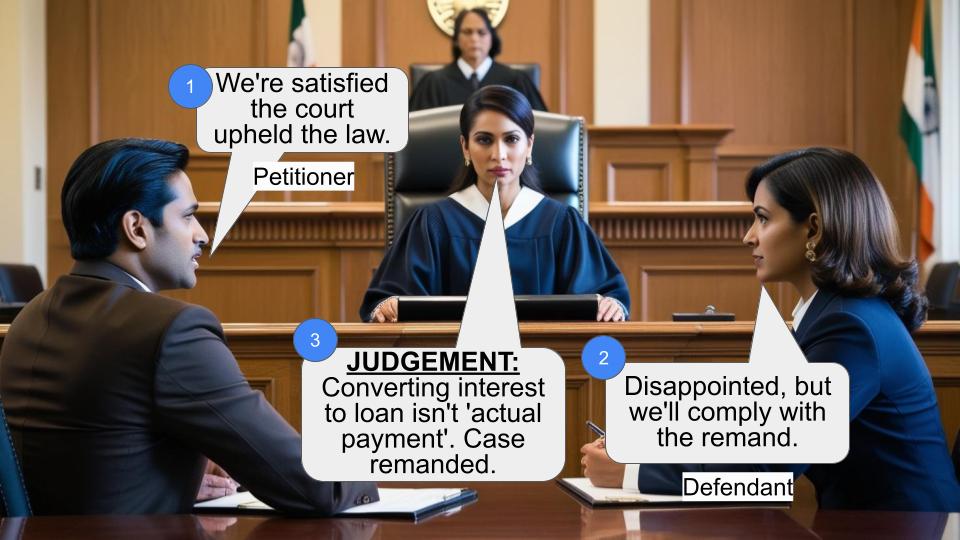
Interest converted to loan not "actually paid" under Section 43B (of Income Tax Act, 1961), rules High Court
Interest converted to loan not "actually paid" under Section 43B (of Income Tax Act, 1961), rules High Court
This case revolves around the interpretation of Section 43B (of Income Tax Act, 1961). The main dispute was whether converting interest liability into a loan amounts to "actual payment" under this section, allowing for tax deductions. The High Court ruled in favor of the Revenue Department, stating that such conversion does not qualify as actual payment for tax deduction purposes.
Get the full picture - access the original judgement of the court order here
Case Name:
Commissioner of Income Tax Vs Eicher Ltd. (High Court of Delhi)
ITA 191/2003
Date: 30th April 2015
Key Takeaways
1. Converting interest liability into a loan does not qualify as "actual payment" under Section 43B (of Income Tax Act, 1961).
2. Explanation 3C to Section 43B (of Income Tax Act, 1961), added retrospectively from 01.04.1989, clarifies that interest converted into a loan is not considered "actually paid."
3. The court remanded the case to the Assessing Officer to determine if any actual interest payments were made during the relevant Assessment Year.
Issue
Does the conversion of interest liability into a term loan amount to "actual payment" as contemplated by Section 43B (of Income Tax Act, 1961)?
Facts
1. The assessee (the taxpayer) had some interest liability to financial institutions like IFCI, IDBI, and HDFC Bank.
2. Instead of paying this interest, they converted it into a loan.
3. The assessee claimed that this conversion should be considered as "payment" under Section 43B (of Income Tax Act, 1961), which would allow them to get a tax deduction.
4. The Assessing Officer (AO) disagreed and disallowed a sum of ₹5,00,03,643.
5. The Commissioner of Income Tax (Appeals) reversed the AO's decision, siding with the assessee.
6. The Income Tax Appellate Tribunal (ITAT) agreed with the CIT(Appeals), saying that this kind of "constructive payment" should count under Section 43B (of Income Tax Act, 1961).
7. The case then went to the High Court.
Arguments
The assessee's argument was pretty straightforward:
- They claimed that converting the interest into a loan should be considered as "payment" under Section 43B (of Income Tax Act, 1961).
- This would allow them to claim a tax deduction for that amount.
The Revenue Department's argument:
- They contended that merely converting interest into a loan doesn't constitute "actual payment" as required by Section 43B (of Income Tax Act, 1961).
- They likely argued that the law requires real, tangible payment, not just a reshuffling of debt.
Key Legal Precedents
The court relied on a few important cases and legal amendments:
1. Commissioner of Income Tax-II v. Pennar Profiles Limited (I.T.A. No. 289/2003 decided on 11.02.2015)
- This case dealt with an identical question and considered the impact of Explanation 3C to Section 43B (of Income Tax Act, 1961).
2. Eicher Motors Limited v. Commissioner of Income Tax
- This Madhya Pradesh High Court case held that conversion of interest into a loan is not "actual payment" under Section 43B (of Income Tax Act, 1961).
3. Finance Act, 2006 amendment
- This added Explanation 3C to Section 43B (of Income Tax Act, 1961), retrospectively effective from 01.04.1989, clarifying that interest converted to a loan is not "actually paid."
Judgement
Alright, so here's what the court decided:
1. The High Court ruled in favor of the Revenue Department.
2. They said that converting interest into a loan doesn't count as "actual payment" under Section 43B (of Income Tax Act, 1961).
3. The court based this on Explanation 3C to Section 43B (of Income Tax Act, 1961), which was added retrospectively from 1989.
4. However, they also said, "Hold on, let's be fair here." They sent the case back to the Assessing Officer to check if the assessee had made any actual interest payments in the relevant year (1993-94).
5. If there were any real payments made, the assessee would still get the benefit of Section 43B (of Income Tax Act, 1961) for those amounts.
FAQs
1. Q: What does Section 43B (of Income Tax Act, 1961) deal with?
A: Section 43B (of Income Tax Act, 1961) deals with certain deductions that are only allowed on an "actual payment" basis.
2. Q: Why did the court rule against the assessee?
A: The court based its decision on Explanation 3C to Section 43B (of Income Tax Act, 1961), which explicitly states that interest converted into a loan is not considered "actually paid."
3. Q: What's the significance of Explanation 3C being retrospective from 1989?
A: It means this interpretation applies to all relevant cases from 1989 onwards, even though the explanation was added much later in 2006.
4. Q: Does this mean the assessee gets no deduction at all?
A: Not necessarily. The court asked the Assessing Officer to check if any actual payments were made in the relevant year, which could still be eligible for deduction.
5. Q: How might this affect other taxpayers?
A: This ruling clarifies that businesses can't claim deductions under Section 43B (of Income Tax Act, 1961) by simply converting interest into loans. They need to make actual payments to claim the deduction.

1. The question of law framed in this case is as follows:-
“Whether the funding of the interest amount by way of a term loan amounts to actual payment as contemplated by Section 43B (of Income Tax Act, 1961)?”
2. The assessee had claimed benefit of Section 43B (of Income Tax Act, 1961) in respect of conversion of its interest liability before Financial Institutions (IFCI, IDBI and HDFC Bank), asserting that this did not amount to “payment”. Thus, this entitled the assessee to the benefit. The Assessing Officer (AO) disallowed the sum of ₹ 5,00,03,643/-. The CIT (Appeals) reversed the decision. The Income Tax Appellate Tribunal (hereinafter referred to as “the ITAT”) upheld the CIT (Appeals)’s order on the ground that payment under Section 43B (of Income Tax Act, 1961) included said constructive payment.
3. The Income Tax Act, 1961 (hereinafter referred to as “the Act”) was amended by Finance Act, 2006 w.e.f. 01.04.1989. The relevant provision added by virtue of this amendment reads as follows:-
“Section 43B (of Income Tax Act, 1961), Explanation 3D.—For the removal of doubts, it is hereby declared that a deduction of any sum, being interest payable under clause (e) of this section, shall be allowed if such interest has been actually paid and any interest referred to in that clause which has been converted into a loan or advance shall not be deemed to have been actually paid.”
4. An identical question had been framed by the Telangana and Andhra Pradesh High Court in Commissioner of Income Tax-II v. Pennar Profiles Limited (framed and decided) I.T.A. No. 289/2003 decided on 11.02.2015. After noticing the backdrop of similar facts, the High Court held as follows:-
“8. In this backdrop, we have perused the provisions contained in Section 43B (of Income Tax Act, 1961), in particular, Explanation 3C thereof, which was inserted by the Finance Act, 2006 with retrospective effect from 01.04.1989. This provision was inserted in 2006 and hence, this Court in Mahindra Nissans case, had no occasion to deal with the case in the light of this provision. Insofar as the Karnataka High Court is concerned, though this provision was existing on the date of judgment, it appears that it was not brought to the notice of learned Judges and hence, the Division Bench proceeded to consider and decide the appeal of the assessee without referring to Explanation 3C appended to Section 43B (of Income Tax Act, 1961).
9. As a matter of fact, from reading of Explanation 3C, in our opinion, the question as raised in the present appeals stands answered without further discussion. This provision was inserted for removal of doubts and it was declared that deduction of any sum, being interest payable under clause (d) of Section 43B (of Income Tax Act, 1961), shall be allowed if such interest has been actually paid and any interest referred to in that clause, which has been converted into a loan or borrowing, shall not be deemed to have been actually paid. Thus, the doubt stands removed in view of Explanation 3C. This provision was considered by the Madhya Pradesh High Court in Eicher Motors Limited v. Commissioner of Income Tax to hold that in view of the Explanation 3C appended to Section 43B (of Income Tax Act, 1961) with retrospective effect from 01.04.1989, conversion of interest amount into loan would not be deemed to be regarded as actually paid amount within the meaning of Section 43B (of Income Tax Act, 1961).
10. It is not in dispute that the assessment years with which we are concerned in the present appeals are covered by Explanation 3C, which was inserted by the Finance Act, 2006 with retrospective effect form 01.04.1989. In this view of the matter, the appeals filed by the Revenue deserve to be allowed. Accordingly, we answer the substantial question of law framed by us in favour of the Revenue and against the assessee. However, there shall be no order as to costs.”
5. In light of the above development which occurred during the pendency of this appeal, the question of law framed has to be answered in favour of the Revenue.
6. Learned Counsel for the assessee relies upon the alternative submissions made – noticed by the CIT (Appeals) and the ITAT contending that the interest payment actually made for the concerned Assessment Year (AY) 1993-94 at least ought to receive the benefit of the deduction under Section 43B (of Income Tax Act, 1961). We noticed that this aspect was urged but was not considered by the ITAT since the larger issue was decided in favour of the assessee. This question is accordingly remitted to the AO who shall decide whether such payments were made and, if so, to what extent. If, in fact, such payments were made during the concerned AY, the benefit of Section 43B (of Income Tax Act, 1961) would, of course, be available.
7. The appeal is partly allowed in above terms.
S. RAVINDRA BHAT
(JUDGE)
R.K. GAUBA
(JUDGE)
APRIL 30, 2015
×
Questions
Interest converted to loan not "actually paid" under Section 43B (of Income Tax Act, 1961), rules High Court
Write your CommentSimilar Posts


Generic
- Reportdata/3782.pdf
