


No Incriminating Material, No Tax Addition: Court Upholds Tribunal’s Decision



Full News
No Incriminating Material, No Tax Addition: Court Upholds Tribunal’s Decision
No Incriminating Material, No Tax Addition: Court Upholds Tribunal’s Decision
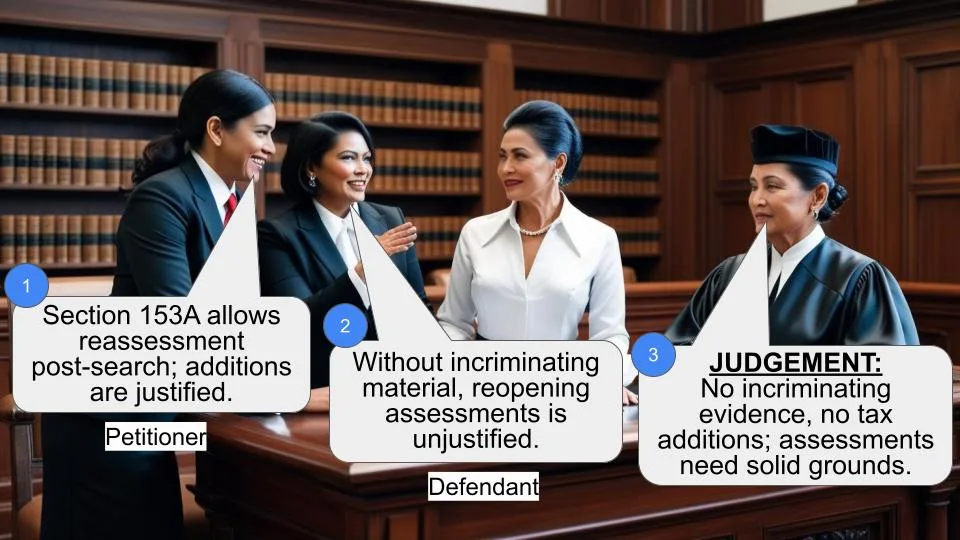
The case involves the Income Tax Department and an assessee, where the central issue was whether additions could be made under Section 153A (of Income Tax Act, 1961) when no incriminating material was found during a search. The court upheld the tribunal’s decision to delete the additions, emphasizing that without incriminating evidence, no additional tax assessments should be made.
Get the full picture - access the original judgement of the court order here
Case Name:
Principal Commissioner of Income Tax Vs. Dipak Jashvantlal Panchal (High Court of Gujarat)
Tax Appeal No. 110, 111, 115 & 116 of 2017
Date: 14th February 2017
Key Takeaways:
- Section 153A (of Income Tax Act, 1961): This section is triggered by a search or requisition and allows for the assessment of income for six preceding years.
- Incriminating Material: Additions to income can only be made if incriminating material is found during the search.
- Legal Precedent: The court relied on previous decisions, including those from the Delhi High Court and Rajasthan High Court, to support its ruling.
- Tribunal’s Role: The tribunal’s decision to delete the additions was upheld, reinforcing the principle that assessments must be based on evidence found during searches.
Issue
Can the Income Tax Department make additions to an assessee’s income under Section 153A (of Income Tax Act, 1961) if no incriminating material is found during a search?
Facts
The case arose from a search conducted on the assessee, Dipak Jashvantlal Panchal, under Section 132 (of Income Tax Act, 1961). The Assessing Officer made additions to the assessee’s income for the years 2000-2001 to 2004-2005 based on the search. However, the assessee argued that no incriminating material was found to justify these additions.
Arguments
- Income Tax Department: Argued that the additions were justified under Section 153A (of Income Tax Act, 1961), which allows for reassessment following a search.
- Assessee: Contended that without incriminating material, the completed assessments should not be reopened or altered.
Key Legal Precedents
- Kabul Chawla Case: The Delhi High Court decision emphasized that additions under Section 153A (of Income Tax Act, 1961) require incriminating material.
- Jai Steel (India), Jodhpur v. Assistant Commissioner of Income Tax: The Rajasthan High Court held that without incriminating material, earlier assessments should be reiterated.
Judgement
The court upheld the tribunal’s decision to delete the additions made by the Assessing Officer. It agreed with the tribunal that without incriminating material found during the search, no additions could be made under Section 153A (of Income Tax Act, 1961). The court emphasized that the purpose of Section 153A (of Income Tax Act, 1961) is to assess undisclosed income found during a search, not to reassess completed assessments without new evidence.
FAQs
Q1: What is Section 153A (of Income Tax Act, 1961)?
A1: It allows for the assessment of income for six years preceding a search or requisition, but additions can only be made based on incriminating material found during the search.
Q2: Why was the tribunal’s decision upheld?
A2: The tribunal’s decision was upheld because it correctly applied the legal principle that without incriminating material, no additions should be made under Section 153A (of Income Tax Act, 1961).
Q3: What does this decision mean for taxpayers?
A3: It reinforces the protection for taxpayers that completed assessments cannot be arbitrarily reopened without new evidence found during a search.

1.00. As common question of law and facts arise in this group of appeals and are between the same parties but with respect to different assessment years, all these appeals are decided and disposed of by this common order.
2.00. Feeling aggrieved and dissatisfied with the impugned common judgement and order passed by the learned Income Tax Appellate Tribunal, Ahmedabad
(hereinafter referred to as “the learned tribunal”) in I.T.A. Nos.371/AHD/2011, 372/AHD/2011 and 373/AHD/2011 and Cross Objection No.125 of 2011, by which the learned tribunal has partly allowed the said appeals preferred by the common assessee and has deleted the additions made by the A.O., made under section 153(A) (of Income Tax Act, 1961), 1961 for the A.Ys. 2000-2001 to 2004-2005, revenue has preferred present Tax Appeals with the following proposed questions of law :-
“[a] Whether on the facts and in the circumstances of
the case, the Appellate Tribunal is right in law in
narrowing down the scope of assessment u/s. 153(A) (of Income Tax Act, 1961) in
respect of completed assessment by holding that only
undisclosed income and undisclosed assets detected
during the search could be brought to tax ?
[b] Whether on the facts and in the circumstances of
the case, the Appellate Tribunal is correct in law in
holding the scope of section 153(A) (of Income Tax Act, 1961) is limited to
assessing only search releated income, thereby denying
Revenue the opportunity of taxing other escaped
income, that comes to the notice of the Assessing
Officer ?
[c] Whether on the facts and in the circumstances of
the case, the Appellate Tribunal was right in law in
limiting the scope of Section 153(A) (of Income Tax Act, 1961) only to undisclosed
income when as per the section the Assessing officer
has to assess the total income of the six assessment
years ?
[d] Whether the findings of the Tribunal that no
incriminating material is found is perverse inasmuch as
incriminating documents were found, though pertaining
to the other Assessment years which could be linked
with the present Assessment Year?”
3.00. Facts leading to the present appeals, in nutshell,
are as under :-
3.01. That a warrant of authorization under section
132(1) of the Act was issued and executed in the case of the
assessee on 10/2/2006. Thereafter, proceedings under section
153(A) of the Act were initiated and notice under section
153(A) of the Act was issued and served upon the assessee in
lieu of which returns were field.
3.02. The assessments were made under section 153(A) (of Income Tax Act, 1961)
read with section 143(3) (of Income Tax Act, 1961) for the A.Ys. 2000-2001 to
2004-2005.
3.03. That the A.O. made additions under section 153(A) (of Income Tax Act, 1961)
of the Act on the basis of incriminating materials found /
recovered at the time of search.
3.04. Feeling aggrieved and dissatisfied with the
additions made by the A.O. under section 153(A) (of Income Tax Act, 1961) on the basis
of incriminating material found during the search operation
conducted on 10/2/2006, the assessee preferred appeals
before the learned C.I.T.(A). And the learned C.I.T.(A).
dismissed the appeals preferred by the assessee and
confirmed the additions made by the A.O. under section
153(A) of the Act.
3.05. Feeling aggrieved and dissatisfied with the
impugned order passed by the learned C.I.T.(A). confirming
the additions made by the A.O. under section 153(A) (of Income Tax Act, 1961) of the
Act, the assessee preferred appeals before the learned
tribunal. It was contended before the learned tribunal that the
assessment for the A.Ys. 2000-2001 to 2004-2005 could not
have been made under section 153(A) (of Income Tax Act, 1961) as no
incriminating material was found at the time of search to
reopen the completed assessment.
3.06. Accepting the submissions made on behalf of the
assessee and relying upon the decision of the Delhi High Court
in the case of Commissioner of Income Tax Versus Kabul
Chawla reported in 380 ITR 573, the learned tribunal has
allowed the appeals preferred by the assessee and has deleted
the additions made under section153(A) (of Income Tax Act, 1961) for the
A.Ys. 2000-2001 to 2004-2005.
3.07. Feeling aggrieved and dissatisfied with the
impugned judgement and order passed by the learned tribunal
in directing to delete additions made by the A.O. under section
153(A) of the Act for the A.Ys. 2000-2001 to 2004-2005,
revenue has preferred present appeals with the aforesaid
proposed questions of law.
4.00. We have heard Mr.Varun Patel, learned counsel
appearing on behalf of the revenue. We have perused and
considered the assessment orders passed under section
153(A) of the Act as well as the order passed by the learned
CIT(A) as well as the impugned judgement and order passed by
the learned tribunal. The learned tribunal has deleted the
additions made under section 153(A) (of Income Tax Act, 1961), made on the
basis of incriminating material found during the search, on the
ground that under section 153(A) (of Income Tax Act, 1961) in respect of
undisclosed income and undisclosed assets detected during
the search could be brought to tax. In support of the above,
the learned tribunal has heavily relied upon the decision of the
Delhi High Court in the case of Kabul Chawla (supra).
4.01. Identical question came to be considered by the
Division Bench of this Court in the case of Principal
Commissioner of Income Tax-2 Versus Jay Infrastructure
and Properties Pvt. Ltd. rendered in Tax Appeal No. 740
of 2016 and considering the earlier decision of the Division
Bench in the case of Principal Commissioner of Income
Tax -4 vs. Saumya Construction Pvt. Ltd. rendered in Tax
Appeal No.24 of 2016 in which, it is specifically held that the
A.O. while framing the assessment under Section 153(A) (of Income Tax Act, 1961) of the
Act for the block period may make addition considering the
incriminating material found for the year under consideration
only which was collected during the search. The Division Bench
in the case of Saumya Construction Pvt. Ltd. (supra) in
paragraph Nos. 15, 16 and 19 has observed and held as under:
15. On a plain reading of section 153A (of Income Tax Act, 1961), it
is evident that the trigger point for exercise of powers
thereunder is a search under section 132 (of Income Tax Act, 1961) or a
requisition under section 132A (of Income Tax Act, 1961). Once a
search or requisition is made, a mandate is cast upon
the Assessing Officer to issue notice under section
153A of the Act to the person, requiring him to furnish
the return of income in respect of each assessment
year falling within six assessment years immediately
preceding the assessment year relevant to the
previous year in which such search is conducted or
requisition is made and assess or reassess the same.
Since the assessment under section 153A (of Income Tax Act, 1961) is
linked with search and requisition under sections 132 (of Income Tax Act, 1961)
and 132A of the Act, it is evident that the object of the
section is to bring to tax the undisclosed income which
is found during the course of or pursuant to the search
or requisition. However, instead of the earlier regime
of block assessment whereby, it was only the
undisclosed income of the block period that was
assessed, section 153A (of Income Tax Act, 1961) seeks to assess the
total income for the assessment year, which is clear
from the first proviso thereto which provides that the
Assessing Officer shall assess or reassess the total
income in respect of each assessment year falling
within such six assessment years. The second proviso
makes the intention of the legislature clear as the
same provides that assessment or reassessment, if
any, relating to the six assessment years referred to in
the sub-section pending on the date of initiation of
search under section 132 (of Income Tax Act, 1961) or requisition under section
132A, as the case may be, shall abate. Sub-section (2)
of section 153A (of Income Tax Act, 1961) provides that if any
proceeding or any order of assessment or
reassessment made under sub-section (1) is annulled
in appeal or any other legal provision, then the
assessment or reassessment relating to any
assessment year which had abated under the second
proviso would stand revived. The proviso thereto says
that such revival shall cease to have effect if such
order of annulment is set aside. Thus, any proceeding
of assessment or reassessment falling within the six
assessment years prior to the search or requisition
stands abated and the total income of the assessee is
required to be determined under section 153A (of Income Tax Act, 1961) of the
Act. Similarly, sub-section (2) provides for revival of
any assessment or reassessment which stood abated,
if any proceeding or any order of assessment or
reassessment made under section 153A (of Income Tax Act, 1961) is
annulled in appeal or any other proceeding.
16. Section 153A (of Income Tax Act, 1961) bears the heading Assessment in
case of search or requisition. It is well settled as held
by the Supreme Court in a catena of decisions that the
heading of the section can be regarded as a key to the
interpretation of the operative portion of the section
and if there is no ambiguity in the language or if it is
plain and clear, then the heading used in the section
strengthens that meaning. From the heading of
section 153 (of Income Tax Act, 1961), the intention of the legislature is clear
viz., to provide for assessment in case of search and
requisition. When the very purpose of the provision is
to make assessment in case of search or requisition, it
goes without saying that the assessment has to have
relation to the search or requisition. In other words,
the assessment should be connected with something
found during the search or requisition, viz.,
incriminating material which reveals undisclosed
income. Thus, while in view of the mandate of sub-
section (1) of section 153A (of Income Tax Act, 1961), in every case
where there is a search or requisition, the Assessing
Officer is obliged to issue notice to such person to
furnish returns of income for the six years preceding
the assessment year relevant to the previous year in
which the search is conducted or requisition is made,
any addition or disallowance can be made only on the
basis of material collected during the search or
requisition. In case no incriminating material is found,
as held by the Rajasthan High Court in the case of Jai
Steel (India), Jodhpur v. Assistant Commissioner
of Income Tax (supra), the earlier assessment would
have to be reiterated. In case where pending
assessments have abated, the Assessing Officer can
pass assessment orders for each of the six years
determining the total income of the assessee which
would include income declared in the returns, if any,
furnished by the assessee as well as undisclosed
income, if any, unearthed during the search or
requisition. In case where a pending reassessment
under section 147 (of Income Tax Act, 1961) has abated, needless to
state that the scope and ambit of the assessment
would include any order which the Assessing Officer
could have passed under section 147 (of Income Tax Act, 1961) as
well as under section 153A (of Income Tax Act, 1961).
19. On behalf of the appellant, it has been
contended that if any incriminating material is found,
notwithstanding that in relation to the year under
consideration, no incriminating material is found, it
would be permissible to make additions and
disallowance in respect of all the six assessment
years. In the opinion of this court, the said contention
does not merit acceptance, inasmuch as, the
assessment in respect of each of the six assessment
years is a separate and distinct assessment. Under
section 153A (of Income Tax Act, 1961), an assessment has to be
made in relation to the search or requisition, namely,
in relation to material disclosed during the search or
requisition. If in relation to any assessment year, no
incriminating material is found, no addition or
disallowance can be made in relation to that
assessment year in exercise of powers under section
153A of the Act and the earlier assessment shall have
to be reiterated. In this regard, this court is in
complete agreement with the view adopted by the
Rajasthan High Court in the case of Jai Steel (India),
Jodhpur v. Assistant Commissioner of Income
Tax (supra). Besides, as rightly pointed out by the
learned counsel for the respondent, the controversy
involved in the present case stands concluded by the
decision of this court in the case of Commissioner of
Income-tax-1 v. Jayaben Ratilal Sorathia (supra)
wherein it has been held that while it cannot be
disputed that considering section 153A (of Income Tax Act, 1961), the
Assessing Officer can reopen and/or assess the return
with respect to six preceding years; however, there
must be some incriminating material available with
the Assessing Officer with respect to the sale
transactions in the particular assessment year."
4.02. Similar view has been taken by this Court recently
in the case of The Principal Commissioner of Income Tax-
1 Versus Devangi Alias Rupa in Tax Appeal No.54 of
2017.
4.03. Considering the facts and circumstances of the
case, it cannot be said that the learned tribunal has
committed any error in deleting the additions made under
section 153(A) (of Income Tax Act, 1961) for the A.Ys. 2000-2001 to 2004-
2005 and/or any substantial question of law arise. In view of
the aforesaid binding decisions of this Court in Tax Appeal
Nos.749/2016 & 54/2017, we see no reason to interfere with
the impugned judgement and order passed by the learned
tribunal. No substantial question of law arise in this group of
appeals.
5.00. In view of the above and for the reasons stated
above and considering the binding decisions of this Court in
the case of Jay Infrastructure and Properties Pvt Ltd (supra)
and Saumya Construction Pvt. Ltd. (supra) and decision of the
Delhi High Court in the case of Kabul Chawla (supra), we see
no reason to interfere with the impugned judgment and order
passed by the learned Tribunal. No substantial question of law
arise in this group of appeals. Hence, all these appeals deserve
to be dismissed and are accordingly dismissed.
Sd/-
(M.R. SHAH, J.)
Sd/-
(B.N. KARIA, J.)
×
Questions
No Incriminating Material, No Tax Addition: Court Upholds Tribunal’s Decision
Write your CommentSimilar Posts

Generic
- Reportdata/2010.pdf
