


No Notice Under Section 143(2) (of Income Tax Act, 1961), No Valid Assessment


Full News
No Notice Under Section 143(2) (of Income Tax Act, 1961), No Valid Assessment
No Notice Under Section 143(2) (of Income Tax Act, 1961), No Valid Assessment
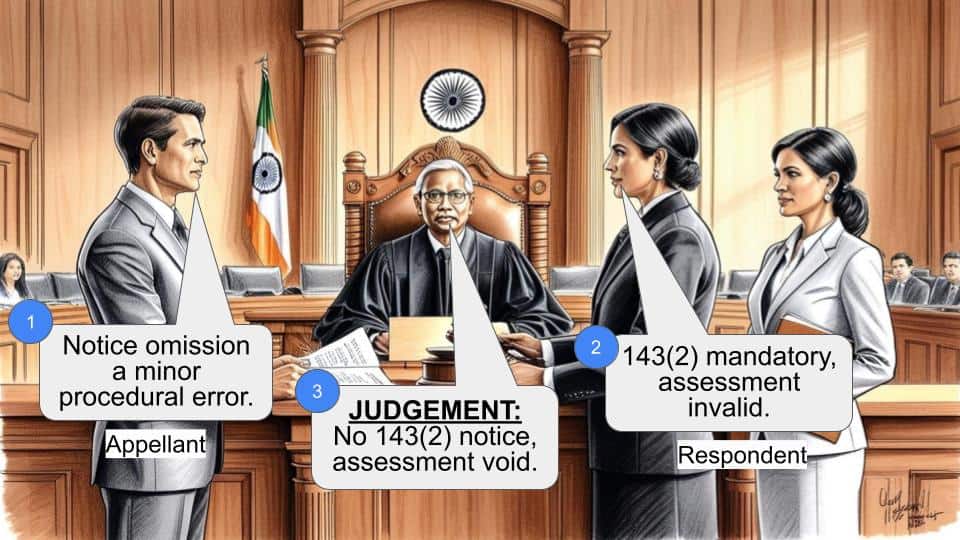
This case involves a dispute between the Income Tax Department (Revenue) and an assessee (taxpayer) regarding the validity of an assessment made without issuing a mandatory notice under Section 143(2) (of Income Tax Act, 1961). The court ruled in favor of the assessee, stating that the omission of this notice vitiates the entire assessment process.
Get the full picture - access the original judgement of the court order here
Case Name:
Commissioner of Income Tax Vs Sodder Builder and Development (P) Ltd. (High Court of Bombay)
Tax Appeal No. 49/2008
Date: 16th July 2019
Key Takeaways:
1. Issuance of notice under Section 143(2) (of Income Tax Act, 1961) is mandatory before making an assessment.
2. Omission to issue this notice is not a curable procedural irregularity.
3. Even for block assessments under Chapter XIV-B, notice under Section 143(2) (of Income Tax Act, 1961) is required.
4. The Supreme Court's decision in Hotel Blue Moon case is a significant precedent in this matter.
Issue:
Is the issuance of a notice under Section 143(2) (of Income Tax Act, 1961) mandatory before passing an assessment order, and does its omission vitiate the entire assessment process?
Facts:
1. A search was conducted on the assessee's premises on 9/3/2000 and 10/3/2000.
2. A notice under Section 158BC (of Income Tax Act, 1961) was issued on 26/3/2000 to assess undisclosed income.
3. The assessment order was made by ACIT, Central Circle, Panaji on 28/3/2002.
4. The Commissioner (Appeals) dismissed the assessee's appeal on 31/3/2004.
5. The Income Tax Appellate Tribunal (ITAT) allowed the assessee's appeal on 13/8/2007.
6. The Revenue filed an appeal under Section 260-A (of Income Tax Act, 1961).
7. Crucially, no notice under Section 143(2) (of Income Tax Act, 1961) was ever issued to the assessee.
Arguments:
Assessee's Argument:
- The non-issuance of notice under Section 143(2) (of Income Tax Act, 1961) vitiates the entire assessment process.
Revenue's Argument:
- The omission of notice under Section 143(2) (of Income Tax Act, 1961) is a curable procedural irregularity.
Key Legal Precedents:
1. Assistant Commissioner of Income Tax & anr. vs. Hotel Blue Moon (2010 (3) SCC 259): The Supreme Court held that issuing a notice under Section 143(2) (of Income Tax Act, 1961) is mandatory and not a mere procedural irregularity.
2. Nawal Kishore & Sons Jewellers vs. Assessee (87 ITD 407): This case was initially relied upon by the Commissioner (Appeals) and ITAT to rule against the assessee, but was effectively overruled by the Hotel Blue Moon judgment.
Judgement:
1. The court ruled in favor of the assessee.
2. It held that the omission to issue a notice under Section 143(2) (of Income Tax Act, 1961) vitiates the entire assessment process.
3. The court applied the law laid down in the Hotel Blue Moon case.
4. The appeal by the Revenue was dismissed.
FAQs:
Q1: What is the significance of Section 143(2) (of Income Tax Act, 1961) notice?
A1: Section 143(2) (of Income Tax Act, 1961) notice is a mandatory requirement before making an assessment. It cannot be dispensed with and its omission is not a curable procedural irregularity.
Q2: Does this ruling apply to block assessments under Chapter XIV-B?
A2: Yes, the court clarified that even for block assessments under Chapter XIV-B, notice under Section 143(2) (of Income Tax Act, 1961) is required.
Q3: What impact does this judgment have on future assessments?
A3: This judgment reinforces the importance of following proper procedures in tax assessments. The Income Tax Department must ensure that notices under Section 143(2) (of Income Tax Act, 1961) are issued before making assessments to avoid them being invalidated.
Q4: Can the Revenue appeal this decision further?
A4: While the judgment doesn't mention it explicitly, the Revenue could potentially appeal to the Supreme Court if they believe there's a substantial question of law involved.
Q5: What should taxpayers do if they receive an assessment order without having received a Section 143(2) (of Income Tax Act, 1961) notice?
A5: Based on this judgment, taxpayers could potentially challenge such assessments. However, it's always advisable to consult with a tax professional or lawyer for specific advice.

Heard Ms. Amira Razaq, learned Standing Counsel for the Appellant and Mr. A. F. Diniz, learned Counsel for the Respondent.
2. This Court, on 1st April, 2019, framed an additional substantial question of law by making the following order :
“Mr. Diniz, learned counsel for the Respondent states that though the Respondent has not filed any cross objection, the Respondent is entitled to challenge the findings of fact rendered by the Income Tax Appellate Tribunal of the State which are against his client. He submits that there is an error in the findings of fact rendered by the ITAT on the issue as to whether a notice under Section 143(2) (of Income Tax Act, 1961) was mandatory or not before passing the order of assessment under Section 143(3) (of Income Tax Act, 1961). He submits that the ITAT has rendered findings against the Respondent based on the order of the Special Bench of ITAT in the case of Nawal Kishore & Sons Jewellers, 87 ITD 407.
2. The learned counsel invited our attention to the judgment of the Hon'ble Supreme Court in the case of Assistant Commissioner of Income Tax and another Vs Hotel Blue Moon 1 and in particular the paragraphs 13, 21, 22, 24 and 27 in support of the submission that the Hon'ble Supreme Court has held that the issuance of notice under Section 143(2) (of Income Tax Act, 1961) is mandatory before passing the assessment order under Section 143(3) (of Income Tax Act, 1961). He tenders an additional substantial question of law with a request to decide the same along with other questions. We are satisfied that an additional substantial question of law can be framed even at this stage which is necessitated in view of the judgment of the Hon'ble Supreme Court in case of Hotel Blue Moon (supra). We, therefore, frame an additional substantial question of law as under :
'Whether the finding of the Tribunal ( & the CIT (A)) that non issuance of notice under Section 143(2) (of Income Tax Act, 1961), does not vitiate the proceedings, is unsustainable in view of the judgment of the Hon'ble Supreme Court reported in 2010(3) SCC 259, and consequently, the assessment has to be set aside on this ground also ?'
3. This additional substantial question of law to be considered along with the other substantial question of law already formulated by this Court at the stage of admission of this appeal.
4. Stand over to 23rd April, 2019.”
3. It is common ground that if the additional substantial question of law, as framed in the order dated 1st April, 2019, is answered against the Revenue and in favour of the Assessee, then, there will not be any necessity of adverting to the remaining substantial questions of law which were framed at the stage of admission of the appeal. Accordingly, we proceed to decide on the additional substantial question of law, as recorded in the order dated 1.4.2019.
4. The facts, in brief, are that a search was conducted in the Assessee's premises on 9/3/2000 and 10/3/2000, pursuant to which a notice was issued under Section 158 (of Income Tax Act, 1961) BC of the Income-tax Act, 1961 (said Act) on 26/3/2000 to the Assessee seeking to assess the undisclosed income by initiating proceedings under the provisions of Chapter XIV-B of the said Act. The assessment order was made by ACIT, Central Circle, Panaji on 28/3/2002. An appeal against the same was dismissed by the Commissioner (Appeals) on 31.3.2004. The Assessee, thereupon, appealed to the Income Tax Appellate Tribunal (ITAT) which appeal, was allowed by Judgment and Order dated 13.8.2007. The Revenue has, therefore, instituted the present appeal under Section 260-A (of Income Tax Act, 1961) of the said Act.
5. As noted earlier, we permitted framing of an additional substantial question of law because the records indicated that no notice under Section 143(2) of the Income Tax Act, 1961 was issued to the Assessee and it was the contention of the Assessee that non-issuance of such a notice vitiates the assessment undertaken under the special procedure under Chapter XIV-B of the said Act.
6. The record indicates that the aforesaid contention, based upon non-issuance of notice under Section 143(2) of the Income Tax Act, 1961, was specifically raised by the Assessee before both, the Commissioner (Appeals), as well as the ITAT. However, this contention was negatived by the Commissioner (Appeals), as well as the ITAT by relying upon the decision of the Special Bench in the case of Nawal Kishore & Sons Jewellers vs. Assessee, 87 ITD 407.
7. The issue relating to service of notice under Section 143(2) of the Income Tax Act, 1961, is an issue which goes to the root of the matter. The Hon'ble Apex Court in the case of Assistant Commissioner of Income Tax & anr. vs. Hotel Blue Moon, 2010 (3) SCC 259 has now held that issuance of notice under Section 143(2) of the Income Tax Act, 1961 is a mandatory requirement and not some mere procedural irregularity which can be said to be curable. In this decision, the Apex Court, in clear terms, has held that omission on the part of the assessing authority to issue a notice under Section 143(2) (of Income Tax Act, 1961) cannot be regarded as a procedural irregularity which is curable. Therefore,the requirement of notice under Section 143(2) (of Income Tax Act, 1961) cannot be dispensed with. The Hon'ble Apex Court has, in fact, concluded that even for the purpose of Chapter XIV-B of the said Act for determination of the undisclosed income for a block period under Section 158BC (of Income Tax Act, 1961), provisions of Section 142 (of Income Tax Act, 1961) and Section 143(2) (of Income Tax Act, 1961), and (3) are applicable and no assessment could be made without issuing a notice under Section 143(2) of the Income Tax Act, 1961.
8. In the present case, admittedly, no notice under Section 143(2) of the Income Tax Act, 1961 was ever issued to the Assessee. By applying the law laid down by the Hon'ble Apex Court in Hotel Blue Moon (supra), we will have to hold that the assessment made in the present case stands vitiated. Therefore, even if we were to hold in favour of the Revenue with regard to the other substantial questions of law framed at the time of admission of this appeal, the assessment made in the present matter would nevertheless stand vitiated for want of mandatory notice under Section 143(2) of the Income Tax Act, 1961.
9. Accordingly, the additional substantial question of law as framed in the order dated 1st April, 2019 is required to be answered against Revenue and in favour of the Assessee. As a result, this Appeal is required to be dismissed and is, hereby, dismissed. In the facts of the present case, there shall be no order as to costs.
Nutan D. Sardessai, J. M.S. Sonak, J.
×
Questions
No Notice Under Section 143(2) (of Income Tax Act, 1961), No Valid Assessment
Write your CommentSimilar Posts


Generic
- Reportdata/3942.pdf
