


Court rules non-issuance of notice under Section 143(2) (of Income Tax Act, 196…



Full News
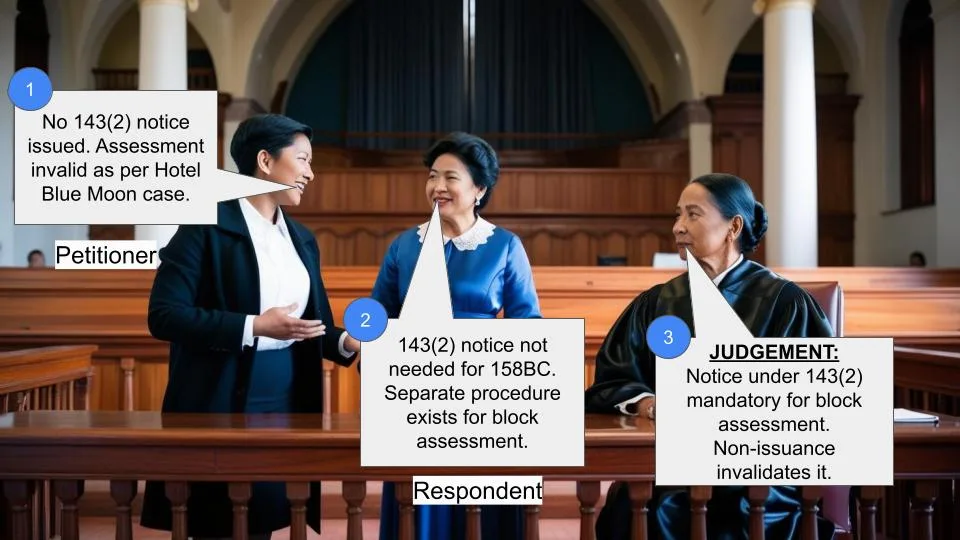
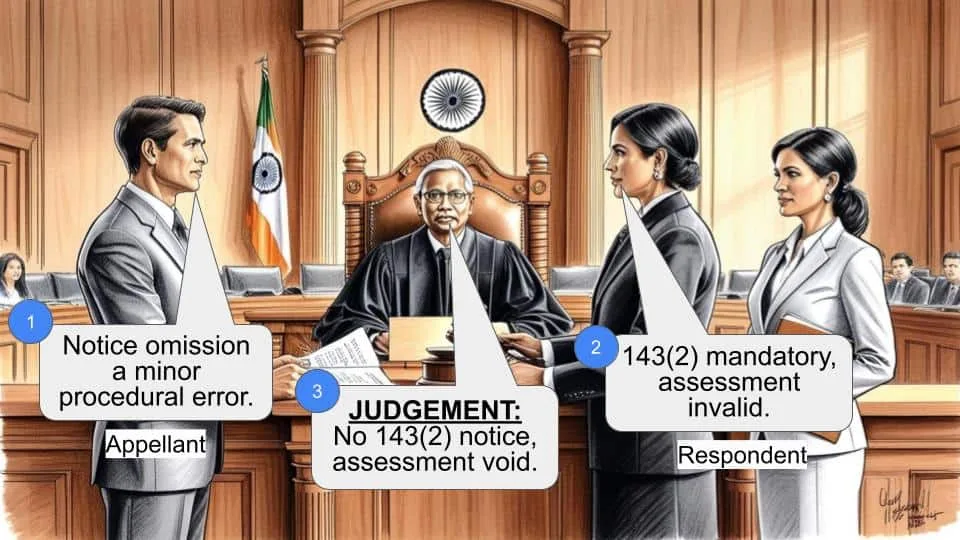
Court rules non-issuance of notice under Section 143(2) (of Income Tax Act, 1961) invalidates block assessment.
Court rules non-issuance of notice under Section 143(2) (of Income Tax Act, 1961) invalidates block assessmen…
The case involves the assessee challenging a block assessment order due to the non-issuance of a mandatory notice under Section 143(2) (of Income Tax Act, 1961). The court ruled in favor of the assessee, setting aside the assessment order as invalid due to this procedural lapse.
Get the full picture - access the original judgement of the court order here.
Case Name:
Chandrabhan vs. Commissioner of Income Tax. (High Court)
Income Tax Appeal No. 2 of 2011
Key Takeaways
- The court emphasized the mandatory nature of issuing a notice under Section 143(2) (of Income Tax Act, 1961) in block assessment proceedings under Section 158BC (of Income Tax Act, 1961).
- The failure to issue this notice is not a procedural irregularity but a fatal error that invalidates the assessment.
- The decision aligns with the precedent set by the Supreme Court in Assistant Commissioner of Income-Tax vs. Hotel Blue Moon.
Issue
Is the issuance of a notice under Section 143(2) (of Income Tax Act, 1961) mandatory for making an assessment under Section 158BC (of Income Tax Act, 1961)?
Facts
- The assessee was found carrying unexplained silver ornaments, leading to a requisition under Section 132A (of Income Tax Act, 1961).
- The assessee filed returns for the block period, but the Assessing Officer (AO) did not issue a notice under Section 143(2) (of Income Tax Act, 1961).
- The AO treated a portion of the silver ornaments as unexplained and taxed them accordingly.
- The assessee appealed, arguing that the non-issuance of the notice under Section 143(2) (of Income Tax Act, 1961) invalidated the assessment.
Arguments
- Assessee's Argument:
The notice under Section 143(2) (of Income Tax Act, 1961) is mandatory for block assessments under Section 158BC (of Income Tax Act, 1961), and its non-issuance invalidates the assessment. The assessee relied on the Supreme Court's decision in Assistant Commissioner of Income-Tax vs. Hotel Blue Moon.
- Revenue's Argument:
The Revenue contended that the notice under Section 143(2) (of Income Tax Act, 1961) is not required in block assessments under Section 158BC (of Income Tax Act, 1961), as the procedure is separately prescribed.
Key Legal Precedent
- Assistant Commissioner of Income-Tax vs. Hotel Blue Moon:
This Supreme Court case established that the issuance of a notice under Section 143(2) (of Income Tax Act, 1961) is mandatory for block assessments under Section 158BC (of Income Tax Act, 1961).
- Virendra Dev Dixit vs. Assistant Commissioner of Income-Tax:
This Division Bench decision of the Allahabad High Court followed the precedent set by the Supreme Court in Hotel Blue Moon.
Judgement
The court ruled in favor of the assessee, setting aside the Tribunal's order and the block assessment due to the non-issuance of the mandatory notice under Section 143(2) (of Income Tax Act, 1961). The court held that this procedural lapse was fatal to the validity of the assessment.
FAQs
Q1: Why is the notice under Section 143(2) (of Income Tax Act, 1961) important?
A1: The notice under Section 143(2) (of Income Tax Act, 1961) is crucial because it ensures that the assessee has an opportunity to present evidence and arguments before the assessment is finalized. Its non-issuance invalidates the assessment.
Q2: What was the main legal precedent cited in this case?
A2: The main legal precedent was the Supreme Court's decision in Assistant Commissioner of Income-Tax vs. Hotel Blue Moon, which established the mandatory nature of the notice under Section 143(2) (of Income Tax Act, 1961) for block assessments.
Q3: What was the outcome of the case?
A3: The court ruled in favor of the assessee, setting aside the block assessment due to the non-issuance of the mandatory notice under Section 143(2) (of Income Tax Act, 1961).
Q4: Does this ruling affect other block assessments?
A4: Yes, this ruling reinforces the requirement for issuing a notice under Section 143(2) (of Income Tax Act, 1961) in all block assessments under Section 158BC (of Income Tax Act, 1961), impacting similar cases.

1. This appeal under Section 260-A (of Income Tax Act, 1961) has been filed by the assessee challenging order dated 13.10.2005 passed by Income Tax Appellate Tribunal, Agra Bench, Agra (hereinafter called as 'Tribunal').
2. This appeal was admitted on 11.01.2011 on the following question of law:-
“(I) Whether on a true and correct interpretation of the provisions of section 143(2) (of Income Tax Act, 1961), the Tribunal was legally correct in holding that non-issuance/ non-service of notice thereunder, had no bearing on the validity of Block assessment order dated 28.04.2000 as had been passed by the Assessing Officer under Section 158BC (of Income Tax Act, 1961) read with section 143(3) (of Income Tax Act, 1961)?
(ii) Whether the “Tribunal” was legally correct in holding that the provisions related to service of notice under section 143(2) (of Income Tax Act, 1961) stood dispensed with, after the assessee was given an opportunity of being heard by issue of notice under various other sections, from time to time, which the assessee had availed by his participation?”
3. Brief facts of the case are that assessee was intercepted by police and was found to be carrying silver jewellery in a Maruti van weighing 242.507 kg. As the assessee could not explain source of acquisition of silver ornaments, warrant of
authorisation for requisition of the same was issued under Section 132 (of Income Tax Act, 1961) A of the Income Tax Act (hereinafter called as 'Act') on 29.04.1998 by Commissioner of Income Tax, Agra. Assessing Officer issued and served notice under Section 158BC (of Income Tax Act, 1961) on the assessee on 08.10.1998. Assessee filed return in Form 2B for the block period on 23.07.1999. During course of block assessment proceedings, assessee initially surrendered 54 kg of silver ornament for taxation, the same was revised to 75 kg and finally to 100 kg. Assessing Officer treated 102.54 kg of silver ornament as unexplained and the balance as explained. The value of unexplained silver jewellery ornaments was determined at Rs.4,33,907/-. The said amount was taxed in the assessment year 1999-2000.
4. Assessee had never filed return of income till action under Section 132 (of Income Tax Act, 1961) A was taken on 29.04.1998. Assessee, thereafter, filed return of income on 18.05.1998 for assessment year 1994-95 to 1997-98, while return for assessment year 1998-99 was filed on 31.10.1998. The assessee in all these return had disclosed income from business of silver ornament on labour basis. As the returns of income had been filed after the search, Assessing Officer, therefore, held that this income was undisclosed income of the assessee and included the same in assessment of undisclosed income for the block period. Aggrieved by assessment order, the assessee filed appeal which was partly allowed by Commissioner Income Tax (Appeals)- II, Agra on 11.12.2001. The assessee challenged order of the CIT (A) before Tribunal, which was partly allowed on 13.10.2005 and the ground raised by assessee that the Assessing Officer not having issued any notice under Section 143(2) (of Income Tax Act, 1961) in block assessment which was mandatory, was turned down, and thus, the present appeal.
5. Before proceeding, it would be necessary to have a glance of provisions of Section 143(2) (of Income Tax Act, 1961) and Section 158BC (of Income Tax Act, 1961).
(2) Where a return has been furnished under section 139 (of Income Tax Act, 1961), or in response to a notice under sub-section (1) of section 142 (of Income Tax Act, 1961), the Assessing Officer or the prescribed income-tax authority, as the case may be, if, considers it necessary or expedient to ensure that the assessee has not understated the income or has not computed excessive loss or has not under-paid the tax in any manner, shall serve on the assessee a notice requiring him, on a date to be specified therein, either to attend the office of the Assessing Officer or to produce, or cause to be produced before the Assessing Officer any evidence on which the assessee may rely in support of the return:
Provided that no notice under this sub-section shall be served on the assessee after the expiry of six months from the end of the financial year in which the return is furnished.]
158BC. Where any search has been conducted under section 132 (of Income Tax Act, 1961) or books of account, other documents or assets are requisitioned under section 132A (of Income Tax Act, 1961), in the case of any person, then,—
(a) the Assessing Officer shall—
(b) the Assessing Officer shall proceed to determine the undisclosed income of the block period in the manner laid down in section 158BB (of Income Tax Act, 1961) and the provisions of section 142 (of Income Tax Act, 1961), sub-sections (2) and (3) of section 143 (of Income Tax Act, 1961), [section 144 (of Income Tax Act, 1961) and section 145 (of Income Tax Act, 1961)] shall, so far as may be, apply;
6. Counsel for the assessee submitted that Tribunal had wrongly held that full opportunity was afforded to assessee to substantiate his claim, thus, the want of issue of notice under Section 143(2) (of Income Tax Act, 1961) on the part of Assessing Officer was only a procedural error to be cured by suitable directions, and no prejudice was caused to the assessee.
7. He further submitted that the notice under Section 143(2) (of Income Tax Act, 1961) was mandatory in block assessment proceedings held under Section 158BC (of Income Tax Act, 1961) and non-issuance of such notice goes to root of the case. He relied upon a decision of the Apex Court in Assistant Commissioner of Income-Tax and another vs. Hotel Blue Moon, [2010] 321 ITR 362 (SC). Relevant portion relied upon is extracted below:-
“We may now revert back to section 158BC(b) (of Income Tax Act, 1961) which is the material provision which requires our consideration. Section 158BC(b) (of Income Tax Act, 1961) provides for enquiry and assessment. The said provision reads "that the assessing officer shall proceed to determine the undisclosed income of the block period in the manner laid down in Section 158BB (of Income Tax Act, 1961) and the provisions of section 142 (of Income Tax Act, 1961), sub-sections (2) and (3) of section 143 (of Income Tax Act, 1961), section 144 (of Income Tax Act, 1961) and section 145 (of Income Tax Act, 1961) shall, so far as may be, apply." An analysis of this sub-section indicates that, after the return is filed, this clause enables the Assessing Officer to complete the assessment by following the procedure like issue of notice under Sections 143(2) (of Income Tax Act, 1961)/142 and complete the assessment under Section 143(3) (of Income Tax Act, 1961). This section does not provide for accepting the return as provided under Section 143(1)(a) (of Income Tax Act, 1961). The Assessing Officer has to complete the assessment under section 143(3) (of Income Tax Act, 1961) only. In case of default in not filing the return or not complying with the notice under Sections 143(2) (of Income Tax Act, 1961)/142, the Assessing Officer is authorized to complete the assessment ex parte under Section 144 (of Income Tax Act, 1961). Clause (b) of Section 158BC (of Income Tax Act, 1961) by referring to Section 143(2) (of Income Tax Act, 1961) and (3) would appear to imply that the provisions of section 143(1) (of Income Tax Act, 1961) are excluded. But Section 143(2) (of Income Tax Act, 1961) itself becomes necessary only where it becomes necessary to check the return, so that where block return conforms to the undisclosed income inferred by the authorities, there is no reason, why the authorities should issue notice under Section 143(2) (of Income Tax Act, 1961). However, if an assessment is to be completed under Section 143(3) (of Income Tax Act, 1961) read with section 158BC (of Income Tax Act, 1961), notice under Section 143(2) (of Income Tax Act, 1961) should be issued within one year from the date of filing of block return. Omission on the part of the assessing authority to issue notice under Section 143(2) (of Income Tax Act, 1961) cannot be a procedural irregularity and the same is not curable and, therefore, the requirement of notice under Section 143(2) (of Income Tax Act, 1961) cannot be dispensed with. The other important feature that requires to be noticed is that the Section 158BC(b) (of Income Tax Act, 1961) specifically refers to some of the provisions of the Act which requires to be followed by the Assessing Officer while completing the block assessments under Chapter XIV-B of the Act. This legislation is by incorporation. This section even speaks of sub-sections which are to be followed by the Assessing Officer. Had the intention of the Legislature been to exclude the provisions of Chapter XIV of the Act, the Legislature would have or could have indicated that also. A reading of the provision would clearly indicate, in our opinion, if the Assessing Officer, if for any reason, repudiates the return filed by the assessee in response to notice under Section 158BC(a) (of Income Tax Act, 1961), the Assessing Officer must necessarily issue notice under Section 143(2) (of Income Tax Act, 1961) within the time prescribed in the proviso to Section 143(2) (of Income Tax Act, 1961). Where the Legislature intended to exclude certain provisions from the ambit of section 158BC(b) (of Income Tax Act, 1961) it has done so specifically. Thus, when section 158BC(b) (of Income Tax Act, 1961) specifically refers to applicability of the proviso thereto it cannot be excluded. We may also notice here itself that the clarification given by Central Board of Direct Taxes in its circular No.717 dated August 14, 1995, has a binding effect on the Department, but not on the court. This circular clarifies the requirement of law in respect of service of notice under sub-section (2) of section 143 (of Income Tax Act, 1961). Accordingly, we conclude that even for the purpose of Chapter XIV-B of the Act, for the determination of undisclosed income for a block period under the provisions of section 158BC (of Income Tax Act, 1961), the provisions of Section 142 (of Income Tax Act, 1961) and sub-sections (2) and (3) of section 143 (of Income Tax Act, 1961) are applicable and no assessment could be made without issuing notice under Section 143(2) (of Income Tax Act, 1961).”
8. He further relied upon a decision of Division Bench of this Court in case of Virendra Dev Dixit vs. Assistant Commissioner of Income-Tax (2010) 41 DTR (All.) 43.
9. Per contra, counsel for the Revenue submitted that in proceedings under Section 158BC (of Income Tax Act, 1961), there is no requirement of a notice to be issued under Section 143(2) (of Income Tax Act, 1961), as issuance of notice in block assessment under Section 158BC (of Income Tax Act, 1961) is separately prescribed. He also submitted that in case of search and seizure under Section 132 (of Income Tax Act, 1961) and in case of requisition of books of accounts under Section 132-A (of Income Tax Act, 1961), the Assessing Officer is left with no discretion but to proceed with block assessment and procedure has been prescribed in Chapter XIV-B of the Act, while in ordinary assessment proceedings as envisaged under Chapter XIV of the Act, the notice under Section 143(2) (of Income Tax Act, 1961) is essential for production of material by the assessee.
10. We have heard Sri Ashish Bansal, learned counsel for the appellant-assessee and Sri Manu Ghildyal, learned counsel for the Revenue and perused the material on record.
11. The question under consideration is as to whether issuance of notice under Section 143(2) (of Income Tax Act, 1961) is mandatory for making assessment under Section 158BC (of Income Tax Act, 1961). The issue involved is no more res-integra and is covered by the decision of Apex Court in case of Assistant Commissioner of Income-Tax and another vs. Hotel Blue Moon (supra), which has been followed by Division Bench of this Court in case of Virendra Dev Dixit (supra).
12. Counsel for the Revenue very fairly conceded that the matter stands covered by the decision of Apex Court in case of Hotel Blue Moon (supra).
13. After having considered the case and perusal of record, we are of the view that the case of the assessee is covered by the decision of the Apex Court in case of Assistant Commissioner of Income-Tax and another vs. Hotel Blue Moon (supra), as Assessing Officer did not issue notice as contemplated under Section 143(2) (of Income Tax Act, 1961) in block assessment proceedings under Section 158BC (of Income Tax Act, 1961), which was mandatory and non service thereof is fatal.
14. The order of the Tribunal dated 13.10.2005 as far as non- issuance of notice under Section 143(2) (of Income Tax Act, 1961) is set aside.
15. The appeal is allowed. The question of law, therefore, is answered in favour of the assessee and against the Revenue.
Order Date :- 21.8.2019
V.S.Singh
×
Questions
Court rules non-issuance of notice under Section 143(2) (of Income Tax Act, 1961) invalidates block assessment.
Write your CommentSimilar Posts


Generic
- Reportdata/3949.pdf
