


No Separate Notice Required for Block Assessment Under Income Tax Act



Full News
No Separate Notice Required for Block Assessment Under Income Tax Act
No Separate Notice Required for Block Assessment Under Income Tax Act
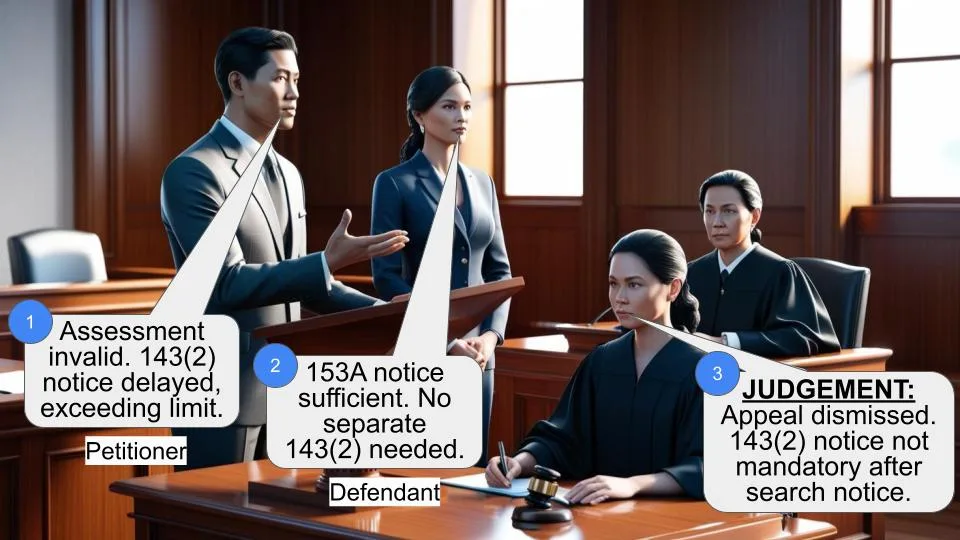
A guy named Tarsem Singla appealed against the Income Tax Department. The main issue was whether a specific notice (under Section 143(2) (of Income Tax Act, 1961)) was needed for a block assessment after a search. The High Court said nope, it's not necessary when they've already given a notice under Section 153A(1)(a) (of Income Tax Act, 1961). Basically, Singla lost this round.
Get the full picture - access the original judgement of the court order here
Case Name:
Tarsem Singla Vs Deputy Commissioner of Income Tax (High Court of Punjab & Haryana)
ITA No.112 of 2015 (O&M)
Date: 18th February 2016
Key Takeaways:
1. For block assessments following a search, a separate notice under Section 143(2) (of Income Tax Act, 1961) isn't mandatory if a notice under Section 153A(1)(a) (of Income Tax Act, 1961) has been issued.
2. The court clarified that the procedure for regular assessments doesn't fully apply to assessments after a search.
3. This decision helps streamline the assessment process for the Income Tax Department in cases involving searches.
Issue:
The main question here was: Is it mandatory to issue a notice under Section 143(2) (of Income Tax Act, 1961) within a specific time period for assessments made under Section 153A (of Income Tax Act, 1961) (which deals with assessments after a search)?
Facts:
1. Tarsem Singla is in the real estate business.
2. On May 7, 2008, the Income Tax Department conducted a search at Singla's premises.
3. They then did a block assessment for the previous six years.
4. On December 5, 2008, they issued a notice under Section 153A (of Income Tax Act, 1961) for the 2004-05 assessment year.
5. Singla filed his tax return on January 30, 2009, declaring an income of ₹1,49,250.
6. The tax officer issued notices under Sections 143(2) (of Income Tax Act, 1961) and 142(1) on June 10, 2010.
7. The final assessment order came on December 30, 2010, adding more income to Singla's declared amount.
8. Singla appealed this decision, arguing that the notice under Section 143(2) (of Income Tax Act, 1961) was issued too late.
Arguments:
Singla's side:
- The notice under Section 143(2) (of Income Tax Act, 1961) was issued after the six-month time limit.
- This delay meant the Assessing Officer had no jurisdiction to proceed with the assessment.
- They cited several court cases to support their argument.
Tax Department's side:
- The specific notice under Section 143(2) (of Income Tax Act, 1961) isn't required for assessments under Section 153A (of Income Tax Act, 1961).
- They also cited court cases supporting their stance.
Key Legal Precedents:
1. Ashok Chaddha vs. Income Tax Officer, (2011) 337 ITR 399 (Delhi): This case held that there's no specific requirement for a Section 143(2) (of Income Tax Act, 1961) notice in Section 153A (of Income Tax Act, 1961) assessments.
2. ACIT and another vs. Hotel Blue Moon, (2010) 321 ITR 362 (SC): This case dealt with a different section (158BC) and wasn't applicable here.
3. CIT v. Madhya Bharat Energy Corpn., ITA No. 950/08: This case held that for assessments under Section 147 (of Income Tax Act, 1961), a Section 143(2) (of Income Tax Act, 1961) notice isn't mandatory.
Judgement:
The High Court dismissed Singla's appeal. Here's why:
1. They agreed with the Delhi High Court's decision in the Ashok Chaddha case.
2. The court said that Section 153A (of Income Tax Act, 1961) doesn't specifically require a notice under Section 143(2) (of Income Tax Act, 1961).
3. They pointed out that a notice under Section 153A(1)(a) (of Income Tax Act, 1961) was already given, making an additional Section 143(2) (of Income Tax Act, 1961) notice unnecessary.
4. The court also mentioned that two questionnaires sent to Singla were sufficient notice for him to provide evidence supporting his tax return.
FAQs:
1. Q: Does this mean the Income Tax Department can skip all notices now?
A: No, they still need to issue the notice under Section 153A(1)(a) (of Income Tax Act, 1961) for block assessments after a search.
2. Q: How does this affect regular tax assessments?
A: This decision specifically applies to block assessments after a search. Regular assessments still follow their usual procedure.
3. Q: Can taxpayers challenge assessments if they don't receive a Section 143(2) (of Income Tax Act, 1961) notice after a search?
A: Based on this judgment, that argument alone wouldn't be sufficient to challenge the assessment.
4. Q: What's the main difference between Section 153A (of Income Tax Act, 1961) and regular assessment procedures?
A: Section 153A (of Income Tax Act, 1961) is specifically for assessments after a search and has its own procedure, which doesn't necessarily include all steps from regular assessments.
5. Q: Does this decision apply to all types of tax-related searches?
A: This judgment specifically deals with assessments under Section 153A (of Income Tax Act, 1961), which applies to searches under Section 132 (of Income Tax Act, 1961) or requisitions under Section 132A (of Income Tax Act, 1961).

CM No.7425 CII of 2015
1. This is an application under Section 5 of the Limitation Act, 1963 for condonation of delay of 164 days in filing the appeal.
2. Notice of the application was given to the respondent. For the reasons stated in the application and after hearing learned counsel for the parties, the delay of 164 days in filing the appeal is condoned. CM stands disposed of.
ITA No.112 of 2015
3. This appeal has been preferred by the appellant under Section 260A (of Income Tax Act, 1961) (in short, “the Act”) against the order dated 22.11.2013, Annexure A.4 passed by the Income Tax Appellate Tribunal, Chandigarh 'B' Bench in ITA No.590/CHD/2012 for the assessment year 2004-05, claiming following substantial questions of law:-
“I) Whether the issuance of notice under Section 143(2) (of Income Tax Act, 1961) within the stipulated time period is mandatory or curable procedural irregularities so as to clothe the Assessing Officer with jurisdiction to undertake the assessment?
II) Whether the balance sheets and capital account filed by the assessee in the course of block assessment be considered as evidence/material found in consequence of the search so as to sustain the addition of income in the block assessment?
III) Whether the figure disclosed in the opening balance sheet in a particular year represents the income earned in the previous years and thus addition, if any, could be made to the relevant/previous years and not in the subsequent year?”
4. A few facts relevant for the decision of the controversy involved as narrated in the appeal may be noticed. The appellant assessee is engaged in the business of real estate. A search and seizure was carried out under Section 132(1) (of Income Tax Act, 1961) on 7.5.2008 by the investigation wing at the premises of the appellant. Consequently, block assessment was carried out with respect to the preceding six years. Notice under Section 153A (of Income Tax Act, 1961) for the assessment year 2004-05 was issued to the assessee on 5.12.2008 and in compliance thereof, the appellant filed return of income on 30.1.2009 declaring an income of 1,49,250/-. Thereafter, notices under sections 143(2) (of Income Tax Act, 1961) and 142(1) of the Act were issued to the assessee on 10.6.2010. The Assessing Officer vide order dated 30.12.2010, Annexure A.1 made addition of 5,25,000/- on account of construction of the house and a sum of 9,95,029/- on account of the difference in the capital reflected in the balance sheet and computed the taxable income to be 16,69,280/-. Penalty proceedings were also ordered to be carried out.
Aggrieved by the order, the appellant filed appeal before the Commissioner of Income Tax (Appeals) [CIT(A)]. Vide order dated 16.4.2012, Annexure A.3, the CIT(A) partly allowed the appeal and deleted the addition of 5,25,000/- on the construction of the house by holding that the same was available out of the increase in the capital amounting to 9,95,029/- for which separate addition had already been made by the Assessing Officer.
However, the remaining part of the impugned order was kept intact and upheld by the CIT(A). Still dissatisfied by the order, the assessee filed appeal before the Tribunal inter alia on the ground that the stipulated time period for service of notice under section 143(2) (of Income Tax Act, 1961) shall also be applicable in respect of assessment framed under Section 153A (of Income Tax Act, 1961).
Learned counsel for the appellant-assessee sought adjournment on the due date of hearing by filing an application but the same was declined. The appellant was proceeded against ex parte. Vide order dated 22.11.2013, Annexure A.4, the appeal was dismissed by the Tribunal. Hence the instant appeal by the appellant-assessee.
5. We have heard learned counsel for the parties.
6. Learned counsel for the appellant-assessee submitted that the Tribunal erred in dismissing the appeal filed by the assessee. In the present case, notice under section 153A (of Income Tax Act, 1961) was issued on 5.12.2008 and the assessee filed the income tax return on 30.1.2009. Notice under Section 143(2) (of Income Tax Act, 1961) was issued to the assessee on 10.6.2010 much beyond the stipulated time period of six months. In view of this, the Assessing Officer did not have any jurisdiction to proceed with the matter. Learned counsel for the assessee relied upon judgments in ACIT and another vs. Hotel Blue Moon, (2010) 321 ITR 362 (SC), Virendra Dev Dixit and another vs.ACIT, (2011) 331 ITR 483 (All.), CIT vs. B.Satyanarayana, (2013) 356 ITR 323 (AP), CIT vs. Pratapbhai K.Soni, (2014) 361 ITR 201 (Guj.) and R. Romi vs. CIT, (2014) 363 ITR 311 (Ker.) to assail the order of the Tribunal.
7. On the other hand, learned counsel for the respondent besides supporting the impugned order relied upon judgments in CIT vs. Panchvati Motors (P) Limited, (2011) 243 CTR 189 (P&H), CIT vs. Raj Kumar Arora, (2014) 367 ITR 517 (All.), Ashok Chaddha vs. Income Tax Officer, (2011) 337 ITR 399 (Delhi).
8. The question that arises for consideration in this appeal relates to whether there is any mandatory requirement of issuance of notice under Section 143(2) (of Income Tax Act, 1961) in respect of assessment proceedings under Section 153A (of Income Tax Act, 1961) or not. The question is no longer res integra as Delhi High Court in Ashok Chaddha's case (supra) delving into identical matter had opined in the negative holding that there was no specific provision in the Act requiring the assessment made under section 153A (of Income Tax Act, 1961) to be after issue of notice under section 143(2) (of Income Tax Act, 1961). After considering the matter in detail, it was recorded as under:-
“9. There is no specific provision in the Act requiring the assessment made under section 153A (of Income Tax Act, 1961) to be after issue of notice under section 143(2) (of Income Tax Act, 1961). Learned counsel for the assessee places heavy reliance on the judgment of the Hon‟ble Supreme Court in Hotel Blue Moon v. DCIT, (Supra) wherein it was held that the where an assessment has to be completed under section 143(3) (of Income Tax Act, 1961) read with section 158BC (of Income Tax Act, 1961), notice under section 143(2) (of Income Tax Act, 1961) must be issued and omission to do so cannot be a procedural irregularity and the same is not curable. It is to be noted that the above said judgment was in the context of Section 158BC (of Income Tax Act, 1961). Clause (b) of Section 158BC (of Income Tax Act, 1961) expressly provides that "the AO shall proceed to determine the undisclosed income of the block period in the manner laid down in section 158BB (of Income Tax Act, 1961) and the provisions of Section 142 (of Income Tax Act, 1961), sub sections (2) and (3) of Section 143 (of Income Tax Act, 1961), Section 144 (of Income Tax Act, 1961) and Section 145 (of Income Tax Act, 1961) shall, so far as may be, apply. This is not the position under section 153A (of Income Tax Act, 1961). The law laid down in Hotel Blue Moon, is thus not applicable to the facts of the present case.
10. The decision of Lunar Diamond Ltd. (supra), Vardhman Estates (supra) and Bhan Testiles (supra) relied upon by learned counsel for the assessee related to the requirement of service of notice upon the assessee within a prescribed time and thus not applicable to the present case. The case of Pawan Gupta (supra) related to mandatory issue of notice under Section 143(2) (of Income Tax Act, 1961) in the case of regular assessment as also on block assessment. This being not a case of assessment based on search under Section 153A (of Income Tax Act, 1961), the same is not applicable to the present case. In the case of Raj Kumar Chawla (supra) relied upon by learned counsel for the assessee was that of the Tribunal, wherein, a view was taken that if a return filed under Section 148 (of Income Tax Act, 1961) is sought to be scrutinized, the compliance of provision contained in proviso under Section 143(2) (of Income Tax Act, 1961) is mandatory. The issue of requirement of notice under section 143(2) (of Income Tax Act, 1961) for an assessment under section 147 (of Income Tax Act, 1961) came up for consideration before this court recently in CIT v. Madhya Bharat Energy Corpn., ITA No. 950/08 decided on 11-07-2011. In that case also, this court has held that in the absence of any specific provision under Section 147 (of Income Tax Act, 1961), the issuance of notice under Section 143(2) (of Income Tax Act, 1961) cannot be held to be a mandatory requirement.
11. It is also to be noted that Section 153A (of Income Tax Act, 1961) provides for the procedure for assessment in case of search or requisition. Sub section (1) starts with non-obstante clause stating that it was notwithstanding‟anything contained in sections 147, 148 and 149, etc. Clause(a) thereof provides for issuance of notice to the person searched under Section 132 (of Income Tax Act, 1961) or where documents etc. are requisitioned under Section 132(A) (of Income Tax Act, 1961), to furnish a return of income. This clause nowhere prescribes for issuance of notice under Section 143(2) (of Income Tax Act, 1961). Learned counsel for the assessee/appellant sought to contend that the words, "so far as may be applicable" made it mandatory for issuance of notice under Section 143(2) (of Income Tax Act, 1961) since the return filed in response to notice under Section 153A (of Income Tax Act, 1961) was to be treated as one under Section 139 (of Income Tax Act, 1961). Learned counsel relies upon R. Dalmia v CIT (supra) wherein the question of issue of notice under Section 143(2) (of Income Tax Act, 1961) was examined with reference to Section 148 (of Income Tax Act, 1961) by the Supreme Court in the context of Section 147 (of Income Tax Act, 1961). The Apex Court held as under:
"As to the argument based upon Sections 144-A, 246 and 263, we do not doubt that assessments under Section 143 (of Income Tax Act, 1961) and assessments and reassessments under Section 147 (of Income Tax Act, 1961) are different, but in making assessment and re-assessments under Section 147 (of Income Tax Act, 1961) the procedure laid down in Sections subsequent to Section 139 (of Income Tax Act, 1961), including that laid down by Section 144B (of Income Tax Act, 1961), has to be followed."
12. The case of R. Dalmia v CIT (supra) primarily was with regard to applicability of section 144B (of Income Tax Act, 1961) and Section 153 (of Income Tax Act, 1961) (since omitted with effect from 01.04.1989) to the assessment made under section 147 (of Income Tax Act, 1961) and 148 and thus cannot be said to be the decision laying down the law regarding mandatory issue of notice under Section 143(2) (of Income Tax Act, 1961).
13. The words "so far as may be" in clause (a) of sub section (1) of Section 153A (of Income Tax Act, 1961) could not be interpreted that the issue of notice under Section 143(2) (of Income Tax Act, 1961) was mandatory in case of assessment under Section 153A (of Income Tax Act, 1961). The use of the words, "so far as may be" cannot be stretched to the extent of mandatory issue of notice under Section 143(2) (of Income Tax Act, 1961). As is noted, a specific notice was required to be issued under Clause (a) of sub-section (1) of Section 153A (of Income Tax Act, 1961) calling upon the persons searched or requisitioned to file return. That being so, no further notice under Section 143(2) (of Income Tax Act, 1961) could be contemplated for assessment under Section 153A (of Income Tax Act, 1961).
14. No specific notice was required under section 143(2) (of Income Tax Act, 1961) when the notice in the present case as required under Section 153A(1)(a) (of Income Tax Act, 1961) was already given. In addition, the two questionnaires issued to the assessee were sufficient so as to give notice to the assessee, asking him to attend the office of the AO in person or through a representative duly authorized in writing or produce or cause to be produced at the given time any documents, accounts, and any other evidence on which he may rely in support of the return filed by him.”
In view of the aforesaid pronouncement, we do not find any error or perversity in the approach of the Tribunal warranting interference by this Court.
9. With regard to the judgments relied upon by the learned counsel for the assessee, suffice it to notice that none of them was relating to applicability of requirement of issuance of notice under Section 143(2) (of Income Tax Act, 1961) within the prescribed period thereunder relating to framing of assessment under Section 153A (of Income Tax Act, 1961). Thus, the assessee cannot derive any advantage from the said pronouncements.
10. In view of the above settled position of law, no substantial question of law arises. The appeal stands dismissed.
(Ajay Kumar Mittal)
Judge
February 18, 2016 (Raj Rahul Garg)
'gs' Judge
×
Similar Ripples
Questions
No Separate Notice Required for Block Assessment Under Income Tax Act
Write your CommentSimilar Posts


Generic
- Reportdata/3074.pdf
