


ONGC wins tax case; payments to foreign firms for oil extraction services taxab…






Full News

ONGC wins tax case; payments to foreign firms for oil extraction services taxable under Section 44BB (of Income Tax Act, 1961), not 44D.
ONGC wins tax case; payments to foreign firms for oil extraction services taxable under Section 44BB (of Inco…
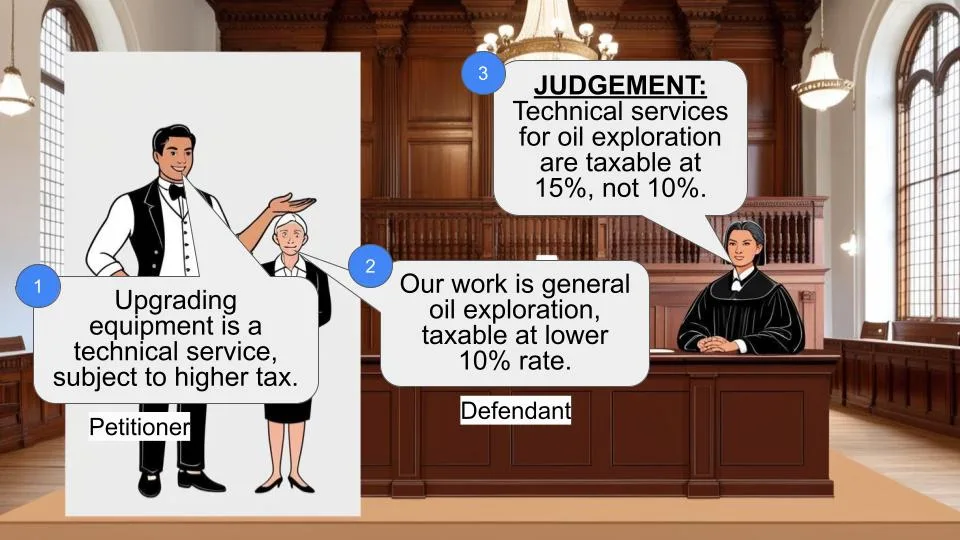
The Supreme Court ruled in favor of Oil and Natural Gas Corporation (ONGC) in a series of appeals concerning the taxation of payments made to foreign companies for services related to oil and gas extraction. The court held that such payments should be taxed under Section 44BB (of Income Tax Act, 1961), which deals with the taxation of income from the business of prospecting for mineral oils, rather than Section 44D (of Income Tax Act, 1961), which covers fees for technical services.
Case Name:
Oil & Natural Gas Corporation Limited vs Commissioner of Income Tax
Civil Appeal No. 731 of 2007
Key Takeaways:
- Payments made by ONGC to foreign companies for services related to oil and gas extraction are taxable under Section 44BB (of Income Tax Act, 1961), not Section 44D (of Income Tax Act, 1961).
- The court looked at the "pith and substance" of the agreements, which were inextricably linked to oil and gas prospecting, extraction, and production.
- The dominant purpose of the agreements was for oil and gas activities, even if ancillary technical services were involved.
- The court overturned the High Court's decision and restored the view of the Income Tax Appellate Tribunal.
Issue:
Whether the payments made by ONGC to foreign companies for providing various services in connection with prospecting, extraction, or production of mineral oil should be taxed as "fees for technical services" under Section 44D (of Income Tax Act, 1961) or on a presumptive basis under Section 44BB (of Income Tax Act, 1961).
Facts:
ONGC entered into agreements with various foreign companies to provide services related to oil and gas exploration, extraction, and production. The tax authorities initially assessed these payments under Section 44D (of Income Tax Act, 1961) (fees for technical services), but the Appellate Commissioner and Income Tax Appellate Tribunal held that they should be taxed under Section 44BB (of Income Tax Act, 1961) (income from the business of prospecting for mineral oils). The High Court of Uttarakhand overturned this view and ruled in favor of taxation under Section 44D (of Income Tax Act, 1961). ONGC appealed to the Supreme Court.
Arguments:
- ONGC argued that the "pith and substance" of the agreements was inextricably linked to oil and gas prospecting, extraction, and production, even if technical services were involved. Therefore, Section 44BB (of Income Tax Act, 1961) should apply.
- The Revenue contended that the agreements clearly involved the rendering of technical services by the foreign companies, making Section 44D (of Income Tax Act, 1961) applicable.
Key Legal Precedents:
- The court cited the principles of strict interpretation of fiscal statutes and exemption notifications, as established in cases like Swedish Match AB v. SEBI, CIT v. Ajax Products Ltd, B. Premanand v. Mohan Koikal, Novopan India Ltd. v. CCE, and Hansraj Gordhandas v. CCE and Customs.
Judgement:
The Supreme Court allowed ONGC's appeals and set aside the High Court's orders. The court held that the "pith and substance" of each agreement was inextricably connected with prospecting, extraction, or production of mineral oil, even if ancillary works were contemplated. The dominant purpose was oil and gas activities, so the payments should be taxed under Section 44BB (of Income Tax Act, 1961), not Section 44D (of Income Tax Act, 1961). The court restored the view of the Income Tax Appellate Tribunal.
FAQs:
Q1: What is the significance of this case?
A1: This case clarifies the taxation of payments made by oil and gas companies to foreign firms for services related to exploration and extraction activities. It establishes that such payments should be taxed under Section 44BB (of Income Tax Act, 1961), which deals specifically with the business of prospecting for mineral oils, rather than the more general Section 44D (of Income Tax Act, 1961) for technical services.
Q2: How did the court determine the applicable section?
A2: The court looked at the "pith and substance" or dominant purpose of the agreements between ONGC and the foreign companies. Since the agreements were inextricably linked to oil and gas prospecting, extraction, and production, even if technical services were involved, the court held that Section 44BB (of Income Tax Act, 1961) should apply.
Q3: What legal principles did the court rely on?
A3: The court relied on the principles of strict interpretation of fiscal statutes and exemption notifications, as established in various precedents. It emphasized that the clear language of the provisions should be followed, and exemptions or exceptions should be interpreted narrowly.
Q4: What does this mean for ONGC and the foreign companies?
A4: ONGC will be able to assess the payments made to foreign companies under Section 44BB (of Income Tax Act, 1961), which may have different tax implications than Section 44D (of Income Tax Act, 1961). The foreign companies may also be impacted by the change in the applicable tax section.
Q5: Does this case have broader implications for the oil and gas industry?
A5: Yes, this case provides clarity on the taxation of payments made by oil and gas companies to foreign firms for services related to exploration and extraction activities. It establishes a precedent for how such payments should be taxed under the Income Tax Act, which could impact other companies in the industry.

1. The issue that arise for consideration in this group of appeals is common and may be summarized as follows.
“Whether the amounts paid by the ONGC to the non-resident assessees /foreign companies for providing various services in connection with prospecting, extraction or production of mineral oil is chargeable to tax as “fees for technical services” under Section 44D (of Income Tax Act, 1961) read with Explanation 2 to Section 9(1)(vii) (of Income Tax Act, 1961) or will such payments be taxable on a
presumptive basis under Section 44BB (of Income Tax Act, 1961)”?
2. The appellant-ONGC has been assessed in a representative capacity on behalf of the different foreign companies with whom it had executed separate agreements for services to be rendered by such companies in connection with prospecting, extraction or production of mineral oils by ONGC.
3. The primary/assessing authority took the view that the assessments should be made under Section 44D (of Income Tax Act, 1961) and not Section 44BB (of Income Tax Act, 1961) (hereinafter referred to as the ‘Act’). The Appellate Commissioner and the Income Tax Appellate Tribunal disagreed with the views of the assessing authorities leading to the institution of separate appeals before the High Court of Uttrakhand in respect of each of the assessments made for the years
in question. The High Court considered the facts of Civil Appeal No. 731 of 2007 (Income Tax Appeal No. 239 of 2001 before the High Court) as the lead case and on the grounds and reasons assigned in the impugned order dated 15.12.2005, the High Court overturned the view taken by the Appellate Commissioner and the learned Tribunal and held the payments made to be liable for assessment under Section 44D (of Income Tax Act, 1961). Aggrieved, the ONGC has filed the present group of appeals.
4. We have heard Shri Arvind P. Datar, learned senior counsel appearing for the appellant and Shri Guru Krishna Kumar, learned senior counsel for the Revenue.
5. As the facts of Civil Appeal No. 731 of 2007 corresponding to
I.T.A. No. 239 of 2001 has been considered in detail by the High Court
and the view expressed in the said proceeding have been followed in
all the other appeals before the High Court, it may be necessary to
notice in detail the said facts arising in the appeal in question.
6. The appellant-ONGC and a non resident/foreign company one
M/s. Foramer France had entered into an agreement by which the
non-resident company had agreed to make available supervisory staff
and personnel having experience and expertise for operation and
management of drilling rigs Sagar Jyoti and Sagar Pragati for the
assessment year 1985-86 and the drilling rig Sagar Ratna for the
assessment year 1986-87. Faced with the different views taken by the
authorities under the Act, as mentioned above, the High Court
proceeded to analyse the different clauses of the contract between the
parties. A consideration of such analysis made by the High Court
would go to show that it had come to light before the High Court that
the contract between the parties visualized operation of the oil rigs
including drilling operations by the personnel made available under
the contracts/agreements, which fact was further stated on affidavit
before the High Court by an authorized official of the ONGC in the
following terms.
“That under the said agreement, Foramer
was required, through its personnel listed in
Exhibit-A to the said agreement, to carry out
inter-alia the drilling operations specified in
clause 4.3 to 4.10 of the said agreement.”
Despite the above, the High Court took the view that under the
agreement payment to M/s. Foramer France was required to be made
at the rate of 3450 USD per day and that the contract clearly
contemplated rendering of technical services by personnel of the
non-resident company. Specifically, taking the view that the contract
did not mention that the personnel of the non-resident company was
also carrying out the work of drilling of wells and as the company had
received fees for rendering service the payments made were liable to
be taxed under the provisions of Section 44D (of Income Tax Act, 1961). As already
noticed, in the rest of the appeals before the High Court the aforesaid
decision dated 15.12.2005 passed in I.T.A. No. 239 of 2001 was
followed on the basis that the facts in all the appeals were similar to
those involved in I.T.A. No. 239 of 2001.
7. It will be convenient and in fact necessary for the purposes of
present adjudication to take a careful note of the provisions of
Sections 44BB, 44D and also clause (vii) of Explanation 2 to Section
9(1) of the Income Tax Act, 1961 (hereinafter for short the ‘Act’).
“44BB. Special provision for computing profits and
gains in connection with the business of exploration,
etc., of mineral oils.-
(1) Notwithstanding anything to the contrary contained
in sections 28 to 41 and sections 43 and 43A, in
the case of an assessee, being a non-resident,
engaged in the business of providing services or
facilities in connection with, or supplying plant
and machinery on hire used, or to be used, in the
prospecting for, or extraction or production of,
mineral oils, a sum equal to ten per cent of the
aggregate of the amounts specified in sub-section
(2) shall be deemed to be the profits and gains of
such business chargeable to tax under the head
"Profits and gains of business or profession" :
Provided that this sub-section shall not apply
in a case where the provisions of section
42 or section 44D (of Income Tax Act, 1961) or [section 44DA (of Income Tax Act, 1961) or] section
115A or section 293A (of Income Tax Act, 1961) apply for the purposes of
computing profits or gains or any other income
referred to in those sections.
(2) The amounts referred to in sub-section (1) shall be
the following, namely:—
(a) the amount paid or payable (whether in or out
of India) to the assessee or to any person on
his behalf on account of the provision of
services and facilities in connection with, or
supply of plant and machinery on hire used,
or to be used in the prospecting for, or
extraction or production of, mineral oils in
India; and
(b) the amount received or deemed to be received
in India by or on behalf of the assessee on
account of the provision of services and
facilities in connection with, or supply of
plant and machinery on hire used, or to be
used in the prospecting for, or extraction or
production of mineral oils outside India.
[(3) Notwithstanding anything contained in sub-section
(1), an assessee may claim lower profits and gains
than the profits and gains specified in that
sub-section, if he keeps and maintains such books
of account and other documents as required under
sub-section (2) of section 44AA (of Income Tax Act, 1961) and gets his
accounts audited and furnishes a report of such
audit as required under section 44AB (of Income Tax Act, 1961), and
thereupon the Assessing Officer shall proceed to
make an assessment of the total income or loss of
the assessee under sub-section (3) of section
143 and determine the sum payable by, or
refundable to, the assessee.]
Explanation.—For the purposes of this section,—
(i) "plant" includes ships, aircraft, vehicles, drilling
units, scientific apparatus and equipment used for
the purposes of the said business;
(ii) "mineral oil" includes petroleum and natural gas.]”
“44D. Special provision for computing income by way of
royalties, etc., in the case of foreign companies.-
Notwithstanding anything to the contrary contained
in sections 28 to 44C, in the case of an assessee, being
a foreign company,—
(a) the deductions admissible under the said sections
in computing the income by way of royalty or fees
for technical services received [from Government
or an Indian concern in pursuance of an agreement
made by the foreign company with Government or
with the Indian concern] before the 1st day of
April, 1976, shall not exceed in the aggregate
twenty per cent of the gross amount of such
royalty or fees as reduced by so much of the gross
amount of such royalty as consists of lump sum
consideration for the transfer outside India of, or
the imparting of information outside India in
respect of, any data, documentation, drawing or
specification relating to any patent, invention,
model, design, secret formula or process or trade
mark or similar property;
(b) no deduction in respect of any expenditure or
allowance shall be allowed under any of the said
sections in computing the income by way of
royalty or fees for technical services received [from
Government or an Indian concern in pursuance of
an agreement made by the foreign company with
Government or with the Indian concern] after the
31st day of March, 1976 [but before the 1st day of
April, 2003];
(c) [***]
(d) [***]
Explanation.—For the purposes of this section,—
(a) "fees for technical services" shall have the same
meaning as in [Explanation 2] to clause (vii) of
sub-section (1) of section 9 (of Income Tax Act, 1961);
(b) "foreign company" shall have the same meaning as
in section 80B (of Income Tax Act, 1961);
(c) "royalty" shall have the same meaning as
in Explanation 2 to clause (vi) of sub-section (1)
of section 9 (of Income Tax Act, 1961);
(d) royalty received [from Government or an Indian
concern in pursuance of an agreement made by a
foreign company with Government or with the
Indian concern] after the 31st day of March, 1976,
shall be deemed to have been received in
pursuance of an agreement made before the 1st
day of April, 1976, if such agreement is deemed,
for the purposes of the proviso to clause (vi) of
sub-section (1) of section 9 (of Income Tax Act, 1961), to have been made
before the 1st day of April, 1976.]”
“ 9. (1) (vii) income by way of fees for technical
services payable by—
(a) the Government ; or
(b) a person who is a resident, except where the
fees are payable in respect of services utilised
in a business or profession carried on by such
person outside India or for the purposes of
making or earning any income from any
source outside India; or
(c) a person who is a non-resident, where the fees
are payable in respect of services utilised in a
business or profession carried on by such
person in India or for the purposes of making
or earning any income from any source in
India :
[Provided that nothing contained in this clause shall
apply in relation to any income by way of fees for
technical services payable in pursuance of an agreement
made before the 1st day of April, 1976, and approved by
the Central Government.]
[Explanation 1.—For the purposes of the foregoing
proviso, an agreement made on or after the 1st day of
April, 1976, shall be deemed to have been made before
that date if the agreement is made in accordance with
proposals approved by the Central Government before
that date.]
[Explanation 2.—For the purposes of this clause, "fees
for technical services" means any consideration
(including any lump sum consideration) for the
rendering of any managerial, technical or consultancy
services (including the provision of services of technical
or other personnel) but does not include consideration
for any construction, assembly, mining or like project
undertaken by the recipient or consideration which
would be income of the recipient chargeable under the
head "Salaries".]
(2) Notwithstanding anything contained in sub-section
(1), any pension payable outside India to a person
residing permanently outside India shall not be deemed
to accrue or arise in India, if the pension is payable to a
person referred to in article 314 of the Constitution or
to a person who, having been appointed before the 15th
day of August, 1947, to be a Judge of the Federal Court
or of a High Court within the meaning of the
Government of India Act, 1935, continues to serve on
or after the commencement of the Constitution as a
Judge in India.
[Explanation.—For the removal of doubts, it is hereby
declared that for the purposes of this section, income of
a non-resident shall be deemed to accrue or arise in
India under clause (v) or clause (vi) or clause (vii) of
sub-section (1) and shall be included in the total income
of the non-resident, whether or not,—
(i) the non-resident has a residence or place of business
or business connection in India; or
(ii) the non-resident has rendered services in India.]”
8. A careful reading of the aforesaid provisions of the Act goes to
show that under Section 44BB(1) (of Income Tax Act, 1961) in case of a non-resident providing
services or facilities in connection with or supplying plant and
machinery used or to be used in prospecting, extraction or production
of mineral oils the profit and gains from such business chargeable to
tax is to be calculated at a sum equal to 10% of the aggregate of the
amounts paid or payable to such non-resident assessee as mentioned
in Sub-section (2). On the other hand, Section 44D (of Income Tax Act, 1961) contemplates that
if the income of a foreign company with which the government or an
Indian concern had an agreement executed before 1.4.1976 or on any
date thereafter the computation of income would be made as
contemplated under the aforesaid Section 44D (of Income Tax Act, 1961). Explanation (a) to
Section 44D (of Income Tax Act, 1961) however specifies that “fees for technical services” as
mentioned in Section 44D (of Income Tax Act, 1961) would have the same meaning as in
Explanation 2 to Clause (vii) of Section 9(1) (of Income Tax Act, 1961). The said explanation as
quoted above defines “fees for technical services” to mean
consideration for rendering of any managerial, technical or
consultancy services. However, the later part of the explanation
excludes from consideration for the purposes of the expression i.e.
“fees for technical services” any payment received for construction,
assembly, mining or like project undertaken by the recipient or
consideration which would be chargeable under the head “salaries”.
Fees for technical services, therefore, by virtue of the aforesaid
explanation will not include payments made in connection with a
mining project.
9. Before the High Court, a Circular No. 1862 dated 22.10.1990
having a bearing on the subject was placed for consideration by the
appellant-assessee. The aforesaid instruction may be conveniently
reproduced herein below.
“Subject: Definition of “fees for technical services” in
Explanation to Section 9(1)(vii) (of Income Tax Act, 1961),
1961 whether prospecting for or extraction of
production of mineral oil are “mining”
operations-clarification regarding.
The expression “fees for technical services” has been
defined in Explanation 2 to Section 9(1)(vii) (of Income Tax Act, 1961) of the
Income Tax Act, 1961 as under:
“Explanation 2.—For the purposes of this clause, "fees
for technical services" means any consideration
(including any lump sum consideration) for the
rendering of any managerial, technical or consultancy
services (including the provision of services of technical
or other personnel) but does not include consideration
for any construction, assembly, mining or like project
undertaken by the recipient or consideration which
would be income of the recipient chargeable under the
head "Salaries".
2. The question whether prospecting for, or extraction
or production of, mineral oil can be termed as ‘mining
operations, was referred to the Attorney General of
India for his opinion. The Attorney General has opined
that such operations are mining operations and the
expressions ‘mining project’ or ‘like projects’ occurring
in Explanation 2 to Section 9(1)(ii) (of Income Tax Act, 1961) would cover rendering of services like imparting of
training and carrying out drilling operations for
exploration or exploitation of oil and natural gas.
3. In view of the above opinion, the consideration for
such services will not be treated as fees for technical
services for the purpose of Explanation 2 to Section 9(1) (of Income Tax Act, 1961)
(vii) of the Income-tax Act, 1961. Payments for such
services to a foreign company, therefore, will be income
chargeable to tax under the provisions of section 44BB (of Income Tax Act, 1961)
of the Income-tax Act, 1961 and not under the special
provision for the taxation of fees for technical services
contained in section 115A (of Income Tax Act, 1961) read with section 44D (of Income Tax Act, 1961) of the
Income-tax Act, 1961.
4. A copy of the statement of the case dated 16.3.1990
(without annexures) and a copy of the Attorney
General’s opinion dated 13.5.90 are enclosed.
5. These instructions may brought to the notice of all
the officers in your region.
[F.No.500/6/89-FTD dt.22.10.90 from CBDT]”
10. Before us the opinion of the learned Attorney General has been
placed by the learned counsel for the appellants at great length to
contend that the views expressed by the learned Attorney which had
been accepted by the CBDT were based on an exhaustive
consideration of the provisions of the Mines Act, 1952 and the Mines
and Minerals (Regulation and Development) Act, 1957 read with the
relevant Entries in the Union and the State List in the 7th Schedule to
the Constitution of India. It is urged that the eventual test is one of
pith and substance of the agreement, namely, whether the works
contemplated or services to be rendered under the agreement is
directly and inextricably linked with the prospecting, extraction or
production of mineral oil. It is submitted on behalf of the appellants
that the agreements in question satisfy the above test for which
purpose the appellants have categorized the different contracts under
8 heads which may be conveniently set out at this stage hereinbelow.
1. Carrying out seismic surveys and drilling for oil
and gas
2. Services starting/re-starting/enhancing production
of oil and gas from wells
3. Services for prospecting for exploration of oil and
or gas
4. Planning and supervision of repair of wells
5. Repair, Inspection or Equipment used in the
exploration, extraction or production of oil and gas
6. Imparting Training
7. Consultancy in regard to exploration of oil and gas
8. Supply, Installation, etc. of software used for oil
and gas exploration”
11. It is also urged on behalf of the appellants that the
instruction/Circular dated 22.10.1990 issued by the CBDT was
binding on the primary authority on the ratio of the decision of this
Court in K.P. Varghese Vs. Income Tax Officer, Ernakulam and
Others1
. It has been further pointed on behalf of the appellants that
even under the provisions of Section 3D (of Income Tax Act, 1961) of the Oil Fields (Regulation
and Development) Act 1948 a mining lease means a lease granted for
the purposes of searching for, winning, working, getting, making
merchandisable, carrying away or disposing of mineral oils or for the
purpose connected therewith and such a lease includes an exploring
or prospecting lease. Reference has also been made to the Petroleum
and Natural Gas Rules, 1959 framed under Section 5 (of Income Tax Act, 1961) of the aforesaid
Act. Under Rule 4 of the said Rules no person can prospect for
petroleum except pursuant to a Petroleum Exploration License (PEL)
granted under the Rules and no person can mine petroleum except in
pursuance of a Petroleum Mining License (PML) granted under the
Rules. It is pointed out that under Rule 7 (of Income Tax Rules, 1962) of 1959 a
petroleum mining license (PML) entitles the licensee to carry out
construction and maintenance in and on such land, works, buildings,
plants, waterways, roads, pipelines etc. as may be necessary for full
enjoyment of the PML. On the said basis it is argued that rendering
any service in connection with prospecting and extraction is an
integral part of mining and that the expression “mining” in the
Explanation 2 to Section 9(1) (of Income Tax Act, 1961), in the absence of
any definition under the Income Tax Act, has to be understood as per
the provisions of the Oil Fields (Regulation and Development) Act,
1948 read with the Petroleum and Natural Gas Rules, 1959.
12. Opposing the contentions advanced on behalf of the appellants,
Shri Gurukrishna Kumar, learned senior counsel for the Revenue
has urged that the opinion of the Attorney General relied upon and the
CBDT Circular has no relevance to the present case inasmuch as the
agreements between ONGC and the non-resident companies made it
abundantly clear that what is paid to the non-resident company are
fees for technical services rendered. Though such services may have
some connection with the prospecting, extraction or production of
mineral oil, the primary service rendered by the non-resident
companies on the basis of the agreements is not for prospecting,
extraction or production of mineral oil but various ancillary services
like training of personnel etc. which may have a somewhat remote
connection with the business of prospecting, exploration or production
of mineral oils. Learned counsel for the revenue has even suggested
that if it is held that the High Court ought to have examined each
agreement or contract to find out its real purpose and intent the
revenue would have no objection if the matters are remanded for a
complete exercise to be made on the above basis.
13. The Income Tax Act does not define the expressions “mines” or
“minerals”. The said expressions are found defined and explained in
the Mines Act, 1952 and the Oil Fields (Development and Regulation)
Act 1948. While construing the somewhat pari materia expressions
appearing in the Mines and Minerals (Development and Regulation)
Act 1957 regard must be had to the provisions of Entries 53 and 54 of
List I and Entry 22 of List II of the 7th Schedule to the Constitution to
understand the exclusion of mineral oils from the definition of
minerals in Section 3(a) of the 1957 Act. Regard must also be had to
the fact that mineral oils is separately defined in Section 3(b) (of Income Tax Act, 1961) of the
1957 Act to include natural gas and petroleum in respect of which
Parliament has exclusive jurisdiction under Entry 53 of List I of the 7th
Schedule and had enacted an earlier legislation i.e. Oil Fields
(Regulation and Development) Act, 1948. Reading Section 2(j) (of Income Tax Act, 1961) and 2(jj)
of the Mines Act, 1952 which define mines and minerals and the
provisions of the Oil Fields (Regulation and Development) Act, 1948
specifically relating to prospecting and exploration of mineral oils,
exhaustively referred to earlier, it is abundantly clear that drilling
operations for the purpose of production of petroleum would clearly
amount to a mining activity or a mining operation. Viewed thus, it is
the proximity of the works contemplated under an agreement,
executed with a non-resident assessee or a foreign company, with
mining activity or mining operations that would be crucial for the
determination of the question whether the payments made under such
an agreement to the non-resident assessee or the foreign company is
to be assessed under Section 44BB (of Income Tax Act, 1961) or Section 44D (of Income Tax Act, 1961). The
test of pith and substance of the agreement commends to us as
reasonable for acceptance. Equally important is the fact that the
CBDT had accepted the said test and had in fact issued a circular as
far back as 22.10.1990 to the effect that mining operations and the
expressions “mining projects” or “like projects” occurring in
Explanation 2 to Section 9(1) (of Income Tax Act, 1961) would cover rendering of
service like imparting of training and carrying out drilling operations
for exploration of and extraction of oil and natural gas and hence
payments made under such agreement to a non-resident/foreign
company would be chargeable to tax under the provisions of Section
44BB and not Section 44D (of Income Tax Act, 1961). We do not see how any other
view can be taken if the works or services mentioned under a
particular agreement is directly associated or inextricably connected
with prospecting, extraction or production of mineral oil. Keeping in
mind the above provision, we have looked into each of the contracts
involved in the present group of cases and find that the brief
description of the works covered under each of the said contracts as
culled out by the appellants and placed before the Court is correct.
The said details are set out below.
S. No. Civil
Appeal
No.
Work covered under the contract
1. 4321 Drilling of exploration wells and carrying
out seismic surveys for exploratory drilling.
2. 740 Drilling, furnishing personnel for manning,
maintenance and operation of drilling rig
and training of personnel.
3. 731 Drilling, furnishing personnel for manning,
maintenance and operation of drilling rig
and training of personnel.
4. 1722 Furnishing supervisory staff with expertise
in operation and management of Drilling
unit.
5. 729 Capping including subduing of well, fire
fighting.
6. 738 Capping including subduing of well, fire
fighting.
7. 1528 Analysis of data to prepare job design,
procedure for execution and details
regarding monitoring.
8. 1532 Study for selection of enhanced Oil
Recovery processes and conceptual design
of Pilot Tests.
9. 1520 Engineering and technical support to ONGC
in implementation of Cyclic Steam
Stimulation in Heavy Oil Wells.
10. 2794 Assessment and processing of seismic data
along with engineering and technical
support in implementation of Cyclic Steam
Stimulation.
11. 1524 Conducting reservoir stimulation studies in
association with personnel of ONGC.
12. 1535 Laboratory testing under simulated
reservoir conditions.
13. 1514 Consultancy for optimal exploitation of
hydrocarbon resources.
14. 2797 Consultancy for all aspects of Coal Bed
Methane.
15. 6174 Analysis of data of wells to prepare a job
design.
16. 1517 Geological study of the area and analysis of
seismic information reports to design 2
dimensional seismic surveys.
17. 7226 Opinion on hydrocarbon resources and
foreseeable potential.
18. 7227 Opinion on hydrocarbon resources and
foreseeable potential.
19. 7230 Opinion on hydrocarbon resources and
foreseeable potential.
20. 6016 Opinion on hydrocarbon resources and
foreseeable potential.
21. 6008 Evaluation of ultimate resource potential
and presentations outside India in
connection with promotional activities for
Joint Venture Exploration program.
22. 1531 Review of sub-surface well data, provide
repair plan of wells and supervise repairs.
23. 733 Repair of gas turbine, gas control system
and inspection of gas turbine and
generator.
24. 741 Repair and inspection of turbines.
25. 737 Repair, inspection and overhauling of
turbines.
26. 736 Inspection, engine performance evaluation,
instrument calibration and inspection of far
turbines.
27. 1522 Replacement of choke and kill consoles on
drilling rigs.
28. 1521 Inspection of gas generators.
29. 1515 Inspection of rigs.
30. 2012 Inspection of generator.
31. 1240 Inspection of existing control system and
deputing engineer to attend to any problem
arising in the machines.
32. 1529 Inspection of drilling rig and verification of
reliability of control systems in the drilling
rig.
33. 2008 Expert advice on the device to clean insides
of a pipeline.
34. 2795 Feasibility study of rig to assess its
remaining useful life and to carry out
structural alterations.
35. 925 Engineering analysis of rig.
36. 1519 Imparting training on cased hold
production log evaluation and analysis.
37. 1533 Training on well control.
38. 1518 Training on implementation of Six Sigma
concepts.
39. 1516 Training on implementation of Six Sigma
concepts.
40. 6023 Training on Drilling project management.
41. 2796 Training in Safety Rating System and
assistance in development and audit of
Safety Management System.
42. 1239 To develop technical specification for 3D
Seismic API modules of work and to prepare
bid packages.
43. 1527 Supply supervision and installation of
software which is used for analysis of flow
rate of mineral oil to determine reservoir
conditions.
44. 1523 Supply, installation and familiarization of
software for processing seismic data.
The above facts would indicate that the pith and substance of
each of the contracts/agreements is inextricably connected with
prospecting, extraction or production of mineral oil. The dominant
purpose of each of such agreement is for prospecting, extraction or
production of mineral oils though there may be certain ancillary works
contemplated thereunder. If that be so, we will have no hesitation in
holding that the payments made by ONGC and received by the
non-resident assessees or foreign companies under the said contracts
is more appropriately assessable under the provisions of Section 44BB (of Income Tax Act, 1961)
and not Section 44D (of Income Tax Act, 1961). On the basis of the said conclusion
reached by us, we allow the appeals under consideration by setting
aside the orders of the High Court passed in each of the cases before it
and restoring the view taken by the learned Appellate Commissioner
as affirmed by the learned Tribunal.
14. Consequently, all the appeals are allowed with no order as to the
costs.
........................................J.
[RANJAN GOGOI]
........................................J.
[PINAKI CHANDRA GHOSE]
NEW DELHI;
JULY 01, 2015.
1. A short and precise question which is common to all the appeals
under consideration has arisen in the present group of appeals
instituted by the Oil and Natural Gas Corporation (ONGC) which has
been assessed as a representative assessee within the meaning of
Section 160-A (of Income Tax Act, 1961). The assessments in question
have been made under the provisions of the Companies (Profits)
Surtax Act, 1964 (hereinafter referred to as the ‘Surtax Act’).
2. The question posing for an answer revolves around the true and
correct purport and effect of exemption notification bearing No.GSR
307(E) dated 31.03.1983 issued under Section 24AA of the Surtax Act.
For a quick understanding of the question that arise for consideration,
the provisions of Section 24-AA of the Surtax Act and the contents of
the notification bearing No.GSR 307(E) may be extracted below :
“24AA. Power to make exemption, etc., in relation to
participation in the business of prospecting for,
extraction, etc., of mineral oils.
(1) If the Central Government is satisfied that it is
necessary or expedient so to do in the public interest,
it may, by notification in the official Gazette, make in
exemption, reduction in rate or other modification in
respect of surtax in favour of any class of foreign
companies specified in sub-section (2) or in regard to
the whole or any part of the profits chargeable of such
class of companies.
Explanation.-For the purposes, of this sub-section,
"foreign company" shall have the meaning assigned to
it in clause (4) of section 80B (of Income Tax Act, 1961).
(2)The foreign companies referred to in sub-section (1)
are the following, namely:-
(a) foreign companies with whom the Central
Government has entered into agreements for
the association or participation of that
Government or any person authorized by
that Government in any business consisting
of the prospecting for or extraction or
production of mineral oils; and
(b) foreign companies providing any services
or facilities or supplying any ship, aircraft,
machinery or plant (whether by way of sale
or hire) in connection with any business
consisting of the prospecting for or
extraction or production of mineral oils
carried on by that Government or any person
specified by that Government in this behalf
by notification in the official Gazette.
(3) Every notification issued under this section shall be
laid before each House of Parliament.
Explanation.-For the purposes of this section, "mineral
oil" includes petroleum and natural gas.”
“GSR No. 307(E) - Exemption from surtax of foreign
companies with whom Central Government has ente...
Exemption from surtax of foreign companies with
whom Central Government has entered into agreements
for participation in business of prospecting for or
extraction of mineral oils -Notification issued under
sub-section (1)
Whereas the Central Government is satisfied that it is
necessary and expedient in the public interest to make
an exemption in respect of surtax in favour of foreign
companies with whom the Central Government has
entered into agreements for the association or
participation of that Government or any person
authorised by that Government in any business
consisting of the prospecting for or extraction or
production of mineral oils;
Now, therefore, in exercise of the powers conferred by
section 24AA of the Companies (Profits) Surtax Act, 1964,
1964 (7 of 1964), the Central Government hereby
provides that no surtax shall be payable by such
foreign companies.
Explanation : For the purposes of this notification :
(a) "foreign company" shall have the meaning assigned
to it in clause (4) of section 80B (of Income Tax Act, 1961),
1961 (43 of 1961);
(b) "mineral oil" includes petroleum and natural gas.
Notification : GSR No. 307(E), dated 31-3-1983.”
3. Section 24-AA of the Surtax Act, as it would appear, vests in the
Central Government the power to make exemption, reduction in rate
or other modification in respect of Surtax in favour of any class of
foreign companies which are specified in sub-section (2), in regard to
the whole or any part of the chargeable profits liable to tax under the
Surtax Act. Sub-section (2) of Section 24-AA (of Income Tax Act, 1961) refers to two categories
of foreign companies. The first is foreign companies with whom the
Central Government has entered into agreements for association or
participation, including participation by any authorized person, in
any business consisting of the prospecting or extraction or production
of mineral oils. The second category of foreign companies mentioned
in sub-section (2) is foreign companies that may be providing services
or facilities or supplying any ship, aircraft, machinery or plant in
connection with any business of prospecting or extraction or
production of mineral oils carried on by the Central Government or
any authorised person. Specifically the Section states that mineral
oils will include petroleum and natural gas.
4. The exemption notification bearing No.GSR 307(E) dated
31.3.1983, as it has been noticed, specifically grants exemption in
respect of surtax in favour of foreign companies with whom the
Central Government has entered into agreements for association or
participation of that Government or any authorized person in the
business of prospecting or extraction or production of mineral oils.
5. In the present appeals, the ONGC had executed agreements with
different foreign companies for services or facilities or for supply of
ship, aircraft, machinery and plant, as may be, all of which were to be
used in connection with the prospecting or extraction or production of
mineral oils. Such agreements do not contemplate a direct association
or participation of the ONGC (a person authorized by the Central
Government by notification dated 2.8.1989) in the prospecting or
extraction or production of mineral oils but involved the taking of
services and facilities or use of plant or machinery which is connected
with the business of prospecting or extraction or production of mineral
oils.
6. In the above situation, the primary authority took the view that
the agreements executed by the ONGC with the foreign companies
being for services to be rendered and such agreements not being for
association or participation in the prospecting or extraction or
production of mineral oils, would not be covered by the exemption
notification in question which by its very language granted exemption
only to foreign companies with whom there were agreements for
participation by the Central Government or the person authorized in
the business of prospecting, extraction or production of mineral oils.
The agreements in question, according to assessing authority, were,
therefore “Service Agreements” and hence covered by sub-section 2(b) (of Income Tax Act, 1961)
of Section 24-AA of the Surtax Act and were accordingly beyond the
purview of the exemption notification.
7. The said view was reversed by the learned Appellate
Commissioner and upheld by the Learned Income Tax Appellate
Tribunal. In the appeal under Section 260A (of Income Tax Act, 1961), the High Court
of Uttarakhand in the lead case (CA No.730 of 2007) overturned the
view taken by the Appellate Commissioner and the learned Tribunal
leading to the institution of the present appeal by the aggrieved
representative assessee i.e. the ONGC.
8. We have heard Shri Arvind P. Datar, learned senior counsel
appearing for the appellant and Shri Guru Krishna Kumar, learned
senior counsel for the Revenue.
9. The respective arguments though have been elaborate the point
urged is brief. Shri Datar would contend that as the exemption
notification contains/uses the same language as found in sub-section
2(a) of Section 24-AA of the Surtax Act its applicability should be
understood with reference to the existence of agreement with the
foreign companies rather than the immediate purpose of such
agreement, namely, involvement of the Central Government or the
authorized person in the business of prospecting or extraction or
production of mineral oils. It is further argued by the learned senior
counsel that regardless of the fact whether the agreement brings about
association or participation of the Central Government or the
authorized person in such business of prospecting or extraction or
production of mineral oils or such agreement results in rendering of
service, so long as the rendering of such service is directly associated
with the business of prospecting or extraction or production of mineral
oils, Sub-section 2(a) (of Income Tax Act, 1961) of Section 24-AA of the Surtax Act must be
understood to include even such foreign companies with whom the
ONGC had executed agreements to provide such services or to make
available plant or machinery. The exemption notification dated
31.3.1983 must be understood in the above light, it is argued. If that
be so, according to Shri Datar, sub-section 2(b) of Section 24-AA (of Income Tax Act, 1961))
would only include foreign companies with whom the ONGC has no
direct agreement though such foreign companies may nevertheless be
providing similar services, may be, on the strength of separate
agreements with the foreign companies with whom the ONGC has
executed an agreement as contemplated in Sub-section 2(a) (of Income Tax Act, 1961) of Section
24-AA of the Surtax Act.
10. Shri Guru Krishna Kumar, learned senior counsel appearing for
the Revenue, has countered the arguments advanced on behalf of the
appellants by contending that the relevant provisions of the Surtax Act
i.e. Section 24-AA (of Income Tax Act, 1961) and the exemption notification must be construed
by its plain and unambiguous language which indicate two separate
situations in respect of which power to grant exemption is conferred
by section 24-AA (of Income Tax Act, 1961). It is contended that though the Central Government
has also been empowered to grant exemptions in respect of the
situations covered by sub-section 2(b) (of Income Tax Act, 1961), namely, where only services are
provided, yet, the Central Government while issuing the exemption
notification dated 31.3.1983 had clearly chosen to grant exemption in
respect of situation covered by sub-section 2(a) of Section 24-AA (of Income Tax Act, 1961)),
alone, namely, in respect of agreements with foreign companies
resulting in direct association or participation of the Central
Government or the authorized person in the business of prospecting or
extraction or production of mineral oils. Situations where the foreign
Company is providing services or making available plant or machinery
though may be connected in the business of prospecting, extraction or
production of mineral oils are clearly excluded from the purview of
exemption by the notification in question, it is contended.
11. It will not be necessary to traverse the long line of decisions of
this Court dealing with the fundamental principles of interpretation of
a taxing statute or an exemption notification. The core of aforesaid
principles have been reiterated in a recent decision of this Court in
Commissioner of Income Tax-III Vs. Calcutta Knitwears,
Ludhiana2
. It is the aforesaid principles, extracted below, that will
have to be applied to the present case and the correct meaning and
purport of the exemption notification has to be determined on the said
basis.
20. Section 158-BD (of Income Tax Act, 1961) provides for “undisclosed
income” of any other person. Before we proceed to
explain the said provision, we intend to remind
ourselves of the first or the basic principles of
interpretation of a fiscal legislation. It is time and again
reiterated that the courts, while interpreting the
provisions of a fiscal legislation should neither add nor
subtract a word from the provisions of instant meaning
of the sections. It may be mentioned that the foremost
principle of interpretation of fiscal statutes in every
system of interpretation is the rule of strict interpretation
which provides that where the words of the statute are
absolutely clear and unambiguous, recourse cannot be
had to the principles of interpretation other than the
literal rule. (Swedish Match AB v. SEBI and CIT v. Ajax
Products Ltd.)
30. In B. Premanand v. Mohan Koikal this Court has
observed as follows: (SCC p. 273, para 24)
“24. The literal rule of interpretation really means that
there should be no interpretation. In other words, we
should read the statute as it is, without distorting or
twisting its language. We may mention here that the
literal rule of interpretation is not only followed by
Judges and lawyers, but it is also followed by the
layman in his ordinary life. To give an illustration, if a
person says ‘this is a pencil’, then he means that it is a
pencil; and it is not that when he says that the object is
a pencil, he means that it is a horse, donkey or an
elephant. In other words, the literal rule of interpretation
simply means that we mean what we say and we say
what we mean. If we do not follow the literal rule of
interpretation, social life will become impossible, and we
will not understand each other. If we say that a certain
object is a book, then we mean it is a book. If we say it
is a book, but we mean it is a horse, table or an
elephant, then we will not be able to communicate with
each other. Life will become impossible. Hence, the
meaning of the literal rule of interpretation is simply that
we mean what we say and we say what we mean.”
31. Thus, the language of a taxing statute should
ordinarily be read and understood in the sense in which
it is harmonious with the object of the statute to
effectuate the legislative animation. A taxing statute
should be strictly construed; common sense approach,
equity, logic, ethics and morality have no role to play.
Nothing is to be read in, nothing is to be implied; one can
only look fairly at the language used and nothing more
and nothing less. (J. Srinivasa Rao v. State of A.P. and
Jagdambika Pratap Narain Singh v. CBDT.)
Specifically, insofar as an exemption notification is concerned the
view expressed in Commissioner of Central Excise, New Delhi Vs.
Hari Chand Shri Gopal and Others3
would require notice.
29. The law is well settled that a person who claims
exemption or concession has to establish that he is
entitled to that exemption or concession. A provision
providing for an exemption, concession or exception, as
the case may be, has to be construed strictly with
certain exceptions depending upon the settings on which
the provision has been placed in the statute and the
object and purpose to be achieved. If exemption is
available on complying with certain conditions, the
conditions have to be complied with. The mandatory
requirements of those conditions must be obeyed or
fulfilled exactly, though at times, some latitude can be
shown, if there is a failure to comply with some
requirements which are directory in nature, the
non-compliance of which would not affect the essence or
substance of the notification granting exemption.
30. In Novopan India Ltd. this Court held that a person,
invoking an exception or exemption provisions, to relieve
him of tax liability must establish clearly that he is
covered by the said provisions and, in case of doubt or
ambiguity, the benefit of it must go to the State. A
Constitution Bench of this Court in Hansraj Gordhandas
v. CCE and Customs held that (Novopan India Ltd.
case4, SCC p. 614, para 16)
“16. ... such a notification has to be interpreted in the
light of the words employed by it and not on any other
basis. This was so held in the context of the principle
that in a taxing statute, there is no room for any
intendment, that regard must be had to the clear
meaning of the words and that the matter should be
governed wholly by the language of the notification i.e.
by the plain terms of the exemption.”
12. Section 24-AA of the Surtax Act vests power in Central
Government, inter alia, to grant exemption to foreign companies with
whom agreements have been executed by the Central Government for
association or participation in the prospecting or extraction or
production of mineral oils and also to foreign companies who are
providing support services or facilities or making available plant and
machinery in connection with the business of prospecting or
extraction or production of mineral oils in which the Central
Government or an authorized person is associated. In other words, the
power to grant exemption is two-fold and covers agreements directly
associated with the prospecting or extraction or production of mineral
oils or contracts facilitating or making available services in connection
with such a business. There is nothing in the provisions of the Act
which could have debarred the Central Government from granting
exemptions to both categories of foreign companies mentioned above
or to confine the grant of exemption to any one or a specified category
of foreign companies. Reading the notification No.GSR 307(E) dated
31.3.1983 it clearly appears that the exemption has been granted only
to foreign companies with whom the Central Government had
executed agreements for direct association or participation by the
Central Government or the persons authorized by it (ONGC) in the
prospecting or extraction or production of mineral oils. In other words,
the exemption notification confines or restricts the scope of the
exemption to only one category of foreign companies which has been
specifically enumerated in sub-section 2(a) of Section 24-AA (of Income Tax Act, 1961)) of the
Surtax Act. The second category of foreign companies that may be
providing services as enumerated in sub-section 2(b) of Section 24-AA (of Income Tax Act, 1961))
is specifically omitted in the exemption notification. The power under
Section 24-AA of the Surtax Act, as already noticed, is wide enough to
include even this category of foreign companies. The omission of this
particular category of foreign companies in the exemption notification,
notwithstanding the wide amplitude and availability of the power
under Section 24-AA (of Income Tax Act, 1961), clearly reflects a conscious decision on the part
of the Central Government to confine the scope of the exemption
notification to only those foreign companies that are enumerated in
and covered by sub-section 2(a) (of Income Tax Act, 1961) of Section 24-AA of the Surtax Act.
13. Section 24-AA of the Surtax Act was brought into the statute
book by Act 16 of 1981 i.e. Finance Act, 1981 with effect from
1.4.1981. The explanatory notes on the provisions of Finance Act
[Paragraph 11(4) and 26(1)] clearly goes to show that the legislative
intent behind inclusion of Section 24-AA (of Income Tax Act, 1961) is to encourage foreign
companies to enter into participating contracts with the Union
Government in the business of oil exploration or production. The
further legislative intent was to seek greater participation of foreign
companies in the matter of providing services including supply of
ships, aircrafts, machinery or plant in connection with business of
extraction or production of mineral oils. The aforesaid legislative intent
which is two-fold is manifested by the two limbs of sub-section 2 (of Income Tax Act, 1961) of
Section 24AA of the Surtax Act to which the power of exemption was
intended to operate i.e. sub-section 2(a) (of Income Tax Act, 1961) and 2(b) of Section 24AA (of Income Tax Act, 1961). If
out of the two limbs where the power of exemption was intended to
operate, the repository of the power i.e. Central Government, had
consciously chosen to grant exemption in one particular field i.e.
foreign companies covered by sub-section 2(a) of Section 24-AA (of Income Tax Act, 1961)), the
scope of the grant cannot be enhanced or expanded by a judicial
pronouncement which is what the arguments made on behalf of the
appellants intend to achieve. Any such interpretation must, therefore,
be avoided. Consequently, we see no reason to depart from the basic
principles of interpretation, as already noticed, that should govern the
present issue. We, accordingly, do not find any merit in any of the
appeals under consideration. The same are, therefore, dismissed,
however, without any order as to costs. The orders of the High Court,
under challenge in the appeals are affirmed.
........................................J.
[RANJAN GOGOI]
........................................J.
[PINAKI CHANDRA GHOSE]
NEW DELHI;
JULY 01, 2015.
×
Similar Ripples
Questions
ONGC wins tax case; payments to foreign firms for oil extraction services taxable under Section 44BB (of Income Tax Act, 1961), not 44D.
Write your CommentSimilar Posts


Generic
- Reportdata/SC-731-2007.pdf
