


Full News
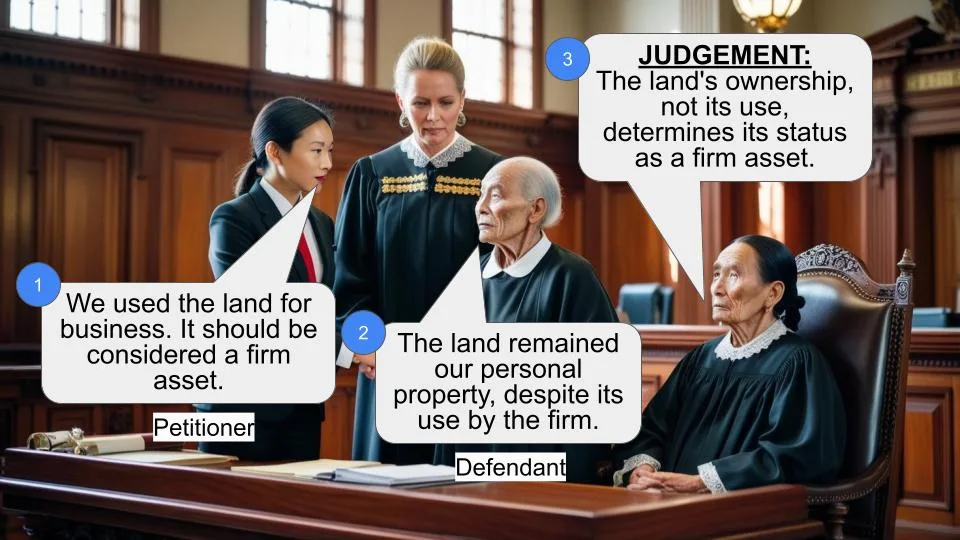
Partners' Land Not Firm's Asset, Despite Use in Business
Partners' Land Not Firm's Asset, Despite Use in Business
This case involves a dispute between the Commissioner of Income Tax, Agra, and Shiraz Poultry & Agricultural Farm. The main issue was whether land contributed by individual partners as capital to the partnership firm should be considered a business asset of the firm. The High Court ruled in favor of the assessee (Shiraz Poultry & Agricultural Farm), stating that the land remained the property of individual partners and was not a business asset of the firm.
Case Name**: Commissioner of Income Tax, Agra and another VS Shiraz Poultry & Agricultural Farm
**Key Takeaways**:
1. Land contributed by partners as capital doesn't automatically become a firm's asset.
2. The title and ownership of the land are crucial in determining its status.
3. Historical treatment of the land in previous assessments is significant.
4. The nature of the land (agricultural vs. non-agricultural) can impact tax implications.
**Issue**:
The central legal question was whether land introduced by partners as their capital contribution should be considered a business asset of the partnership firm, even when the title remained with the individual partners.
**Facts**:
1. Shiraz Poultry & Agricultural Farm was a partnership firm established on October 18, 1971, with seven partners and one minor.
2. Most partners contributed their individual land as capital to the firm.
3. The firm was reconstituted several times over the years, with partners joining and leaving.
4. When partners left the firm, they withdrew their contributed land.
5. On December 8, 1987, the remaining three partners sold their land.
6. The land was consistently shown as individual assets in the partners' wealth tax proceedings.
**Arguments**:
Department's Argument:
- The land should be treated as the partnership firm's property since it was contributed as capital.
- A building (constructed by the firm) cannot exist without land, so the land must belong to the firm.
Assessee's Argument:
- The land was brought by individual partners for the firm's use but never transferred to the firm's ownership.
- The partnership deed specified that retiring partners could withdraw their land.
**Key Legal Precedents**:
The judgment doesn't explicitly mention any specific legal precedents. However, it relies heavily on the interpretation of the partnership deed and the historical treatment of the land in previous tax assessments.
**Judgement**:
The High Court ruled in favor of Shiraz Poultry & Agricultural Farm, concluding that:
1. The land belonged to individual partners and was never transferred to the partnership firm.
2. The land was agricultural land and not a business asset of the firm.
3. The Tribunal's decision was justified based on the evidence and historical treatment of the land.
The court dismissed the appeal filed by the Income Tax Department.
**FAQs**:
1. Q: Does contributing land as capital automatically make it a firm's asset?
A: No, the ownership and title of the land are crucial factors in determining its status.
2. Q: Can partners withdraw their contributed land when leaving a firm?
A: Yes, if specified in the partnership deed and if the land's ownership was never transferred to the firm.
3. Q: How important is the historical treatment of assets in tax cases?
A: Very important. In this case, the court considered how the land was treated in previous tax assessments.
4. Q: Does constructing a building on partners' land make the land a firm's asset?
A: Not necessarily. The court rejected this argument, focusing instead on ownership and title.
5. Q: What impact does this ruling have on partnerships?
A: It emphasizes the importance of clearly defining asset ownership in partnership agreements and maintaining consistent treatment in tax filings.

The above appeal has been preferred against the judgment and order dated 19th of August, 2002 passed by the Income Tax Appellate Tribunal, Agra Bench, Agra in two cross appeals being ITA No.1721/Del/1993 and ITA No.1739/Del/1993, for the assessment year1988-89.
The present appeal has been admitted on the following substantial questions of law:-
1. "Whether the Hon'ble Tribunal was legally right in law on the facts and circumstances of the case in holding that the entire land introduced by the partners as their capital and later on withdrawn in the year 1986 was an agricultural land ignoring the facts on record.
2. Whether the Hon'ble ITAT was legally right in law and on facts in holding that only the profit on sale of building erected by the firm on the land of the partners introduced as their capital can be considered in the hands of the firm ignoring the fact the land appurtenant to the structure was also part and parcel of the business of the assessee firm and the land cannot be separated from the building after construction of structure as also the facts mentioned in the assessment order as well as in the order of the CIT (A)."
Heard Sri Shambhu Chopra, learned counsel for the Department and Sri Ashok Trivedi, Advocate, for the respondents.
The dispute relates to the Assessment Year 1988-89. The assessee is a partnership firm and was carrying a poultry farm for the relevant assessment year. During the assessment proceedings, the Assessing Officer noticed that the assessee sold a building for a sum of Rs.8,23,317/- which is included in the total profit of theassessee. It was noticed that the assessee had reflected a sum of Rs.1,26,650/- as the value of land forming a part of fixed assets in the balance sheet as on 31st of March, 1986. The said land was not taken as a part of business asset for the assessment year 1987-88. The matter was inquired into by the Assessing Officer. The explanation given by the assessee firm that the individual partners had brought the land as their contribution and the land continued to belong to the individual partners and was never firm's property,was not accepted by the Assessing Officer in the assessment order dated 27th March, 1992. In appeal, the CIT (A) gave a marginal relief and allowed the appeal in part. Both, the assessee and the department preferred further appeals before the Tribunal and the Tribunal by the order under appeal has allowed the appeal filed by the assessee firm and dismissed that of the department.
Sri Shambu Chopra, learned counsel for the department, submits that the Tribunal has wrongly not treated the contribution of land as partnership firm's property and treated as individual property of the respective partners. This was the main issue urged by him.
In reply, Sri Ashok Trivedi, learned counsel for the assessee, submits that there is voluminous evidence to show on record that the individual partners brought the land for the purposes of carrying on the firm's business thereon but it was never considered as the firm's property.
Considered the respective submissions of the learned counsel for the parties and perused the record.
A perusal of the assessment order would show that the Assessing Officer negated the contention of the assessee firm simply on the ground that a building without land cannot be imagined. He was of the view that since the constructions were admittedly raised by the firm and the profit whereof has been shown in the firm's return, necessarily the land beneath the construction belonging to the firm. He proceeded on the footing that it is immaterial even if the land earlier belonged to the partners. The partners introduced the land in firm as their capital contribution.
It has come on record that the assessee firm was constituted on 18th October,1971 with seven partners and one minor for carrying on the business of agricultural farming and poultry. Except one partner the others brought individual land as capital. The land belonged to the individual partners. The title to the land remained with the individual partners. The said fact is evident from the partnership deed.
On 30th June, 1973 the firm was reconstituted to admit the minor as full-fledged partner and one partner retired from the partnership firm. It was again reconstituted on 15.2.1974. This time, four partners retired from the firm. It has been noticed that the retiring partners withdrew the land which was brought by them. The firm was again reconstituted in the year 1981 when one partner withdrew certain land out of his share in the land. On 8th December,1987 relevant to the accounting year 1987-88 corresponding to the Assessment Year 1988-89 the three remaining partners sold off their land.
The land was standing in their individual names. It has also come on record that in the wealth tax proceedings the individual partners shown the land in question as their individual assets. The Tribunal has found that the assessee firm was allowed to use the land of the partners for the agricultural farming and poultry business.
It is relevant to note that in the partnership deed it was specifically agreed upon among the partners that the retiring partner will withdraw his land.
The Tribunal has taken into consideration the history of the firm reconstituted from time to time that whenever the firm was reconstituted the outgoing partner took away the land along with him, the wealth tax assessment of the individual partners and the fact that at no point of time the ownership of the land was transferred to the partnership firm by means of transfer entry or sale deed, has rightly held that the land was owned by the partners of the firm in their individual capacity.
The tribunal has further noticed that in the earlier assessment orders, the agricultural income was shown from the land in question. It considered the agricultural income derived from the land for the last five assessment years and reached to the conclusion that the land was agricultural land. As against above, the department could not place any material to take a different view of the matter.
In view of the fact that the land was always treated as agricultural land for the earlier assessment years, the finding by the Tribunal that it was agricultural land for the relevant assessment year is perfectly justified. In view of the above, we do not find any merit in the appeal and the finding recorded by the Tribunal that the land in question was agricultural land and it belonged to the individual partners and was never partnership firm's property is perfectly justified.
The appeal is dismissed. But no order as to costs.
(Prakash Krishna, J.) (Ashok Bhushan, J.)
Order Date :- 8.5.2012
×
Similar Ripples
Questions
Partners' Land Not Firm's Asset, Despite Use in Business
Write your CommentSimilar Posts

Generic
- Reportdata/5856.pdf
