


R&D Sales Proceeds Not Deducted from Expenditure: High Court Rules


Full News

R&D Sales Proceeds Not Deducted from Expenditure: High Court Rules
R&D Sales Proceeds Not Deducted from Expenditure: High Court Rules
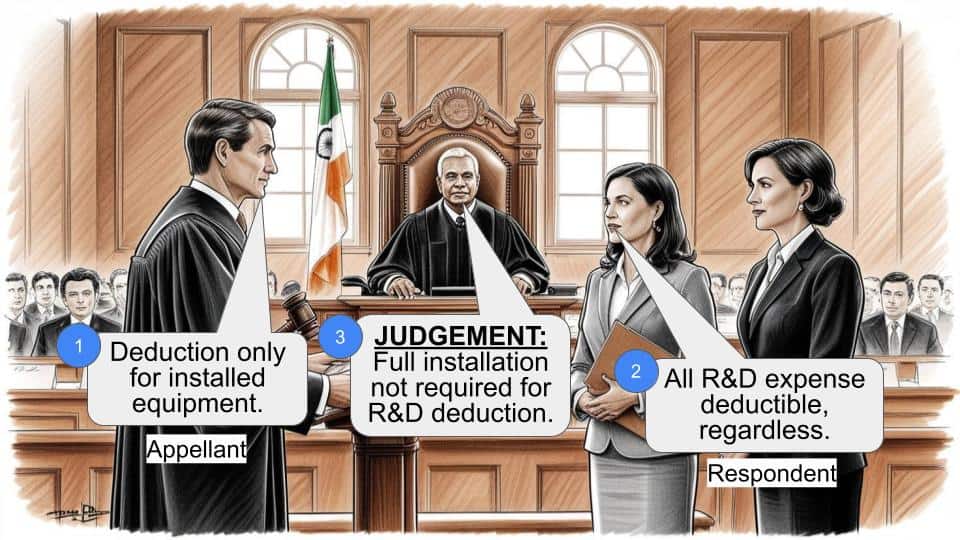
The case involves the Commissioner of Income Tax and Microlabs Ltd., where the central issue was whether sales proceeds from products developed through R&D should be deducted from R&D expenditure for tax purposes. The High Court ruled in favor of Microlabs Ltd., deciding that such sales proceeds should not be deducted from R&D expenditure as they are part of normal business receipts.
Get the full picture - access the original judgement of the court order here
Case Name:
Commissioner of Income Tax and Another vs. Microlabs Ltd. (High Court of Karnataka)
Income Tax Appeal No. 471 of 2015
Date: 11th March 2016
Key Takeaways:
- The court clarified that sales proceeds from products developed through R&D do not reduce R&D expenditure.
- The decision emphasizes that such sales are part of normal business income and should be treated as business receipts.
- The ruling impacts how companies can claim deductions under Section 35(2AB) (of Income Tax Act, 1961).
Issue
Should sales proceeds from products developed through R&D be deducted from R&D expenditure for tax purposes?
Facts
Microlabs Ltd. engaged in scientific research and developed products through its R&D activities. The company claimed deductions under Section 35(2AB) (of Income Tax Act, 1961) for its R&D expenditure. The tax authorities argued that sales proceeds from these products should reduce the R&D expenditure, affecting the deduction amount.
Arguments
- Microlabs Ltd.: Argued that sales proceeds from R&D products are part of normal business income and should not reduce R&D expenditure.
- Tax Authorities: Contended that such sales should offset R&D expenditure, reducing the deduction claimable under Section 35(2AB) (of Income Tax Act, 1961).
Key Legal Precedents
The court referred to the DSIR guidelines, particularly clause 5(vii), which states that sales realization from assets sold should offset R&D expenditure. However, it clarified that this does not apply to products developed through R&D, which are part of business receipts.
Judgement
The High Court ruled in favor of Microlabs Ltd., stating that sales proceeds from products developed through R&D should not be deducted from R&D expenditure. The court reasoned that these proceeds are part of normal business income and should be treated as such in the company's financial statements.
FAQs
Q1: What does this ruling mean for companies with R&D activities?
A1: Companies can treat sales proceeds from R&D-developed products as normal business income, not reducing their R&D expenditure for tax deduction purposes.
Q2: How does this affect tax deductions under Section 35(2AB) (of Income Tax Act, 1961)?
A2: The ruling allows companies to claim full R&D expenditure deductions without reducing them by sales proceeds from R&D products.
Q3: Why did the court decide in favor of Microlabs Ltd.?
A3: The court found that sales from R&D products are part of normal business operations and should be reflected as business receipts, not reducing R&D expenditure.

The appellant has preferred the present appeal by raising two main substantial questions of law, which are as under:
i) “Whether, on the facts and in the circumstances of the case, the Tribunal is right in law in setting aside the computation made by the assessing authority in respect of claim for deduction under Section 35(2AB) (of Income Tax Act, 1961) of
I.T. Act even when the assessing authority rightly adopted the net expenditure for allowing the weighted deduction and same was done on the
basis of DSIR guidelines wherein it was stated that the receipts to the in-house R&D centre needs to be reduced from gross expenditure and in accordance with parameters of the provision?
ii) Whether on the facts and the circumstances of the case, the Tribunal
was corrected in law in deleting the addition made under Section 14A (of Income Tax Act, 1961)
computed under Rule 8D(2)(ii) (of Income Tax Rules, 1962) amounting to Rs.49,42,473/- even when
the assessing authority rightly quantified the aforesaid disallowance under Section 14A (of Income Tax Act, 1961) as per Rule 8D (of Income Tax Rules, 1962)?
2. We have heard Mr. Aravind, learned counsel appearing for the appellant - Revenue.
3. On the first question, the observations made by the Tribunal in the impugned order from paragraph Nos.12 to 17 are as under:
“12. We have heard the submissions of the ld.
DR and the ld. counsel for the assessee and
also perused the documents filed in paperbook.
As we have already seen, the assessee carries
on scientific research. It is in the business of
manufacture of drugs and pharmaceuticals. It
incurred expenditure on scientific research and
the quantum of such expenditure on scientific
research, which is a sum of Rs.7,80,52,805, is
not in dispute. The weighted deduction u/s.
35(2AB) at 150% was claimed by the assessee
at a sum of Rs.12,57,00,920. What is now to
be examined is the guidelines of DSIR, which
the prescribed authority u/s.35(2AB)(3) (of Income Tax Act, 1961) & (4)
of the Act, has to follow before granting
approval of the scientific research carried out
by the assessee as eligible for deduction u/s.35 (of Income Tax Act, 1961)
(2AB). A copy of the guidelines of DSIR is at
pages 27 to 33 of assessee’s paperbook.
Guidelines 5(vii) is relevant for the present
case and it reads as follows:
“(vii) Assets acquired and products, if
any emanating out of R&D work
done in approved facility, shall not
be disposed off without approval of
the Secretary, DSIR. Sales realization
arising out of the assets sold shall be
offset against the R&D expenditure of the
R&D Centre claimed under section
35(2AB) for the year in which such sales
realization accrues under section
35(2AB) of IT Act, 1961. Expenditure
claimed for deduction under the
subsection shall be reduced to that
extent.”
13. The CIT(A) in his order passed u/s. 154 (of Income Tax Act, 1961)
of the Act has not quoted the first sentence of
the guideline 5(vii) (given above in bold
letters), which in our opinion, is very material.
The above guideline only means that in the
process of carrying out the R&D work, if the
assessee acquires any assets or products that
should not be disposed of without the approval
of Secretary, DSIR. If such assets are sold,
the sales realization arising therefrom are to be
setoff against the R&D expenditure of the R&D
centre which is claimed as decuction u/s.
35(2AB). It is evident from the above
guideline that it is only sales realization arising
out of the assets sold that should be offset
against R&D expenditure. In respect of sale of
products acquired emanating out of R&D work
done in an approved facility, the sale proceeds
need not be reduced from the R&D
expenditure. In our view, the reason for not
including sales realization arising out of
products emanating out of R&D work done and
sold is because such sales would be reflected
as receipts by the assessee in its books of
account and income from business would be
computed treating such sale as part of
business receipts. The receipts arising out of
sale of products will not go to reduce the
expenditure on R&D, whereas the assets
acquired in the process of carrying out the R&D
if they are sold, such sales realization would go
to reduce the expenditure on scientific
research and that is why sales realization
arising out of assets sold is required to be
offset against R&D expenditure. The above
explanation will be sufficient to hold that the
order passed by the CIT(A) u/s. 154 (of Income Tax Act, 1961)
is unsustainable. Nevertheless, we will also
examine as to what is the exact nature of
receipts from sale of products.
14. A copy of license and supply agreement
which was filed by the assessee before the AO
as well as CIT(A) is at pages 5 to 26 of the
assessee’s paperbook. The sale of products is
nothing but the sale of Dossiers by the
assessee to persons not associated with the
assessee or its directors. In the course of
carrying out the scientific research, the
assessee prepares elaborate documents
regarding the products that would emanate
from carrying out scientific research. This
would also include the requirement of health
authorities for grant of license to approve the
products for human use. The assessee gives
the Dossiers so prepared to entities outside
India, who are interested in getting the
marketing authorization for the product in a
particular territory. They pay to the assessee
the Dossier charges and apply for license to
market the products for human use in their
respective territories. On getting the license,
they get marketing authorization from the
assessee. The person who takes the Dossier
(knowhow) takes it for the limited purpose of
registration of product in other countries and
after registration sale of the products in their
country. If they get any order M/s. Micro Labs
will manufacture and sell them at agreed price.
So the knowhow given to them is only for
limited purpose of registering with the drug
control authorities for approval for human
consumption. The foreign entities who get the
dossiers will get rights to market the
assessee’s products in their territory and the
actual manufacture in course of time will be
done by M/s. Micro Labs Limited i.e., the
Assessee.
15. All intellectual property rights, title and
interest of any kind whatsoever in and/or to
the Dossier and the Products shall be the
exclusive property of MICRO LABS (the
Assessee). MICRO LABS i.e., the Assessee
may sell the Dossier to any third party,
including its clients without the consent of
foreign entity buying the dossier. However,
MICRO LABS (the Assessee) shall notify the
person acquiring the dossier of the transfer or
sale of the Dossier to such third party and shall
undertake that such third party respect the
terms and conditions of the agreement with
the other third party who buys dossier from
the Assessee.
16. DSIR guidelines no. vii has specifically
provided that assets acquired if any out of R &
D work shall be disposed with approval of
DSIR. The assessee has been submitting
yearly audit reports & accounts of approved R
& D sanction to DSIR. The R & D accounts
have been separately maintained and separate
P & L Account prepared and the dossier sales
have been credited to P & L Account of R & D
because these sales are part of normal sales.
17. It is clear from the sample copy of the
license and supply agreement filed before us
that the product development charges received
by the assessee will not be covered under
clause 5(vii) of the DSIR guidelines. As we
have already seen, these receipts are credited
to profit & loss account are part of normal
sales. They are, therefore, not to be reduced
from the expenditure incurred by the assessee
on carrying out scientific research on which
deduction u/s. 35(2AB) (of Income Tax Act, 1961) has to be allowed. We
are, therefore, of the view that there is no
merit in ground No.2 raised by the revenue
and that the order passed by the CIT(A)
DATED 9.4.2014 U/S. 154 (of Income Tax Act, 1961) cannot be
sustained and the same is hereby reversed.
Thus, ITA No.764/B/14 by the assessee is
allowed, while ground No.2 raised by the
revenue is dismissed.”
The aforesaid paragraphs show that the Tribunal has
proceeded on the premise that when the regular work is in
the nature of R&D work done and sold, it becomes a
business income and chargeable as business income. It is
only when the assets acquired in the process of carrying
on R&D work, if they are sold, such realization would go to
reduce the expenditure of scientific research.
4. In our view, the approach to the issue
considered by the Tribunal is appropriate. In any case, no
substantial question of law would arise for consideration as
canvassed.
5. For the second question, the observations
made by the Tribunal in the impugned order reads as
under:
“32. Ground No.2 raised by the assessee
reads as follows:-
“2. The learned Commissioner of Income Tax
(Appeals) has erred in sustaining the additions
made by the assessing officer u/s. 14A (of Income Tax Act, 1961) read
with rule 8D (of Income Tax Rules, 1962) on the ground that the appellant
has not produced the evidentiary support in
relation to dispersal of loan and utilization of
loan. Whereas the appellant has produced the
evidence that the amount invested was out of
positive bank balance and no borrowings were
utilized for the purpose of investment.”
33. The assessee earned dividend income of
Rs.38,75,857. It quantified a sum of
Rs.3,22,426 as expenditure incurred in earning
tax free income dividend income which does
not form part of the total income and which is
to be disallowed u/s. 14A (of Income Tax Act, 1961).
34. The break-up of the sum of Rs.3,22,426
is not specifically given, but is stated to be
relating to management fee, legal &
professional charges, security transaction
charges and NSDL charges. It is thus clear
that the assessee by implication had claimed
that there was no expenditure incurred by way
of interest, either directly or indirectly, which is
attributable to the borrowed funds which were
used for the purpose of investment which
yielded tax free income.
35. The AO observed that Schedule G to the
Financial Statements of the assessee had
shown investment to the tune of
Rs.28,45,29,937 in shares mutual funds of
various companies. He was of the view that
such investments cannot be made routinely.
No prudent businessman would make any
investment without applying the resources
wisely. Obviously this entails expenditure,
direct as well as indirect. He thereafter
proceeded to make disallowance u/s. 14A (of Income Tax Act, 1961) of
the Act, which is given as annexure to the
assessment order and enclosed as
ANNEXURE-II to this order.
36. Aggrieved by the assessment order, the
assessee preferred appeal before the
CIT(Appeals).
37. Before CIT(A), the assessee submitted
that interest bearing loans were borrowed for
specific purposes and not for investment
purposes and in support of the above
contention, the Assessee filed copies of
balance sheets as on 31.03.2003 upto
31.03.2009 to show that the various loans
availed from banks were all taken for specific
purposes and could not have been utilized for
making any investments out of which exempt
income was earned. These loans include short
term loans from IDBI Bank, Exim Bank,
Barclays Bank and Standard Chartered Bank in
respect of which it was explained that the
loans could not have been used for making any
long term investment. Copies of some
communications from banks regarding sanction
of the loans were also filed before me to
substantiate the nature of the loan. In respect
of IDBI loan, it was submitted that the same
had been returned back before the year end,
thus bringing the balance to Nil.
38. On consideration of the above
submissions and on perusal of the relevant
documents, the CIT(A) was of the view that
the claim of the Assessee was not evidenced
from the documents submitted in view of the
loans and other sources of funds being mixed
up in the common pool of funds. The CIT(A)
further held that the burden of proof in this
matter clearly continues to rest with the
Assessee and that it was not enough to merely
show that surplus funds were available or that
bank loans had been availed for specific
purposes including short term reasons. A one-
to-one correlation must also be established to
prove that the loans were absolutely utilized
for the purpose for which they were claimed.
The CIT(A) also held that there was no
utilization certificate from the bank filed before
the AO nor was such evidence furnished before
the CIT(A). The CIT(A) also held that the
documents submitted from the bank during the
course of appeal only refer to the disbursal of
the loan and even these specify certain
conditions required to be met. The date-wise
actual disbursal and utilization is not proved
from the ledger copies as submitted. The
CIT(A) also referred to the decision of Mumbai
ITAT in the case of Hercules Hoists Ltd. (ITA
No.7944, 7946, 2255 & 7943/mum/2011),
wherein it was held that with the introduction
of Rule 8D (of Income Tax Rules, 1962) the burden of proof on the assessee
has become “more stringent, so that rather
than showing existence of sufficient capital, the
matter would be required to be examined from
the stand point of utilization of the borrowed
interest bearing funds.” In the absence of
categorical utilization certificate from the bank,
the CIT(A) was of the view that there was no
evidentiary support of the assessee’s claim.
Hence, the disallowance u/s.14A (of Income Tax Act, 1961) as
made by the AO was upheld by the CIT(A).
39. Aggrieved by the order of CIT(A), the
assessee has raised ground No.2.
40. We have heard the rival submissions. A
copy of the availability of funds and
investments made was filed before us which is
at pages 38 to 42 of the assessee’s paperbook
and the same is enclosed as ANNEXURE-III
to this order. It is clear from the said
statement that the availability of profit, share
capital and reserves & surplus was much more
than investments made by the assessee which
could yield tax free income.
41. The Hon’ble Bombay High Court in
Reliance Utilities & Power Ltd. 313 ITR 340
(Bom) has held that where the interest free
funds far exceed the value of investments, it
should be considered that investments have
been made out of interest free funds and no
disallowance u/s. 14A (of Income Tax Act, 1961) towards any interest
expenditure can be made. This view was again
confirmed by the Hon’ble Bombay High Court
in CIT v. HDFC Bank Ltd., ITA No.330 of 2012,
judgment dated 23.7.14, wherein it was held
that when investments are made out of
common pool of funds and non-interest
bearing funds were more than the investments
in tax free securities, no disallowance of
interest expenditure u/s. 14A (of Income Tax Act, 1961) can be made.
42. In the light of above said decisions, we
are of the view that disallowance of interest
expenses in the present case of Rs.49,42,473
made under Rule 8D(2)(ii) (of Income Tax Rules, 1962)
should be deleted. We order accordingly.”
The aforesaid shows that the Tribunal has followed a
decision of the Bombay High Court in the case of CIT v.
HDFC Bank Ltd., (ITA No.330/2012 disposed of on
23/7/2014). When the issue is already covered by a
decision of the High Court of Bombay with which we
concur, we do not find any substantial question of law
would arise for consideration as canvassed.
6. In view of the above observations, the appeal
is dismissed.
Sd/-
JUDGE
Sd/-
JUDGE
×
Similar Ripples
Questions
R&D Sales Proceeds Not Deducted from Expenditure: High Court Rules
Write your CommentSimilar Posts


Generic
- Reportdata/3015.pdf
