


Reassessment Proceedings Quashed: No New Material Justifies Reopening





Full News
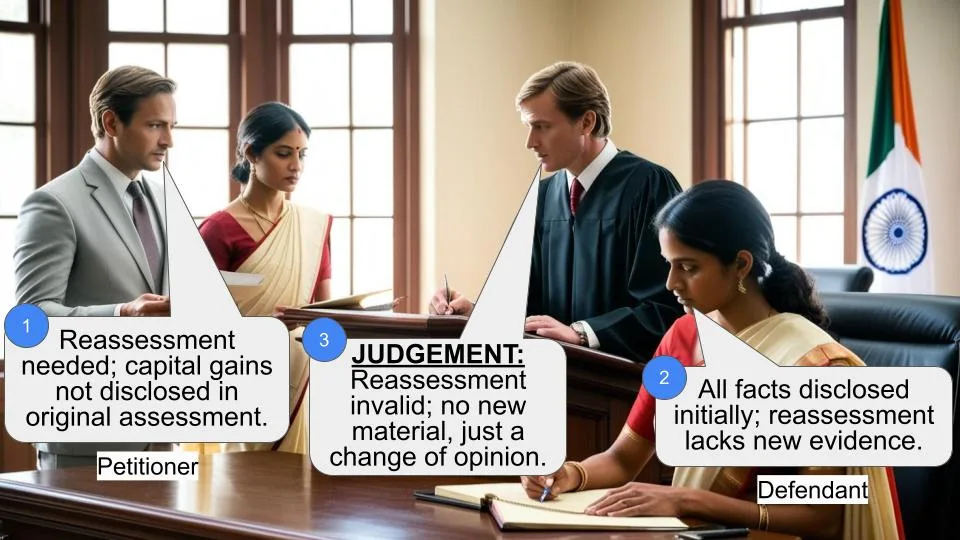
Reassessment Proceedings Quashed: No New Material Justifies Reopening
Reassessment Proceedings Quashed: No New Material Justifies Reopening
The case involves the Commissioner of Income Tax and Chaitanya Properties (P) Ltd. The dispute centers around the initiation of reassessment proceedings by the Assessing Officer (AO) under Section 147 (of Income Tax Act, 1961). The court ruled in favor of Chaitanya Properties, holding that the reassessment was invalid as it was based on a mere change of opinion without any new tangible material.
Get the full picture - access the original judgement of the court order here
Case Name:
Commissioner of Income Tax vs. Chaitanya Properties (P) Ltd. (High Court of Karnataka)
ITA No. 205 of 2015
Date: 16th February 2016
Key Takeaways:
- The court emphasized that reassessment proceedings cannot be initiated merely on a change of opinion.
- The absence of new tangible material to justify the reassessment was a critical factor in the court's decision.
- The decision reinforces the principle that full and true disclosure by the assessee in the original assessment is crucial to prevent reassessment.
Issue
Was the initiation of reassessment proceedings under Section 147 (of Income Tax Act, 1961) valid, given the absence of new tangible material and the full disclosure by the assessee during the original assessment?
Facts
Chaitanya Properties held a property as an investment, which was later converted into stock-in-trade. The property was subject to a Joint Development Agreement (JDA) with Prestige Estates and Properties Ltd. The original assessment was completed under Section 143(3) (of Income Tax Act, 1961). The AO later initiated reassessment proceedings, claiming that the JDA resulted in a transfer of capital assets, giving rise to capital gains under Section 45(2) (of Income Tax Act, 1961).
Arguments
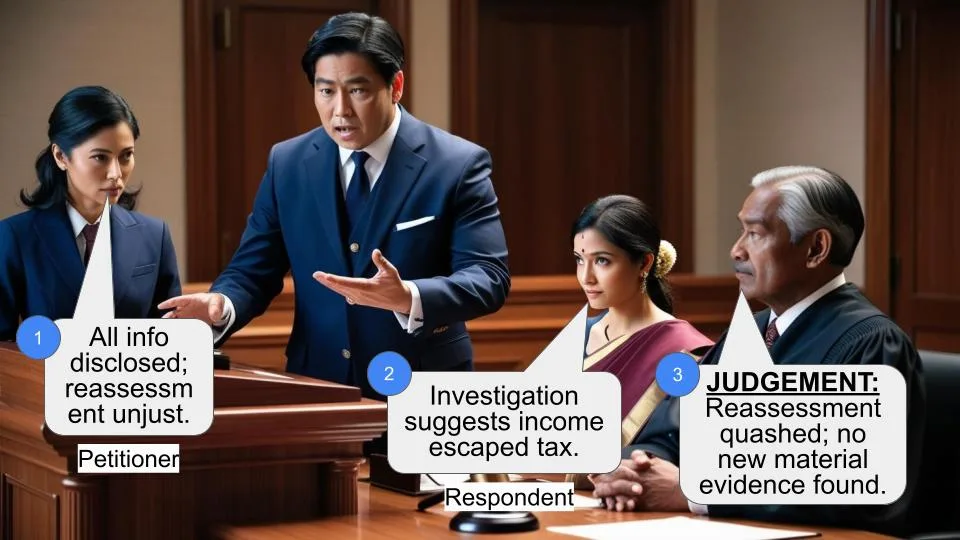
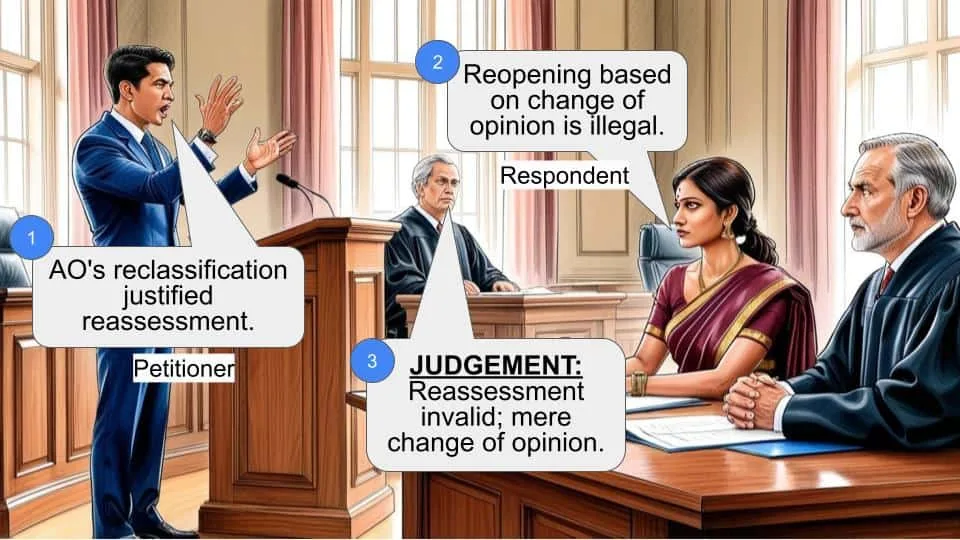
- Chaitanya Properties (Assessee): Argued that all material facts were disclosed during the original assessment, and the reassessment was based on a change of opinion without new material.
- Commissioner of Income Tax (Revenue): Contended that the assessee failed to disclose the incidence of capital gains, justifying the reassessment.
Key Legal Precedents
- CIT v. Kelvinator of India Ltd., 320 ITR 561 (SC): The Supreme Court held that reassessment cannot be based on a mere change of opinion.
- Chaturbhuj Dwarkadas Kapadia v. CIT, 260 ITR 491 (Bom): Cited by the AO, but the court noted it was decided before the original assessment.
Judgement
The court ruled in favor of Chaitanya Properties, stating that the reassessment proceedings were invalid as they were based on a change of opinion without any new tangible material. The court emphasized that the original assessment had considered all disclosed facts, and the AO's reasons for reassessment did not indicate any failure by the assessee to disclose material facts.
FAQs
Q1: Why was the reassessment considered invalid?
A1: The reassessment was invalid because it was based on a change of opinion without new tangible material, and the assessee had fully disclosed all material facts during the original assessment.
Q2: What is the significance of the court's decision?
A2: The decision reinforces the principle that reassessment cannot be initiated merely on a change of opinion and highlights the importance of full disclosure by the assessee.
Q3: How does this case impact future reassessment proceedings?
A3: It sets a precedent that reassessment requires new tangible material and cannot be based solely on a change of opinion, ensuring fairness in tax assessments.

The Revenue has preferred the present appeal by formulating the following substantial questions of law:
1. Whether the Tribunal was correct in holding that the reasons recorded by the assessing officer did not spell out that escapement of income was due to the assessee not fully and truly disclosing all material facts necessary for completion of assessment for the relevant assessment year without considering the fact that the assessing officer recorded that the assessee did not file any information regarding incidence of capital gains?
2. Whether the Tribunal was correct in holding that the initiation of reassessment has been merely on the basis of change of opinion and is not without appreciating that no opinion was formed in the original assessment on the issue and hence change of opinion does not arise?”
2. We have heard Mr. K.V. Aravind, learned Counsel for the appellants-Revenue and Mr. A. Shankar, learned Counsel for the respondent-assessee.
3. We may record that the Tribunal in its order dated 21.11.2014 (Annexure ‘C’) while dealing with the said aspects has observed from paragraph 12 to paragraph 26 as under:
“12. It could be seen from the facts narrated
as above that the proceeding u/s. 147 (of Income Tax Act, 1961) of the
Act were sought to be initiated after a period of
four years from the end of the relevant
assessment year. It is also clear from the facts
narrated as above that in the case of assessee
for the A.Y. 2005-06, an order of assessment
u/s. 143(3) (of Income Tax Act, 1961) had already been made.
Therefore, proviso to section 147 (of Income Tax Act, 1961) will
apply.
13. It can also be seen from the reasons
recorded by the AO for initiating proceedings
u/s.147 (of Income Tax Act, 1961), that the narration in para 1
to 9 of the reasons recorded are facts which
were well within the knowledge of the AO while
completing the original assessment proceedings
u/s.143(3) (of Income Tax Act, 1961). The joint development
agreement between the Assessee and PEPL was
taken note by the AO in the order passed
u/s.143(3) (of Income Tax Act, 1961). The narration in para-10
in the reasons recorded by the AO relate to
application of the provisions of Sec.45(2) (of Income Tax Act, 1961) of the
Act. As we have already seen the Assessee held
the Whitefield property as investment and
converted the same as stock-in-trade of
business. This fact has also been recorded by
the AO in the order of assessment passed
u/s.143(3) (of Income Tax Act, 1961). Sec.45(2) (of Income Tax Act, 1961)
provides that the profits or gains arising from
the transfer by way of conversion by the owner
of a capital asset into, or its treatment by him
as stock-in-trade of a business carried on by
him shall be chargeable to income-tax as his
income of the previous year in which such
stock-in-trade is sold or otherwise transferred
by him. The taxable event for application of
Sec.45(2) (of Income Tax Act, 1961) is conversion of capital asset into
stock-in-trade of business. The point of time at
which tax is levied is the year in which the
stock-in-trade is sold. When the original
assessment was completed u/s.143(3) (of Income Tax Act, 1961) of the
Act, the AO did not think it fit to invoke
provisions of Sec.45(2) (of Income Tax Act, 1961) either because
he overlooked the applicability of those
provisions or because he thought that the point
of time at which tax is to be levied u/s.45(2) (of Income Tax Act, 1961) of
the Act, viz., sale of the stock-in-trade had not
occurred during the previous year. In the
reasons recorded by the AO, the AO makes a
reference to the provisions of Sec.45(2) (of Income Tax Act, 1961) of the
Act and claims that the said provisions are
applicable because the assessee had entered
into agreement for development of the
Whitefield property on 5.2.2005 with M/S.PEPL
and further executed a power of attorney on
01/03/2005 in favour of M/s. PEPL for transfer
of stock for development. According to the AO,
the above act by the Assessee amounts to
transfer/relinquishment /sale of stock by the
Assessee to M/S.PEPL. According to the AO,
the consideration so received has to be brought
to tax as capital gains as per the provisions of
the income tax Act. In para 12 to 15 of the
reasons recorded the AO has narrated as to
how capital gain had to be computed. In para-
16 of the reasons recorded the AO has referred
to judicial pronouncements wherein a view has
been expressed that whenever property is given
on Joint Development, the date of transfer
would be the date of the Joint Development
Agreement for the purpose of levy of capital
gains tax. In the remaining paragraphs, the AO
has computed capital gain that has to be
brought to tax which in his opinion has
escaped assessment.
14. On the facts as narrated above and on the
basis of provisions of section 147 (of Income Tax Act, 1961) as well as
proviso to section 147 (of Income Tax Act, 1961), the ld.
counsel for the assessee contended as follows:-
a) Initiation of reassessment proceedings
is bad in law because proviso to
Sec.147 (of Income Tax Act, 1961) will apply in the present case
and therefore the initiation of
reassessment proceedings can be only
if there was failure on the part of the
assessee to fully and truly disclose
material facts necessary for
assessment of income for AY 05-06.
b) Initiation of reassessment proceedings
are merely on a change of opinion and
therefore bad in law.
14.1 On point (a) as above, the learned counsel
for the Assessee submitted that the fact that
assessee owned 100.02 acres of land in
Whitefield and the fact that the aforesaid
property was treated as investment as on
31.3.2004 and shown as stock-in-trade as on
31.3.2005 are all facts within the knowledge of
the AO, while completing the original
assessment u/s. 143(3) (of Income Tax Act, 1961). The fact that
the property was subject matter of the joint
development agreement (“JDA”) between the
assessee and PEPL under an agreement dated
5.2.2005 to develop the same as a residential
complex by name ‘Shantiniketan’ is also within
the knowledge of the AO. All the relevant books
of account as well as agreements had been filed
before the AO. The fact that the land which was
held as investment in A.Y. 2004-05 was
converted into stock-in-trade during the
previous year relevant to A.Y. 2005-06 was also
well within the knowledge of the AO. These
facts have been duly recorded by the AO in the
order of assessment passed u/s. 143(3) (of Income Tax Act, 1961) dated
31.12.2007.
14.2 Our attention was drawn to the provisions
of section 147 (of Income Tax Act, 1961) and proviso to section
147 which reads as under:-
“147: Income escaping assessment.
If the Assessing Officer, has reason to believe
that any income chargeable to tax has escaped
assessment for any assessment year, he may,
subject to the provisions of sections 148 to 153,
assess or reassess such income and also any
other income chargeable to tax which has
escaped assessment and which comes to his
notice subsequently in the course of the
proceedings under this section, or recompute
the loss or the depreciation allowance or any
other allowance, as the case may be, for the
assessment year concerned (hereafter in this
section and in sections 148 to 153 referred to
as the relevant assessment year):
Provided that where an assessment under sub-
section (3) of section 143 (of Income Tax Act, 1961) or this section has
been made for the relevant assessment year, no
action shall be taken under this section after
the expiry of four years from the end of the
relevant assessment year, unless any income
chargeable to tax has escaped assessment for
such assessment year by reason of the failure
on the part of the assessee to make a return
under section 139 (of Income Tax Act, 1961) or in response to a notice
issued under sub-section
(1) of section 142 (of Income Tax Act, 1961) or section 148 (of Income Tax Act, 1961) or to disclose
fully and truly all material facts necessary for
his assessment for that assessment year:”
14.3 As per the proviso to section 147 (of Income Tax Act, 1961) of the
Act, where an assessment u/s. 143(3) (of Income Tax Act, 1961)
has been made in any assessment year and if
after expiry of four years from the end of the
relevant assessment year, action is sought to be
taken u/s. 147 (of Income Tax Act, 1961), such action can be
only in cases where income chargeable to tax
has escaped assessment for such assessment
year, by reason of failure on the part of the
assessee to disclose truly and fully all material
facts necessary for his assessment for that
assessment year. He drew our attention to the
reasons recorded by the AO u/s. 147 (of Income Tax Act, 1961)
before issue of notice u/s. 148 (of Income Tax Act, 1961) and
submitted that in the reasons so recorded by
the AO, there has been no allegation that there
was escapement of income due to failure on the
part of the assessee to disclose fully and truly
all material facts necessary for assessment of
income of the assessee for A.Y. 2002-03.
14.4 Our attention was also drawn to the
decision of the Hon’ble Karnataka High Court
in the case of CIT and ACIT v. Hewelett
Packard Digital Global Solutions Ltd., ITA No.406
of 2007, judgment dated 19.09.2011, wherein
the Hon’ble Karnataka High Court after making
a reference to the decision of the Hon’ble
Bombay High Court in the case of Hindustan
Lever Ltd. v. R.B. Wadkar (2004) 137 Taxmann
479 (Bom) observed as follows:-
“7. It is observed in the said judgment
that the reason recorded by the
Assessing Officer no where state that
there was failure on the part of the
assessee to disclose fully and truly all
material facts necessary for the
assessment of that assessment year. It
is for the Assessing Officer to disclose
and open his mind through reasons. He
has to speak through his reasons. It is
for the Assessing Officer to reach the
conclusion as to whether there was
failure on the part of the assessee to
disclose fully and truly all material facts
necessary for his assessment for the-
concerned assessment year. It is for the
Assessing Officer to form his opinion. It
is for him to put his opinion on record in
black and white. The reasons recorded
should be clear and unambiguous and
should not suffer from any vagueness.
The reasons recorded must disclose, his
mind. The reasons are the manifestation
of the mind of the Assessing Officer. The
reasons recorded should be self-
explanatory and should not keep the
assessee guessing for the reasons.
Reasons provide the link between
conclusion and evidence. The order
passed by the Assessing Authority did
not state anywhere that there was a
failure on the part of the assessee to
disclose fully and truly all material facts
necessary for the assessment of that
year. All that has been stated in the
order is that the assessee has appended
the note and at no point of time, the
assessee has disclosed as to the nexus
between the amount of Rs. 10,06,617/-
and the 10A unit. The disclosure has to
be full and true. Both the criteria have
to be met. In the assessee’s case, by
failing to bring out the nexus between
the 10A unit and the interest income,
the assessee has not discharged its
responsibility of furnishing full
disclosure of facts. As set out above, the
note clearly sets out the interest income
earned by the STP unit and the claim of
the assessee for exemption under
Section 10A (of Income Tax Act, 1961). It is not the requirement of
law that further the assessee should
show the nexus between the amount
claimed and 10A unit. When he has
categorically stated that the interest,
which is earned from STP unit, is eligible
for exemption under Section 10A (of Income Tax Act, 1961), even
that nexus is manifest. The Assessing
Authority has not properly applied his
mind towards the statutory provisions
and has not taken into consideration
that the original assessment passed
under Section 143(3) (of Income Tax Act, 1961) which was also
reopened once and adjustment was
made. It is for the second time, he was
raising all these objections. When
admittedly the second reopening of the
assessment is beyond four years, under
law, it is barred by time and the findings
recorded by the Tribunal is legal and
valid and does not suffer from any legal
infirmity. In that view of the matter, no
substantial question of law arises for
consideration in these appeals.
Accordingly, the appeals are dismissed.”
14.5 Our attention was drawn to the decision of
the Hon’ble Gujarat High Court in the case of
General Motors India Pvt. Ltd. Vs. DCIT, 360
ITR 527 (Guj) wherein the Hon’ble Gujarat High
Court held:
“ It is required to be noted that in the present
case notice u/s 148 (of Income Tax Act, 1961) had been issued
on 27/4/2011 in relation to the Assessment
Year 2005-06. Hence, admittedly the same had
been issued after expiry of a period of four
years from the end of the relevant assessment
year. Under the circumstances, in light of the
proviso to section 147 (of Income Tax Act, 1961), in case, where
assessment has been framed under section
143(3) of the Act, no action can be taken under
section 147 (of Income Tax Act, 1961), unless income chargeable to tax
has escaped assessment by reason of the
failure on the part of the assessee to disclose
fully and truly all material facts necessary for
his assessment, for the assessment year. There
was not even a whisper to the effect that
income has escaped assessment on account of
any failure on the part of the assessee to
disclose fully and truly all material facts
necessary for its assessment. Even while
considering the objections raised by the
assessee and replying to the assessee, there
was no such case pleaded on behalf of the
revenue even in the Affidavit-in-reply filed,
there was no allegation of any such failure on
the part of the assessee. The AO was not in a
position to satisfy the Court with respect to
compliance / satisfaction of the requirement of
the proviso to section 147 (of Income Tax Act, 1961). Under the
circumstances, it was apparent that the
requirement of the proviso to section 147 (of Income Tax Act, 1961) was
not satisfied. Secondly, in absence of any
satisfaction having been recorded by the
Assessing Officer that the income has
escaped by reason of the failure on the part
of the assessee to disclose fully and truly all
mater ial facts necessary for its assessment
for the Assessment Year under
consideration, assumption of jurisdiction
u/s 147 (of Income Tax Act, 1961) was failure and therefore,
the impugned notice u/s 147 (of Income Tax Act, 1961),
cannot be sustained. Identical question came
to be considered by the Division Bench of this
Court in the case of Kanak Fabrics Vs. Income
Tax Officer in Special Civil Application No. 335
of 2001 and in absence of any such satisfaction
by the Assessing Officer, the Division Bench of
this Court has quashed and set aside the notice
of reassessment u/s 148 (of Income Tax Act, 1961). In view of the above
and for the reasons stated above notice of
reassessment u/s 148 (of Income Tax Act, 1961) quashed and set aside.”
(emphasis supplied)
14.6 It was thus submitted by the ld. counsel
for the assessee that reopening of the
assessment should be held to be bad in law, as
the AO in the present case has not recorded
specifically that escapement of income was due
to the failure on the part of the assessee to
disclose fully and truly all material facts
necessary for his assessment for the A.Y. 2005-
06. It was also submitted that factually there
was no failure on the part of the Assessee to
disclose fully and truly all material facts
necessary of his assessment for AY 05-06. In
this regard our attention was drawn to the fact
that all facts relating to the Joint Development
Agreement between the Assessee and PEPL had
be duly disclosed and even considered by the
AO while concluding the original assessment
proceedings. It was emphasized that no new
material whatsoever has been referred to in the
reasons recorded.
15. The ld. DR, on the other hand submitted
that there was a failure on the part of the
Assessee to fully and truly disclose material
facts and in this regard drew our attention to
para-19 of the reasons recorded wherein the AO
has recorded the fact that the Assessee has not
filed any information to the effect that there
was incidence of capital gain u/s. 45(2) (of Income Tax Act, 1961) of the
Act, as per the return of income. Further
reference was also made to Expln.1 to Sec.147 (of Income Tax Act, 1961)
of the Act which lays down that merely filing of
documents before AO from which facts
regarding escapement of income could be
gathered, will not necessarily amount to
disclosure of all facts by an Assessee.
Further reference was made to the fact that
while completing the original assessment
u/s.143(3) (of Income Tax Act, 1961) there was no discussion
regarding applicability of Sec.45(2) (of Income Tax Act, 1961).
Reliance was placed on page-10 and 11 of the
CIT(A)’s order wherein the CIT(A) has upheld
the action of the AO in initiating proceedings
u/s.147 (of Income Tax Act, 1961).
16. The ld. counsel for the assessee, in
rejoinder, pointed out to Explanation 1 to
section 147 (of Income Tax Act, 1961), which reads as under:-
“Explanation 1.— Production before
the Assessing Officer of account
books or other evidence from which
material evidence could with due
diligence have been discovered by the
Assessing Officer will not necessarily
amount to disclosure within the
meaning of the foregoing proviso.”
17. According to him, Explanation 1 to section
147 will not be applicable in the present case
because Explanation only lays down that
production before the AO of account books or
other evidence from which material evidence
could with due diligence have been discovered
by the AO “will not necessarily” amount to
disclosure within the meaning of the foregoing
proviso. The expression “will not necessarily
mean” found in Expln.-1 as above, will only
mean that one has to look into the facts and
circumstances of the given case to come to a
conclusion, whether there was failure on the
part of the assessee to fully and truly disclose
all necessary facts for his assessment for that
assessment year. The fact that the Assessee
filed all documents and accounts and other
evidence from which material evidence could
with diligence have been discovered by the AO,
will not be conclusive in the matter. According
to him, elaborate discussion in the order of AO
while completing the original assessment will
clearly show that there was a complete
disclosure by the assessee of all material facts.
According to him, there is nothing brought on
record to show that there was failure on the
part of assessee as contemplated by the proviso
to section 147 (of Income Tax Act, 1961). Primary facts have been
disclosed by the Assessee and the legal
inferences to be drawn from such primary facts
lies in the domain of the AO. The Assessee
cannot therefore be said to have failed to
disclose fully and truly material facts. In this
regard, it was submitted by him that reasons
recorded only mention the fact that assessee
has not filed any information regarding capital
gains u/s. 45(2) (of Income Tax Act, 1961) in the return of
income filed. According to him, this allegation
cannot tantamount to an allegation by the AO
that assessee has failed to fully and truly
disclose all material facts.
18. On the reopening of assessment being
merely on a change of opinion, the learned
counsel for the Assessee submitted that while
completing the original assessment the AO was
fully aware of the fact that the land at
Whitefield was converted into stock in trade
during the previous year relevant to AY 05-05
and the fact that the said property was subject
matter of a Joint Development Agreement with
Prestige Estates and Properties Ltd. It was his
contention that the AO while completing the
assessment did not deem it proper to consider
the act of the Assessee entering into a
Development agreement in respect of the
property as resulting to a transfer giving raise
to charge of capital gain u/s.45(2) (of Income Tax Act, 1961). It
was pointed out by him that in the reasons
recorded the AO has not referred to any
material which had come into his possession
subsequent to the passing of the order
u/s.143(3) (of Income Tax Act, 1961) based on which he
entertained belief that Development Agreement
resulted in a Transfer and thereby provisions of
Sec.45(2) (of Income Tax Act, 1961) became applicable. There
being no material which has come to the
possession of the AO since the conclusion of
the original assessment proceedings, it was not
possible for the AO to change or form a different
opinion on the same set of facts and resort to
reopening of a completed assessment.
According to him, doing so will result in the AO
reviewing his own order which is not legally
permissible. According to him even assuming
that there was a failure on the part of the AO in
this regard, the appropriate action can only be
under section 263 (of Income Tax Act, 1961). It was his
submission that the law is well settled that to
assume jurisdiction u/s. 147 (of Income Tax Act, 1961), there
should be reason to believe that income
chargeable to tax has escaped assessment.
Such reason to believe cannot be on a mere
change of opinion. This position is well settled
by the decision of the Hon’ble Supreme Court
in the case of CIT v. Kelvinator of India Ltd., 320
ITR 561 (SC). Attention was also drawn to a
decision of the Hon’ble Karnataka High Court
in the case of CIT Vs. Hardware Trading Co.,
248 ITR 673 (Karn) laying down identical
proposition.
19. The ld. DR submitted that in the original
order of assessment, the AO had not made any
discussion with regard to applicability of
section 45(2) (of Income Tax Act, 1961) and therefore it cannot
be said that there was any expression of
opinion in the order originally passed u/s.
143(3). It was his submission that there cannot
be any change of opinion in the given
circumstances.
20. With regard to the contention of the ld. DR
regarding change of opinion, ld. counsel for the
assessee brought to our notice the following
observations of the Hon’ble Supreme Court in
the case of Kelvinator of India Ltd.:-
“On going through the changes, quoted
above, made to s. 147 of the Act, we find
that, prior to Direct Tax Laws
(Amendment) Act, 1987, reopening could
be done under above two conditions and
fulfillment of the said conditions alone
conferred jurisdiction on the AO to make
a back assessment, but in s.147 of the
Act (w.e.f. 1st April, 1989), they are given
a go by and only one condition has
remained, viz., that where the AO has
reason to believe that income has escaped
assessment, confers jurisdiction to reopen
the assessment. Therefore, post 1st April,
1989, power to reopen is much wider.
However, one needs to give a schematic
interpretation to the words "reason to
believe" failing which, we are afraid, s.
147 would give arbitrary powers to the AO
to reopen assessments on the basis of
"mere change of opinion", which cannot
be per se reason to reopen. We must also
keep in mind the conceptual difference
between power to review and power to
reassess. The AO has no power to review;
he has the power to reassess. But
reassessment has to be based on
fulfillment of certain pre-condition and if
the concept of "change of opinion" is
removed, as contended on behalf of the
Department, then, in the garb of
reopening the assessment, review would
take place. One must treat the concept of
"change of opinion" as an in-built test to
check abuse of power by the AO. Hence,
after 1st April, 1989, AO has power to
reopen, provided there is "tangible
material" to come to the conclusion that
there is escapement of income from
assessment. Reasons must have a live
link with the formation of the belief.”
He laid emphasis on the fact that there was
absence of tangible material in possession of
the AO to come to conclusion that there was
escapement of income from assessment.
According to him, the present action of the AO
is clearly a case of resort to reassessment
proceedings merely on change of opinion.
21. We have given a very careful consideration
to the rival submissions. As we have already
seen the Assessee held the Whitefield property
as investment and converted the same as
stock-in-trade of business during the previous
year relevant to AY 05-06. This fact has also
been recorded by the AO in the order of
assessment passed u/s.143(3) (of Income Tax Act, 1961).
Sec.45(2) (of Income Tax Act, 1961) provides that the profits or
gains arising from the transfer by way of
conversion by the owner of a capital asset into,
or its treatment by him as stock-in-trade of a
business carried on by him shall be chargeable
to income-tax as his income of the previous
year in which such stock-in-trade is sold or
otherwise transferred by him. The taxable event
for application of Sec.45(2) (of Income Tax Act, 1961) is
conversion of capital asset into stock-in-trade
of business. The point of time at which tax is
levied is the year in which the stock-in-trade is
sold. When the original assessment was
completed u/s.143(3) (of Income Tax Act, 1961), the AO did not
think it fit to invoke provisions of Sec.45(2) (of Income Tax Act, 1961) of
the Act either because he overlooked the
applicability of those provisions or because he
thought that the point of time at which tax is to
be levied u/s.45(2) (of Income Tax Act, 1961), viz., sale of the
stock-in-trade had not occurred during the
previous year. It is clear from a perusal of the
order u/s. 143(3) (of Income Tax Act, 1961) dated 31.12.2007
that AO was fully aware of the fact that
property at Whitefield which was held as
investment got converted into stock-in-trade
during the previous year relevant to A.Y. 2005-
06. It is also clear from the order u/s. 143(3) (of Income Tax Act, 1961) of
the Act that AO was fully conscious of the fact
that property at Whitefield having been given
under joint development agreement to PEPL on
5.2.2005. In the said assessment order, the AO
despite knowing the fact that property at
Whitefield was stock-in-trade of the business of
the assessee and that it was subject matter of
joint development agreement, by which
property was to be developed as a residential
complex, did not consider the JDA dated
5.2.2005 as giving rise to a transfer within the
meaning of section 45(2) (of Income Tax Act, 1961). In the
reasons recorded by the AO before issue of
notice u/s. 148 (of Income Tax Act, 1961), the AO has come to
the conclusion that by virtue of JDA dated
5.2.2005, there was a transfer of the capital
asset giving rise to capital gains u/s. 45(2) (of Income Tax Act, 1961) of
the Act. In this regard, the AO has relied on two
important factors viz., (i) assessee has executed
POA in favour of developer and the fact that
assessee received refundable and
nonrefundable deposits under the JDA, and (ii)
the fact that several courts have held that
capital gains is liable to tax on account of JDA
entered into by the land owners with the
builder on handing over of the possession of the
property for joint development. In coming to the
aforesaid conclusion, the AO has placed
reliance on the decision of the Hon’ble Bombay
High Court in the case of Chaturbhuj
Dwarkadas Kapadia v. CIT, 260 ITR 491 (Bom)
rendered on 13.2.2007, which was much before
when the AO concluded the original assessment
proceedings u/s. 143(3) (of Income Tax Act, 1961) on
31.12.2007. The other decision referred to by
the AO in the reasons recorded is CIT v. T.K.
Dayalu, 202 Taxman 531. This decision was
rendered on 20.6.2011, after the conclusion of
the original assessment proceedings. The
decision rendered subsequent to the original
assessment proceedings will not mean that
assessee did not fully and truly disclose
material facts. If reassessment proceedings are
initiated on the basis of a subsequent judicial
decision, then that would also be a case of
change of opinion, as was held by the Hon’ble
Bombay High Court in the case of Sesa Goa
Ltd. v. JCIT, 294 ITR 101 (Bom) on which
reliance was placed by ld. counsel for the
assessee.
22. In the present case, the facts on record and
reasons recorded clearly show that all facts
were available before the AO when he
completed the original assessment proceedings
u/s. 143(3) (of Income Tax Act, 1961). There is no tangible
material which has come to the possession of
the AO justifying initiation of reassessment
proceedings. On the facts and circumstances of
the present case, we are of the view that
initiation of reassessment proceedings has
been merely on the basis of change of opinion
and in view of the law laid down by the Hon’ble
Supreme Court in the case of Kelvinator of India
Ltd. (supra), initiation of reassessment
proceedings has to be held as not proper.
23. We are also of the view that initiation of
reassessment proceedings will have to be held
as invalid for the reason that reasons recorded
by the AO do not spell out that escapement of
income was due to the assessee not fully and
truly disclosing all material facts necessary for
completion of assessment for the relevant
assessment year. In this regard, we are also of
the view that allegations in para 19 of the
reasons recorded do not spell out the belief that
there was a failure on the part of the assessee
to fully and truly disclose all material facts. In
fact, the assessee had disclosed all facts in the
original assessment proceedings u/s. 143(3) (of Income Tax Act, 1961) of
the Act.
24. With regard to reliance placed by the ld. DR
on Explanation to section 147 (of Income Tax Act, 1961), we are of the
view that Explanation 1 only lays down that
facts and circumstances of each case will have
to be looked into to ascertain as to whether
there was failure on the part of the assessee to
fully and truly disclose material facts. As rightly
contended by the ld. counsel for the assessee,
the expression “will not necessarily” in
Explanation 1 will only mean that facts and
circumstances of each case will have to be seen
as to whether production of books of account
and other evidence before the AO will amount
to full and true disclosure of material facts. In
the present case, as we have already seen,
evidence was produced before the AO in the
course of the original assessment proceedings
u/s.143(3) (of Income Tax Act, 1961) and the same was
perused by the AO and he had not chosen to
draw any conclusion that there was a transfer
by the assessee to PEPL. The fact that assessee
was following completion method of accounting
for income from the JDA, has also been
acknowledged by the AO. In the given
circumstances, we are of the view that
Explanation 1 cannot be resorted to by the
revenue. Explanation-1 to Sec.147 (of Income Tax Act, 1961) cannot be
read in a manner so as to override Proviso to
Sec.147 (of Income Tax Act, 1961).
25. Before us, the ld. DR had placed reliance on
the order of the CIT(Appeals) on the issue of
validity of initiation of reassessment
proceedings. In our view, the ld. CIT(Appeals)
has merely proceeded on the basis that income
arises on executing joint development
agreement to the assessee. He has not
addressed the issue with regard to applicability
of proviso to section 147 (of Income Tax Act, 1961) or the
question whether reassessment proceedings
were initiated merely on change of opinion.
26. We are, therefore, of the view that in the
given facts and circumstances of the case,
initiation of reassessment proceedings u/s 147 (of Income Tax Act, 1961)
of the Act is held to be illegal and consequently,
order passed u/s. 147 (of Income Tax Act, 1961) is cancelled on
this ground.”
4. As such, whether it was a case of change of
opinion or the non-disclosure of true and correct facts,
if considered in light of the report, one may say that
such may fall in the arena of question of fact which may
include the consideration of the earlier proceedings of
the assessment. The Tribunal having found that the
relevant material including that of transfer by the
assessee to PEPL was on record and therefore it was not
a case where there was non-disclosure of true and
correct facts. The aforesaid finding, in our view, could
be said to be rather pertaining to the questions of fact to
be examined on the basis of the material on record
which would fall outside the judicial scrutiny in the
present appeal.
5. On the questions of law, the Tribunal has gone
by the decision of the Apex Court in case of
Commissioner of Income Tax Vs. Kelvinator of
India Ltd., reported at (2010) 320 ITR 561 in addition
to other decisions of Karnataka High Court. In our
view, if the Tribunal has taken the view based on the
decision of the Apex Court and also of the jurisdictional
High Court i.e., High Court of Karnataka, we do not find
that any substantial questions of law would arise for
consideration, as sought to be canvassed.
6. Under the circumstances, the appeal is
dismissed.
Sd/-
JUDGE
Sd/-
JUDGE
×
Similar Ripples
Questions
Reassessment Proceedings Quashed: No New Material Justifies Reopening
Write your CommentSimilar Posts

Generic
- Reportdata/3086.pdf
