Refund Delayed Despite Determination: Court Orders Immediate Release





Full News

Refund Delayed Despite Determination: Court Orders Immediate Release
Refund Delayed Despite Determination: Court Orders Immediate Release
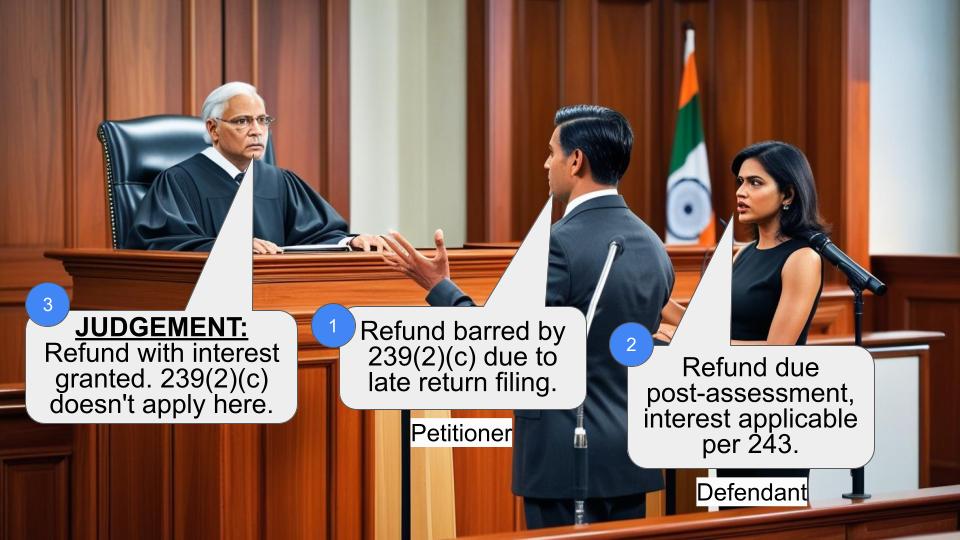
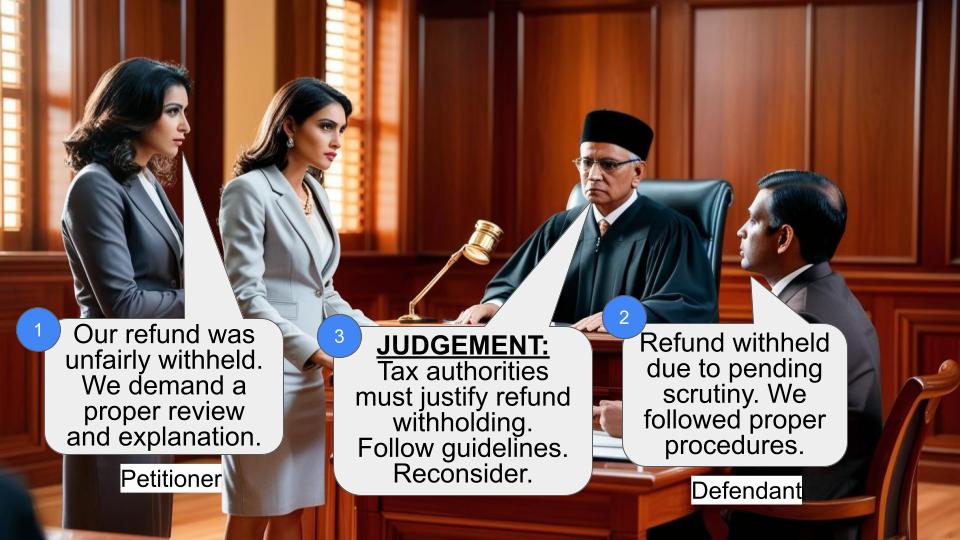
In the case of Ingenico International India Pvt. Ltd. vs. Deputy Commissioner of Income Tax, the court addressed the issue of a delayed tax refund. Despite the Revenue determining a refund amount in October 2019, it was not remitted to the assessee. The court ruled that the mere issuance of a scrutiny notice under Section 143(2) (of Income Tax Act, 1961) does not justify withholding the refund unless specific conditions under Section 241A (of Income Tax Act, 1961) are met. The court ordered the Revenue to release the refund with interest.
Get the full picture - access the original judgement of the court order here
Case Name:
Ingenico International India Pvt. Ltd. Vs. Deputy Commissioner of Income Tax (High Court of Delhi)
W.P.(C) 10764/2020
Date: 18th March 2021
Key Takeaways:
- Refund Process: Once a return is processed and a refund is determined under Section 143(1) (of Income Tax Act, 1961), it should be granted unless specific conditions under Section 241A (of Income Tax Act, 1961) are met.
- Scrutiny Notice: The issuance of a scrutiny notice under Section 143(2) (of Income Tax Act, 1961) alone cannot stall a refund.
- Section 241A (of Income Tax Act, 1961) Conditions: Refund can be withheld if the Assessing Officer records reasons in writing and obtains approval from a superior officer, indicating that the refund would adversely affect the Revenue.
- Court’s Directive: The court mandated the immediate release of the refund with interest, highlighting the importance of adhering to statutory provisions.
Issue
Can the Revenue withhold a tax refund solely based on the issuance of a scrutiny notice under Section 143(2) (of Income Tax Act, 1961)?
Facts
- The Revenue determined a refund amount of Rs. 5,89,14,434 for Ingenico International India Pvt. Ltd. in October 2019.
- Despite this determination, the refund was not remitted.
- A scrutiny notice under Section 143(2) (of Income Tax Act, 1961) was issued in September 2019.
- Ingenico engaged in correspondence with the Revenue and filed a complaint due to the delay.
- The court was approached for resolution.
Arguments
- Petitioner (Ingenico): Argued that the refund should be granted as determined, and the scrutiny notice does not justify withholding it. No order under Section 241A (of Income Tax Act, 1961) was issued to legally withhold the refund.
- Revenue: Failed to provide a counter-affidavit or evidence of an order under Section 241A (of Income Tax Act, 1961) justifying the withholding of the refund.
Key Legal Precedents
- Section 143(1) (of Income Tax Act, 1961): Outlines the process for determining refunds after processing returns.
- Section 241A (of Income Tax Act, 1961): Allows withholding of refunds if a scrutiny notice is issued and the refund would adversely affect the Revenue, provided reasons are recorded and approved by a superior officer.
- Maple Logistics § Ltd. v. Principal Commissioner of Income Tax and Ericsson India Pvt. Ltd. v. ACIT: Cited to support the argument that refunds should not be withheld without fulfilling Section 241A (of Income Tax Act, 1961) conditions.
Judgement
The court ruled in favor of Ingenico, ordering the Revenue to remit the refund amount determined in October 2019 along with interest. The court emphasized that the mere issuance of a scrutiny notice does not suffice to withhold a refund unless Section 241A (of Income Tax Act, 1961) conditions are met.
FAQs
Q1: What does this case mean for taxpayers?
A1: It reinforces that refunds should be processed promptly unless specific legal conditions justify withholding them.
Q2: Can a scrutiny notice alone delay a refund?
A2: No, a scrutiny notice under Section 143(2) (of Income Tax Act, 1961) cannot delay a refund unless conditions under Section 241A (of Income Tax Act, 1961) are met.
Q3: What should the Revenue do to withhold a refund legally?
A3: The Revenue must record reasons in writing and obtain approval from a superior officer under Section 241A (of Income Tax Act, 1961) to withhold a refund.
Q4: What was the court’s final order?
A4: The court ordered the Revenue to release the refund with interest within 10 days of the judgment.

1. The singular grievance of the petitioner in the instant case is that despite the fact that the amount to be refunded was determined by the Revenue in October 2019, the amount, so determined, has not been remitted, as yet.
1.1. Interestingly, the order determining the refund is dated 02.10.2019. We have asked Mr. Kunal Sharma, who appears for the Revenue, as to how that date was endorsed on the order. His candid reply was that although he was not aware as to why the said order bore 02.10.2019 as the date, there was no dispute about the genuineness of the order.
2. What is not in dispute is that the said order has quantified the refund amount at Rs.5,89,14,434/-. This amount concerns the assessment year [in short „AY‟] 2018-2019. The intimation received vide order dated 02.10.2019 by the petitioner was sent by the Revenue pursuant to return being filed qua the aforementioned AY and the same being processed under Section 143(1) (of Income Tax Act, 1961) [in short “the Act”].
3. Interestingly, in the month preceding the intimation of refund, via order dated 02.10.2019, the petitioner was served with notice dated 22.09.2019 under Section 143(2) (of Income Tax Act, 1961) [hereafter referred to as “scrutiny notice”].
4. It appears, since the refund amount was not being released to the petitioner; it entered into a correspondence on the issue with the Revenue. The letters sent to the Revenue in this behalf are dated 16.07.2020, 06.10.2020, 17.08.2020, 22.09.2020, 06.10.2020 and 19.10.2020.
5. These efforts bore no fruit. Exasperated with the approach of the Revenue, the petitioner uploaded a complaint on the E-Nirvan Grievance Portal of the Revenue. This complaint was addressed to the assessing officer [in short “A.O.”]. The complaint was lodged on 22.10.2020. The complaint was also copied to the Central Processing Centre [in short “CPC”].
6. The A.O. in response to the complaint wrote back to the petitioner on 02.12.2020 wherein, he indicated that, since the Income tax return for AY 2019-2020 disclosed that the petitioner‟s total income amounted to Rs.18,01,18,140/-, he no longer had jurisdiction in the matter.
6.1 We may indicate, at this juncture, that the petitioner‟s communication dated 22.09.2020 and 17.08.2020 was addressed to the Assistant Commissioner of Income Tax, Circle 10(1) [in short “ACIT”], i.e., the officer who evidently had jurisdiction in the matter.
6.2. Resultantly, in effect, there was no resolution to the grievance articulated by the petitioner. The petitioner in the fond hope that issue could still be resolved wrote another letter dated 26.10.2020 to the Revenue; only to be disappointed.
7. It is in this backdrop that the petitioner finally took the decision to approach this Court. Notice in the instant writ petition was issued on 21.12.2020 when service on behalf of the Revenue was accepted by Mr. Kunal Sharma. The order, briefly, recorded the controversy in issue. The returnable date in the matter was fixed as 15.01.2021.
7.1 On 15.01.2021, Mr. Sharma was not present in the case. The Court in the interest of justice deferred adverse orders and directed that the matter be placed before it on 19.02.2021.
7.2. On 19.02.2021, the Bench recorded the following:
“1. Further time to obtain instructions qua refund is sought.
2. The counsel for the petitioner states that the refund has already been delayed for one and a half years.
3. This state of affairs cannot be tolerated.
4. If within two weeks it is not informed that any notice under Section 241A (of Income Tax Act, 1961) has been issued and the notice not placed before this Court, this Court will direct refund without granting any further time.
5. List on 8th March, 2021.”
8. Thereafter, the matter was listed before this Bench on 08.03.2021 when the following was noted:
“1. Despite three orders being passed by this Court, there is no clarity as to whether notice has been issued by the Assessing Officer (in short „AO‟) under Section 241A (of Income Tax Act, 1961).
1.1. As a matter of fact, the last order, i.e., order dated 19.02.2021 [which, although not on our file, but has been screen-shared by Mr. Salil Kapoor], discloses that the Court had put the Revenue to notice that “if within two weeks it is not informed that any notice under Section 241A (of Income Tax Act, 1961) has been issued and the notice not placed before this Court, this Court will direct refund without granting any further time.”
1.2. Mr. Kunal Sharma, who appears for the Revenue, has indicated that since a faceless system has been put in place, AO has not been able to pass on the information sought with due alacrity to respondent no. 4.
1.3. We are informed that respondent no. 4 is responsible for ordering payment of the refund amount.
2. List the matter on 18.03.2021. In case there is no clarity, on this issue on the next date of hearing, we will assume that there is no order passed under Section 241 (of Income Tax Act, 1961) A of the Income Tax Act, 1961. Furthermore, the concerned officer will join the proceedings on the next date of hearing.”
9. It is in these circumstances that the matter has been taken for hearing. Mr. Sharma has literally thrown up his hands and indicated to us that he has received no instructions as regard payment of refund to the petitioner.
9.1 Mr. Sharma says that the system has become faceless and therefore, the A.O. is not in the position to give requisite instructions.
10. On the other hand, Mr. Salil Kapoor, who appears for the petitioner, has pointed out that the record discloses, as noted by us hereinabove, that several opportunities have been given despite which there is no movement in the matter.
10.1. It is Mr. Kapoor‟s submission that under the extant provisions of the law, i.e., Section 143(1) (of Income Tax Act, 1961), once a return is processed and refund is determined, the Revenue is obliged to grant refund notwithstanding the fact that the scrutiny notice has been issued.
10.2. It is Mr. Kapoor‟s submission that, up-until today, the petitioner has not been served with any order under Section 241A (of Income Tax Act, 1961). In support of this plea, Mr. Kapoor has relied upon the following judgments:
(i) Maple Logistics (P) Ltd. v. Principal Commissioner of Income Tax, (2019) 112 taxmann.com 199 (Delhi): 2019 SCC OnLine Del 10961
(ii) Ericsson India Pvt. Ltd. v. ACIT, (2020) 217 taxmann.com 381. 11. We have heard learned counsel for the parties and have perused the record. Before we proceed further, it may be relevant to extract the relevant parts of Section 143(1) (of Income Tax Act, 1961):
“143. (1) Where a return has been made under section 139 (of Income Tax Act, 1961), or in response to a notice under sub-section (1) of section 142 (of Income Tax Act, 1961), such return shall be processed in the following manner, namely:
(a) the total income or loss shall be computed after making the following adjustments, namely:
(i) any arithmetical error in the return; [***]
(ii) an incorrect claim, if such incorrect claim is apparent from any information in the return;
[(iii) disallowance of loss claimed, if return of the previous year for which set off of loss is claimed was furnished beyond the due date specified under sub-section (1) of section 139 (of Income Tax Act, 1961);
(iv) disallowance of expenditure indicated in the audit report but not taken into account in computing the total income in the return;
(v) disallowance of deduction claimed under sections 10AA (of Income Tax Act, 1961), 80-IA, 80- IAB, 80-IB, 80-IC, 80-ID or section 80-IE (of Income Tax Act, 1961), if the return is furnished beyond the due date specified under sub-section (1) of section 139 (of Income Tax Act, 1961); or
(vi) addition of income appearing in Form 26AS or Form 16A or Form 16 which has not been included in computing the total income in the return: Provided that no such adjustments shall be made unless an intimation is given to the assessee of such adjustments either in writing or in electronic mode:
Provided further that the response received from the assessee, if any, shall be considered before making any adjustment, and in a case where no response is received within thirty days of the issue of such intimation, such adjustments shall be made:]
[Provided also that no adjustment shall be made under sub-clause (vi) in relation to a return furnished for the assessment year commencing on or after the 1st day of April, 2018;]
(b) the tax [interest and fee], if any, shall be computed on the basis of the total income computed under clause (a);
(c) the sum payable by, or the amount of refund due to, the assessee shall be determined after adjustment of the tax [interest and fee], if any, computed under clause (b) by any tax deducted at source, any tax collected at source, any advance tax paid, any relief allowable under an agreement under section 90 (of Income Tax Act, 1961) or section 90A (of Income Tax Act, 1961), or any relief allowable under section 91 (of Income Tax Act, 1961), any rebate allowable under Part A of Chapter VIII, any tax paid on self-assessment and any amount paid otherwise by way of tax [interest or fee];
(d) an intimation shall be prepared or generated and sent to the assessee specifying the sum determined to be payable by, or the amount of refund due to, the assessee under clause (c); and
(e) the amount of refund due to the assessee in pursuance of the determination under clause (c) shall be granted to the assessee.”
12. A perusal of the aforesaid provisions would show that once the return is filed under Section 139 (of Income Tax Act, 1961) or in response to the notice under Section 142(1) (of Income Tax Act, 1961), the return is required to be processed in the manner indicated in the latter part of the provision.
12.1. In particular, clause (c) of the sub-section (1) of Section 143 (of Income Tax Act, 1961) inter alia provides for determination of the refund after adjustment of tax, interest and fee, if any, computed under clause (d) of the very same provision. Clause (d) of sub-section (1) of Section 143 (of Income Tax Act, 1961) speaks about intimation being prepared or generated and sent to the assessee specifying the sum determined to be payable or the amount of refund due to the assessee under clause (c). Clause (e) of Sub-Section 1 (of Income Tax Act, 1961) of Section 143 (of Income Tax Act, 1961) provides that the amount of refund due to the assessee in pursuance of the determination made under clause (c) of the very same provision “shall be granted to the assessee”.
13. Record shows that the assessee‟s case has crossed the stage alluded to in clause (c) and (d) of sub-section (1) of Section 143 (of Income Tax Act, 1961), the only part which remains is the grant of refund. The Revenue can, in law, withhold the refund only by exercising powers under Section 241A (of Income Tax Act, 1961).
13.1. For the sake of convenience, the said provision is extracted hereafter:
“241A. For every assessment year commencing on or after the 1st day of April, 2017, where refund of any amount becomes due to the assessee under the provisions of sub-section (1) of section 143 (of Income Tax Act, 1961) and the Assessing Officer is of the opinion, having regard to the fact that a notice has been issued under sub-section (2) of section 143 (of Income Tax Act, 1961) in respect of such return, that the grant of the refund is likely to adversely affect the revenue, he may, for reasons to be recorded in writing and with the previous approval of the Principal Commissioner or Commissioner, as the case may be, withhold the refund up to the date on which the assessment is made.”
13.2 A perusal of the aforementioned provision would show that if a scrutiny notice is issued [i.e., notice under section 143(2) (of Income Tax Act, 1961)], as is the case in the present matter, then, the Revenue can stall the grant of refund, if the release of the refund amount is likely to adversely affect its interests.
13.3 However, before the A.O. embarks on this route, he is required to cross two hoops. First, the A.O. is required to record his reasons in writing as to how grant of refund is likely to adversely affect the interest of the Revenue. Second, the A.O. is obliged to obtain the previous approval of his superior, i.e., the Principal Commissioner or the Commissioner as the case may be.
14. Therefore, a plain reading of Section 241A (of Income Tax Act, 1961) shows that the mere issuance of the scrutiny notice under Section 143(2) (of Income Tax Act, 1961) cannot stall the remittance of refund to the assessee. The refund can only be stalled if the conditions stipulated in Section 241A (of Income Tax Act, 1961), to which we have made a reference above, are fulfilled, i.e., the A.O. records his reasons in writing as to why the release of refund is likely to affect the interests of the Revenue and that this step of the A.O. receives the imprimatur [which obviously would mean prior approval] of his superior officer, i.e., Principal Commissioner or Commissioner as the case may be.
15. The Revenue has brought nothing on record to show that an order under Section 241A (of Income Tax Act, 1961) has been issued. As a matter of fact, no counter-affidavit has been filed by the Revenue.
16. Therefore, the mandate of the law requires the Revenue to remit the amount determined in its order dated 02.10.2019 to the petitioner along with interest as required under the provisions of the Act. This is also the view of the coordinate Benches of this Court taken in Maple Logistics and Ericsson India Pvt. Ltd. (Supra)
17. Before we part, we may also indicate that prior to the A.O. passing an order under Section 241A (of Income Tax Act, 1961), it may possibly be a constructive approach if the assessee is heard. There are several cases where assessees‟ are looking for liquidity in the form of money received via refund and even if the A.O. is of the view that release of refund is likely to adversely affect the interests of the Revenue, the Revenue could, in a given case, take security in the form of bank guarantee or other solvent security as deemed fit and thus, in a sense, balance the interests of both the assessee and the Revenue. We have only given one illustration, there could be several situations of like nature and therefore, perhaps hearing the assessee at some stage, either before or after, the A.O. may help in resolving such disputes.
18. As a matter of fact, in GKN Drive Shafts (India) Ltd. v. ITO, (2003) 1 SCC 72, in the context of proceedings under Section 147 (of Income Tax Act, 1961), the Supreme Court has put in place a regime whereby reasons recorded by the A.O. are required to be furnished to the assessee on demand and qua them, the assessee is permitted to file objections. The Revenue is, thereafter, required to pass a formal order disposing of the objections. Similar regime could, perhaps be followed in cases concerning exercise of power by the A.O. under section 241A (of Income Tax Act, 1961).
19. This aspect, however, does not arise in the facts of this case, and therefore, is not the plank on which our decision is rendered in the instant matter. In a matter where such facts arise and the plea is taken, we will examine the pros and cons of what has been observed hereinabove.
20. The writ petition is, accordingly, allowed. The Revenue is directed to remit the amount as determined in the order dated 02.10.2019 along with requisite interest as payable under the extant provisions of the Act. The payment determined shall be released within 10 days from the date of receipt of a copy of this judgement.
21. Pending application(s), if any, shall stand closed.
×