


Revenue's appeal dismissed: AO's hasty disallowance without proper verification…


Full News
Revenue's appeal dismissed: AO's hasty disallowance without proper verification backfires
Revenue's appeal dismissed: AO's hasty disallowance without proper verification backfires
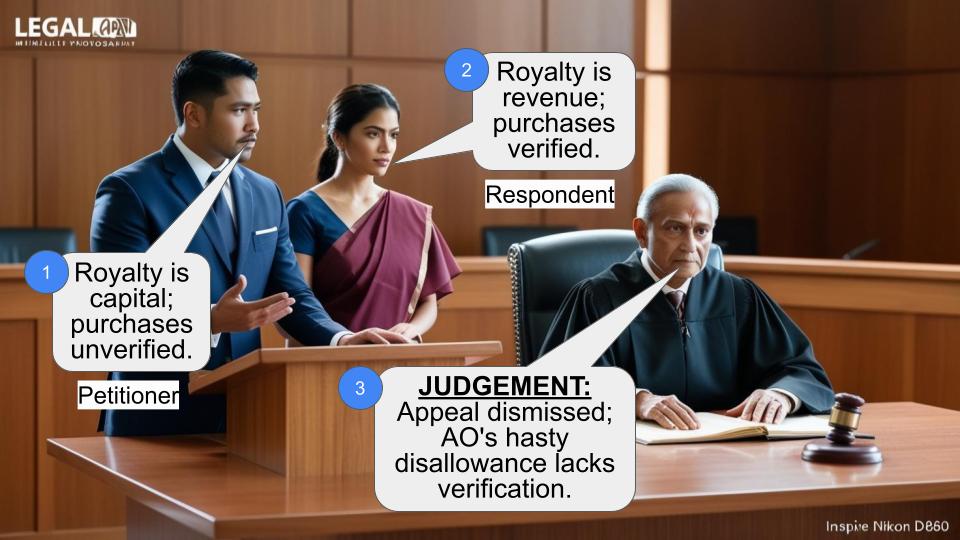
The case involves the Principal Commissioner of Income Tax (Revenue) appealing against Elofic Industries Ltd. (assessee) for the Assessment Year 2004-05. The High Court dismissed the Revenue's appeal, upholding the decisions of the CIT(Appeals) and the Income Tax Tribunal, which had ruled in favor of the assessee on two key issues: royalty payments and disallowance of certain expenditures.
Get the full picture - access the original judgement of the court order here
Case Name:
Principal Commissioner of Income Tax Vs Elofic Industries Ltd. (High Court of Delhi)
ITA 1472/2018
Date: 19th December 2018
Key Takeaways:
1. The Revenue cannot prefer an appeal without proper discussion and factual findings by the Assessing Officer (AO).
2. Hasty additions or disallowances without giving the assessee an opportunity to explain or reconcile discrepancies violate principles of natural justice.
3. The appellate authorities' factual findings on the genuineness of expenses and additional evidence are generally not interfered with by higher courts unless there's a substantial question of law.
Issue:
Did the Assessing Officer err in treating royalty payments as capital expenditure and disallowing certain purchases without proper verification, and were the CIT(Appeals) and Tribunal correct in reversing these decisions?
Facts:
1. For the Assessment Year 2004-05, Elofic Industries Ltd. filed a return declaring an income of Rs.2,02,01,290.
2. After scrutiny, the income was determined at Rs.2,34,27,852.
3. A reassessment notice under Section 147 (of Income Tax Act, 1961) read with Section 148 (of Income Tax Act, 1961) was issued.
4. The reassessment order made two additions:
a) Royalty payments of Rs.82,76,880 treated as capital expenditure
b) Disallowance of purchases amounting to Rs.5,87,50,440
5. The CIT(Appeals) and the Tribunal ruled in favor of the assessee on both issues.
Arguments:
Revenue's Arguments:
1. Royalty payments should be treated as capital expenditure.
2. Certain purchases were unverified and should be disallowed.
Assessee's Arguments:
1. Royalty payments were revenue expenditure for using trademarks and names.
2. The AO acted hastily in disallowing purchases without giving an opportunity to reconcile discrepancies.
3. Sufficient evidence was provided to verify the purchases.
Key Legal Precedents:
The judgment doesn't mention specific case laws. However, it notes that the AO merely referred to case law without proper discussion or factual findings.
Judgement:
1. The High Court dismissed the Revenue's appeal.
2. On the royalty issue, the court noted the lack of discussion and factual findings by the AO.
3. Regarding the disallowance of purchases, the court upheld the CIT(Appeals) and Tribunal's decisions, considering the additional evidence and confirmations provided by the assessee.
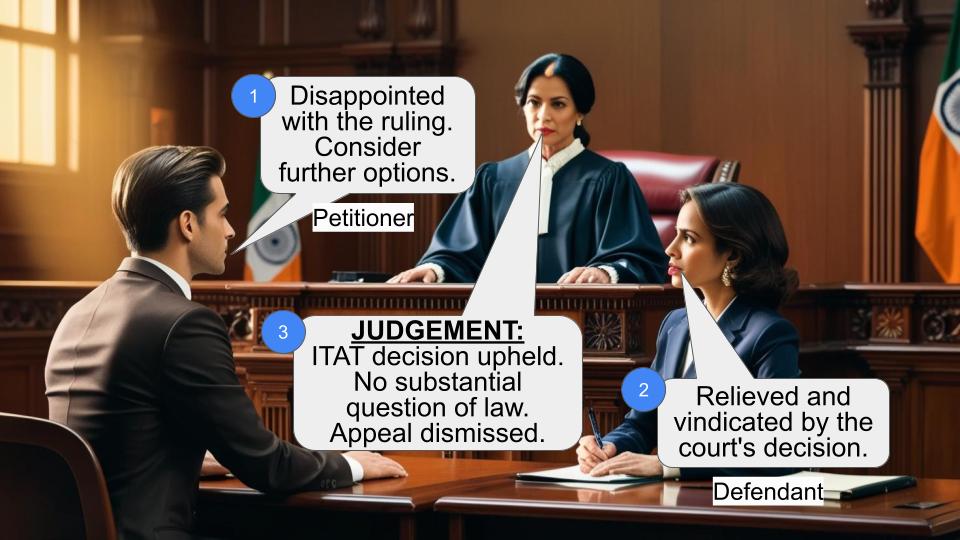
4. The court found no substantial question of law arising from the case.
FAQs:
1. Q: Why did the High Court dismiss the Revenue's appeal?
A: The court found no substantial question of law and noted the lack of proper discussion and factual findings by the Assessing Officer.
2. Q: What was the significance of the additional evidence provided by the assessee?
A: The additional evidence, including confirmations and reconciliation statements, helped prove the genuineness of the purchases, leading to the deletion of the disallowance.
3. Q: What principle of tax assessment did this case highlight?
A: The case emphasized the importance of following principles of natural justice and giving the assessee an opportunity to explain discrepancies before making additions or disallowances.
4. Q: Can the Revenue appeal against factual findings of lower authorities?
A: While the Revenue can appeal, higher courts generally don't interfere with factual findings unless there's a substantial question of law involved.
5. Q: What lesson can tax authorities learn from this case?
A: Tax authorities should conduct thorough investigations, provide opportunities for assessees to explain discrepancies, and record proper factual findings before making additions or disallowances.

Before issuing notices on the application for condonation of delay of 2 days in filing and 315 days in re-filing, we have deemed it appropriate to first examine the appeal, ITA No. 1472/2018 on merits.
2. This appeal by Revenue under Section 260A (of Income Tax Act, 1961) ('Act', for short) in the case of M/s Elofic Industries Ltd ('respondent-assessee', for short) pertains to the Assessment year 2004-05 and arises from the order of the Income Tax Tribunal ('Tribunal', for short) dated 09.08.2017.
3. For Assessment Year 2004-05, the respondent-assessee had filed return declaring an income of Rs. 2,02,01,290/-. After scrutiny assessment under section 143(3) (of Income Tax Act, 1961), total income was determined at Rs.2,34,27,852/-. Subsequently, reassessment notice under Section 147 (of Income Tax Act, 1961) read with Section 148 (of Income Tax Act, 1961) notice was issued and reassessment order dated 23/12/2009 was passed. In the present appeal we are concerned with two additions made vide the reassessment order i.e., (i) Royalty and (ii) Disallowance of expenditure of Rs.5,87,50,440/-.
3.1. Royalty
3.1.1 The reassessment order, after referring to case law relating to capital and revenue expenditure, abruptly without any discussion on the nature and character of royalty payments, held that Rs.1,10,35,840/- was capital expenditure on which depreciation @ 25% of Rs. 27,58,960/-, should be allowed. Accordingly addition/net disallowance of Rs. 82,76,880/- was made.
3.1.2 The addition was deleted by the Commissioner of Income Tax (Appeals) ['CIT (Appeals)', for short] and the Tribunal had affirmed the said decision.
The findings recorded for deleting the disallowance are:-
(i). The respondent-assessee had paid Rs. 23,46,814/- to M/s Elofic Industries (India) Ltd. for using their brand name on oil-filters. No technical knowledge was received from M/s Elofic Industries (India) Ltd.
(ii). The respondent-assessee had also paid Rs. 32,49,447/- and Rs. 54,39,580/- to Telco and Mahindra & Mahindra respectively, for using their trademarks and names on the oil-filters.
(iii). The respondent-assessee had not acquired any exclusive rights to manufacture or sell products for which royalty was paid. Royalty was paid for the use of trademarks and names belonging to a third party. Either party could opt out of the said arrangement at anytime. Payments had enabled the respondent-assessee to carry on business more ably and efficiently. Royalty payment had directly contributed to increased turnover, business and profits.
3.1.3 We are surprised that the Revenue has deemed it appropriate to prefer this present appeal in the absence of any discussion and factual findings recorded by the Assessing Officer who had merely referred to the case law.
3.2. Disallowance of expenditure of Rs.5,87,50,440.
3.2.1 The reasoning given by the Assessing Officer for disallowance of Rs. 5,87,50,440 is reproduced herein below:
"2. Regarding verification of purchases of amount Rs. 255890935 made in the year under consideration the assessee was required to file its details which were filed during the course of assessment hearing. On perusal of the same it was found that out of the amount of Rs. 25.58 crores, purchases worth Rs. 2.3 crores have been made from foreign suppliers and the rest were made from Indian suppliers. Notice u/s 133(6) (of Income Tax Act, 1961) were issued test check basis to the following parties:
Name of the party Amount (In Rs.) Remarks M/s Emco Perfortors
2410739/- Reply received on 15.10.2009 where in the party requested for extension of time period to submit details.
However, no reply has been received so far.
Amson Industries 3477938/- Not compliance
Deep Jyoti Industries 4761499/- Do.
Mittal Enterprises 5611139/- Compliance made.
Polymer Paper Ltd. 4859906/- Not compliance M/s Rohit Enterprises 39691356/- Notice complied with but amount confirmed by the party is Rs.9228089
M/s Asu Udyog 5251642/- Not compliance M/s Pawan Industries
7525449/- Not compliance
On perusal of the table above it is clearly seen that purchases amounting to Rs.58750440/- remains unverified and hence are added back to the income of the assessee. Since the assessee has furnished inaccurate particulars of income I am satisfied that penalty proceedings u/s 271(1)(C) (of Income Tax Act, 1961) should be initiated which are accordingly done. "
3.2.2 Along with the appeal filed before the CIT (Appeals), the respondent- assessee had preferred an application under Rule 46A (of Income Tax Rules, 1962) of the Income Tax, Rules, 1962 ('Rules', for short), for taking on record confirmation letters with the PAN Nos., copy of the assessee's account statement, copy of the balance sheet of the suppliers etc. Specific confirmation from suppliers with full particulars were filed.
3.2.3 Respondent-assessee had alleged that the Assessing Officer had acted in haste, and had made the addition/disallowance without giving any opportunity to the respondent-assessee to file reconciliation statement in case of difference in amount and get confirmation directly from the parties.
3.2.4 For sake of completeness, we would like to reproduce herein under the submissions made by the respondent-assessee as recorded in the order passed by the CIT (Appeals):
"The partywise reconciliation of the apparent discrepancy as stated in the chart on page 6 of the assessment order is as under:
(A) M/s Emco Perfortors (Rs. 24,10,739/-). According to the AO in this case the party sought extension of time to reply to her notice u/s 133(6) (of Income Tax Act, 1961) and then however no reply was received. If the reply from the party had not been received inspite of the extension of time, the AO had the following powers with her to enforce compliance which, unfortunately, were not invoked by the AO for reasons best known to her.
(i) Power u/s 131 (of Income Tax Act, 1961) to enforce compliance.
(ii) Giving the assessee company an opportunity to either produce the party or adduce evidence in support of verification of the same.
The following evidence in verification of the purchases made from M/s Emco Perfortors amounting to Rs. 24,10,739/- is enclosed as Annexure "29":
(i) Reconciliation statement from the party along with the copy of account of the appellant in the books of the party, and
(ii) Reconciliation statement from the appellant along with copy of account of the party in the books of appellate.
(B) M/s Amson Industries (Rs. 34,77,938/-) : According to the AO in this case 'no compliance' was made by the party. If the party had not compliance with the notice u/s 133(6) (of Income Tax Act, 1961), the AO had the following powers with her to enforce compliance, which unfortunately were not invoked by the AO for reasons best known to her.
(iii) Power u/s 131 (of Income Tax Act, 1961) to enforce compliance
(iv) Giving the assessee company an opportunity to either produce the party or adduce evidence in support of verification of the same.
The following evidence in verification of the purchases made from M/s Amson Industries amounting to Rs. 34,77,938/- is enclosed as Annexure "30": -
(i) Reconciliation statement from the party along with the copy of the appellate in the books of the party, and
(ii) Reconciliation statement from the appellate along with copy of account of the party in the books of appellate.
(C) M/s Deep Jyoti Industries (Rs. 47,61,499/-) : According to the AO in this case 'no compliance' was made by the party. If the party had not compliance with the notice u/s 133(6) (of Income Tax Act, 1961), the AO had the following power with her to enforce compliance, which unfortunately were not invoked by the AO for reasons best known to her.
(iii) Power u/s 131 (of Income Tax Act, 1961) to enforce compliance
(iv) Giving the assessee company an opportunity to either produce the party or adduce evidence in support of verification of the same.
The following evidence in verification of the purchases made from M/s Deep Jyoti Industries amounting to Rs. 47,61,499/- is enclosed as Annexure "31": -
(i) Reconciliation statement from the party duly confirmed by their chartered accountant along with the copy of account of the appellate in the books of the party, and
(ii) Reconciliation statement from the appellate along with copy of account of the party in the books of appellate.
(D) M/s Mittal Enterprises (Rs. 56,11,139/-) : As the M/s Mitttal Enterprises have complied with the notice u/s (6) and no adverse remark has been stated against them, therefore, no further comment/submission is called for in this case.
(E)M/s Polymers Paper Ltd. (Rs. 48,59,906/-) : According to the AO in this case 'no compliance' was made by the party. If the party had not compliance with the notice u/s 133(6) (of Income Tax Act, 1961), the AO had the following powers with her to enforce compliance, which unfortunately were not invoked by the AO for reasons best known to her.
(i) Power u/s 131 (of Income Tax Act, 1961) to enforce compliance
(ii) Giving the assessee company an opportunity to either produce the party or adduce evidence in support, of verification of the same.
The following evidence in verification of the purchases made from M/s Polymers Paper Ltd. amounting to Rs. 48,59,906/- is enclosed as Annexure "32": -
(i) Reconciliation statement of the party duly confirmed by their chartered accountant along with the copy of account of the appellate in the books of the party, and
(ii) Reconciliation statement from the appellate along with copy of account of the party in the books of appellate.
(F) M/s Rohit Enterprises (Rs. 3,96,91,356/-) : According to the AO, in this case the party has complied with the notice but the amount confirmed by them is Rs. 92,28,089/-. However, according to the party no such amount was confirmed by them before the AO.
In this case the appellate respectfully submits that if there was an apparent discrepancy in the amount as stated by the appellate and as confirmed by the party then the AO should have followed the principles of natural justice and given an opportunity to the appellate to represent and reconcile the difference between the two amounts.
As the principles of natural justice was not followed by the AO the addition made in this case is therefore bad in law and is liable to be quashed.
However, the following evidence in respect of the amount stated by the appellate and as confirmed by the party M/s Rohit Enterprises on account of purchases amounting to Rs.3,96,91,356/- is enclosed as Annexure "33" :
(i) Reconciliation statement from the party duly confirmed by their chartered accountant,
(ii) Reconciliation statement by the appellate, and
(iii) Copy of account of the party M/s Rohit Enterprises in the books of the appellate.
(G) M/s Asu Udyog (Rs. 52,51,642/-) : According to the AO in this case 'no compliance' was made by the party. If the party had not compliance with the notice u/s 133(6) (of Income Tax Act, 1961), the AO had the following powers with her to enforce compliance, which unfortunately were not invoked by the AO for reasons best known to her.
(i) Power u/s 131 (of Income Tax Act, 1961) to enforce compliance
(ii) Giving the assessee company an opportunity to either produce the party or adduce evidence in support of verification of the same.
The following evidence in verification of the purchases made from M/s Asu Udyog amounting to Rs. 52,51,642/- is enclosed as Annexure "34":
(i) Reconciliation statement from the party duly confirmed by their chartered accountant along with the copy of account of the appellate in the books of the party, and
(ii) Reconciliation statement from the appellate along with copy of account of the party in the books of appellate.
(H) M/s Pawan Industries (Rs. 75,25,449/-) : According to the AO in this case 'no compliance' was made by the party. If the party had not compliance with the notice u/s 133(6) (of Income Tax Act, 1961), the AO had the following powers with her to enforce compliance, which unfortunately were not invoked by the AO for reasons best known to her.
(i) Power u/s 131 (of Income Tax Act, 1961) to enforce compliance
(ii) Giving the assessee company an opportunity to either produce the party or adduce evidence in support of verification of the same.
The following evidence verification of the purchases made from M/s Pawan Industries amounting to Rs. 75,25,449/- is enclosed as Annexure "35" :
(i) Reconciliation statement from the party along with the copy of account of the appellate in the books of the party, and
(ii) Reconciliation statement from the appellate along with copy of account of the party in the books of appellate.
The AO had clearly violated the principles of natural justice by making an addition of Rs.5,87,50,440/- in respect of purchases without giving any opportunity what so ever to the appellate to clarify or reconcile the purchases enumerated on page 6 of her order.
Further, the appellate has adduced sufficient evidence in support of the verification of the purchases amounting to Rs. 5,87,50,440/- from the parties mentioned above, therefore, under the facts and circumstances of the case, the addition so made on account of the purchases deserves to be deleted. "
3.2.5 The CIT (Appeals) after calling for the remand report, had taken additional documents on record. He observed that out of 4 parties, 3 were assessed in the same circle as the respondent-assessee. In view of confirmations, reconciliation statements, bank statements, cheque nos. with dates etc., the CIT (Appeals) held that the addition made by the Assessing Officer was unjustified and wrong.
3.2.6 Tribunal by the impugned order has dismissed the appeal preferred by the Revenue, inter alia, observing :-
" 9. Having considered the matter in its entirety in the light of the law on the aspect, we are of the considered opinion that there is no illegality or irregularity in the findings of the Ld. CIT(A) and they do not warrant any interference by this Tribunal. We, therefore, while upholding the legality of the impugned order, dismiss the grounds of appeal. "
3.2.7 Findings of CIT (Appeals) as affirmed by the Tribunal on the question of genuineness of the expenses incurred and the proof and material are factual. Revenue along with the present appeal has not filed evidence and material examined and considered by the appellate authorities. On the question of admission of additional evidence under Rule 46 (of Income Tax Rules, 1962) the CIT (Appeals) have given good reasons and justifications.
These findings again are primarily factual. In these circumstances, we do not find any substantial question of law arising for consideration on the second issue.
4. Accordingly, we are not issuing notice on the applications for condonation of delay. Subsequently, the applications and the appeal are dismissed.
SANJIV KHANNA, J.
ANUP JAIRAM BHAMBHANI, J.
DECEMBER 19, 2018
×
Similar Ripples
Questions
Revenue's appeal dismissed: AO's hasty disallowance without proper verification backfires
Write your CommentSimilar Posts


Generic
- Reportdata/995_AR2x2MB.pdf
