


Separate Books for Export Business Justify Full 80HHC Deduction, Rules High Cou…


Full News
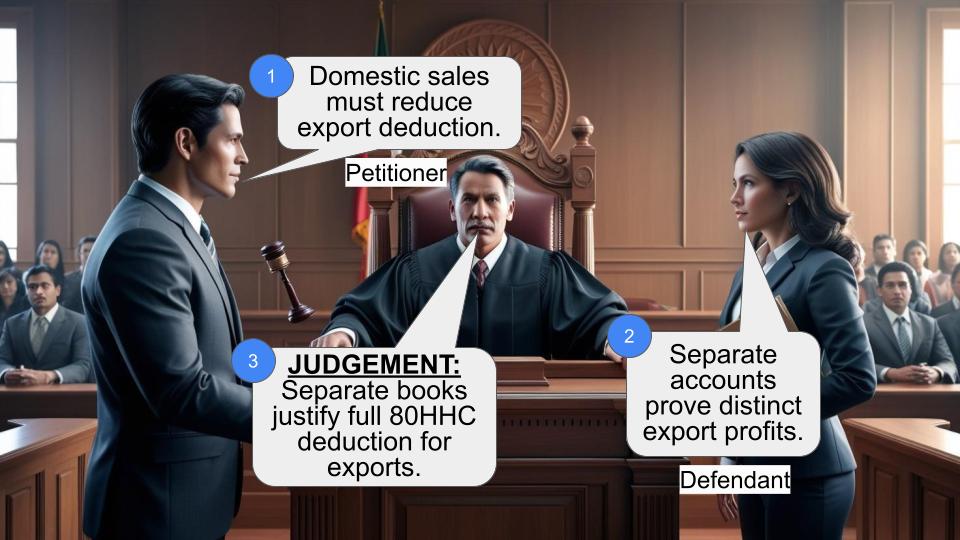
Separate Books for Export Business Justify Full 80HHC Deduction, Rules High Court
Separate Books for Export Business Justify Full 80HHC Deduction, Rules High Court
This case involves a dispute between the Commissioner of Income Tax and M. Gani & Co., a garment manufacturer and exporter. The main issue was whether the assessee (M. Gani & Co.) was entitled to claim a full deduction under Section 80HHC (of Income Tax Act, 1961) on their export profits, even when they had domestic sales as well. The High Court ruled in favor of the assessee, upholding the decision of the Income Tax Appellate Tribunal.
Get the full picture - access the original judgement of the court order here
Case Name:
Commissioner of Income Tax Vs M. Gani & Co. (High Court of Madras)
Tax Case (Appeal) No.33 of 2008
Date: 4th February 2008
Key Takeaways:
1. Maintaining separate books of accounts for export and domestic businesses justifies full deduction under Section 80HHC (of Income Tax Act, 1961) for export profits.
2. The court reaffirmed previous rulings on this issue, strengthening the precedent.
3. The purpose of Section 80HHC(3)(b) (of Income Tax Act, 1961) is to disallow partial deductions only when the entire claim can't be attributed to exports.
Issue:
Is the assessee entitled to a full deduction under Section 80HHC (of Income Tax Act, 1961) on export profits when they maintain separate books of accounts for export and domestic businesses?
Facts:
1. M. Gani & Co. is a manufacturer of garments and fancy items, and also an exporter.
2. For the assessment year 2001-2002, they filed a return claiming deduction under Section 80HHC (of Income Tax Act, 1961) on export turnover, ignoring domestic turnover results.
3. The Assessing Officer recomputed the deduction by considering both export and domestic turnover.
4. The assessee appealed to the Commissioner of Income-tax (Appeals), who allowed their claim.
5. The Income-tax Appellate Tribunal confirmed the Commissioner's order, dismissing the Department's appeal.
6. The Revenue then filed this appeal in the High Court.
Arguments:
Revenue's Argument:
- Section 80HHC(3)(a) (of Income Tax Act, 1961) should apply, requiring consideration of both export and domestic turnover for calculating the deduction.
Assessee's Argument:
- Separate books of accounts were maintained for export and domestic businesses, justifying full deduction on export profits under Section 80HHC (of Income Tax Act, 1961).
Key Legal Precedents:
1. COMMISSIONER OF INCOME TAX VS. RATHORE BROTHERS (254 ITR 656): Established that when separate accounts are maintained for export and domestic sales, there's no warrant for disallowing any portion of export earnings pro rata under Section 80HHC(3)(b) (of Income Tax Act, 1961).
2. COMMISSIONER OF INCOME TAX VS. SURESH B. MEHTA (291 ITR 462): Followed the Rathore Brothers case, affirming that separate accounts justify full relief.
3. COMMISSIONER OF INCOME TAX VS. MACMILLAM INDIA LTD. (295 ITR 67): Reiterated that separate accounts and sufficient documentation justify full deduction on export earnings.
Judgement:
The High Court dismissed the Revenue's appeal, ruling in favor of M. Gani & Co. The court held that:
1. The Tribunal was justified in granting full deduction under Section 80HHC (of Income Tax Act, 1961) on export profits.
2. The assessee maintained separate books of accounts for export and domestic businesses, which is crucial for this decision.
3. Previous High Court decisions on similar facts support this ruling.
FAQs:
1. Q: What is Section 80HHC (of Income Tax Act, 1961)?
A: Section 80HHC (of Income Tax Act, 1961) provides for deductions on profits from export business, aimed at promoting exports.
2. Q: Why is maintaining separate books of accounts important in this case?
A: Separate books clearly distinguish between export and domestic profits, justifying full deduction on export earnings without pro-rata calculations.
3. Q: Does this ruling apply to all businesses with both export and domestic sales?
A: Not necessarily. The key factor is maintaining separate, clear accounts for export and domestic businesses.
4. Q: What would have happened if the assessee didn't maintain separate books?
A: The Assessing Officer's approach of considering both turnovers might have been upheld, potentially reducing the deduction.
5. Q: How does this judgment impact other exporters?
A: It reinforces the importance of maintaining separate accounts for exporters who want to claim full Section 80HHC (of Income Tax Act, 1961) deductions on their export profits.

This appeal has been filed against the order of the Income Tax Appellate Tribunal in I.T.A.No.942/Mds/2005 dated 30.11.2006. The relevant assessment year is 2001-02.
2. The assessee is a manufacturer of garments and fancy items and exporter. The assessee filed its return of income on 29.10.2001 for the relevant assessment year 2001-2002 claiming deduction under Section 80HHC (of Income Tax Act, 1961) (hereinafter referred to as the "Act") on export turn over ignoring the results of domestic turn over. The Assessing Officer after going through the facts that the assessee while computing the deduction under Section 80HHC (of Income Tax Act, 1961) has taken into consideration only the turn over of the export division for the purpose of total turn over, has made a composite turn over of both the export turn over as well as domestic turn over and accordingly re-computed the deduction under Section 80HHC (of Income Tax Act, 1961). Aggrieved by that order, the assessee preferred an appeal before the Commissioner of Income-tax (Appeals) and the Commissioner of Income-tax (Appeals) allowed the claim of the assessee relying upon the provisions of Section 80HHC(3)(c) (of Income Tax Act, 1961). The Revenue carried the matter on further appeal before the Income-tax Appellate Tribunal, which confirmed the order of the Commissioner of Appeals and dismissed the appeal preferred by the Department. Aggrieved by that order, the present appeal has been filed by formulating the following substantial questions of law:-
Whether, on the facts and in the circumstances of the case, the Income-tax Appellate Tribunal is right in law in holding that the assessee is entitled for deduction under Section 80HHC (of Income Tax Act, 1961) fully on export profits, even though section 80HHC(3)(a) (of Income Tax Act, 1961) will applicable to the facts and in the circumstances of the case ? "
3. We heard the learned standing counsel appearing for the Revenue.
4. This question of law as to whether where the assessee has maintained the separate books of accounts in respect of domestic transaction as well as the export transaction the clubbing of income was permissible was considered by this Court in COMMISSIONER OF INCOME TAX VS. RATHORE BROTHERS reported in 254 ITR 656. In that case, it was held that where the assessee has maintained separate accounts and it had maintained its trading receipts and profit and loss accounts separately for export sales and domestic sales and there was sufficient materials supported by all the necessary documents to show that the deduction claimed was entirely due to export, there was no warrant for disallowing any portion of the export earnings pro rata by invoking clause (b) of sub-section 3 (of Income Tax Act, 1961) of Section 80 (of Income Tax Act, 1961) HHC of the Act. The purpose of the clause was to disallow a part of the allowances under the section only when the entire claim could not be regarded as being relatable to export. That decision has been followed subsequently, in COMMISSIONER OF INCOME TAX VS. SURESH B. MEHTA reported in 291 ITR 462 in a similar set of facts, where the assessee had maintained the separate accounts for domestic transaction as well as the export transaction. Having regard to the said fact, this Court has held that the assessee was maintaining separate accounts independent of his other business and that there was no intermingling of expenditure or interlacing of funds of any kind whatsoever the assessee was entitled to the relief. That decision was followed in another case in COMMISSIONER OF INCOME TAX VS. MACMILLAM INDIA LTD., reported in 295 ITR 67, wherein also, the Court held as follows:- "Where the assessee had maintained separate accounts and maintained its trading receipts and profit and loss accounts separately for export sales and domestic sales and produced sufficient material in support of all the necessary documents to show that the deduction claimed was entirely due to export, there is no warrant for disallowing any portion of the export earnings pro rata by invoking clause (b) of sub-section (3) of section 80HHC (of Income Tax Act, 1961), as the purpose of the clause is to disallow a part of the allowance under that section only when the entire deduction claimed could not be regarded as being relatable to exports."
5. Incidentally, in the latter two cases, one of us was party (CVJ). In paragraph-6 of the order, the Tribunal has categorically stated without any ambiguity that the assessee maintaining separate set of books of accounts. Hence, the assessee is entitled for deduction under Section 80HHC (of Income Tax Act, 1961) fully on export profit. In view of the fact that the assessee maintained the separate books of accounts for export business and domestic business and in the light of the earlier decisions cited, we are of the considered view that the Tribunal has decided the issue correctly and the appeal deserves no merit consideration. Therefore, the appeal is dismissed. No costs.
K.RAVIRAJA PANDIAN, J. and CHITRA VENKATARAMAN, J.
×
Questions
Separate Books for Export Business Justify Full 80HHC Deduction, Rules High Court
Write your CommentSimilar Posts


Generic
- Reportdata/4903_.pdf
