


Settlement Commission's Decision Upheld: Revenue's Belated Challenge Rejected



Full News
Settlement Commission's Decision Upheld: Revenue's Belated Challenge Rejected
Settlement Commission's Decision Upheld: Revenue's Belated Challenge Rejected
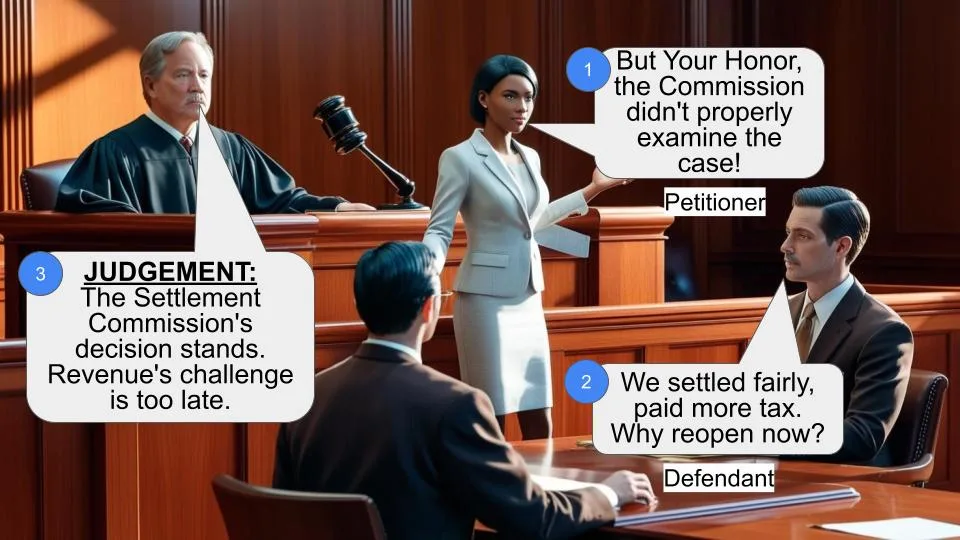
This case involves a dispute between the Commissioner of Income Tax and the Income Tax Settlement Commission. The Revenue (tax authorities) attempted to reopen a settlement decision made by the Settlement Commission regarding tax assessments for the years 2000-01 to 2006-07. The High Court ultimately rejected the Revenue's petition, upholding the finality of the Settlement Commission's decision.
Get the full picture - access the original judgement of the court order here
Case Name:
Commissioner of Income Tax & Anr Vs Income Tax Settlement Commission (IT & WT) & Anr. (High Court of Patna)
Civil Writ Jurisdiction Case No.10663 of 2019
Date: 6th October 2020
Key Takeaways:
1. The Settlement Commission's decisions are meant to be final and bring certainty to tax disputes.
2. Courts are reluctant to interfere with Settlement Commission decisions, especially when there's no evidence of misconduct.
3. Belated challenges to settlements, particularly after accepting payments, are viewed unfavorably.
4. The writ jurisdiction of courts is discretionary and should be exercised judiciously, considering the facts of each case.
Issue:
Can the Revenue reopen a settlement decision made by the Income Tax Settlement Commission based on a single observation in the order, when the settlement was accepted without protest and the additional tax was paid?
Facts:
1. The case pertains to tax assessments for the years 2000-01 to 2006-07.
2. The assessees (taxpayers) had disclosed additional income of Rs.97,79,272/-, which was almost 100 times more than initially declared.
3. The Settlement Commission passed an order on 28.03.2008 accepting the settlement.
4. The Revenue filed a petition on 24.8.2009, more than a year after the order, challenging the settlement.
5. The challenge was based on a single observation in the order: "It is not practicable for the Commission to examine the records and investigate the cases for proper settlement".
Arguments:
Revenue's Argument:
- The Settlement Commission didn't properly examine the records or investigate the case before accepting the settlement.
Assessees' Argument:
- The settlement was fair and proper, mutually beneficial, and accepted without protest.
- The Revenue's challenge is belated and immoral, given that they accepted the enhanced tax payment.
Key Legal Precedents:
1. Ajmera Housing Corporation and another Versus Commissioner of Income Tax (2010) 8 SCC 739
2. Union of India v. Star Television News Ltd. [2015] 373 ITR 528 (SC)
3. Commissioner of Income Tax Central Jaipur vs. M/s Anil Hastkala (p) Ltd. & Anr (2010) 329 ITR 41
4. Commissioner of Income –Tax Versus Hari Kishan Vijayvergia and another, (2011) 336 ITR 174
5. Ritesh Tiwari and Anr v. State of Utter Pradesh and Ors (2010) 10 SCC 677
Judgement:
The High Court dismissed the Revenue's petition, stating:
1. The Settlement Commission had all records before it and the Revenue had made its representation.
2. The impugned sentence in the order doesn't indicate impropriety but suggests the matter was straightforward.
3. The integrity and ability of the Settlement Commission members were not in doubt.
4. The settlement was accepted without protest, and the enhanced tax was paid.
5. Reopening the case after a significant delay would defeat the purpose of the settlement process.
FAQs:
1. Q: Why did the court reject the Revenue's petition?
A: The court found the petition to be belated, filed without any evidence of misconduct, and contrary to the purpose of the settlement process.
2. Q: What is the significance of the Settlement Commission in tax disputes?
A: The Settlement Commission is meant to provide a mechanism for expeditiously resolving tax disputes and allowing taxpayers to come clean with a fresh start.
3. Q: Can all Settlement Commission decisions be challenged in court?
A: While they can be challenged, courts are generally reluctant to interfere unless there's clear evidence of misconduct or grave miscarriage of justice.
4. Q: What was the main issue with the Revenue's challenge in this case?
A: The challenge was based on a single sentence in the order and was filed more than a year after the settlement, which the court found problematic.
5. Q: How does this judgment impact future tax settlements?
A: It reinforces the finality of Settlement Commission decisions and discourages belated challenges, promoting certainty in tax dispute resolutions.

Petitioners have prayed for the following relief(s): -
“That by this writ petition the petitioners seek issuance of an appropriate writ/writs, direction/directions and order/orders on the respondents in the facts and circumstance of the case after quashing the order dated 28.03.2008 passed by the Income Tax Settlement Commission (IT & WT), Kolkata, as contained herein in Annexure-3, in settlement applications as contained in Annexure-1 herein, under the section 245D(4) (of Income Tax Act, 1961), (after an order passed by this Hon’ble Court on the Settlement Commission, Respondent No.1 herein to dispose of the applications by 31.3.08, (as contained in annexure-3 herein) whereby and where under after giving the opportunity to the petitioner no.1, the Commissioner Income Tax (Central), Patna and applicants (therein before the Settlement Commission) without examining the record and investigating the case.”
2. The object and purpose of introducing a separate Chapter XIX-A, titled as “settlement of cases”, comprising of Sections 245A to 245M of the Income-Tax Act, 1961 (hereinafter referred to as ‘the Act’) was inter alia to provide for a mechanism for putting an end, expeditiously, to the alleged or suspected cases of evasion of tax by an assessee. Equally, it was to enable a taxpayer to truthfully come out clean and begin his relationship with the department with a clean slate. An independent body termed as Settlement Commission was established, to act as an umpire, a neutral person. The Act contemplated a level playing field for both the assessee as also the Revenue. The Chapter itself provides a mechanism, enabling the Revenue as also the assessee to settle the issues, be it of whatever nature and magnitude, pending before any Income-Tax Authority.
3. The Settlement Commission is required to adhere to the procedure prescribed thereunder. The powers are immense, inter alia, calling for the reports from the Commissioner (the authorized representative of the Revenue) as defined under the Act; carry out inspection, etc. It also has the power under Section 245H (of Income Tax Act, 1961), to grant immunity from prosecution from the imposition of penalty.
4. The object sought to be achieved with the legislation was to ensure finality and certainty, both in the order and decision- making process.
5. Noticeably, the members of the Settlement Commission are the senior-most officers of the department, having sufficient experience, people with immense integrity and outstanding ability, apart from special knowledge and expertise in the subject of direct taxes and business accounts.
6. We are dealing with a case where the Revenue is trying to reopen one such settlement which took place under an application submitted by the assessees, so decided to vide the impugned order dated 28.3.2008. Noticeably, the application pertains to the assessment years commencing from 2000-01 to 2006-07.
7. It is not the case of the Revenue that the assessees did not furnish true and correct particulars as required under law, i.e., Chapter XIX-A of the Act. The challenge laid in the present petition, so filed on 24.8.2009, which came about after a period of more than one year of the passing of the impugned order, is only on account of a single observation made in the order, “It is not practicable for the Commission to examine the records and investigate the cases for proper settlement”.
8. We have gone through the records as placed before us. Noticeably the Settlement Commission itself records report from the Commission was called and responded to, being part of the record. We also notice that the amount disclosed by the assessees is not small. In the instant case, the assesses had come forward disclosing an additional income of Rs.97,79,272/-, which was almost 100 times more than what stood initially declared in the returns filed.
9. Therefore, in our considered opinion, the only inference drawn from the impugned statement of the Settlement Commissioner was that it was not practicable for the Commission to examine the records further and investigate the case, as the objective of the application stood achieved.
10. If the Settlement Commissioner had all records before him, Revenue had duly made its representation, and the Settlement Commission had thereinafter accepted the settlement, to us the only way of reading the impugned sentence is that the matter was straightforward on the face of the record. It is also not disputed before us that the Settlement Commission necessarily was required to pass orders before 31.3.2008, else the proceedings would have abated. Revenue has not pointed any finger of misconduct against any one of the members of the Settlement Commission.
11. Even before us, the integrity and ability of the members of the Settlement Commission are not in doubt. In this background, can an isolated sentence, purportedly crept into the order, be allowed to defeat the object and purpose sought to be achieved with the enactment in question?
12. We clarify that the impugned order stood passed in the presence of the Revenue and none objected to the same. As per the assessees, of which we do not express any opinion, the stand taken is highly immoral for the Authorities to file the instant petition even though enhancement is to the extent of 100 per cent. And the amount deposited in terms thereof was accepted without any protest or demur. All this is for the Settlement Commission to examine if the need so arises.
13. Mrs. Archana Sinha, learned counsel for the petitioners, under instructions, states that the Settlement Commission was under no option but to arrive at a settlement, for it had to dispose of more than 200 cases in one day, to which Mr. S.D.Sanjay, learned Senior Counsel for the respondents, responds that the settlement was just, fair and proper and in the interest of Revenue, else the proceedings would have abated. The settlement was mutually beneficial and acceptable. The money stood accepted without any protest or demur. As such, at a belated stage in the year 2020, more so, after a period of one year from the settlement, Revenue cannot be allowed to raise pleas, technical in nature, particularly when matter stood conclusively decided and concluded even at the end of Revenue. Further, with the mere change of the Revenue Officer, opinion cannot be allowed to change.
14. Given the aforesaid, we need not advert to other submissions made by Ms. Archana Sinha, inviting our attention to the decisions rendered by Hon'ble Apex Court in Ajmera Housing Corporation and another Versus Commissioner of Income Tax (2010) 8 SCC 739, Union of India v. Star Television News Ltd. [2015] 373 ITR 528 (SC) and High Court of Rajasthan in Commissioner of Income Tax Central Jaipur vs. M/s Anil Hastkala (p) Ltd. & Anr (2010) 329 ITR 41; Commissioner of Income –Tax Versus Hari Kishan Vijayvergia and another, (2011) 336 ITR 174. More so, when our attention is invited to the fact that now as a policy matter, Revenue is not to prolong litigations but bring finality, particularly when the amount of Revenue involved is not more than two crores.
15. We also must keep in mind the words of the Hon’ble Apex Court in Ritesh Tiwari and Anr v. State of Utter Pradesh and Ors (2010) 10 SCC 677, reiterating that the writ jurisdiction is an equitable and discretionary remedy which must be exercised keeping in mind the facts in each individual case, and the advancement of justice as its objective:
“26. The power under Article 226 of the Constitution is discretionary and supervisory in nature. It is not issued merely because it is lawful to do so. The extraordinary power in writ jurisdiction does not exist to set right mere errors of law which do not occasion any substantial injustice. A writ can be issued only in case of a grave miscarriage of justice or where there has been a flagrant violation of law. The writ court has not only to protect a person from being subjected to a violation of law but also to advance justice and not to thwart it. The Constitution does not place any fetter on the power of the extraordinary jurisdiction but leaves it to the discretion of the court. However, being that the power is discretionary, the court has to balance competing interests, keeping in mind that the interests of justice and public interest are coalesce generally. A court of equity, when exercising its equitable jurisdiction must act so as to prevent perpetration of a legal fraud and promote good faith and equity. An order in equity is one which is equitable to all the parties concerned. Petition can be entertained only after being fully satisfied about the factual statements and not in a casual and cavalier manner. (Vide Champalal Binani v. The Commissioner of Income Tax, West Bengal (1971) 3SCC 20; Chimajirao Kanhojirao Shrike v. Oriental Fire and General Insurance Co. Ltd. (2000)6 SCC 622; LIC of India v. Smt. Asha Goel (2001) 2 SCC160; The State Financial Corporation v. Jagdamba Oil Mills (2002) 3 SCC 496; Chandra Singh v. State of Rajasthan (2003) 6 SCC545; and Punjab Roadways, Moga through its General Manager v. Punja Sahib Bus and Transport Co. (2010) 5 SCC 235).”
16. No other submission was made on behalf of either of the parties.
17. For all the reasons aforesaid, the petition stands disposed of.
18. Interlocutory application, if any, shall also stand disposed of.
K.C.Jha/-
(Sanjay Karol, CJ)
( S. Kumar, J)
×
Similar Ripples
Questions
Settlement Commission's Decision Upheld: Revenue's Belated Challenge Rejected
Write your CommentSimilar Posts
Generic
- Reportdata/6173.pdf
