


"Supreme Court Dismisses Appeal Challenging Income Tax Department's Auction of …



Full News

"Supreme Court Dismisses Appeal Challenging Income Tax Department's Auction of Attached Property for Debt Recovery".
"Supreme Court Dismisses Appeal Challenging Income Tax Department's Auction of Attached Property for Debt Rec…
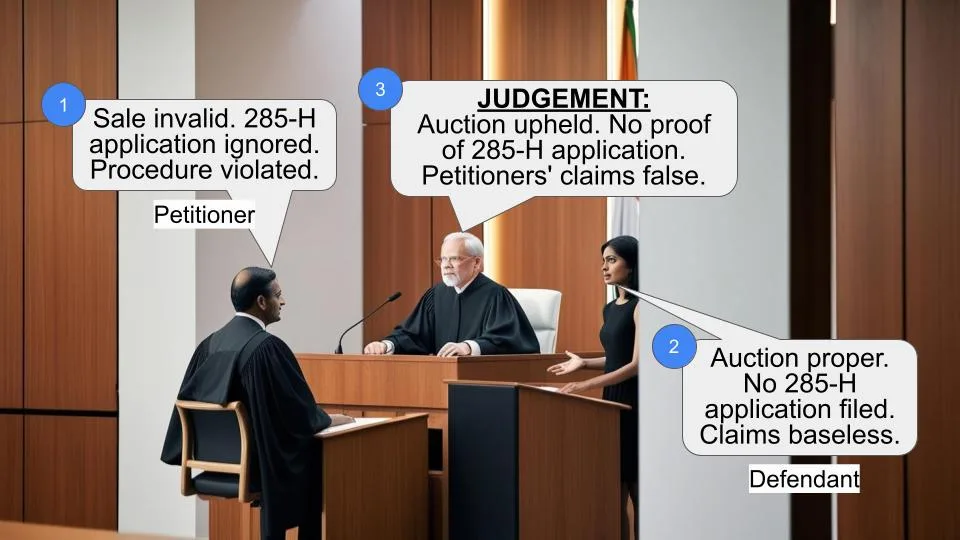
This appeal is against the judgment of the Division Bench of the High Court of Andhra Pradesh at Hyderabad in a writ petition. The main question in this appeal is whether the Income Tax Department was justified in auctioning the attached property for debt recovery. The appellant, M/s Janatha Textiles, is a registered firm with four partners. The firm and its partners had tax arrears for certain assessment years, but the demands for those years were stayed and never enforced for collection. However, the demand for the assessment year 1985-86 was enforced, and the agricultural lands owned by the partners were attached and sold in public auction. The appellant firm had a demand of Rs. 4,99,133/- for the assessment year 1985-86, along with additional amounts for interest and penalty. The total amount due from the appellants for that assessment year was Rs. 12,55,150/-. The Income Tax Department auctioned the property to recover its outstanding dues. The appellants raised objections to the auction sale, claiming that their objections were not disposed of before the sale took place. They also argued that the application for waiver of interest and the stay application were pending. They further contended that the nature of the lands in the auction notice was incorrectly mentioned as dry lands when they were actually a mango orchard and building structure. The High Court rejected the appellants' arguments and upheld the auction sale. The court stated that the appellants had an alternate remedy under the Income Tax Act but chose to file a petition before the High Court instead. The court also emphasized the principle of protecting the rights of bona fide purchasers for value and cited various precedents in support of this principle. The Supreme Court heard the appeal and upheld the judgment of the High Court. The court reiterated the distinction between a stranger bona fide purchaser at an auction sale and a decree-holder purchaser, stating that the former is afforded protection by the court. The court concluded that the auction sale was valid and dismissed the appeal. This summary provides an overview of the case and the main arguments made by the parties. It highlights the key points discussed in the judgment of the Supreme Court, which affirmed the decision of the High Court.

This appeal pertains to a judgment passed by the Division Bench of the High Court of Andhra Pradesh at Hyderabad in writ petition No.22038 of 1996 on 6.9.2001. The central question in this appeal is whether the Income Tax Department is justified in auctioning the attached property for debt recovery.
The appellant, M/s Janatha Textiles, is a registered firm with four partners. The firm and its partners had outstanding tax arrears for various assessment years, with the demands for assessment years 1986-87 to 1989-90 being stayed by different Income Tax Authorities. However, the demand for assessment year 1985-86 was enforced.
The agricultural lands owned by the partners of the appellant firm were attached and sold in a public auction on 5.8.1996, following the prescribed procedures. The highest bid was made by L. Krishna Prasad, and there were no allegations of irregularities in the auction process.
The total outstanding amount due from the appellants for the assessment year 1985-86, including tax, interest, and penalty, was Rs. 12,55,150/-. The respondent-department argued that they were justified in auctioning the property to recover their dues. The demands related to assessment years 1986-87 to 1989-90 had not been enforced due to stay orders.
The appellants contended that the respondent-department proceeded with the auction sale without disposing of their objections and that the sale was illegal and unsustainable. They also mentioned that their application for waiver of interest was pending, and their stay application was not disposed of, making the sale illegal.
The High Court failed to consider that the property mentioned in the auction notice was wrongly described as dry lands, while it was actually a mango orchard and building structure with a higher value. The appellants argued that this error alone should invalidate the auction.
The appellants further argued that the respondent-department failed to give them notice of demand concerning their share in the partnership firm, but the court found no merit in this argument as individual notices were received and no prejudice was caused.
The respondent-department stated that the auction proceedings were initiated only for the arrears related to the assessment year 1985-86 and that the appellants had an alternate remedy available under the Income Tax Act.
The case discussed the principle of protecting the rights of bona fide purchasers for value in auction sales. The court referred to various judgments, including the Privy Council's ruling in Nawab Zain-Ul-Abdin Khan v. Muhammad Asghar Ali Khan & others, to emphasize that bona fide purchasers who are strangers to the decree should be protected.
After considering the arguments and reviewing the documents, the court found no merit in the appeal and upheld the judgment of the High Court. The appeal was dismissed, and the parties were directed to bear their own costs.
Date: May 16, 2008.

1. This appeal is directed against the judgment of the
Division Bench of the High Court of Andhra Pradesh at
Hyderabad passed in writ petition No.22038 of 1996 on
6.9.2001.
2. The short question which arises for consideration in this
appeal is whether the Income Tax Department is justified in
auctioning the attached property for recovery of debt?
3. Brief facts which are necessary to dispose of this appeal
are as under:
The appellant M/s Janatha Textiles is a registered firm
with four partners viz. Radhey Shyam Modi, Pawan Kumar
Modi, Padmadevi Modi and Indira Chirmar. The firm and its
partners were in arrears of tax for the assessment years 1985-
86, 1986-87, 1987-88, 1989-90. All the demands pertaining
to assessment years 1986-87 to 1989-90 have been stayed by
various Income Tax Authorities and these demands were
never enforced for collection. The demand pertaining to
assessment year 1985-86 was alone enforced.
4. The agricultural lands owned by the partners of the
appellant firm at Bodametlapalem had been attached and sold
in public auction on 5.8.1996 after following the entire
procedure laid down under second schedule to the Income
Tax Act, 1961 (hereinafter referred to as “the 1961 Act”). Nine
people participated in the public auction held on 5.8.1996.
The sale was confirmed in favour of L. Krishna Prasad who
offered the highest price. No procedural irregularity or
illegality in public auction process was even alleged by the
appellants.
5. A demand of Rs.7,84,072/- for the assessment year
1985-86 was initially raised against the appellant firm. By
virtue of grant of partial relief in the appeal, the demand was
reduced to Rs.4,65,174/- and as against the said amount, the
appellant firm paid only Rs.4,34,927/- leaving a balance of
Rs.30,247/-. In addition to this, there was demand of
Rs.5,65,538/- raised by virtue of levy of penalty imposed
under section 271(1)(c) of the Income Tax Act, 1961 for the said
assessment year. The levy was confirmed in appeal by the
Commissioner of Income Tax (Appeals). Further demands
were also raised for a sum of Rs.2,82,160/-, Rs.3,42,518/-
and Rs.2,86,075/- at the hands of individual assessment of
appellant nos.2, 3, and 4 respectively. In the assessment year
1985-86, partial relief was granted and ultimately quantified
the amount due from the appellant firm and its partners.
After adjusting the amounts paid, the amount due as on the
date of auction for the assessment year 1985-86 stood at
Rs.4,99,133/-. In addition to these arrears, an amount of
Rs.7,56,017 fell due by way of interest. Thus, a total amount
of Rs.12,55,150/- was due from the appellants for the
assessment year 1985-86 towards tax, interest and penalty.
6. It may be pertinent to mention that the demands
relatable to assessment years 1986-87 to 1989-90 have never
been enforced because of the various stay orders by the
different Income Tax authorities.
7. Even after issuance of sale proclamation, the
respondent-department issued communication in SR No.2/94
dated 15.7.1996 informing the appellants that a sum of
Rs.5,68,913/- was due as on that date towards tax, interest
and penalty under the 1961 Act. The said amount, however,
does not include interest payable under section 220(2) (of Income Tax Act, 1961) of the
1961 Act. The appellant firm acknowledged receipt of the
letter on 17.7.1996 and had not contradicted the quantum of
tax and interest as mentioned in the said letter. It was made
clear that the demand for the assessment year 1985-86 alone
was being enforced. Therefore, it was absolutely no warrant
for the appellant to mix up the said demands relatable to the
assessment year 1985-86 in this appeal. According to the
records of the Income Tax Department, the net amount of tax,
interest and penalty due for the assessment year 1985-86 as
on the date of auction stood at Rs.12,55,150/- and hence the
respondent-department was fully justified in auctioning the
property of the appellants to recover its outstanding dues.
8. Learned counsel for the appellants contended that even
though they had filed objections at various stages of the notice
issued for the auction sale, but the respondent-department
without disposing of the said objections proceeded with the
sale and, therefore, even on that ground the sale conducted by
the respondent-department was illegal and unsustainable.
The appellants further submitted that with reference to the
assessment year 1985-86, the application for waiver of
interest was pending before the authorities and further the
stay application filed before the Commissioner was not
disposed of. Even on that count also the sale conducted by
the respondent-department on 5.8.1996 was illegal and
unsustainable.
9. It was categorically mentioned on behalf of the
respondent-department that the sale proceedings were
initiated continued only with reference to arrears relating to
the assessment year 1985-86.
10. The appellants contended that the High Court has failed
to notice that the nature of the lands in the auction notice was
wrongly mentioned as dry lands. In fact the said lands were a
mango orchard and building structure and of much higher
value. The auction ought to be vitiated on this ground alone.
11. Learned counsel for the appellants also submitted that
the appellants have received the notice of demand as
defaulters in their individual capacity and also as the partners
of the firm, however, the respondent-department has failed to
give notice of demand to the appellants qua their share in the
partnership firm. They did not receive the notices indicating
their respective shares. The appellants have raised hyper
technical ground. Admittedly, no prejudice of any kind has
been caused to the appellants when notices were received
individually by each partner of the firm both in their
individual capacity and in the capacity as a partner of the
firm. This argument of the appellants is devoid of any merit
and is accordingly rejected.
12. Learned counsel for the respondent-department
submitted that it is not the case of the assessee appellants
that they do not owe the amount to the respondent-
department towards tax for the assessment year 1985-86.
The appellants also failed to make out the case that the proper
procedure which has been laid down has not been followed by
the respondent-department in recovering its outstanding
amount. It was asserted on behalf of the respondent-
department that the amount fetched in the public auction was
more than reasonable.
13. The reserve price and the amounts fetched in the auction
are mentioned hereunder:
Name Reserve price fixed by the assessing officer (with the prior
approval of Dy. Commissioner)
Sale Value
Pawan Kumar 89,800 1,67,800
Radheshyam Modi 96,000 1,84,400
Padmadevi Modi 40,000 76,600
14. The appellants had never complained about fixing of the
reserve price before holding of auction, though they were
intimated of the same through sale proclamation.
15. In pursuance to the notice issued by this court,
respondent-department filed the counter affidavit.
Respondent no. 2 also filed a separate counter affidavit.
Respondent no. 2 in the counter affidavit stated that it is
totally incorrect to suggest that the auction sale did not fetch
the actual market value of the property. Respondent no.2 also
mentioned in the counter affidavit that the said lands are
agricultural dry lands and there are no mango gardens as
alleged by the appellants. There are however few mango trees
scattered all over the land.
16. Respondent-department in the counter affidavit stated
that the appellant firm had alternate efficacious remedy by
way of filing a petition under rules 60 (of Income Tax Rules, 1962) and 61 (of Income Tax Act, 1961) of the Second
Schedule to the 1961 Act. The appellant ought to have availed
of the statutory remedy for ventilating its grievances instead of
filing a petition before the High Court.
17. There is another very significant aspect of this case,
which pertains to the rights of the bona fide purchaser for
value. It was asserted that respondent no. 2 is a bona fide
purchaser of the property for value. It was further stated that
he had purchased the said property in a valid auction and he
cannot be disturbed according to the settled legal position.
18. It is an established principle of law that in a third party
auction purchaser’s interest in the auctioned property
continues to be protected notwithstanding that the underlying
decree is subsequently set aside or otherwise. This principle
has been stated and re-affirmed in a number of judicial
pronouncements by the Privy Council and this court.
Reliance has been placed on the following decisions.
19. The Privy Council in Nawab Zain-Ul-Abdin Khan v.
Muhammad Asghar Ali Khan & others (1887) 15 I.A. 12 for
the first time crystallized the law on this point, wherein a
three Judge Bench held as follows:
“A great distinction has been made between
the case of bona fide purchasers who are not
parties to a decree at a sale under execution and
the decree-holders themselves. In Bacon’s
Abridgment, it is laid down, citing old authorities,
that “If a man recovers damages, and hath
execution by fieri facias, and upon the fieri facias
the sheriff sells to a stranger a term for years, and
after the judgment is reversed, the party shall be
restored only to the money for which the term was
sold, and not to the term itself, because the sheriff
had sold it by the command of the writ of fieri
facias.”. So in this case, those bona fide purchasers
who were no parties to the decree which was then
valid and in force, had nothing to do further than to
look to the decree and to the order of sale.”
20. In the case of Janak Raj vs. Gurdial Singh & Another
(1967) 2 SCR 77, the Division Bench comprising Justice
Wanchoo and Justice Mitter held that in the facts of the said
case the appellant auction-purchaser was entitled to a
confirmation of the sale notwithstanding the fact that after the
holding of the sale, the decree was set aside. It was observed:
“The policy of the Legislature seems to be that
unless a stranger auction-purchaser is protected
against the vicissitudes of the fortunes of the suit,
sales in execution would not attract customers and
it would be to the detriment of the interest of the
borrower and the creditor alike if sales were allowed
to be impugned merely because the decree was
ultimately set aside or modified.”
21. In the case of Gurjoginder Singh v. Jaswant Kaur
(Smt.) & Another (1994) 2 SCC 368, this court relying on the
judgment rendered by the Privy Council held that the status of
a bona fide purchaser in an auction sale in execution of a
decree to which he was not a party stood on a distinct and
different footing from that of a person who was inducted as a
tenant by a decree-holder-landlord. It was held as follows:
“A stranger auction purchaser does not derive
his title from either the decree-holder or the
judgment-debtor and therefore restitution may not
be granted against him but a tenant who obtains
possession from the decree-holder landlord cannot
avail of the same right as his possession as a tenant
is derived from the landlord.”
22. In the case of Padanathil Ruqmini Amma v. P. K.
Abdulla (1996) 7 SCC 668, this court in para 11 observed as
under:
“11. In the present case, as the ex parte decree
was set aside, the judgment-debtor was entitled to
seek restitution of the property which had been sold
in court auction in execution of the ex parte decree.
There is no doubt that when the decree-holder
himself is the auction-purchaser in a court auction
sale held in execution of a decree which is
subsequently set aside, restitution of the property
can be ordered in favour of the judgment-debtor.
The decree-holder auction-purchaser is bound to
return the property. It is equally well settled that if
at a court auction sale in execution of a decree, the
properties are purchased by a bona fide purchaser
who is a stranger to the court proceedings, the sale
in his favour is protected and he cannot be asked to
restitute the property to the judgment-debtor if the
decree is set aside. The ratio behind this distinction
between a sale to a decree-holder and a sale to a
stranger is that the court, as a matter of policy, will
protect honest outsider purchasers at sales held in
the execution of its decrees, although the sales may
be subsequently set aside, when such purchasers
are not parties to the suit. But for such protection,
the properties which are sold in court auctions
would not fetch a proper price and the decree-
holder himself would suffer. The same
consideration does not apply when the decree-
holder is himself the purchaser and the decree in
his favour is set aside. He is a party to the litigation
and is very much aware of the vicissitudes of
litigation and needs no protection.”
23. In Para 16, the court further elaborated the distinction
between the decree-holder auction purchaser and a stranger
who is a bona fide purchaser in auction. Para 16 reads as
under:
“16. The distinction between a stranger who
purchases at an auction sale and an assignee from
a decree-holder purchaser at an auction sale is
quite clear. Persons who purchase at a court
auction who are strangers to the decree are afforded
protection by the court because they are not in any
way connected with the decree. Unless they are
assured of title; the court auction would not fetch a
good price and would be detrimental to the decree-
holder. The policy, therefore, is to protect such
purchasers. This policy cannot extend to those
outsiders who do not purchase at a court auction.
When outsiders purchase from a decree-holder who
is an auction-purchaser clearly their title is
dependent upon the title of decree-holder auction-
purchaser. It is a defeasible title liable to be
defeated if the decree is set aside. A person who
takes an assignment of the property from such a
purchaser is expected to be aware of the
defeasibility of the title of his assignor. He has not
purchased the property through the court at all.
There is, therefore, no question of the court
extending any protection to him. The doctrine of a
bona fide purchaser for value also cannot extend to
such an outsider who derives his title through a
decree-holder auction-purchaser. He is aware or is
expected to be aware of the nature of the title
derived by his seller who is a decree-holder auction-
purchaser.”
24. In the case of Ashwin S. Mehta & Another v.
Custodian & Others (2006) 2 SCC 385, this court whilst
relying upon the aforementioned two judgments stated the
principle in the following words:
“In any event, ordinarily, a bona fide
purchaser for value in an auction sale is treated
differently than a decree holder purchasing such
properties. In the former event, even if such a
decree is set aside, the interest of the bona fide
purchaser in an auction sale is saved.”
25. We have heard the learned counsel for the parties at
length and have perused the material documents on record.
26. Law makes a clear distinction between a stranger who is
a bona fide purchaser of the property at an auction sale and a
decree holder purchaser at a court auction. The strangers to
the decree are afforded protection by the court because they
are not connected with the decree. Unless the protection is
extended to them the court sales would not fetch market value
or fair price of the property.
27. In our opinion, the view taken by the High Court in the
impugned judgment is eminently just and fair. No
interference is therefore called for.
28. The appeal being devoid of any merit is accordingly
dismissed. In the facts and circumstances of the case, we
direct the parties to bear their own costs.
(Ashok Bhan)
(Dalveer Bhandari)
New Delhi;
May 16, 2008
×
Similar Ripples
Questions
"Supreme Court Dismisses Appeal Challenging Income Tax Department's Auction of Attached Property for Debt Recovery".
Write your CommentSimilar Posts

Generic
- Reportdata/2377_ODNLXOF.pdf
