


Supreme Court upholds deductibility of interest on loans for business purposes,…




Full News

Supreme Court upholds deductibility of interest on loans for business purposes, even if advanced to third parties.
Supreme Court upholds deductibility of interest on loans for business purposes, even if advanced to third par…
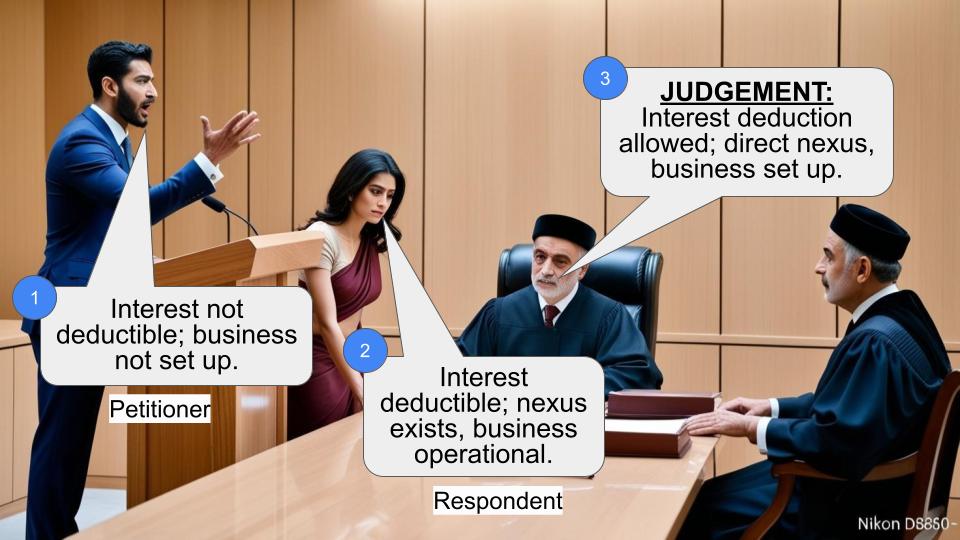
The Supreme Court ruled in favor of Hero Cycles (P) Ltd., allowing the company to claim deduction for interest paid on loans taken for business purposes, even though the funds were advanced to its subsidiary and directors. The court held that once the nexus between the expenditure and business purpose is established, the tax authorities cannot question the commercial expediency of the transaction.
Get the full picture - access the original judgement of the court order here
Case Name:
Hero Cycles (P) Ltd. vs Commissioner of Income Tax (Supreme Court)
Civil Appeal No. 514 of 2008
Date: 5th November 2015
Key Takeaways
- Interest paid on loans taken for business purposes is deductible under Section 36(1)(iii) (of Income Tax Act, 1961), even if the borrowed funds are advanced to third parties like subsidiaries or directors.
- The tax authorities cannot substitute their judgment for that of the businessman in determining what constitutes reasonable expenditure for commercial expediency.
- The expression "for the purpose of business" is wider in scope than "for the purpose of earning profits."
- The court reiterated the principle that a businessman cannot be compelled to maximize profits, and the tax authorities must view the matter from the perspective of a prudent businessman.
Issue
Whether the interest paid by Hero Cycles (P) Ltd. on borrowed funds, which were advanced to its subsidiary and directors, is deductible as a business expenditure under Section 36(1)(iii) (of Income Tax Act, 1961).
Facts
- For the Assessment Year 1988-1989, Hero Cycles (P) Ltd. claimed deduction for interest paid on borrowed funds from banks under Section 36(1)(iii) (of Income Tax Act, 1961).
- The Assessing Officer disallowed the deduction on the grounds that the borrowed funds were advanced to the company's subsidiary, Hero Fibres Limited (interest-free), and to its directors (at 10% interest).
- The Commissioner of Income Tax (Appeals) and the Income Tax Appellate Tribunal (ITAT) allowed the deduction, holding that the interest was paid for business purposes.
- The High Court, however, reversed the ITAT's decision, relying on its own judgment in another case (Commissioner of Income Tax-I, Ludhiana v. M/s. Abhishek Industries Limited).
Arguments
- Hero Cycles argued that the loans to the subsidiary and directors were given for commercial expediency and business purposes, and hence, the interest paid should be deductible.
- The Revenue contended that when loans are taken from banks for business purposes, the interest thereon cannot be claimed as a deduction if the borrowed funds are advanced to third parties.
Key Legal Precedents
1. S.A. Builders Ltd. v. Commissioner of Income Tax (Appeals) and Another [2007 (288) ITR 1 (SC)]
- The court discussed the scope of "commercial expediency" and held that the borrowed funds advanced to a third party should be for commercial expediency to claim deduction under Section 36(1)(iii) (of Income Tax Act, 1961).
- The expression "for the purpose of business" is wider than "for the purpose of earning profits.
2. Madhav Prasad Jatia v. CIT [1979 (118) ITR 200 (SC)]
- If the borrowed amount is donated for personal or sentimental reasons, and not for commercial expediency, the interest thereon cannot be allowed as a deduction under Section 36(1)(iii) (of Income Tax Act, 1961).
3. CIT v. Dalmia Cement (B.) Ltd. [2002 (254) ITR 377]
- Once the nexus between the expenditure and the purpose of business is established, the Revenue cannot question the reasonableness of the expenditure by substituting its judgment for that of the businessman.
- The tax authorities must view the matter from the perspective of a prudent businessman, who cannot be compelled to maximize profits.
Judgement
The Supreme Court allowed Hero Cycles' appeal and set aside the High Court's judgment, restoring the ITAT's order. The court held:
1. The High Court erred in not discussing the facts pertaining to the interest-free advance to the subsidiary and the loans to directors at 10% interest.
2. Relying on the precedents in S.A. Builders Ltd. and Dalmia Cement (B.) Ltd., the court held that once the nexus between the expenditure and business purpose is established, the Revenue cannot question the commercial expediency of the transaction.
3. The court agreed with the CIT (Appeals) and ITAT's findings that the loans to the subsidiary and directors were for business purposes, and the interest paid was deductible under Section 36(1)(iii) (of Income Tax Act, 1961).
4. The court reiterated that the tax authorities must view the matter from the perspective of a prudent businessman and cannot compel the assessee to maximize profits.
FAQs
Q1. What is the significance of this case?
A1. This case reinforces the principle that once the nexus between an expenditure and business purpose is established, the tax authorities cannot substitute their judgment for that of the businessman in determining the commercial expediency of the transaction. It also clarifies that the expression "for the purpose of business" is broader than "for the purpose of earning profits.
Q2. Can interest paid on loans taken for non-business purposes be deducted?
A2. No, the interest paid on loans taken for non-business purposes cannot be deducted under Section 36(1)(iii) (of Income Tax Act, 1961).
Q3. What is the significance of the precedents cited in this case?
A3. The precedents cited, such as S.A. Builders Ltd., Madhav Prasad Jatia, and Dalmia Cement (B.) Ltd., establish the legal principles regarding the deductibility of interest paid on borrowed funds advanced to third parties, the scope of "commercial expediency," and the limitations on the tax authorities in questioning the reasonableness of business expenditure.
Q4. Can the tax authorities compel a businessman to maximize profits?
A4. No, the court reiterated that the tax authorities cannot compel a businessman to maximize profits. They must view the matter from the perspective of a prudent businessman, who may have valid reasons for incurring certain expenditures that may not directly lead to profit maximization.
Q5. What is the impact of this case on future tax disputes?
A5. This case strengthens the position of taxpayers in claiming deductions for interest paid on borrowed funds advanced to third parties, as long as the nexus with business purposes is established. It also reinforces the principle that the tax authorities cannot substitute their judgment for that of the businessman in determining the commercial expediency of a transaction.

The present appeal preferred by the assessee pertains to the Assessment Year 1988-1989. In the income tax return filed by the assessee for the aforesaid Assessment year, the assessee, inter alia, claimed deduction of interest paid on borrowed sums from Bank under the provisions of Section 36(1)(iii) (of Income Tax Act, 1961) (hereinafter referred to as 'Act'). The aforesaid deduction was disallowed by the Assessing Officer vide his Assesssment Order dated 26.03.1991 on the following two points: -
(1) The assessee had advanced a sum of Rs.1,16,26,128/- to its subsidiary company known as M/s. Hero Fibers Limited and this advance did not carry any
interest. According to the Assessing Officer, the assessee had borrowed the money from the banks and paid interest thereupon. Deduction was claimed as business expenditure but substantial money out of the loans taken from the Bank was diverted by giving advance to M/s. Hero Fibres Limited on which no interest was charged by the assessee. Therefore, he concluded that money borrowed on which interest was paid was not for business purposes and no deduction could be allowed.
(2) In addition, the assessee had also given advances to its own directors in the sum of Rs. 34 lakhs on which the assessee charged from those directors interest at the rate of 10 per cent, whereas interest payable on the money taken by way of loans by the assessee from the Banks carried interest at the rate of 18 per cent. On that basis, the Assessing Officer held that charging of interest at the rate of 10 per cent from the above
mentioned persons and paying interest at much more rate, i.e., at the rate of 18 per cent on the money borrowed by the assessee cannot be treated for the purposes of business of the assessee.
We may note here that the assessee had claimed deduction of interest in the sum of Rs.20,53,120/-. The Assessing Officer, after recording the aforesaid reasons, did not allow the deduction of the entire amount and re-calculated the figures, thereby disallowed the aforesaid claim to the extent of Rs.16,39,010/-.
The assessee carried the matter in appeal before the Commissioner of Income Tax (Appeals). The CIT (Appeals) set aside the order of the Assessing Officer holding that the interest paid by the assessee of which deduction was claimed, on the facts of this case, was for business purposes and, therefore, the entire interest paid by the assessee should have been allowed as business expenditure.
It would be pertinent to mention that insofar as the advance given to M/s. Hero Fibres Limited is concerned, the case put up by the assessee even before the Assessing Officer was that it had given an undertaking to the
financial institutions to provide M/s. Hero Fibres Limited the additional margin to meet the working capital for meeting any cash loses. It was further explained that the assessee company was promotor of M/s. Hero Fibres Limited and since it had the controlling share in the said company
that necessitated giving of such an undertaking to the financial institutions. The amount was, thus, advanced in compliance of the stipulation laid down by the three financial institutions under a loan agreement which was entered into between M/s. Hero Fibres Limited and the said financial institutions and it became possible for the financial institutions to advance that loan to M/s. Hero Fibres Limited because of the aforesaid undertaking given by the assessee. It was also mentioned that no interest was to be paid on this loan unless dividend is paid by that company.
On that basis, it was argued that the amount was advanced by way of business expediency. CIT (Appeals) accepted the aforesaid plea of the assessee.
Insofar as the loan given to its own Directors is concerned at the rate of 10 per cent is concerned, the explanation of the assessee was that this loan was never given out of any borrowed funds. The assessee had demonstrated that on the date when the loan was given that is on 25.03.1987 to these directors, there was a credit balance in the account of the assessee from where the loan was given. It was demonstrated that even after the encashment of the cheques of Rs. 34 lakhs in favour of those directors by way of loan, there was a credit balance of Rs.4,95,670/- in the said bank account. The aforesaid explanation was also accepted by the CIT (Appeal) arriving at a finding of fact that the loan given to the Directors was not from the borrowed funds. Therefore, interest liability of the assessee towards the Bank on the borrowing which was taken by the assessee had no bearings because otherwise, the assessee had sufficient funds of its own
which the assessee could have advanced and it was for the Assessing Officer to establish the nexus between the borrowings and advancing to prove that expenditure was for non-business purposes which the Assessing Officer failed to do.
The Department/ Revenue challenged the order of the CIT(Appeal) before the Income Tax Appellate Tribunal (hereinafter referred to as 'ITAT'). The ITAT upheld the aforesaid view of the CIT(Appeal) and thus, dismissed the appeal preferred by the Revenue.
Further appeal of the Revenue before the High Court filed under Section 260A (of Income Tax Act, 1961), however, has been allowed by the High Court vide impugned judgment dated 06.12.2006. Challenging that judgment, special leave
petition was filed in which leave was granted and that is how the present appeal comes up for hearing.
A perusal of the order passed by the High Court would reveal that the High Court has not at all discussed the aforesaid facts which were established on record pertaining to the interest free advance given to M/s. Hero Fibres
Limited as well as loans given to its own Directors at interest at the rate of 10 per cent.
On the other hand, the High Court has simply quoted from its own judgment in the case of 'Commissioner of Income Tax-I, Ludhiana v. M/s. Abhishek Industries Limited, Ludhiana' [ITA No. 110/2005 decided on 04.08.2006]. On that basis, it has held that when loans were taken from the banks at which interest was paid for the purposes of business, the interest thereon could not be claimed as business expenditure.
We are of the opinion that such an approach is clearly faulty in law and cannot be countenanced. Insofar as loans to the sister concern / subsidiary
company are concerned, law in this behalf is recapitulated by this Court in the case of 'S.A. Builders Ltd. v. Commissioner of Income Tax (Appeals) and Another' [2007 (288) ITR 1 (SC)]. After taking note of and discussing on
the scope of commercial expediency, the Court summed up the legal position in the following manner: -
“26. The expression “commercial expediency” is an expression of wide import and includes such expenditure as a prudent businessman incurs for the
purpose of business. The expenditure may not have been incurred under any legal obligation, but yet it is allowable as a business expenditure if it was incurred on grounds of commercial expediency.
27. No doubt, as held in Madhav Prasad Jatia v. CIT [1979 (118) ITR 200 (SC)], if the borrowed amount was donated for some sentimental or personal reasons and not on the ground of commercial expediency, the interest thereon could not have been allowed under section 36(1)(iii) (of Income Tax Act, 1961). In Madhav Prasad's case [1979 (118) ITR 200 (SC)], the borrowed amount was donated to a college with a view to commemorate the memory of the assessee's deceased husband after whom the college was to be named, it was held by this court that the interest on the borrowed fund in such a case could not be allowed, as it could not be said that it was for commercial expediency.
28. Thus, the ratio of Madhav Prasad Jatia's case [1979 (118) ITR 200 (SC)] is that the borrowed fund advanced to a third party should be for commercial
expediency if it is sought to be allowed under section 36(1)(iii) (of Income Tax Act, 1961).
29. In the present case, neither the High Court nor the Tribunal nor other authorities have examined whether the amount advanced to the sister concern was by way of commercial expediency.
30. It has been repeatedly held by this court that the expression “for the purpose of business” is wider in scope than the expression “for the purpose of earning profits” vide CIT v. Malayalam Plantations Ltd. [1964 53 ITR 140 (SC), CIT v. Birla Cotton Spinning and Weaving Mills Ltd. [1971 82 ITR 166 (SC)], etc.”
In the process, the Court also agreed that the view taken by the Delhi High Court in 'CIT v. Dalmia Cement (B.) Ltd.' [2002 (254) ITR 377] wherein the High Court had held that once it is established that there is nexus between the expenditure and the purpose of business (which need not necessarily be the business of the assessee itself), the Revenue cannot justifiably claim to put itself in the arm-chair of the businessman or in the position of the Board of Directors and assume the role to decide how much is reasonable expenditure having regard to the circumstances of the case. It further held that no businessman can be compelled to maximize his profit and that the income tax authorities must put themselves in the shoes of the assessee
and see how a prudent businessman would act. The authorities must not look at the matter from their own view point but that of a prudent businessman.
Applying the aforesaid ratio to the facts of this case as already noted above, it is manifest that the advance to M/s. Hero Fibres Limited became imperative as a business expediency in view of the undertaking given to the financial institutions by the assessee to the effect that it would provide additional margin to M/s. Hero Fibres Limited to meet the working capital for meeting any cash loses. It would also be significant to mention at this stage that, subsequently, the assessee company had off-loaded its share holding in the said M/s. Hero Fibres Limited to various companies of Oswal Group and at that time, the assessee company not only refunded back the entire loan given to M/s. Hero Fibres Limited by the assessee but this
was refunded with interest. In the year in which the aforesaid interest was received, same was shown as income and offered for tax.
Insofar as the loans to Directors are concerned, it could not be disputed by the Revenue that the assessee had a credit balance in the Bank account when the said advance of Rs. 34 lakhs was given. Remarkably, as observed by the CIT (Appeal) in his order, the company had reserve/surplus to the tune of almost 15 crores and, therefore, the assessee company could in any case, utilise those funds for giving advance to its Directors.
On the basis of aforesaid discussion, the present appeal is allowed, thereby setting aside the order of the High Court and restoring that of the Income Tax Appellate Tribunal.
[ A.K. SIKRI ]
[ ROHINTON FALI NARIMAN ]
New Delhi;
November 05, 2015.
×
Similar Ripples
Questions
Supreme Court upholds deductibility of interest on loans for business purposes, even if advanced to third parties.
Write your CommentSimilar Posts


Generic
- Reportdata/SC-514-2008.pdf
