Supreme Court upholds exemption under Section 10(10C) (of Income Tax Act, 1961)…


Full News
Supreme Court upholds exemption under Section 10(10C) (of Income Tax Act, 1961) for RBI employees' voluntary retirement scheme
Supreme Court upholds exemption under Section 10(10C) (of Income Tax Act, 1961) for RBI employees' voluntary …
This case revolves around the applicability of income tax exemption under Section 10(10C) (of Income Tax Act, 1961) for employees who opted for the Voluntary Retirement Scheme (VRS) framed by the Reserve Bank of India (RBI). The court ruled in favor of the employees, stating that they are eligible for the exemption, despite the Income Tax Department's initial objections based on Rule 2BA (of Income Tax Rules, 1962).
For a comprehensive understanding, check out the original judgement of the court order here."
Case Name
R.M. Lakshmanan VS Commissioner of Income Tax (High Court of Madras)
W.P(MD)No.11225 of 2012
Key Takeaways
1. Employees who opted for RBI's Voluntary Retirement Scheme are eligible for exemption under Section 10(10C) (of Income Tax Act, 1961).
2. Rule 2BA (of Income Tax Rules, 1962) cannot exceed the provisions of the Act.
3. The Supreme Court's decision in this case has set a precedent for similar cases involving VRS schemes.
Issue
Is the exemption under Section 10(10C) (of Income Tax Act, 1961) applicable to employees who had taken benefit of the Voluntary Retirement Scheme framed by RBI, even if the scheme doesn't strictly conform to Rule 2BA (of Income Tax Rules, 1962)?
Facts
1. The case originated from a writ petition challenging a demand notice issued by the Income Tax Department on 30.12.2011.
2. The petitioner was an employee of ICICI Bank who had opted for a Voluntary Retirement Scheme.
3. The Income Tax Department initially denied exemption under Section 10(10C) (of Income Tax Act, 1961), claiming the VRS didn't conform to Rule 2BA (of Income Tax Rules, 1962).
4. The case went through various stages of litigation, including decisions by the Bombay High Court and the Supreme Court.
Arguments
- Income Tax Department:
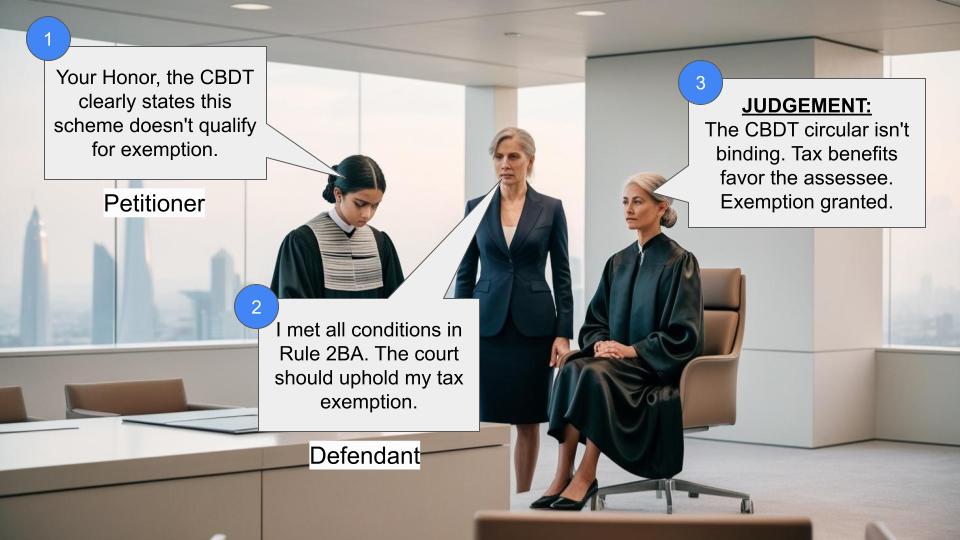
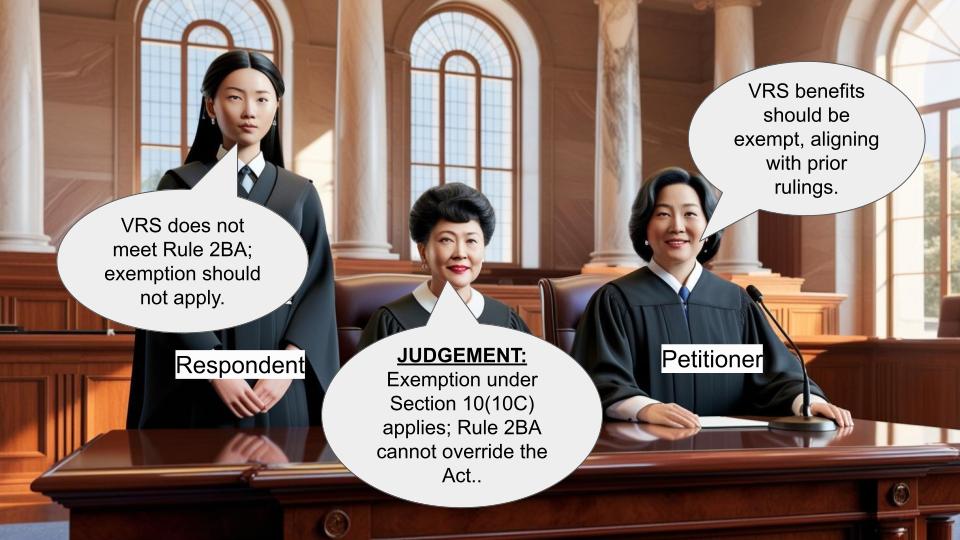
The VRS doesn't strictly conform to Rule 2BA (of Income Tax Rules, 1962), so exemption under Section 10(10C) (of Income Tax Act, 1961) shouldn't apply.
- Petitioner: The Supreme Court and Bombay High Court have already ruled in favor of such exemptions. Rule 2BA (of Income Tax Rules, 1962) cannot exceed the provisions of the Act.
Key Legal Precedents
1. Commissioner of Income Tax vs. Koodathil Kallyatan Ambujakshan (2008) 219 CTR (Bom) 80:
The Bombay High Court held that exemption under Section 10(10C) (of Income Tax Act, 1961) was applicable to RBI employees who took VRS.
2. Chandra Ranganathan & Ors. vs. Commissioner of Income Tax, Chennai (Civil Appeal Nos.6997-7002 of 2009):
The Supreme Court declared that retiring RBI employees would be eligible for exemption under Section 10(10C) (of Income Tax Act, 1961).
3. Mr. S. Parthasarathy vs. The Assistant Commissioner of Income Tax Salary Circle III, Chennai-34 (Tax Case (Appeal) Nos.1210, 1217, 1249 and 1250 of 2009):
The Division Bench of the High Court held that if the tax effect is below Rs.2,00,000/-, the Department need not file an appeal to the Tribunal.
Judgement
The court ruled in favor of the petitioner, allowing the Writ Petition and setting aside the demand notice dated 30.12.2011. The court held that:
1. The exemption under Section 10(10C) (of Income Tax Act, 1961) is applicable to employees who took benefit of the VRS framed by RBI.
2. Rule 2BA (of Income Tax Rules, 1962) cannot exceed the provisions of the Act.
3. The demand made by the Income Tax Department is not sustainable in law.
FAQs
Q1: What is Section 10(10C) (of Income Tax Act, 1961)?
A1: It's a provision that allows for tax exemption on amounts received by employees under voluntary retirement schemes, up to a limit of Rs. 5,00,000/-
Q2: Why was there a dispute about the applicability of this exemption?
A2: The Income Tax Department initially argued that the VRS didn't conform to Rule 2BA (of Income Tax Rules, 1962), which specifies conditions for such schemes.
Q3: What was the significance of the Bombay High Court's decision in this case?
A3: The Bombay High Court's decision in the Koodathil Kallyatan Ambujakshan case set a precedent by ruling that the exemption should apply to RBI employees who took VRS.
Q4: How did the Supreme Court's decision impact this case?
A4: The Supreme Court's decision in the Chandra Ranganathan case confirmed that retiring RBI employees are eligible for the exemption under Section 10(10C) (of Income Tax Act, 1961), strengthening the petitioner's case.
Q5: What's the key principle established by this judgment?
A5: The judgment establishes that Rule 2BA (of Income Tax Rules, 1962) cannot exceed the provisions of the Act, and that the exemption under Section 10(10C) (of Income Tax Act, 1961) should be interpreted in favor of the employees who opted for VRS.

1. Challenging the demand notice dated 30.12.2011 issued by the Income Tax Department, the writ petitioner is before this Court.
2. According to the petitioner, he is an employee of ICICI Bank. The Bank has introduced the Voluntary Retirement Scheme, by which, a consolidated payment was made to the employees. Under Chapter III of the Income Tax Act, 1961, the incomes not included in total income are specified, in which, the agricultural income and income received by an individual as a member of a Hindu undivided family are exempted and so many other exemptions are there.
3. Insofar as this case is concerned, Section 10(10C) (of Income Tax Act, 1961), 1961, is relevant, which reads as under:
"10(10C)- any amount received or receivable by an employee of -
(i) a public sector company; or
(ii) any other company; or
(iii) an authority established under a Central, State or Provincial Act; or
(iv) a local authority ; or
(v) a co-operative society; or
(vi) a University established or incorporated by or under a Central, State or Provincial Act and an institution declared to be a University under section 3 of the University Grants Commission Act, 1956 (3 of 1956);
(vii) an Indian Institute of Technology within the meaning of clause (g) of section 3 of the Institutes of Technology Act, 1961 (59 of 1961) ; or
(viia) any State Government; or
(viib) the Central Government; or
(viic) an institution, having importance throughout India or in any State or States, as the Central Government may, by notification in the Official Gazette, specify in this behalf; or
(viii) such institute of management as the Central Government may, by notification in the Official Gazette, specify in this behalf, On his voluntary retirement or termination of his service, in accordance with any scheme or schemes of voluntary retirement or in the case of a public sector company referred to in sub-clause (i), a scheme of voluntary separation, to the extent such amount does not exceed five lakh rupees;
Provided that the schemes of the said companies or authorities or societies or Universities or the Institutes referred to in sub-clauses (vii) and (viii), as the case may be, governing the payment of such amount are framed in accordance with such guidelines including inter alia criteria of economic viability as may be prescribed:
Provided further that where exemption has been allowed to an employee under this clause for any assessment year, no exemption thereunder shall be allowed to him in relation to any other assessment year:
Provided also that where any relief has been allowed to an assessee under section 89 (of Income Tax Act, 1961) for any assessment year in respect of any amount received or receivable on his voluntary retirement or termination of service or voluntary separation, no exemption under this clause shall be allowed to him in relation to such, or any other, assessment year."
4. Clause (viii) of Section 10(10C) (of Income Tax Act, 1961) specified a limit of Rs.5,00,000/-.
Rule 2BA (of Income Tax Rules, 1962) reads as under:
"2BA. The amount received by an employee of-
(i) a public sector company; or
(ii) any other company; or
(iii) an authority established under a Central, State or Provincial Act; or
(iv) a local authority; or
(v) a co-operative society; or
(vi) a University established or incorporated by or under a Central, State or Provincial Act and an institution declared to be a University under section 3 of the University Grants Commission Act, 1956 (3 of 1956); or
(vii) an Indian Institute of Technology within the meaning of clause (g) of section 3 of the Institutes of Technology Act, 1961 (59 of 1961); or
(viia) an institution, having importance throughout India or in any State or States, as the Central Government may, by notification in the Official Gazette, specify in this behalf; or
(viii) such institute of management as the Central Government may, by notification in the Official Gazette, specify in this behalf, at the time of his voluntary retirement or voluntary separation shall be exempt under clause (10C) of section 10 (of Income Tax Act, 1961) only if the scheme of voluntary retirement framed by the aforesaid company or authority or co-operative society or University or institute, as the case may be or if the scheme of voluntary separation framed by a public sector company, is in accordance with the following requirements, namely:-
(i) it applies to an employee who has completed 10 years of service or completed 40 years of age;
(ii) it applies to all employees by whatever name called including workers and executives of a company or of an authority or of a co-operative society, as the case may be, excepting directors of a company or of a co- operative society;
(iii) the scheme of voluntary retirement or voluntary separation has been drawn to result in overall reduction in the existing strength of the employees;
(iv) the vacancy caused by the voluntary retirement or voluntary separation is not to be filled up;
(v) the retiring employee of a company shall not be employed in another company or concern belonging to the same management;
(vi) the amount receivable on account of voluntary retirement or voluntary separation of the employee does not exceed the amount equivalent to three months salary for each completed year of service or salary at the time of retirement multiplied by the balance months of service left before the date of his retirement on superannuation:
Provided that requirement of (i) above would not be applicable in case of amount received by an employee of a public sector company under the scheme of voluntary separation framed by such public sector company."
5. According to the rule, any Scheme shall be in conformity with Rule 2BA (of Income Tax Rules, 1962).
6. According to the Income Tax Department, Voluntary Retirement Scheme issued by the ICICI Bank is not in conformity with the Rules. Therefore, the employees are not entitled to any exemption under Section 10(10C) (of Income Tax Act, 1961), 1961 (hereinafter referred to as "the Act").
7. The said Voluntary Retirement Scheme was put to judicial scrutiny in view of Rule 2BA (of Income Tax Rules, 1962). There were different views by various High Courts. Ultimately, in the judgment of Commissioner of Income Tax vs. Koodathil Kallyatan Ambujakshan (2008) 219 CTR (Bom) 80, the Bombay High Court in the case of Voluntary Retirement Scheme framed by RBI has held that the exemption under Section 10(10C) (of Income Tax Act, 1961) was applicable to the employees, who had taken benefit of the Scheme framed by RBI and observed as under:
"10........... Merely because the scheme may not expressly set out that the posts will not be filled in cannot result in the scheme not being a scheme falling under s.10(10C) r/w r.2BA (of Income Tax Rules, 1962), bearing in mind the procedural nature of the rules. It will have to be read in harmonious construction with the substantive provisions of the Act so as not to render it ultra vires the provisions of the substantive provisions of the Act."
Against the judgment of the Bombay High Court, the Income Tax Department has not preferred any appeal and the judgment has attained finality. However, in the case of Chandra Ranganathan & Ors. vs. Commissioner of Income Tax, Chennai, dated 21.10.2009, in Civil Appeal Nos.6997 - 7002 of 2009, the Hon'ble Supreme Court declared that the retiring employees of the RBI would be eligible for exemption under Section 10(10C) (of Income Tax Act, 1961) and set aside the order passed by the High Court, based on the circular issued by the Income Tax Department.
8. It is pertinent to note that pursuant to the judgment of the Bombay High Court in Commissioner of Income Tax vs. Koodathil Kallyatan Ambujakshan (2008) 219 CTR (Bom) 80, the Income Tax Department issued a circular that the retiring employees of RBI would be eligible for exemption under Section 10(10C) (of Income Tax Act, 1961), 1961.
9. While the matter stood thus, the Hon'ble Division Bench of this Court in Tax Case (Appeal) Nos.1210, 1217, 1249 and 1250 of 2009, dated 23.12.2009 [Mr.S.Parthasarathy vs. The Assistant Commissioner of Income Tax Salary Circle III, Chennai-34], has held that if the tax effect is below Rs.2,00,000/-, which has been prescribed as a monetary limit by the circular of the Central Board of Direct Taxes in Instruction No.2/2005, dated 24.10.2005, the Department need not have to file an appeal to the Tribunal and the circular has not been taken into consideration by the Tribunal and set aside the impugned demands.
10. In the instant case also, the impugned notice specifies the sum of Rs.3,08,162/- for the assessment year 2004-2005. As per Section 10(10C) (of Income Tax Act, 1961), the individual is entitled to exemption upto Rs. 5,00,000/-. According to the petitioner, the Hon'ble Supreme Court as well as Bombay High Court have categorically held that the employees are eligible for exemption under Section 10(10C) (of Income Tax Act, 1961). Rule 2BA (of Income Tax Rules, 1962), cannot exceed the provisions of the Act. Therefore, the demand made by the Income Tax Department is per se illegal and is not sustainable any further.
11. As discussed above, the matter has attained finality in Commissioner of Income Tax vs. Koodathil Kallyatan Ambujakshan (2008) 219 CTR (Bom) 80 and the same is confirmed by the Hon'ble Supreme Court in Chandra Ranganathan & Ors. vs. Commissioner of Income Tax, Chennai, dated 21.10.2009, in Civil Appeal Nos.6997 - 7002 of 2009. Thereafter, the Special Leave Petitions filed in respect of orders of the Division Bench of this Court in S.L.P.Nos.5281 - 5339/2014,etc., batch were dismissed by the Hon'ble Supreme Court leaving the M.GOVINDARAJ, J.
question of law kept open, by an order dated 08.10.2014 and again, in Civil Appeal Nos.8908 of 2013, etc., batch, except Civil Appeal Nos.51 of 2010 and 4411 of 2010, all other appeals were dismissed by a common order dated 28.01.2015. This Court respectfully follow the decision of the Hon'ble Supreme Court and the Hon'ble Division Bench of this Court. Therefore, the demand made by the Income Tax Department is not sustainable in law. Accordingly, the Writ Petition is allowed and the impugned demand notice dated 30.12.2011 is set aside. No costs. Consequently, the connected miscellaneous petition is closed.
09.04.2018
Index : Yes / No (2/2)
Internet : Yes / No
Order made in
W.P(MD)No.11225 of 2012
×