


Tax Appeal Dismissed: High Court Upholds Tribunal's Decision on Gross Profit, C…



Full News
Tax Appeal Dismissed: High Court Upholds Tribunal's Decision on Gross Profit, Cash Credits, and Subsidies
Tax Appeal Dismissed: High Court Upholds Tribunal's Decision on Gross Profit, Cash Credits, and Subsidies
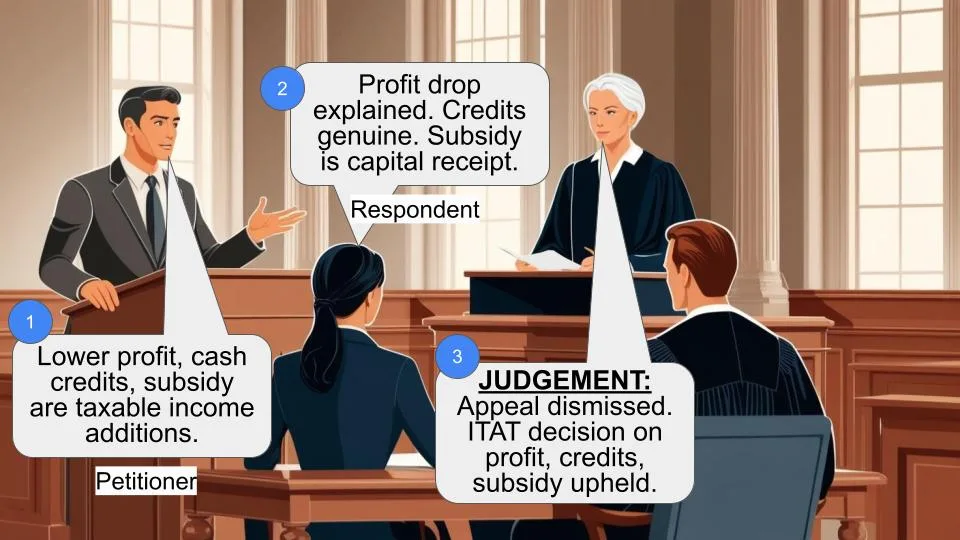
The tax department (Principal Commissioner of Income Tax) appealed against a company called Talbros Engineering Ltd. The tax folks weren't happy with some decisions made by the Income Tax Appellate Tribunal (ITAT) for the 2005-06 assessment year. The High Court looked at the case and basically said, "Nah, the ITAT got it right." They dismissed the tax department's appeal.
Get the full picture - access the original judgement of the court order here
Case Name:
Principal Commissioner of Income Tax vs. Talbros Engineering Ltd. (High Court of Punjab & Haryana)
ITA No.354 of 2015
Date: 25th April 2016
Key Takeaways:
1. The court emphasized that books of account can't be rejected solely based on a decline in gross profit rate.
2. When it comes to cash credits, if a taxpayer provides sufficient evidence of genuineness, the tax department needs to do more than just demand the physical presence of creditors.
3. The nature and purpose of a subsidy determine whether it's a capital or revenue receipt for tax purposes.
Issue:
The main question here was: Did the Income Tax Appellate Tribunal (ITAT) make the right call when it agreed with the CIT(A) and deleted certain additions made by the Assessing Officer to Talbros Engineering Ltd.'s income?
Facts:
1. Talbros Engineering Ltd. filed a tax return for 2005-06, declaring an income of ₹1,46,73,940.
2. The Assessing Officer wasn't convinced and assessed their income at ₹4,18,94,110, making some hefty additions.
3. The main additions were:
a) ₹1,19,93,081 due to an unexplained drop in gross profit rate
b) ₹45,94,710 for cash credits under Section 68 (of Income Tax Act, 1961)
c) ₹21,68,938 for a sales tax subsidy
4. The company appealed to the CIT(A), who sided with them and deleted these additions.
5. The tax department then went to the ITAT, who agreed with the CIT(A).
6. Not happy with this, the tax folks took it to the High Court.
Arguments:
The tax department argued:
1. The fall in gross profit rate from 18.52% to 15.71% was unexplained and suspicious.
2. The company couldn't prove the creditworthiness of certain deposits.
3. The sales tax subsidy should be treated as revenue, not capital.
The company countered:
1. The drop in profit was due to increased steel prices.
2. They provided details of depositors, including PAN numbers and bank accounts.
3. The subsidy was for setting up a unit in a rural area, making it a capital receipt.
Key Legal Precedents:
1. The court mentioned there are numerous precedents stating that books can't be rejected just because of a profit rate decline.
2. For the subsidy issue, they referred to Sahney Steel and Pass Works Limited vs. CIT (228 ITR 253).
3. They also cited Sulzer India Limited vs. DCIT (2010) 134 TTJ(Mum.) (SD) 385, upheld by the Bombay High Court, regarding deferred sales tax liability.
Judgement:
The High Court dismissed the tax department's appeal. They agreed with the ITAT on all points:
1. The books couldn't be rejected just because of a profit rate drop, especially when the company explained it was due to increased steel prices.
2. On cash credits, the court felt the company provided enough evidence of genuineness.
3. For the subsidy, they agreed it was a capital receipt as it was meant to encourage setting up industries in rural areas.
FAQs:
1. Q: Why did the court side with the company on the gross profit issue?
A: The court felt that a decline in gross profit alone isn't enough to reject books of account, especially when the company explained it was due to increased raw material costs.
2. Q: What's the deal with the cash credits?
A: The court believed that if a taxpayer provides sufficient evidence (like PAN numbers and bank details), the tax department should do more than just demand physical presence of depositors.
3. Q: Why was the sales tax subsidy considered a capital receipt?
A: The subsidy was given to encourage setting up industries in rural areas, not for day-to-day operations. The purpose of the subsidy determines its nature for tax purposes.
4. Q: Does this case set any new precedents?
A: Not really. It reinforces existing principles about how to treat gross profit variations, cash credits, and subsidies in tax assessments.
5. Q: What's the main takeaway for businesses from this judgment?
A: Keep good records! If you can explain changes in your financials and provide evidence for transactions, you're in a much stronger position if the tax department comes knocking.

1. This appeal has been preferred by the revenue under Section 260A (of Income Tax Act, 1961) (in short, “the Act”) against the order dated 19.1.2015, Annexure A.III, passed by the Income Tax Appellate Tribunal, New Delhi (In short, “the Tribunal”) in ITA No.534/Del/2009 for the assessment year 2005-06, claiming following substantial questions of law:-
“1. Whether on the facts and in the circumstances, the Hon'ble ITAT was right in law in upholding the order of learned CIT(A) in deleting the addition of ` 1,19,93,081/- made by the Assessing Officer on account of unexplained fall in GP especially when the assessee failed to explain the reason for fall in GP rate from 18.52% in the lst year to 15.71% during the year under consideration?
2. Whether on facts and circumstances of the case, the learned ITAT was justified in law in upholding the deleting of the addition on account of lower GP although the assessee has failed to substantiate continuous fall of gross profit over the years as analyzed along the parameters given by the Assessing Officer either before the Assessing Officer, the CIT(A) and before the learned ITAT?
3. Whether on facts and circumstances of the case, the learned ITAT was justified in law in upholding the deletion of addition on account of low gross profit by holding that the books of account of the assessee could not be rejected by the Assessing Officer despite the Assessing Officer's findings based on hard data that correct profits could not be deduced from the assessee's books?
4. Whether on the facts and in the circumstances, the Hon'ble ITAT was right in law in upholding the order of learned CIT(A) in deleting the addition of ` 45,94,710/- made by the Assessing Officer on account of cash credit under section 68 (of Income Tax Act, 1961) especially when the assessee had failed to prove the creditworthiness of the deposits despite specific requirement?
5. Whether on the facts and in the circumstances, the Hon'be ITAT was right in law in upholding the order of learned CIT(A) in deleting the addition of ` 21,68,938/- made by the Assessing Officer on account of capital subsidy on sales tax even though the assessee's business was already in existence and the subsidy was given after the commencement of production and was not for setting up of the industry and that the same is in contravention of the decision of Hon'ble Supreme court in the case of Sahney Steel & Press Works Limited etc. vs. CIT reported in 228 ITR 253 (SC)?”
2. A few facts relevant for the decision of the controversy involved as narrated in the appeal may be noticed. Return of income declaring total income of ` 1,46,73,940/- was filed by the assessee company on 31.10.2005. Assessment was completed under section 144 (of Income Tax Act, 1961) by making certain additions at an assessed income of ` 4,18,94,110/- vide order dated 18.12.2007, Annexure A.1. Firstly, the Assessing Officer made an addition of ` 1,19,93,081/- on account of unexplained fall in GP rate as compared to the immediately preceding year. The CIT(A) deleted the addition holding that no difference or defect had been detected by the Assessing Officer in the purchases and in the turnover of the company which had been accepted by the Assessing Officer. Aggrieved by the order,the revenue filed appeal before the Tribunal. The Tribunal upheld the deletion made by the CIT(A). Secondly, the Assessing Officer made an addition of 45,94,710/- on account of cash credit under section 68 (of Income Tax Act, 1961) since the assessee had failed to prove the creditworthiness of the deposits despite specific requirement. The CIT(A) on appeal by the assessee deleted the addition holding that the Assessing Officer had not given any adverse remarks and the assessee had furnished elaborate details regarding the deposits of such depositors giving their PAN Nos. and the bank accounts showing all particulars. On appeal by the revenue, the Tribunal upheld the order passed by the CIT(A) observing that the assessee had proved the genuineness of the depositors and once the receipt of deposits amounting to ` 44 lacs from the depositors was held to be genuine,the consequent disallowance of interest amounting to ` 1,94,710/- by the Assessing Officer would automatically stand deleted. Thirdly, the Assessing Officer made an addition of ` 21,68,938/- on account of capital subsidy on sales tax. The CIT(A) deleted the said addition holding that the subsidy was given not to enable the assessee to run the business more profitably but in setting up of the industry in a remote rural area. On appeal by the revenue,the Tribunal upheld the decision taken by the CIT(A) observing that the exercise of option by the assessee in paying half of the amount of deferred tax upfront thereby retaining the remaining half as subsidy cannot convert the otherwise capital subsidy into an item of revenue. Hence the instant appeal by the revenue.
3. We have heard learned counsel for the parties.
4. Detailed findings have been recorded by the Tribunal upholding the deletions made by the CIT(A) on all the issues. The first issue was with regard to addition of ` 1,19,93,981/- made by the Assessing Officer on account of fall in GP rate from 18.52% in the preceding year to 15.71% during the year in question. During the assessment proceedings, it was noticed by the Assessing Officer that the GP rate of the assessee had reduced from 18.52% from the preceding year to 15.71%. On being asked,the assessee explained that there was an increase in the prices of steel round bar during the year which led to the decline in the gross profit rate. The Assessing Officer observed that certain expenses forming part of the computation of the gross profit had reduced as a percentage of sales in comparison with the preceding year. Rejecting the books of account, the Assessing Officer adopted the gross profit rate of the preceding year at 18.52% which resulted into making of GP addition of ` 1.19 crore. The CIT(A) on appeal by the assessee deleted the addition holding that the Assessing Officer had assigned no reason for rejecting the books of account.
The Assessing Officer had not controverted the quantity or value of the closing and opening inventory. The books of account were properly maintained by the assessee. It had maintained all the stock registers required for the purposes of the payment of excise duty. The Tribunal upheld the said findings. The relevant findings recorded by the Tribunal on this issue read thus:-
“4. After considering the rival submissions and perusing the relevant material on record, it is observed that the assessee filed certain additional evidence before the learned CIT(A), who chose to seek remand report from the Assessing Officer, a copy of which is available on pages 88 to 92 of the department paper book. Coming back to the merits of this ground, it can be seen that the Assessing Officer has assigned no reason for rejecting the books of account other than a decline in the gross profit rate. It is matter of record that the assessee is engaged in a manufacturing activity and has maintained all the stock registers required for the purposes of the payment of excise duty. The Assessing Officer has not controverted the quantity or value of the closing and opening inventory. There is no dearth of judicial precedents unanimously holding that books of account cannot be rejected on the solitary reason of decline in the gross profit rate. Since the Assessing Officer was swayed only by the decline in the GP rate to reject the books of account without anything else, we are of the considered opinion that such an action of the Assessing Officer has no sanction of law. The assessee has placed on record a copy of chart, which was also filed before the Assessing Officer to demonstrate that there has been an alarming increase in the price of steel round bar. For example, the rate per mt. of raw material purchased from RINL increased from 20,350/- in the preceding year to ` 26,900/- in the current year, thereby registering an increase of 32%. In the like manner, there is increase in the rate of raw material from other parties ranging between 19% to 36%. This chart indicates that the input costs became costly in the instant year in comparison with the rates prevailing in the preceding year which led to the reduction in the overall profitability. The AO has not contradicted the contents of such chart. When we consider this factor pushing down the gross profit rate coupled with fact that the Assessing officer has not pointed out any mistake in the quantitative records maintained by the assessee or the value of the closing stock, the only conclusion which in our considered opinion can be drawn is that the books of account were properly maintained. We, therefore, hold that the learned CIT(A) was justified in cancelling the action of the AO in rejecting the books and resultantly deleting the addition of ` 1.19 crore on this score.”
Learned counsel for the appellant-revenue has not been able to show any illegality or perversity in the said findings.
5. The second issue was with regard to addition of ` 45,94,710/- made by the Assessing Officer under Section 68 (of Income Tax Act, 1961). The assessee received fixed deposits from nine persons for a total sum of ` 54.75 lacs.The Assessing Officer called upon the assessee to prove the genuineness of the transaction of receipt of FDRs from these persons with necessary evidence. The assessee filed some details and also produced one of such depositors. In the absence of the assessee producing the other creditors, the Assessing Officer held that the deposits amounting to 44 lacs received from six persons were bogus. The assessee had also claimed deduction in respect of interest paid on such FDRs to its depositors. The Assessing Officer made further addition for 1,94,7100/- being the amount of interest paid in respect of about six credits, making a total addition of 45.94 lacs.
The CIT(A) deleted the said addition holding that the Assessing Officer had not given any adverse remarks and the assessee had furnished elaborate details regarding the deposits of such depositors giving their PAN and the bank accounts showing all particulars. The Tribunal upheld the order passed by the CIT(A) observing that once the receipt of deposits amounting to 44 lacs from the six depositors was held to be genuine, the consequent disallowance of interest amounting to 1,94,71/- would automatically stand deleted. The relevant findings recorded by the Tribunal on this issue read thus:-
“7. After considering the rival submissions and perusing the relevant material on record, it is observed that the Assessing Officer made addition under section 68 (of Income Tax Act, 1961) in respect of the above six depositors by treating them as bogus mainly due to the failure of the assessee in producing these depositors. At the outset, we emphasize on the duty of the assessee to comply with the requirements of the Assessing Officer in the course of assessment proceedings. If the Assessing Officer directs the assessee to produce the creditors, it becomes the duty of the assessee to produce the creditors so as to establish the genuineness of the credits to the satisfaction of the AO. This rule is not infallible. If the assessee, pursuant to the direction of the Assessing Officer for producing certain creditors, expresses its inability to produce the persons but places on record sufficient evidence to prove the genuineness of the deposits, the addition cannot be made under section 68 (of Income Tax Act, 1961) without the AO discharging his duty to summon the creditors. Presently, we are dealing with a situation in which the assessee intimated the AO to call these creditors at his own which he did not and chose to make addition without rebutting the evidence filed by the assessee. We will deal with all the six creditors one by one.
14. Once the receipt of deposits amounting to ` 44 lac from the above six depositors is held to be genuine, the consequent disallownace of interest amounting to ` 1,94,710/- made by the Assessing Officer would automatically stand deleted. We, therefore, uphold the impugned order in deleting the addition of 45.94 lacs.”
No material was placed on record by the learned counsel for the appellant to controvert the findings recorded by the Tribunal.
6. The next issue was with regard to addition of 21,68,938 on account of capital subsidy on sales tax. The assessee received a subsidy of sales tax amounting to 21,68,938/- which was claimed as a capital receipt not chargeable to tax. On being asked as to why the subsidy be not treated as revenue receipt, the assessee stated that it was given as per the scheme of the State Government for encouraging the industries to set up their units in rural areas and for compensating for the hardship in setting up such industries in remote rural areas. The Assessing Officer treated this amount as revenue by relying upon judgment of the Apex Court in Sahney Steel and Pass Works Limited vs. CIT, 228 ITR 253. The CIT(A) treated this amount as capital receipt holding that if the purpose of the subsidy was to help the assessee to set up its business or complete a project, the amounts must be treated to have been received for capital purpose. The Tribunal after considering the matter upheld the deletion made by the CIT(A) observing that if some subsidy is given for encouraging the industries for setting up units in the remote or rural areas etc. then such subsidy assumes the character of a capital receipt. If subsidy is given for enabling an assessee to run its business more profitably, then it would amount to an operational subsidy chargeable to tax. The relevant findings recorded by the Tribunal read thus:
“16. We have heard the rival submissions and perused the relevant material on record. The relevant factor for decision as to whether subsidy is a capital or a revenue receipt, is its nature and object. If some subsidy is given for encouraging the industries for setting up units in the remote or rural areas etc then such subsidy assumes the character of a capital receipt. On then other hand, if subsidy is given for enabling an assessee to run its business more profitably, then it would amount to an operational subsidy chargeable to tax. It is clear from the assessee's submissions reproduced in the assessment order that the subsidy was given to the assessee as a compensation for setting up its unit in remote rural areas. The nature of such subsidy has not been disputed by the AO. As the nature of subsidy in the present facts and circumstances is undisputed, being towards the setting up of unit in remote and rural areas, the natural conclusion which therefore follows is that this subsidy is a capital receipt and not chargeable to tax. The learned DR contended that the nature of subsidy has undergone change because of the assessee itself stating that it opted for the half of the amount of the deferred sales tax by making payment for the remaining half of the amount of the deferred tax upfront. In our considered option, the exercise of option by the assessee in paying half of the amount of deferred tax upfront thereby retaining the remaining half as subsidy, cannot convert the otherwise capital subsidy into an item of revenue. The Special Bench of the Tribunal in Sulzer India Limited vs. DCIT, (2010) 134 TTJ(Mum.) (SD) 385 has held that the payment of net present value against a deferred sales tax liability cannot be considered as income under section 41(1) (of Income Tax Act, 1961). This view of the Special bench has been recently upheld by the Hon'ble Bombay High Court vide its judgment dated 5.12.2014, a copy of which has been made available by the learned AR. In view of the above forgoing discussions, we are of the considered opinion that the learned CIT(A) was justified in treating sales tax subsidy as a capital receipt.”
In the absence of any material to assail the findings recorded by the Tribunal on this issue, the same are also upheld.
7. The view adopted by the Tribunal is a plausible view based on appreciation of material on record and the relevant case law on the point.
Learned counsel for the appellant-assessee has not been able to show any illegality or perversity in the findings recorded. Thus, no substantial question of law arises. The appeal stands dismissed.
(Ajay Kumar Mittal)
Judge
April 25, 2016 (Darshan Singh)
gs' Judge
×
Similar Ripples
Questions
Tax Appeal Dismissed: High Court Upholds Tribunal's Decision on Gross Profit, Cash Credits, and Subsidies
Write your CommentSimilar Posts
Generic
- Reportdata/2890.pdf
