


Tax Appeal Partially Admitted: Section 14A (of Income Tax Act, 1961) Disallowan…


Full News
Tax Appeal Partially Admitted: Section 14A (of Income Tax Act, 1961) Disallowance Questioned, Section 41(1) (of Income Tax Act, 1961) Addition Dismissed
Tax Appeal Partially Admitted: Section 14A (of Income Tax Act, 1961) Disallowance Questioned, Section 41(1) (…
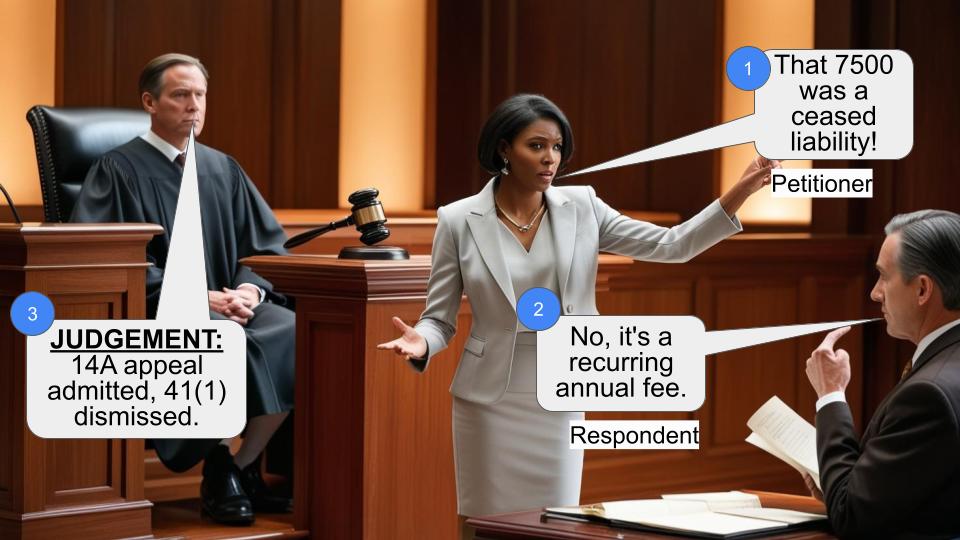
This case involves a tax appeal by the Revenue against M/s Adani Agro Pvt. Ltd. The High Court admitted one question of law regarding the disallowance under Section 14A (of Income Tax Act, 1961), while dismissing the appeal on the addition made under Section 41(1) (of Income Tax Act, 1961).
Get the full picture - access the original judgement of the court order here
Case Name:
Principal Commissioner of Income Tax Vs M/s Adani Agro Pvt. Ltd. (High Court of Gujarat)
R/Tax Appeal No.886 of 2019
Date: 10th February 2020
Key Takeaways:
1. The court partially admitted the tax appeal, focusing on the disallowance under Section 14A (of Income Tax Act, 1961) read with Rule 8D of the Income Tax Act.
2. The court affirmed that merely because liabilities are outstanding for several years, it doesn't mean they have ceased to exist if they continue to be shown in the balance sheet.
3. The case reinforces the interpretation of Section 41(1) (of Income Tax Act, 1961), emphasizing the need for actual remission or cessation of liability for it to be considered as income.
Issue:
1. Whether the Tribunal erred in disallowing Rs.1,39,22,989/- made under Section 14A (of Income Tax Act, 1961) read with Rule 8D(2)(iii) (of Income Tax Rules, 1962)?
2. Whether the addition of Rs.7,500/- made under Section 41(1) (of Income Tax Act, 1961) on account of cessation of liability was justified?
Facts:
- The case pertains to the Assessment Year 2012-13.
- The Revenue proposed two questions of law for consideration by the High Court.
- The first question related to a disallowance of Rs.1,39,22,989/- under Section 14A (of Income Tax Act, 1961).
- The second question concerned an addition of Rs.7,500/- made under Section 41(1) (of Income Tax Act, 1961).
- The assessee (Adani Agro Pvt. Ltd.) had been showing a balance of Rs.7,500/- in the account of Rajesh Mehta & Associates for three years.
- The assessee claimed this amount was for annual consultancy fees, paid in the subsequent year each time.
Arguments:
Revenue's Argument:
- The liability of Rs.7,500/- had become time-barred and should be added back under Section 41(1) (of Income Tax Act, 1961).
Assessee's Argument:
- The amount represented current year's expenditure, not from earlier years.
- The amount was not written back in the Profit & Loss Account.
- The consultant raised the same bill every year, explaining the consistent outstanding balance.
Key Legal Precedents:
1. CIT v/s. Nitin S. Garg (208 taxman 16): The Gujarat High Court held that merely because liabilities were outstanding for many years, it couldn't be inferred that they had ceased to exist if the assessee continued to show them as liabilities in the balance sheet.
Judgement:
1. The court admitted the appeal on the first question related to Section 14A (of Income Tax Act, 1961) disallowance.
2. The court dismissed the appeal on the second question related to the Section 41(1) (of Income Tax Act, 1961) addition.
3. The court agreed with the CIT(A) and Tribunal's findings that the Rs.7,500/- represented current year's liability and not an amount outstanding for more than three years.
4. The court emphasized that for Section 41(1) (of Income Tax Act, 1961) to apply, there must be actual remission or cessation of liability, which wasn't the case here.
FAQs:
1. Q: What is Section 41(1) (of Income Tax Act, 1961) about?
A: Section 41(1) (of Income Tax Act, 1961) deals with situations where a previously allowed deduction for a trading liability is later remitted or ceases to exist. In such cases, the amount is considered as income for the year in which the remission or cessation occurs.
2. Q: Why was the addition under Section 41(1) (of Income Tax Act, 1961) dismissed in this case?
A: The addition was dismissed because the liability (Rs.7,500/-) was found to be a recurring annual expense that was paid each subsequent year. There was no actual remission or cessation of liability.
3. Q: What's the significance of the Nitin S. Garg case in this judgment?
A: The Nitin S. Garg case established that if liabilities continue to be shown in the balance sheet, they can't be considered ceased merely because they've been outstanding for several years. This precedent was crucial in dismissing the Section 41(1) (of Income Tax Act, 1961) addition in the current case.
4. Q: What happened to the question about Section 14A (of Income Tax Act, 1961) disallowance?
A: The court admitted the appeal on this question, meaning it will be considered in future proceedings. The judgment doesn't provide a final decision on this matter.

1. This Tax Appeal under Section 260A (of Income Tax Act, 1961) [for short, 'the Act, 1961'] is at the instance of the Revenue and is directed against the judgement and order passed by the Income Tax Appellate Tribunal, 'D' Bench, Ahmedabad dated 28th June 2019 in ITA No.1771/Ahd/2016 for A.Y. 201213.
2. The Revenue has proposed the following two questions of law for the consideration of this Court:
“[A] Whether Appellate Tribunal has erred in law and on facts in deleting the disallowance of Rs.1,39,22,989/ made under Section 14A (of Income Tax Act, 1961) r.w. Rule 8D (of Income Tax Rules, 1962)?
[B] Whether Appellate Tribunal has erred in law and on facts in deleting the addition of Rs.7500/ made under Section 41(1) (of Income Tax Act, 1961) on account of cessation of liability?”
3 We are inclined to admit this Tax Appeal on the first question of law as proposed by the Revenue, but, with a slight modification. We admit this Tax Appeal on the following question of law:
“[A] In the facts and circumstances of the case, whether the Tribunal has erred in disallowing Rs.1,39,22,989/ made under Section 14A (of Income Tax Act, 1961) read with Rule 8D(2)(iii) (of Income Tax Rules, 1962)?”
4 So far as the second question of law as proposed by the Revenue is concerned, we take note of the following findings recorded by the CIT(A):
“4.3 I have carefully considered the Assessment Order and the submission filed by the Appellant. The Assessing Officer has observed that the Appellant has shown balance in the account of Rajesh Mehta & Associates for Rs. 7, 500/for three years and as debt has become time barred, such amount was added under Section 41 (of Income Tax Act, 1961) ( 1 ) of the Act. On the other hand, Appellant has argued that it has been making payment of professional charges to said party every year and bill received is credited in his account every year and in subsequent year payment is made. As said party is raising same bill for all the three Assessment Years outstanding balance would remain same every year and liability outstanding as on 31“March, 2012 is out of expenditure incurred in current year and not out of earlier Assessment Years hence such amount cannot be added under Section 41 (of Income Tax Act, 1961) ( 1 ) of the Act. It was also stated that such amount was not written back in Profit & Loss Account hence even on that ground addition cannot be made. On careful consideration of entire facts, it is observed that Rajesh Mehta & Associates is VAT consultants and said party is raising bill of Rs. 7, 500/every year and payment thereof is made in subsequent Assessment Year. It is observed that said party has raised bill of Rs. 7, 500/for A.Y. 201112 for which provision is made by Appellant on 31th March, 2011 hence closing balance of said party as on 31th March, 2011 is Rs. 7, 500/. The Appellant has also made payment against such provision on 27” April, 2011. Subsequently, the said party has raised similar bill for A. Y. 201213 hence Appellant made provision as on 31“ March, 2012 for the same amount and even said amount is paid in subsequent Assessment Year on 27th April, 2012. Thus, year end provision reflected against such party is not outstanding balance since three years as assumed by Assessing Officer hence even on Assessing Officer's stand,addition of Rs. 7, 500/cannot be made Even otherwise, it is observed that outstanding balance is creditors account are shown as liability in its books of account and such amount is not written back in Profit & Loss Account hence applying provisions of section 41 (of Income Tax Act, 1961)( 1), no such addition can be even though debt is time barred or outstanding for more than three years. On identical facts, Hon’ble Gujarat High Court in the case of CIT v/s. Nitin S.Garg 208 taxman 16 has also held as under:
“Section 41(1) (of Income Tax Act, 1961) of the IncomeTax Act, 1961 Remission or cessation of trading liability (Cessation of liability) Assessment Year 2001 02 to 200304 and 200607 in course of assessment, Assessing Officer noticed from balance sheet that various creditors were very old and no interest had been paid on those various loans Assessing Officer gave various opportunities to assessee to furnish details of such creditors viz., confirmation as well as creditworthiness but assessee failed to produce necessary information and details in that regard of aforesaid liabilities. On further appeal, Tribunal deleted addition on ground that assessee had continued to show admitted amounts as liabilities in its balance sheet and thus it could not be treated as a case of cessation of liabilities. Whether merely because liabilities were outstanding for last many years, it could not be inferred that said liabilities had ceased to exist. Held, yes, whether even otherwise, since assessee had continued to show admitted amounts as liabilities in its balance sheet, Tribunal was justified in deleting impugned addition made by Assessing Officer Held yes (in favour of assessee)”.
Following the decision of Hon’ble Gujarat High Court referred supra, disallowance made Assessing Officer u/s. 41(1) (of Income Tax Act, 1961) for Rs. 7,500/ is deleted. This ground of appeal is allowed. “
5 Thus, the CIT(A) relied upon the decision of this Court in the case of CIT vs. Nitin S. Garg 208 Taxman 16. The Tribunal while affirming the order passed by the CIT(A) held as under:
“14 After considering the submissions of the assessee, the Ld. CIT(A) deleted the addition by relying on the decision of Hon'ble Gujarat High Court in the case fo CIT vs. Nitin S. Garg 208 taxman 16(Guj).”
“16 Considered the rival submissions and material available on record, Ld. DR has not made any effort to bring on record any cogent material and not made any elaborate submissions. In absence of the submission and the fact brought on record by the assessee and ld. CIT(A) is considered and we are inclined to accept the findings of the Ld. CIT(A) based on the facts available on record. Therefore ground raised by the Revenue is accordingly dismissed.”
6 The dictum of law as laid in Nitin Garg (supra) provides that once assessee had continued to show admitted amounts as liabilities in its balance sheet, the same could not be treated as a case of cessation of liabilities merely because liabilities were outstanding for last many years,it could not be inferred that such liabilities had ceased to exist.
7 Therefore, when both the authorities have arrived at finding of fact that the liability was existing in the books of accounts of the assessee from year to year and liability of Rs.7500 represented the consultancy fee pertaining to the relevant year credited to the account of the consultant. Therefore, the impression of the Assessing Officer that such amount was outstanding for more than three years was erroneous.
In fact, Rs.7500 as fee was granted as expenditure every year and paid in the subsequent year so that at the end of the year there remained a credit balance of Rs.7500 in respect of that particular year's consultancy fee which was provided in the books of accounts by the assessee.
8 In view of the above finding of fact, the provisions of Section 41(1) (of Income Tax Act, 1961) could not have been invoked as there is no remission of cessation of liability.
9 Section 41(1) (of Income Tax Act, 1961) reads as under:
“41. Profits chargeable to tax
(1) Where an allowance or deduction has been made in the assessment for any year in respect of loss, expenditure or trading liability incurred by the assessee (hereinafter referred to as the first mentioned person) and subsequently during any previous year,
(a) the first mentioned person has obtained, whether in cash or in any other manner whatsoever, any amount in respect of such loss or expenditure or some benefit in respect of such trading liability by way of remission or cessation thereof, the amount obtained by such person or the value of benefit accruing to him shall be deemed to be profits and gains of business or profession and accordingly chargeable to income tax as the income of that previous year, whether the business or profession in respect of which the allowance or deduction has been made is in existence in that year or not; or
(b) the successor in business has obtained, whether in cash or in any other manner whatsoever, any amount in respect of which loss or expenditure was incurred by the first mentioned person or some benefit in respect of the trading liability referred to in clause (a) by way of remission or cessation thereof, the amount obtained by the successor in business or the value of benefit accruing to the successor in business shall be deemed to be profits and gains of the business or profession, and accordingly chargeable to incometax as the income of that previous year.
Explanation. For the purposes of this sub section," successor in business" means
(i) where there has been an amalgamation of a company with another company, the amalgamated company;
(ii) where the first mentioned person is succeeded by any other person in that business or profession, the other person;
(iii) where a firm carrying on a business or profession is succeeded by another firm, the other firm.]”
10 As per the aforesaid provisions of Section 41(1) (of Income Tax Act, 1961), there has to be remission or cessation of trading liability. Merely because the liability has remained outstanding for more than three years and the same is not written back in profit and loss account, application of provisions of Section 41(1) (of Income Tax Act, 1961) cannot be made to consider such liability as income of the year under consideration without there being any remission or cessation of liability.
11 In view of the foregoing, this appeal fails and dismissed so far as the second question as proposed by the Revenue is concerned.
×
Similar Ripples
Questions
Tax Appeal Partially Admitted: Section 14A (of Income Tax Act, 1961) Disallowance Questioned, Section 41(1) (of Income Tax Act, 1961) Addition Dismissed
Write your CommentSimilar Posts
Generic
- Reportdata/6287.pdf
