


Full News
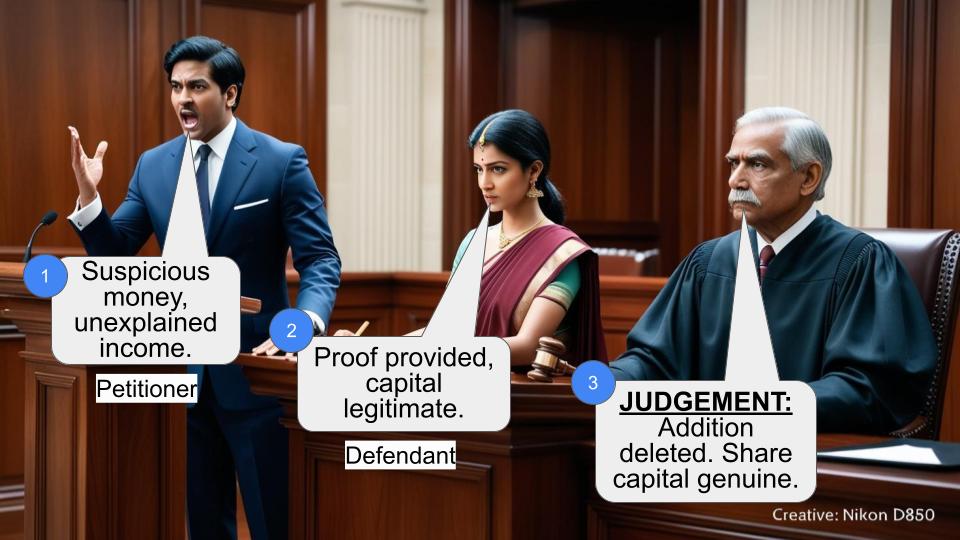
Tax authorities' addition rejected: Assessee's share capital deemed genuine
Tax authorities' addition rejected: Assessee's share capital deemed genuine
This case is all about a company (the Assessee) that received share application money from eight other companies. The tax authorities (Revenue) thought this money was suspicious and wanted to add it to the Assessee's taxable income. But the court sided with the Assessee, saying the tax authorities didn't do enough to prove their case. It's a win for the company.
Get the full picture - access the original judgement of the court order here
Case Name:
Principal Commissioner of Income Tax vs Rakam Money Matters Pvt Ltd. (High Court of Delhi)
ITA 778/2015
Date: 13th October 2015
Key Takeaways:
1. The tax department can't just rely on suspicion; they need solid evidence to prove income is undisclosed.
2. Assessees have a right to be confronted with evidence used against them.
3. Tax authorities should thoroughly investigate before making additions to taxable income.
4. The Income Tax Appellate Tribunal's (ITAT) factual findings are given weight by higher courts.
Issue:
Was the Income Tax Appellate Tribunal (ITAT) correct in law when it confirmed the deletion of the Rs.60,00,000 addition made by the Assessing Officer to the Assessee's income under Section 68 (of Income Tax Act, 1961)?
Facts:
1. The Assessee (Rakam Money Matters Pvt Ltd.) filed a tax return for the 2003-04 assessment year, declaring an income of Rs. 5,64,556.
2. Based on some info from the Director of Income Tax (Investigation), the tax department reopened the assessment in 2010.
3. The Assessee had received Rs. 60 lakhs as share application money from eight companies.
4. The Assessing Officer (AO) thought this money was fishy and added it to the Assessee's taxable income.
5. The Assessee appealed, and both the Commissioner of Income Tax (Appeals) and the ITAT ruled in their favor, deleting the addition.
6. Now, the tax department is challenging this decision in the High Court.
Arguments:
Assessee's side:
- Provided extensive documents to prove the genuineness of the share applications.
- Submitted income tax returns, PAN numbers, bank statements, and other details of the eight companies.
- Argued that the AO didn't properly investigate or give them a chance to respond to the investigation report.
Tax Department's side:
- Claimed the Assessee didn't prove the genuineness or creditworthiness of the investors.
- Pointed out suspicious patterns in the bank accounts of the investing companies.
- Argued that receiving money through banking channels isn't enough to prove genuineness.
Key Legal Precedents:
The tax department cited three cases:
1. CIT v. MAF Academy P. Ltd. (ITA No. 341/2012)
2. CIT v. Nipun Builders & Developers Pvt. Ltd. (ITA No. 120/2012)
3. CIT v. Oasis Hospitalities (Pvt.) Ltd. (ITA No. 2093/2010)
However, the court found that these cases weren't directly applicable to the current situation.
Judgement:
The High Court dismissed the tax department's appeal. Here's why:
1. The AO relied heavily on an investigation report but never showed it to the Assessee. That's not fair play!
2. The Assessee provided tons of documents to prove the share applications were legit.
3. Even if the company directors didn't show up when summoned, the AO could have done more investigating on their own.
4. The court felt that the ITAT's decision was reasonable based on the facts of the case.
FAQs:
1. Q: What's Section 68 (of Income Tax Act, 1961) about?
A: It deals with unexplained cash credits. If you can't explain where some money came from, the tax department can treat it as your income and tax it.
2. Q: Why did the court side with the Assessee?
A: The court felt that the tax department didn't do enough to disprove the evidence provided by the Assessee and didn't give them a fair chance to respond to the allegations.
3. Q: What should the tax department have done differently?
A: They should have shared the investigation report with the Assessee, followed up more thoroughly on their inquiries, and maybe checked with the tax officers handling the other companies' accounts.
4. Q: Does this mean companies can easily hide undisclosed income as share capital?
A: Not at all! The court is just saying that tax authorities need to do a thorough job of investigating and proving their case, not just rely on suspicions.
5. Q: What's the main lesson for taxpayers from this case?
A: Keep good records and be ready to provide extensive documentation if the tax department questions your transactions. It's also important to know your rights in terms of seeing evidence used against you.

CM 22575/2015
1. For the reasons stated in the application, the delay of 149 days in re-filing the appeal is condoned.
2. The application stands disposed of.
ITA 778/2015
3. This is an appeal by the Revenue against the order dated 16th October, 2014 passed by the Income Tax Appellate Tribunal (‘ITAT’) in ITA No. 2821/DEL/2011 for Assessment Year (‘AY’) 2003-04.
4. The question sought to be urged before the Court by the Revenue is whether the ITAT was correct in law in affirming the order of the Commissioner of Income Tax (Appeals) [‘CIT (A)’] deleting the addition in the sum of Rs.60,00,000/- made by the Assessing Officer (‘AO’ ) to the income of the Assessee under Section 68 (of Income Tax Act, 1961) pertaining to share application/capital money received by the Assessee.
5. The Assessee filed its return of income for AY 2003-04 on 02nd December, 2003 declaring an income of Rs. 5,64,556/-. It appears that pursuant to information received from the Director of Income Tax (Investigation) a notice under Section 148 (of Income Tax Act, 1961) was issued to the Assessee on 19th March, 2010 for reopening the assessment. On the question of the validity of the reopening of the assessment, the matter travelled up to the ITAT and was finally remanded to the AO for dealing with the proposed additions on merits.
6. Before the AO, the Assessee filed the details of the eight corporate entities which had made payments by account payee cheques of various sums of money towards subscription of shares of the Assessee. The Assessee also produced the income tax returns, PAN numbers, copies of bank statements of the aforementioned companies, affidavits by way of confirmation on behalf of the said companies confirming that the payments towards share application money were made, copies of details in the Registrar of Companies showing the status of the companies as ‘active’, copies of the balance sheets, certificates of incorporation, articles of association and the share application forms of the respective companies.
7. The AO issued notices to the Directors of the aforementioned companies but none of them appeared. The AO was of the view that the fact that the money had been received through banking channels was not in itself sufficient to prove the genuineness of the creditors or their creditworthiness.
The AO noted that the balance in the respective bank accounts of the companies demonstrated a common pattern where the balance would be very low up to a certain date and then substantial amounts were deposited either by cash or cheque to increase the balance and thereafter invariably withdrawn within a day or two. Since the process was shown to be repeated over and over in the P&L Account of the Assessee, the AO concluded that there was no business activity worthy of mention. Concluding that the Assessee had failed to discharge the onus to prove the genuineness or the creditworthiness of the companies which had made the payments, the AO held that the share application money received from the companies should be treated as income in the hands of the Assessee. He accordingly ordered an addition of Rs.60 lakhs.
8. The CIT(A) has in the order dated 18th March, 2011 observed that the AO has not referred to any material to disprove the extensive documents produced by the Assessee. The Assessee was also not confronted with the report of the DIT (Investigation). The statements made in the course of that investigation were also not provided to the Assessee. In those circumstances,the CIT (A) found that the addition proposed by the AO was not justified.
9. In the impugned order, the ITAT concurred with the finding of the CIT (A) on facts. The ITAT noted that the main basis for making of the addition by the AO was the information received from the DIT (Investigation). The process of examination of the Directors by issue of summons was "not taken to the logical end as after the failure of the directors to attend in response to the summons issued to them no further steps were taken". The ITAT also observed that AO could have cross verified the status of these companies with the respective AOs of those companies. The statements of the third parties recorded during the course of investigation were not put to the Assessee for cross-examination and no opportunity was given to the Assessee for confrontation of the said persons.
10. Mr N.P. Sahni, learned Senior Standing Counsel for the Revenue, did not dispute the fact that the report of the DIT (Investigation) or that the statements recorded during the course of the investigation were not put to the Assessee. He placed reliance on the decision of this Court dated 28th November, 2013 in ITA No. 341/2012 (CIT v. MAF Academy P. Ltd.) the decision dated 7th January, 2013 in ITA No. 120/2012 (CIT v. Nipun Builders & Developers Pvt. Ltd.) and the decision dated 31st January, 2011 in ITA No. 2093/2010 (CIT v. Oasis Hospitalities (Pvt.) Ltd.). He urged that the CIT (A) had not discussed several findings of the AO which showed that the Assessee had not discharged the onus of proving the genuineness or the creditworthiness of the so-called investors.
11. The Court is essentially called upon to consider whether on the facts of the present case, the view taken by CIT(A) as confirmed by the ITAT could be said to be plausible or is it so perverse as to require interference by the Court?
12. A perusal of the order of the AO shows that its foundation is the report of the DIT (Investigation). Admittedly, the Assessee was not confronted with that material in the course of the reassessment proceedings. The Assessee was also not confronted with the statements recorded in the course of the investigation. Once that material is kept aside then the scope of enquiry can only be whether the Assessee has produced documents to discharge the initial onus of proving the genuineness and creditworthiness of the companies who were stated to have subscribed to the Assessee’s shares.
13. It is not in dispute that extensive material was produced by the Assessee in the present case to prove the identity, genuineness and creditworthiness of the companies who had subscribed to its shares. Among the materials produced were the Income Tax Returns and the PAN card details of the eight companies. Even if the Directors of these companies did not respond to the summons issued by the AO, it was not impossible for the AO to make proper enquiries to ascertain the genuineness of these entities and satisfy himself of their creditworthiness. As pointed out by the CIT(A), the AO failed to make any effort in that direction. He did not take to the logical end the half-hearted attempt at getting the Directors to appear before him. He did not even seek the assistance of the AOs of the concerned companies whose ITRs and PAN card copies had been produced.
14. The view taken by the CIT(A) that the AO failed to come up with the material to disprove what had been produced by the Assessee is certainly a plausible view in the facts and circumstances of the case. Likewise, the view taken by the ITAT concurring with the CIT(A) on facts cannot be said to be perverse.
15. The decisions cited by Mr Sahni turn on their own facts. As far as the broad principles governing the law under Section 68 (of Income Tax Act, 1961) is concerned, the Court is satisfied that the order of the CIT(A) as confirmed by the ITAT suffers from no legal infirmity. No substantial question of law arises.
16. The appeal is dismissed.
S.MURALIDHAR, J
VIBHU BAKHRU, J
OCTOBER 13, 2015
×
Similar Ripples
Questions
Tax authorities' addition rejected: Assessee's share capital deemed genuine
Write your CommentSimilar Posts
Generic
- Reportdata/3377.pdf
