


Tax Deduction Dispute: Court Upholds Landowner's Right to Claim Under Section 8…


Full News
Tax Deduction Dispute: Court Upholds Landowner's Right to Claim Under Section 80IB(10) (of Income Tax Act, 1961)
Tax Deduction Dispute: Court Upholds Landowner's Right to Claim Under Section 80IB(10) (of Income Tax Act, 19…
The Income Tax Department (the Revenue) appealed against a decision made by the Income Tax Appellate Tribunal. The Tribunal had directed the Assessing Officer to allow a deduction under Section 80IB(10) (of Income Tax Act, 1961) to a landowner who was part of a housing project. The High Court dismissed the Revenue's appeal, effectively supporting the landowner's right to claim the deduction.
Get the full picture - access the original judgement of the court order here
Case Name:
Commissioner of Income Tax Vs M/s. Astoria Leathers (High Court of Madras)
Tax Case Appeal No..533 & 534 of 2018 & CMP.No.11130 of 2018
Date: 8th July 2020
Key Takeaways:
1. Landowners involved in housing projects can potentially claim deductions under Section 80IB(10) (of Income Tax Act, 1961).
2. The court emphasized that "developing" and "building" are distinct activities in housing projects, both eligible for deductions.
3. The decision aligns with previous judgments from various High Courts and the Supreme Court on similar issues.
Issue:
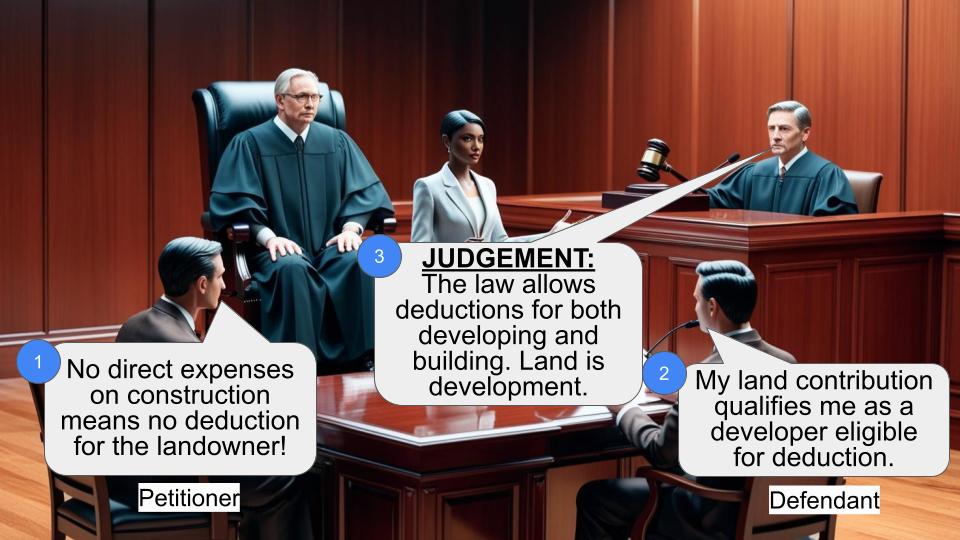
Was the Income Tax Appellate Tribunal correct in directing the Assessing Officer to allow deduction under Section 80IB(10) (of Income Tax Act, 1961) to a landowner who hadn't directly incurred expenses for development or construction of the housing project?
Facts:
We've got a landowner (the assessee) who entered into some kind of agreement with a developer for a housing project. The landowner was supposed to get a 34% share, while the developer got 66%. The Income Tax Department wasn't happy about the landowner claiming a deduction under Section 80IB(10) (of Income Tax Act, 1961). They argued that since the landowner didn't directly spend money on developing or constructing the project, they shouldn't get the deduction. This dispute was for the assessment years 2008-09 and 2010-11.
Arguments:
The Revenue (that's the tax department) argued that the landowner shouldn't get the deduction because they didn't spend any money on the actual development or construction. They were basically saying, "No investment, no deduction."
On the other hand, the landowner probably argued that their contribution of land was enough to qualify for the deduction, even if they didn't directly pay for construction costs.
Key Legal Precedents:
The court referred to several important cases here. Let me list them out for you:
1. CIT Vs. Sanghvi & Doshi Enterprise (2013)
2. ITO Vs. Doshi Enterprise (2013)
3. CIT Vs. Ceebros Property Development (P.) Ltd. (2014)
4. CIT vs. Radhe Developers (2012)
5. CIT vs. Moon Star Developers (2014)
6. CIT vs. Prathama Developers (2013)
7. CIT vs. Cajetano Mario Pereira (2014)
8. CIT vs. Veena Developers (2015)
These cases all dealt with similar issues about who can claim deductions in housing projects. The courts consistently ruled that developers, not just owners, can claim these deductions.
Judgement:
The High Court dismissed the Revenue's appeal. They said the Tribunal was right to ask the Assessing Officer to take a fresh look at the case. The court emphasized that Section 80IB(10) (of Income Tax Act, 1961) allows deductions for both "developing" and "building" a housing project. They pointed out that these are two distinct activities, and the landowner could be considered a developer even if they didn't directly pay for construction.
The court also directed the Assessing Officer to check how much deduction the main developer (who had a 66% share) claimed. If they only claimed for their 66% share, then the landowner should be allowed to claim for their 34% share.
FAQs:
1. Q: Does this mean all landowners in housing projects can claim tax deductions?
A: Not necessarily. Each case would depend on the specific agreement and the landowner's role in the project.
2. Q: Why did the court emphasize the difference between "developing" and "building"?
A: To show that contributing land (developing) is just as valid for claiming deductions as actual construction (building).
3. Q: What happens next in this case?
A: The Assessing Officer will need to re-examine the case, looking at the developer's tax assessment and deciding how much deduction the landowner can claim.
4. Q: Does this decision change any existing laws?
A: Not really. It reinforces previous interpretations of Section 80IB(10) (of Income Tax Act, 1961) from other High Courts and the Supreme Court.
5. Q: Why was the Revenue's argument rejected?
A: The court found that ownership isn't the only criteria for claiming this deduction, and that developers (including landowners who develop) can also be eligible.

These appeals, by the Revenue under Section 260A (of Income Tax Act, 1961) (for short, the Act), are directed against the common order dated 27.12.2017 made in ITA.Nos.2673 and 2674/ Mds/2014 on the file of the Income Tax Appellate Tribunal, Chennai ‘C’ Bench (for brevity, the Act) respectively for the assessment years 2008-09 and 2010-11.
2. We have heard Mr. M.Swaminathan, learned Senior Standing Counsel and Mrs. V.Pushpa and Ms.S.Premalatha, learned Standing Counsel appearing for the appellant – Revenue and Mr. A.S.Sriraman, learned counsel appearing for the respondent.
3. The appeals have been admitted on 23.8.2018 on the following substantial question of law :
“Whether the Income Tax Appellate Tribunal was correct and justified in directing the Assessing Officer to allow deduction under Section 80IB(10) (of Income Tax Act, 1961) to assessee land owner when it had not incurred any expenses towards development or construction of the housing project ?”
4. We find from the impugned order that the Tribunal remanded the matter to the Assessing Officer for a fresh consideration with a specific direction. We quote the relevant portion of the impugned order as hereunder :
“It is not clear from the materials available on record as to whether the developer M/s.KGEYES Residency Pvt. Ltd. was allowed to claim deduction of profits from its share of 66% alone and if it is so, then, the assessee should be allowed to claim deduction of similar profits and gains of its share of 34%. Accordingly, the Assessing Officer is directed to verify the above facts from the assessment order of the developer M/s.KGEYES Residency Pvt. Ltd., and decide the issue afresh in accordance with law after allowing an opportunity of being heard to the assessee. In case the assessee has incurred any expenditure towards land development as noticed by the learned CIT(A) and the developer M/s.KGEYES Residency Pvt. Ltd., has claimed deduction under Section 80IB(10) (of Income Tax Act, 1961) of only its share of 66%, then the assessee should be allowed to claim deduction under Section 80IB(10) (of Income Tax Act, 1961) of its share of 34%. Thus, the ground raised by the Revenue in both the assessment years is allowed for statistical purposes.”
5. From the observations/directions issued by the Tribunal, we are of the view that the Revenue should not be aggrieved by such a direction of the Tribunal. Nevertheless, the substantial question of law framed for consideration has to be answered. To answer the substantial question of law, we need not labour much, as an identical question was considered and decided by a Division Bench of this Court, to which one of us (TSSJ) was a party, in TCA.No.177 of 2018 vide judgment dated 30.1.2019 [M/s.Bashyam Constructions Pvt. Ltd. Vs. DCIT]. In fact, the nature of transaction is also the same. After taking into consideration the decisions of this Court in the cases of (i) CIT Vs. Sanghvi & Doshi Enterprise [reported in (2013) 29 Taxman.com 386], (ii) ITO Vs. Doshi Enterprise [reported in (2013) 55 Taxmann.com 500], (iii) CIT Vs. Ceebros Property Development (P.) Ltd. [reported in (2014) 41 Taxmann.com 263], the decisions of the High Court of Gujarat in the cases of (i) CIT vs. Radhe Developers [reported in (2012) 17 Taxmann.com 156], (ii) CIT vs. Moon Star Developers [reported in (2014) 88 CCH 0211] and (iii) CIT vs. Prathama Developers [reported in (2013) 32 Taxmann.com 336], the decision of the Bombay High Court in the case of CIT vs. Cajetano Mario Pereira [reported in (2014) 88 CCH 0152] and the decision of the Hon'ble Supreme Court in the case of CIT vs. Veena Developers [reported in (2015) 93 CCH 0184 ISCC], the substantial questions of law framed therein were answered to the following effect :
“14. It is interesting to note that in all these decisions, the Revenue placed reliance on the aspect of ownership as a criteria for grant of deduction under Section 80IB (of Income Tax Act, 1961) and submitted that Section 80IB(10) (of Income Tax Act, 1961) contemplates grant of deduction and it being a deduction provision, the same has to be complied in absolute terms by the assessee. The Courts have held that in a case of development, the developer is also entitled to claim deduction and ownership is not the criteria. Unfortunately, in the instant case, the Revenue took a reverse stand contrary to the consistent stand taken by them before this Court and other High Courts, which was rejected by the High courts and affirmed by the Hon'ble Supreme Court......
21. The correctness of the above finding was not considered by the Tribunal and the Tribunal merely stated that no expenses were recorded in the P & L account. Therefore, the contention advanced by the Revenue in this regard is not tenable. That apart, a plain reading of Section 80IB(10) (of Income Tax Act, 1961) evidently makes it clear that deduction is available in a case where an undertaking develops and builds a housing project. The Section clearly draws the distinction between 'developing' and 'building'. In the preceding paragraphs, we have noted the factual position as could be culled out from the joint venture agreement, which clearly shows that the assessee is the developer and M/s.ETA is the builder and mutual rights and obligations are inextricably linked with each other and undoubtedly, the project is a housing project thereby, the assessee would be entitled to claim deduction under Section 80IB(10) (of Income Tax Act, 1961).”
6. Thus, following the above decision, the substantial question of law framed in these appeals is answered against the Revenue. Accordingly, the above tax case appeals are dismissed. We make it clear that the orders of remand by the Tribunal stand confirmed and the Assessing Officer shall scrupulously follow the directions issued by the Tribunal, which directed the Assessing Officer to verify the assessment order of the developer and decide the issue afresh in accordance with law after affording an opportunity of being heard to the assessee. No costs. Consequently, the connected CMP is also dismissed.
T.S.SIVAGNANAM, J
AND
V.BHAVANI SUBBAROYAN, J
×
Similar Ripples
Questions
Tax Deduction Dispute: Court Upholds Landowner's Right to Claim Under Section 80IB(10) (of Income Tax Act, 1961)
Write your CommentSimilar Posts
Generic
- Reportdata/6228.pdf
