


Tax Dispute: Court Sides with Assessee on Stock Valuation Method


Full News

Tax Dispute: Court Sides with Assessee on Stock Valuation Method
Tax Dispute: Court Sides with Assessee on Stock Valuation Method
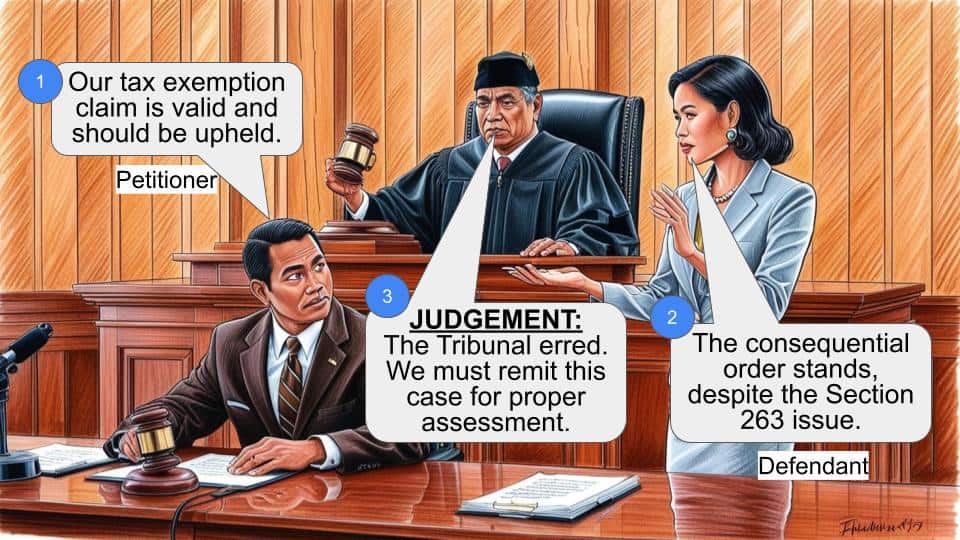
This case involves an income tax dispute between Smt. Deepa S. Pai (the assessee) and the Deputy Commissioner of Income Tax. The main issue was the valuation of shares converted from investments to stock-in-trade. The High Court ultimately ruled in favor of the assessee, setting aside previous orders and remitting the matter back to the Assessing Officer for fresh consideration.
Get the full picture - access the original judgement of the court order here
Case Name:
Smt. Deepa S. Pai Vs Deputy Commissioner of Income Tax (High Court of Karnataka)
ITA No.69 of 2015
Date: 20th January 2020
Key Takeaways:
1. The court emphasized the importance of following the Tribunal's earlier directions in reassessment.
2. The Supreme Court's precedent on valuing converted capital assets was highlighted as crucial for consideration.
3. The case underscores the complexity of tax valuation methods for converted assets.
Issue:
The central legal question was whether the shares held by the appellant, having been converted into stock-in-trade, should be valued at the cost at the time of conversion (market value at conversion) or at the cost of acquisition or net realizable value, whichever is less.
Facts:
1. The assessee, Smt. Deepa S. Pai, filed a nil income tax return for the assessment year 2004-05 on 31.10.2004.
2. She had held certain shares as investments while a minor, which she converted to stock-in-trade upon reaching majority.
3. The assessee valued these shares at fair market value as of 01.04.2003, as per Section 45(2) (of Income Tax Act, 1961).
4. The Assessing Officer disallowed this treatment and determined her income at ₹2,75,48,980/-.
5. The case went through multiple appeals, including to the Income Tax Appellate Tribunal (ITAT), which remanded the matter back to the Assessing Officer with specific instructions.
Arguments:
Assessee's Argument:
- The shares converted to stock-in-trade should be valued at the cost of acquisition or market value at the date of conversion, whichever is lower.
Revenue's Argument:
- The valuation method adopted by the assessee was not appropriate, and the shares should be valued differently.
Key Legal Precedents:
1. COMMISSIONER OF INCOME-TAX, PATIALA Vs. GROZ-BECKERT SABOO LTD. (1979 (116) ITR 125 (SC))
- This Supreme Court decision held that when capital assets are converted to stock-in-trade, taxable profit should be determined by deducting the market value at the time of conversion from the sale proceeds.
Judgement:
1. The High Court ruled in favor of the assessee.
2. The court set aside the orders of the Assessing Officer, CIT (Appeals), and the Tribunal.
3. The matter was remitted back to the Assessing Officer for fresh consideration.
4. The Assessing Officer was directed to decide the matter in light of:
a) The ITAT's order dated 17.09.2010
b) The Supreme Court's decision in COMMISSIONER OF INCOME-TAX, PATIALA Vs. GROZ-BECKERT SABOO LTD.
FAQs:
1. Q: What was the main issue in this case?
A: The main issue was how to value shares that were converted from investments to stock-in-trade for tax purposes.
2. Q: Why did the High Court remit the case back to the Assessing Officer?
A: The court found that the Assessing Officer, CIT (Appeals), and Tribunal had not properly considered the Supreme Court's precedent on valuing converted assets.
3. Q: What is the significance of the COMMISSIONER OF INCOME-TAX, PATIALA Vs. GROZ-BECKERT SABOO LTD. case?
A: This Supreme Court case established the principle for calculating taxable profit when capital assets are converted to stock-in-trade.
4. Q: What should the Assessing Officer consider when re-evaluating this case?
A: The Assessing Officer should consider both the ITAT's earlier directions and the Supreme Court's precedent on valuing converted assets.
5. Q: Does this judgment set a new precedent?
A: While it doesn't set a new precedent, it reinforces the importance of following established Supreme Court guidelines in tax valuation cases.

1. Mr. S. Parthasarathi, learned counsel for the appellant. Mr.E.I.Sanmathi, learned counsel for the respondent.
2. This appeal under Section 260-A (of Income Tax Act, 1961), 1961 (hereinafter referred to as ‘the Act’, for short) has been filed by the assessee which was admitted by a Bench of this Court by order dated 23.06.2015 on the following substantial questions of law:
1. Whether, the order of the Assessing Authority was sustainable when the direction of the Appellate Tribunal in the earlier appellate order was not followed while concluding the assessment?
2. Whether the shares held by the appellant having been converted into stock-in-trade, the value of the closing stock at the end of the year was required to be valued at the cost to the business at the time of conversion (i.e. the market value at the time of conversion) or cost of acquisition or net realizable value whichever is less?
3. Whether for valuation of closing stock, when the principle of “original cost or market value whichever is less “is required to be adopted, in the case of shares converted into stock-in-trade, the value as on the date of conversion can be substituted for its original cost?”.
3. Facts giving rise to the filing of the appeal briefly stated are that the assessee filed return of income for assessment year 2004-05 on 31.10.2004 declaring NIL income. The assessee was holding certain shares as investments while she was a minor. On attaining majority, the assessee converted the shares into stock-in-trade and valued them on fair market value as on 01.04.2003 as per Section 45(2) (of Income Tax Act, 1961). The case was taken up for scrutiny and the assessment was completed vide order dated 28.12.2006 by which the Assessing Officer disallowed the assesse’s claim for treating the shares as stock-in- trade and determined the income of the assessee at 2,75,48,980/-. Being aggrieved by the order of assessment, the assessee filed an appeal before Commissioner of Income Tax (Appeals) which was dismissed by an order dated 17.03.2010. The assessee filed an appeal before the Income Tax Appellate Tribunal (hereinafter referred to as ‘the Tribunal’ for short). The Tribunal, by an order dated 17.09.2010 remitted the matter to the Assessing Officer to re-compute the profits by valuing the closing stock at net realizable value of the shares as on 31.03.2004 or at the value of the opening stock determined and adopted by the assessee i.e., the conversion cost, which ever is lower.
4. The Assessing Officer by an order dated 26.12.2011 valued the closing stock at lower of the cost (conversion cost) or net realizable value of the shares and also levied interest under Sections 234B (of Income Tax Act, 1961) and 220(2) (of Income Tax Act, 1961). Being aggrieved by the order of the aforesaid Assessing Officer, the appellant filed an appeal, which was dismissed by CIT (Appeals) by an order dated 19.03.2013. The assessee again approached the Tribunal. The Tribunal by an order dated 14.11.2008 dismissed the appeal preferred by the assesee. In the aforesaid factual background, this appeal has been filed.
5. Learned counsel for the appellant submitted that the assessee had converted the shares held by her as a stock-in-trade and claimed the closing stock at the cost at which the shares were acquired or the market value as on that date whichever was lower. However, the aforesaid aspect of the matter has not been appreciated by the authorities under the Act. In support of the aforesaid submission, learned counsel for the appellant has placed reliance on the decisions of the Supreme Court in the case of ‘COMMISSIONER OF INCOME- TAX, PATIALA Vs. GROZ-BECKERT SABOO LTD.’ 1979 (116) ITR 125 (SC). On the other hand, learned counsel for the revenue has supported the order passed by the Tribunal and has taken through the order passed by the Assessing Authority, Commissioner of Income Tax (Appeals) as well as the Tribunal.
6. We have considered the submissions made by the learned counsel for the parties and have perused the record. The entire issue pertains to valuation adopted for conversion of investments to stock-in-trade, opening stock and closing stock. The Tribunal by an order dated 17.09.2010 had remanded the matter to the Assessing Officer. The relevant extract reads as under:
“We therefore remit the case back on the file of the Ld. AO to re-compute the profits by valuing the closing stock at net realizable value of the shares as on 31.3.2004 or at the value of the opening stock determined and adopted by the assessee, i.e. the conversion cost whichever is lower, needless to say that the method adopted to value the opening stock shall be followed for valuing the net realizable value of shares held as on 31.3.2004.”
7. The Supreme Court in COMMISSIONER OF INCOME-TAX, PATIALA, supra has held that where an assessee converts his capital assets into stock-in-trade and starts dealing with them, the taxable profit on the sale must be determined by deducting on sale proceeds and the market value at the time of their conversion into stock-in-trade. The aforesaid principle has neither been taken into account by the Assessing Officer as well as by the CIT (Appeals) and the Tribunal. It is not in dispute before us that the CIT (Appeals) and the Tribunal has not examined the aforesaid aspect of the matter.
8. In view of preceding analysis, the substantial question of law No.1 framed by this Court is answered in favour of the assessee and against the revenue. In the result, the order passed by the Assessing Officer as well as CIT (Appeals) and the Tribunal are hereby set aide and the matter is remitted to the Assessing Officer to decide the matter afresh in the light of the directions contained in the order dated 17.09.2010 passed by the Tribunal as well as the decision of the Supreme Court in COMMISSIONER OF INCOME-TAX, PATIALA, supra.
Therefore, it is not necessary to answer 2nd and 3rd substantial question of law.
Accordingly, the appeal is disposed of.
Sd/-
JUDGE
Sd/-
JUDGE
×
Similar Ripples
Questions
Tax Dispute: Court Sides with Assessee on Stock Valuation Method
Write your CommentSimilar Posts


Generic
- Reportdata/6321.pdf
