


Tax notice dispute: Court upholds Tribunal's decision on untimely service


Full News
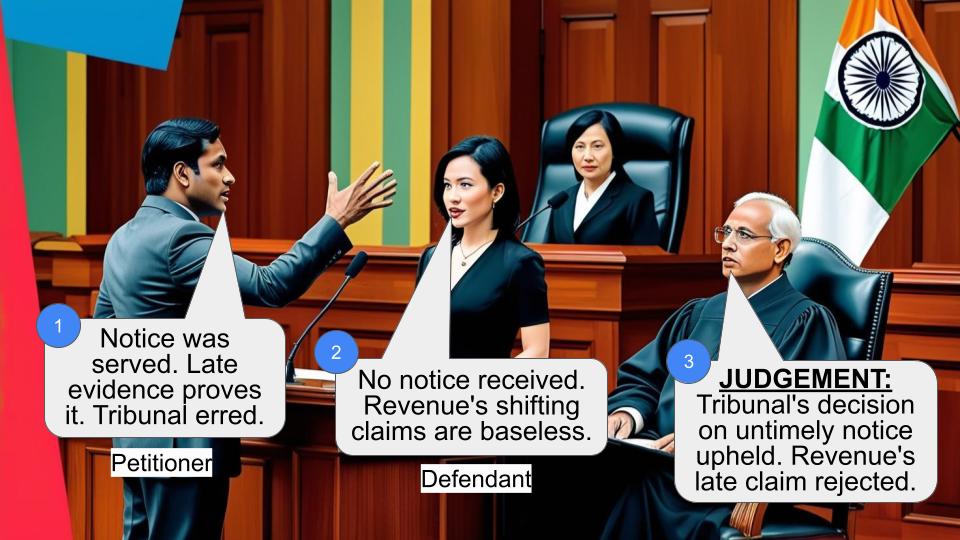
Tax notice dispute: Court upholds Tribunal's decision on untimely service
Tax notice dispute: Court upholds Tribunal's decision on untimely service
This case involves a dispute between the Revenue (Income Tax Department) and an assessee (H.P. Bhardwaj & Sons HUF) regarding the service of a notice under section 143(2) (of Income Tax Act, 1961). The main contention was whether the notice was served on July 31, 2003. The Income-tax Appellate Tribunal ruled in favor of the assessee, and the High Court upheld this decision, dismissing the Revenue's appeal.
Get the full picture - access the original judgement of the court order here
Case Name:
Commissioner of Income Tax vs H.P. Bhardwaj & Sons (HUF) (High Court of Delhi)
ITA 1122/2006
Date: 22nd November 2007
Key Takeaways:
1. The importance of timely service of notices in tax proceedings
2. The court's reliance on the record available before lower authorities
3. The limitations of introducing new evidence at later stages of appeal
4. The significance of consistent arguments throughout the legal process
Issue:
Was the Income-tax Appellate Tribunal justified in concluding that the notice under section 143(2) (of Income Tax Act, 1961) was not served on the assessee on July 31, 2003?
Facts:
1. The case pertains to the assessment year 2002-03.
2. The Revenue claimed to have sent a notice under section 143(2) (of Income Tax Act, 1961) to the assessee on July 31, 2003.
3. The assessee contended that they did not receive the notice on that date.
4. Throughout the proceedings before the Assessing Officer, CIT(A), and Tribunal, the Revenue maintained that the notice was sent by registered post.
5. After the Tribunal's decision, the Revenue filed a rectification application, claiming for the first time that the notice was served through a process server.
6. The Tribunal rejected this new claim in its order dated September 22, 2006.
Arguments:
Revenue's arguments:
1. Initially claimed the notice was sent by registered post on July 31, 2003.
2. Later argued (in the rectification application) that the notice was served through a process server on the same date.
3. Produced a document showing receipt of the notice by an unidentified person.
Assessee's arguments:
1. Denied receiving the notice on July 31, 2003.
2. Argued that the proceedings would be time-barred if the notice wasn't served on that date.
3. Contended that the signature on the newly produced document was not of any person known to the assessee.
Key Legal Precedents:
1. CIT vs. Vardhman Estate (P) Ltd. (2007) 208 CTR (Del) 251 : (2006) 287 ITR 368 (Del) - This case was cited to highlight that there's no provision requiring the Tribunal to call for and peruse assessment records themselves.
Judgment:
1. The High Court dismissed the Revenue's appeal.
2. It found no error in the Tribunal's order, which was based on the available record.
3. The court noted that the Revenue's claim of service through a process server was introduced very late and was inconsistent with their earlier stance.
4. The court also observed that the CIT(A) had not mentioned any notice served by a process server in his order, despite reviewing the assessment records.
5. The court concluded that no substantial question of law arose from the Tribunal's order.
FAQs:
1. Q: Why was the timing of the notice service so crucial in this case?
A: If the notice wasn't served on July 31, 2003, the proceedings would be time-barred, making them invalid.
2. Q: Why didn't the court accept the new evidence presented by the Revenue?
A: The court found it suspicious that this evidence was introduced very late in the process and was inconsistent with the Revenue's earlier arguments.
3. Q: What does this judgment mean for tax authorities?
A: It emphasizes the importance of maintaining consistent arguments throughout the legal process and the difficulties in introducing new evidence at later stages.
4. Q: Can the Tribunal review its own orders?
A: The Tribunal has limited power to rectify its orders under section 254(2) (of Income Tax Act, 1961), but it cannot review its earlier order entirely.
5. Q: What's the significance of the CIT vs. Vardhman Estate case mentioned?
A: It reinforces that the Tribunal is not obligated to call for and examine assessment records on its own, and can base its decision on the evidence presented before it.

1. The Revenue is aggrieved by an order dt. 31st Jan., 2006 passed by the Income-tax Appellate Tribunal (‘Tribunal’), Delhi Bench ‘E’ in ITA No. 4269/Del/2005 relevant for the asst. yr. 2002-03.
2. The short issue that has been urged in this case is whether the notice sent to the assessee on 31st July, 2003 under s. 143(2) of the IT Act, 1961 (for short ‘the Act’) was served upon the assessee on the same day or not. The admitted position is that if it was not so served on the assessee then the proceedings would be barred by time. All through the assessment proceedings before the AO, the Commissioner of Income-tax (Appeals) [CIT(A)] and before the Tribunal, the case of the Revenue was that the notice dt. 31st July, 2003 had been sent by registered post. In fact, it was not the contention of the Revenue before any of the above authorities that the notice had been served through a process server.
3. After dismissal of the appeal filed by the Revenue before the Tribunal, a rectification application under s. 254(2) of the Act was filed by the Revenue in which it was contended, for the first time, that the notice was served on the assessee through a process server on 31st July, 2003 itself. The Tribunal by its order dt. 22nd Sept., 2006 rejected this contention and held that in exercise of its jurisdiction under s. 254(2) of the Act it could not review the earlier order. The Revenue has preferred an appeal being IT Appeal No. 414 of 2007 against that decision, which is being heard and disposed of along with the present appeal.
4. Insofar as the present appeal is concerned, the Revenue has annexed a document showing receipt of the notice by a person whose name is illegible. According to learned counsel for the assessee, the signature is not of any person known to the assessee.
5. We also find from a perusal of the order of the CIT(A) that he has recorded that he has seen the assessment records before passing his order and there is no mention by him of any notice that was served on the assessee by the process server on 31st July, 2003. Clearly, the document now produced was not in the record seen by the CIT(A). Considering this fact coupled with the fact that the case of the Revenue never was, prior to its application under s. 254(2) of the Act, that the notice has been served on the assessee through a process server, we are of the view that no error can be found with the order passed by the Tribunal.
6. We may also mention that in CIT vs. Vardhman Estate (P) Ltd. (2007) 208 CTR (Del) 251 : (2006) 287 ITR 368 (Del) , a similar contention was sought to be urged on behalf of the Revenue. When it was put to learned senior standing counsel of the Revenue whether there existed any provision of law which required the Tribunal to call for the assessment records and peruse it themselves, the answer was in the negative. As far as the present case is concerned, in light of what has been discussed, we hold that the Tribunal committed no error in proceeding on the basis of the record which was available before it.
7. No substantial question of law arises.
8. Dismissed.
MADAN B. LOKUR, J
NOVEMBER 22, 2007 S. MURALIDHAR, J
Kapil
×
Similar Ripples
Questions
Tax notice dispute: Court upholds Tribunal's decision on untimely service
Write your CommentSimilar Posts
Generic
- Reportdata/5155.pdf
