Tax Reassessment Upheld: Undisclosed Property Investments Lead to Valid Proceed…


Full News
Tax Reassessment Upheld: Undisclosed Property Investments Lead to Valid Proceedings
Tax Reassessment Upheld: Undisclosed Property Investments Lead to Valid Proceedings
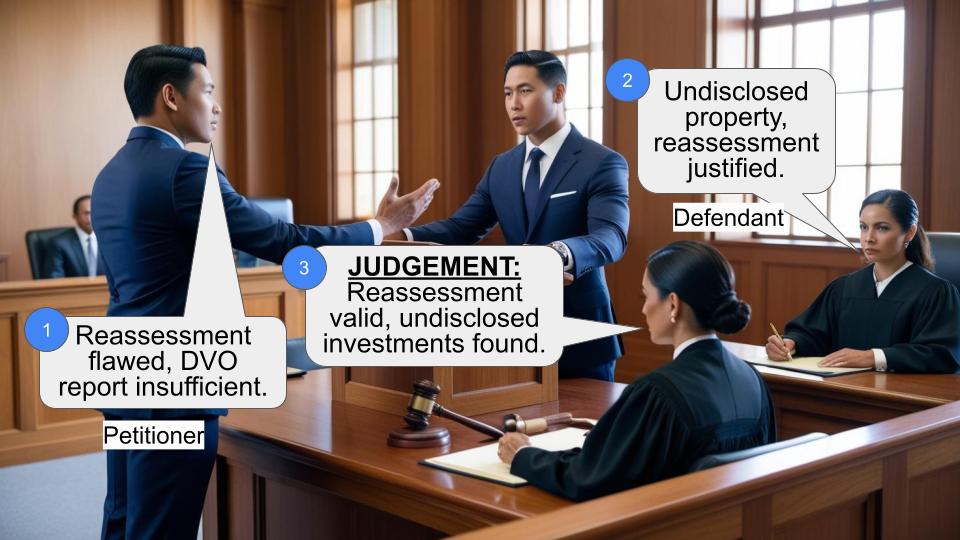
This case involves Dr. Chhangur Rai (the appellant) challenging the Income Tax Department's reassessment proceedings for the assessment years 1992-93 to 1995-96. The main dispute centered around the validity of reassessment notices issued under Section 148 (of Income Tax Act, 1961). The High Court ultimately upheld the reassessment proceedings, ruling in favor of the Income Tax Department.
Get the full picture - access the original judgement of the court order here
Case Name:
Dr. Chhangur Rai Vs Commissioner of Income Tax & Another (High Court of Allahabad)
Income Tax Appeal No.381 of 2008
Date: 22nd March 2017
Key Takeaways:
1. Reassessment proceedings can be initiated based on undisclosed property investments, even without filed tax returns.
2. District Valuation Officer (DVO) reports can be used to estimate undisclosed income in reassessment cases.
3. The court distinguished this case from the Dhariya Construction Co. case, emphasizing the importance of context in reassessment proceedings.
Issue:
Was the Income Tax Department justified in initiating reassessment proceedings against Dr. Chhangur Rai based on undisclosed property investments and the District Valuation Officer's report?
Facts:
1. Dr. Chhangur Rai had made investments in a residential house and a nursing home.
2. He did not file income tax returns for the relevant assessment years (except for 1993-94).
3. The Income Tax Department initiated reassessment proceedings under Section 148 (of Income Tax Act, 1961).
4. The proceedings were based on an Income Tax Inspector's report and a District Valuation Officer's (DVO) report.
5. The Commissioner of Income Tax (Appeals) initially quashed the reassessment notices.
6. The Income Tax Appellate Tribunal (ITAT) reversed the CIT(A)'s decision and upheld the reassessment proceedings.
Arguments:
Appellant (Dr. Chhangur Rai):
1. The reassessment notices were invalid as they were issued after four years from the end of the relevant assessment year.
2. The DVO's report and Income Tax Inspector's report did not constitute valid information for initiating reassessment proceedings.
3. The Income Tax Officer lacked jurisdiction to issue the notices.
Respondent (Income Tax Department):
1. The reassessment proceedings were validly initiated based on information about undisclosed investments.
2. The appellant had not filed returns, thus not disclosing the investments and corresponding income.
3. The DVO's report was used to estimate the quantum of escaped income, not as the sole basis for reassessment.
Key Legal Precedents:
1. Assistant Commissioner of Income Tax Vs. Dhariya Construction Co. (2010) 328 ITR 515 (SC): The Supreme Court held that a DVO's opinion alone is not sufficient information for reopening assessment under section 147 (of Income Tax Act, 1961). However, the High Court distinguished the present case from this precedent.
2. Section 148 (of Income Tax Act, 1961), Section 151 (of Income Tax Act, 1961), and Section 124(3) (of Income Tax Act, 1961) were also referenced in the arguments and judgment.
Judgment:
1. The High Court upheld the ITAT's decision, ruling in favor of the Income Tax Department.
2. The court found that there was sufficient material to initiate reassessment proceedings, given the undisclosed investments and lack of filed returns.
3. The court distinguished this case from the Dhariya Construction Co. case, noting that here, the DVO's report was used in conjunction with other information about undisclosed investments.
4. The court dismissed the appellant's arguments regarding jurisdiction and the validity of the notices.
5. The court also upheld the ITAT's decision on sustaining certain additions to the appellant's income.
FAQs:
1. Q: Why was this case different from the Dhariya Construction Co. case?
A: In this case, the DVO's report was not the sole basis for reassessment. There was additional information about undisclosed investments, and the appellant had not filed tax returns.
2. Q: Can reassessment proceedings be initiated based on a DVO's report alone?
A: Generally, no. The Dhariya Construction Co. case established that a DVO's opinion alone is not sufficient. However, it can be used in conjunction with other information.
3. Q: What was the significance of the appellant not filing tax returns?
A: This meant that the investments in property were not disclosed to the tax authorities, providing a basis for the reassessment proceedings.
4. Q: Did the court consider all the grounds raised by the appellant?
A: The court noted that some grounds raised in the cross-objection before the ITAT were not pressed or discussed, and thus were not considered in this appeal.
5. Q: What are the implications of this judgment for taxpayers?
A: This judgment emphasizes the importance of disclosing all investments and filing tax returns. It also clarifies that tax authorities can use various sources of information to initiate reassessment proceedings.

Heard Sri Shakeel Ahmad, learned counsel for the appellant and Sri Piyush Agrawal and Sri Manu Ghildyal, learned counsel for the department as also perused the record.
This set of appeals have arisen from the common order of the Tribunal dated 30.07.2008 in departmental appeals no. 193 to 196-Alld/2007 for the assessment year 1992-93 to 1995-96; Cross Objections filed by the assessee in the aforesaid departmental appeals being C.O. No. 43, 44, 45 and 48 and; assessee's appeals no. 257 to 260/Alld/2004 for the assessment year 1992-93 to 1995-96.
These appeals were admitted on the following questions of law:-
“(A) Whether upon the facts and circumstances of the case the Tribunal was justified in reversing the well considered order of C.I.T. (Appeal) quashing the notice issued to appellant u/s 148 (of Income Tax Act, 1961), only applying provisions of Section 55-A (of Income Tax Act, 1961) and 142-A (of Income Tax Act, 1961)-(i) overlooking fact that the said notice U/s 148 (of Income Tax Act, 1961) challenged interalia on the grounds of in sufficient reason for issuing the said notice?
(B) Whether upon the facts and circumstances of the case the nearly 3 years old report of I.T.I. & the report of D.V.O. can be termed as information for issue of notice U/s 148 (of Income Tax Act, 1961)?
(C) Whether upon the facts and circumstances of the Tribunal was justified in confirming the order of C.I.T. Appeals sustaining the addition of Rs. 6,70,441/- as
unexplained investment in the building?
(D) Whether upon the facts and circumstances of the case the Tribunal was justified in allowing the addition of Rs. 6,67,395/- in part claimed as deduction made by the wife of assessee, in part ignoring the fact that the credit worthiness of the donars to Smt. Brij Kumari Rai and their identity was proved before the Lower Authorities?”
The dispute involved in all these appeals is in respect of reassessment proceedings for all the years. The CIT (Appeals) had allowed the assessee's appeals on the ground of lack of jurisdiction in view of his finding that the proceedings under Section 148 (of Income Tax Act, 1961) had not been validly initiated. However the other ground before the CIT (Appeals) as to lack of jurisdiction to the Assessing Officer in view of Section 124(3) (of Income Tax Act, 1961) had been rejected thus “There appears to be no evidence that assessee took such objection before the AO. Therefore, the issue cannot be agitated before me. The ground of the assessee fails.”
Before the Tribunal, the department challenged the order of the CIT(Appeals) on the ground that the reassessment proceedings had been validly initiated. On the other hand the assessee raised the following three grounds in his Cross Objections.
“1. Because the notice u/s 148 (of Income Tax Act, 1961) dated 15.2.2001 for A.Y. 1992-93 issued by the Income Tax Officer, Ward Mau, is bad in law as he was not a competent authority to issue such notice after the expiry of 4 years from the end of the relevant assessment year as per the provisions contained in sub-section 2 (of Income Tax Act, 1961) of section 151 (of Income Tax Act, 1961) and therefore the entire proceedings initiated through notice dated 15.2.2001 is void, ab initio and consequently the entire assessment deserves to be quashed.
2. Because in any case at the time of issuance of notice under Section 148 (of Income Tax Act, 1961), the Income Tax Officer, Mau, did not have jurisdiction in the case of the assessee, as no such order conferring jurisdiction on him in the case of the assessee and/or the area in which the appellant has been residing had been issued.
3. Because the learned CIT (A) has erred in law and on facts in holding that such an issue of jurisdiction should have been agitated before the Assessing Officer or CIT in view of section 124(3) (of Income Tax Act, 1961) without appreciating that the issue relating to jurisdiction can be raised at any stage as it is settled law that jurisdiction cannot be conferred by consent but it has to be acquired as per the statutory provisions.” Further in its appeals before the Tribunal the assessee challenged the findings of the Commissioner's Appeals to the extent the said Appellate Authority had sustained certain additions.
It was the assessee's main case that reassessment proceedings had been initiated on the basis of report of DVO and the report of the Income Tax Inspector which did not constitute relevant material for initiation of those proceedings. In paragraph 7 of its order the Tribunal has recorded its finding that there was sufficient material available before the Assessing Officer to issue the notice under Section 148 (of Income Tax Act, 1961) especially when assessee never disclosed or filed its returns and that the reference can be made to Valuation Officer for the purpose of assumption of the value of investment in immovable property.
According to the Tribunal there was material before the Assessing Officer to initiate the assessment proceedings inasmuch as the construction of residential house and Nursing Home were admitted to the assessee at all times and that investment has not been disclosed by the assesse by filing its return of income except that filed for assessment year 1993- 94. Thus, the assese had not disclosed the investment in such constructions.
So far as the cross-objection filed by the assessee is concerned the Tribunal has noted as below:-
“8. In all the cross-objections, the assessee took a plea that the Assessing Officer was not competent to issue the notice after the expiry of four years from the end of the relevant Assessment year as per the provision contained in section 151(2) (of Income Tax Act, 1961).
9. After hearing both the parties it appears that section 151 (of Income Tax Act, 1961) was amended with effect from 1.4.1990 and accordingly after expiry of four years from the end of the relevant Assessment year, the Assessing Officer can issue the notice u/s 148 (of Income Tax Act, 1961) when it is so then was find no merit in the cross-objections filed assessee. All the cross-objections are dismissed.”
In support of his submission that reassessment proceedings could not have been initiated on the basis of DVO's report (which pertains to the first two questions raised in this appeal), Sri Shakeel Ahmad has relied on the judgment of the Supreme Court in the case of Assistant Commissioner of Income Tax Vs. Dhariya Construction Co. reported in (2010) 328 ITR 515 (SC) wherein it has been held as below:-
“Having examined the record, we find that in this case, the Department sought reopening of the assessment based on the opinion given by the District Valuation Officer (DVO). The opinion of the DVO per se is not an information for the purposes of reopening assessment under section 147 (of Income Tax Act, 1961). The Assessing Officer has to apply his mind to the information, if any, collected and must form a belief thereon. In the circumstances, there is no merit in the civil appeal. The Department was not entitled to reopen the assessment.
Civil Appeal is, accordingly, dismissed. No order as to costs.”
There is no quarrel with the proposition of law relied by learned counsel. However, each case turns on its own facts. It is not disputed that the construction of another residential house and Nursing Home had been made by the assessee but the same had not been disclosed by the assessee as he had not filed his returns. Thus the assessee had not disclosed to the revenue investment made by it in those properties and had thus not disclosed its corresponding income from which he made those investments. This material itself constitutes relevant information germane to the belief of escapement. The exact quantum of income that may have escaped assessment, in such a case, would always have to be a matter of estimation for which purpose the assessing officer may be required to make a reference to the DVO and rely on his report for making his estimate of escaped income.
The judgment in the case of Dhariya Construction (Supra) does not help the assessee being distinguishable on facts. In that case the DVO's report alone constituted the entire material for initiating the reassessement proceedings i.e. it appears reassessment proceedings were initiated to enhance the value of investment made in house property over and above the value of those investments disclosed in the books of account which stood accepted clearly implying it to be a case where books of account were not only available but had also been examined and accepted in regular assessment proceedings. In the instant case the information of existence of undisclosed escaped income is otherwise established from the admission of investment made in house property and nursing home property got constructed by the assessee without disclosing such income in return of income. The assessee having not filed his returns, the DVO's report would, in such case, only come in aid of the assessing officer while making estimate of such undisclosed income.
Thus the reassessment proceedings initiated against the assessee upon information of undisclosed investment in immovable property relying on the report of the Income Tax Inspector and the report of the District Valuation Officer is valid in view of the distinguishing features of this case that admittedly investments were made in such property and further nature of investment made is from undisclosed income, the assessee having not filed its returns of income for the years in which such investment was made. The Tribunal was not in error in so far as it has upheld the initiation of re- assessment proceedings.
Accordingly, question nos. 'A' and 'B' raised in the memo of appeal are decided against the assessee and in favour of the revenue.
As far as the issue of cross-objection is concerned, learned counsel for the assessee has taken us through the cross objection filed by the assessee before the Tribunal raising three grounds. While the Tribunal in its order in paragraphs 8 and 9 (as quoted above) as dealt with ground no.1 raised in the cross-objection. There is no discussion to the other two grounds. Clearly the assessee appears to have either given up or not pressed ground nos. 2.1 and 2.2 raised in his cross-objection. We also find that neither assessee filed any rectification application before the Tribunal nor any pleadings nor any question has been raised in the instant appeal on the issue of non consideration of those grounds. In view of the above, the issue of considering grounds no. 2.1 and 2.2 does not arise in the instant appeal. So far as the Tribunal has rejected the ground no. 2 raised in the cross-objection, there is no objection raised by the assessee in the present appeal.
So far as the question no. 'C' by the appellant is concerned, the Tribunal has dealt with the same and recorded its finding in para 16 wherein the Tribunal has held as under:-
“16. Opening capital is a concept which the assessee has brought to explain the substantial investment in the house property. It is not the case of the assessee that the return was regularly filed along with the capital return. Therefore, the assessee could have capital investment in NSC, bank or cash. Regarding the agriculture income the assessee never filed any evidence. The details of the salary income and filing of return in response to notice u/s 148 (of Income Tax Act, 1961) is already given by the lower authorities their orders. By looking the salary of the earlier years especially which was already reflected in the shape of Fixed Deposit, NSC, bank saving account, the CIT(A) has given the relief of Rs. 4,85,000/-. There is no further scope to give any relief. Hence, we uphold the order of CIT(A) who has given the partial relief and sustained the addition of Rs. 6,70,441/- as unexplained investment in the building especially when department is not in cross objections against this relief. Thus, all the grounds pertaining to this addition for all the Assessment Years under consideration, are dismissed.”
We find essentially the issue raised in question no. 'C' is a question of fact on which the Tribunal has recorded its finding after due appraisal of the evidence and material existing on record. In view of the above, the finding of the Tribunal sustaining the part of Rs. 6,76,441/- does not suffer from any infirmity. The question is answered accordingly.
Similarly, in respect of question no. 'D' raised in the memo of appeal, the Tribunal has recorded its finding upholding disallowance of certain cash credit entries in the books of account of the assessee, the Tribunal has considered the material and evidence at length and has thereafter sustained part disallowance. While the identity of the creditors may have been established by the assessee, the other essential ingredients of their credit worthiness and genuineness of the transaction were not found established by the Tribunal. These findings of fact are again based on appraisal of evidence. Again, we do not find any infirmity in these finding of fact recorded by the Tribunal. Question no. 'D' is also answered accordingly.
The appeals thus lacks merit and is accordingly dismissed. No order as to costs.
Dt/-22.03.2017
×