


Tax Tribunal Overrules CIT, Grants Registration to Educational Society




Full News
Tax Tribunal Overrules CIT, Grants Registration to Educational Society
Tax Tribunal Overrules CIT, Grants Registration to Educational Society
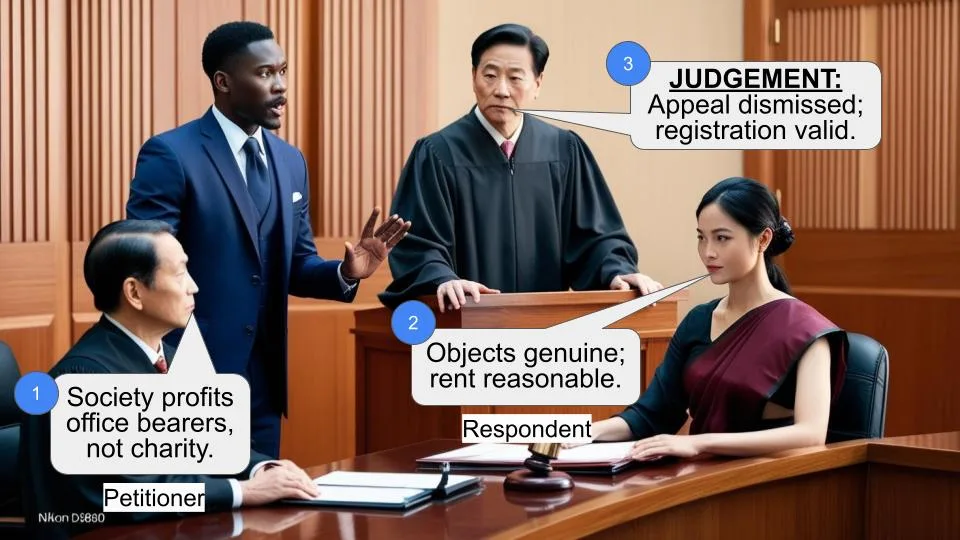
This case involves an appeal by the Commissioner of Income Tax (CIT) against an order by the Income Tax Appellate Tribunal (ITAT) that granted registration under Section 12AA (of Income Tax Act, 1961) to Divine Shiksha Samiti, an educational society. The High Court dismissed the appeal, upholding the ITAT's decision.
Get the full picture - access the original judgement of the court order here
Case Name:
Commissioner of Income Tax Vs Divine Shiksha Samiti (High Court of Madhya Pradesh)
I.T.A No.64/2019
Date: 6th January 2020
Key Takeaways:
1. The CIT's role in granting registration under Section 12AA (of Income Tax Act, 1961) is limited to examining the genuineness of the organization's objects.
2. Issues related to the application of income can be examined during assessment proceedings, not at the registration stage.
3. The court emphasized the importance of focusing on the genuineness of charitable objects when considering registration.
Issue:
Whether the Income Tax Appellate Tribunal (ITAT) was correct in directing the CIT to grant registration under Section 12AA (of Income Tax Act, 1961), despite the CIT's findings that the society existed for the profit of office bearers rather than charitable purposes?
Facts:
1. Divine Shiksha Samiti (the assessee Society) applied for registration under Section 12AA (of Income Tax Act, 1961).
2. The CIT refused registration, claiming the society existed for the profit of office bearers, not charitable purposes.
3. The society appealed to the ITAT, which set aside the CIT's order and allowed the appeal.
4. The CIT then appealed to the High Court against the ITAT's decision.
5. The society runs a Senior Secondary School affiliated with the M.P. Board.
6. The CIT's concerns included disproportionate rent payments to office bearers and maintenance expenses borne by the society.
Arguments:
CIT's Arguments:
1. The society was diverting income to provide undue benefits to its office bearers through rent payments.
2. The society bore maintenance expenses that should have been the landlords' responsibility.
Assessee Society's Arguments:
1. Rent payments were reasonable and within fair rental value as assessed by PWD.
2. Maintenance expenses were in line with the rental agreements and necessary for school operations.
3. The CIT misinterpreted the built-up areas and ignored open spaces in rent calculations.
Key Legal Precedents:
1. CIT Vs. DPR Charitable Trust - (2011) 16 DTR 410
2. Vidyadayani Shiksha Samiti Vs. CIT (Exemption) – ITA No.309/Del/2016
3. DIT Vs. Venkatesh Education Society, High Court of Karnataka (2012) 82 CCH 309
4. Fifth Generation Education Society Vs. CIT, High Court of Allahabad – 87 CIR (All) 169
These cases support the view that the CIT should focus on the genuineness of objects when considering registration under Section 12AA (of Income Tax Act, 1961).
Judgement:
1. The High Court dismissed the appeal, upholding the ITAT's decision.
2. It agreed that the CIT should only examine the genuineness of the organization's objects when considering registration under Section 12AA (of Income Tax Act, 1961).
3. The court found no illegality or perversity in the ITAT's findings.
4. It ruled that issues related to rent payments could be examined during assessment proceedings.
FAQs:
1. Q: What was the main point of contention in this case?
A: The main issue was whether the CIT should consider the application of income when granting registration under Section 12AA (of Income Tax Act, 1961).
2. Q: Why did the High Court dismiss the appeal?
A: The court found that the ITAT's decision was correct in law and that there was no substantial question of law arising from the case.
3. Q: Can the tax department still investigate the rent payments to office bearers?
A: Yes, the court clarified that the revenue department is at liberty to examine the reasonableness of rent paid to members during assessment proceedings.
4. Q: What is the significance of this judgment for other charitable organizations?
A: This judgment reinforces that registration under Section 12AA (of Income Tax Act, 1961) should primarily focus on the genuineness of an organization's charitable objects, not on the specifics of income application.
5. Q: Does this mean the society is exempt from all scrutiny regarding its finances?
A: No, the judgment only pertains to the registration process. The society's financial dealings can still be examined during regular assessment proceedings.

1. Challenge in this appeal filed under Section 260-A (of Income Tax Act, 1961), 1961 (for short “the Act”) is to an order dated 5.10.2018 passed by the Income Tax Appellate Tribunal, Indore in ITA No.1034/Ind/2016 whereby the appeal filed by the assessee was allowed and the order passed by the CIT(E), Bhopal was set aside.
2. The appellant has claimed the following substantial question of law for determination by this Court:-
“Whether, on the facts & circumstances of the case, the ITAT is correct in directing the Ld. CIT(E) to grant the registration u/s 12AA (of Income Tax Act, 1961) of that Act irrespective of the findings by the CIT(E) that the society exists for the purpose of profit of the office bearers not for charitable purpose thus attracts proviso to section 13(1)(c) (of Income Tax Act, 1961) ?”
3. Brief facts of the case are that the respondent-Divine Shiksha Samiti (for short “the assessee Society”) applied for registration under Section 12AA (of Income Tax Act, 1961) before the Commissioner of Income Tax, Bhopal (hereinafter referred to as “the CIT”). The CIT refused to grant registration on the ground that the assessee Society is in existence for the purposes of profit of the office bearers and not for charitable purposes. Against the said order of rejection, the assessee Society filed an appeal before the Income Tax Appellate Tribunal, Indore Bench, Indore. The Tribunal after hearing both the parties and referring to the judicial pronouncements set aside the order of the CIT and allowed the appeal filed by the assessee Society. It was observed that there was no doubt about the genuineness of the objects of the society for grant of registration under Section 12AA (of Income Tax Act, 1961). Feeling aggrieved by the said order of learned Tribunal this appeal has been filed.
4. Learned counsel for the appellant has argued that under the provisions of Section 12AA (of Income Tax Act, 1961), the CIT shall call for the documents or information from the trust or institution as it thinks necessary for the purpose of satisfying itself about the genuineness of activities of the trust or institution and make necessary inquiries as may be deemed fit in this regard.
It is submitted that the CIT can examine the application of income derived by the assessee Society whether it is applied for its objects or elsewhere. The CIT after noticing the clear deviance in payment by way of rent to the office bearers of the Society had rightly come to the conclusion that there is diversion of income of the assessee Society for providing undue benefit to its office bearers. It is further argued that the learned Tribunal has erred in recording the finding that while considering the application for registration of assessee Society, only the object of the assessee Society is required to be seen. Contending thus, it is prayed that this appeal may be allowed and the order passed by the Tribunal may be set aside.
5. We have heard learned counsel for the appellant/Department and find no force in the arguments advanced by him.
6. In the case in hand, the assessee Society applied for registration under Section 12AA (of Income Tax Act, 1961) before the CIT, Bhopal which was rejected mainly on the ground that the payment of the rent of the premises to related parties is not on pro rata basis though the premises are adjoining and the rent was being paid only to the office bearers of the Society. The rent agreement with the office bearers of the assessee Society do not provide for expenses on maintenance and taxes to be borne by the assessee Society, though the assessee Society had incurred the expenses amounting to Rs.7,89,850/- for the year 2014-15 and, therefore, it could be said that the funds of the assessee were being diverted for personal purpose of office bearers and families. On the aforesaid premises, the CIT, Bhopal came to the conclusion that the assessee Society is for the purpose of profit of the office bearers and not for charitable purposes. The assessee had furnished its explanation/information regarding the land area of the building, rental received per month, built up area, number of rooms etc. before the Tribunal controverting each reason adopted by CIT, Bhopal to deny registration to the assessee. It would be apt to notice the detail explanation tendered by the assessee before the Tribunal which is in following terms:-
“That on the facts and circumstances of the case, the learned CIT (Exemption) erred and was not justified in refusing the registration u/s 12AA (of Income Tax Act, 1961).
Your Honors ,
It is respectfully submitted as under :-
a. The main objective of the society is to spread education. For fulfilling the objectives society is running a Senior Secondary School affiliated to M.P. Board, under the name and style of ST Mary's Higher Secondary School at Sehore.
b. Regarding the observation of Learned CIT (Exemption) about the payment of rent to related parties is not on pro rata basis though the premises are adjoining it is submitted that the observation is not correct.
It is submitted that there is no such irregularity and the rent paid is most reasonable. It is also well within the fair rental value as assessed by the office of PWD Sehore. Copy enclosed at P.B. Page no.58 to 63 To further explain we have compiled all the details in a tabular format which explains the total area of land, built up area, open land, rent as per agreement and fair rental value as per PWD Norms as under :-
S. No. Name of land lord Land Area Plot Area and construction thereon (Sq. Ft.) Plot area and construction thereon (Sq.Ft.) No. of rooms Open land (As mentioned in the order)
Open land/play ground (Actually as per registry) Monthly rent as per agreement Monthly rent as per PWD agreement Remarks
1. Lissi Babu 25000(0.57 acre) 12000 Built up area 13467 (4489 per floor *3 in 3 floors) 15 - 20511(25000- 4489)
30000/- 73845/- In rent agreement it is clearly mentioned that there is an open land & also a play ground
2. Babu Antony 35000 (0.75 acre)
- Built up area 3000 in ground floor
7 - 32000(35000-3000) 15000/- 19800/- In rent agreement it is clearly mentioned thatthere is an open land.
3. Manish Tiwari 27010 (0.62 acre) 3500 Built up area 10500 (3500 per floor *3 in 3 floors) 30 23510 23510 (27010- 3500) 31500/- 56500/- In rent agreement, it is clearly mentioned that there is an open land & also a play ground
Your Honors, as seen from above there is no disproportionate rent. It appears that the Learned CIT (Exemption) has taken criteria of numbers of rooms only disregarding built up area and open land. In any case the rent paid is well within the fair rental value as assessed by the office of PWD. Copy enclosed at PB Page No.58 to 63 Specific observations on the rent paid are as under :-
i. Lissy Babu :-
In the premises of Lissy babu, there was open land for playground which has also been mentioned in rent agreement. The learned CIT (Exemption) totally ignored the area of open land. The open land area was 20511 sqft. Copy of Rent agreement and sale ded are enclosed as per PB Page No.31 to 42
ii. Babu Antony :-
In the premises of Babu Antony, there was open land for playground. The learned CIT (Exemption) totally ignored the area of open land. The open land are was 32000 sqft. Further no built up area has been mentioned whereas built up area is 3000 Sq. Ft. on ground floor. Copy of Rent Agreement and sale deed are enclosed as per PB Page No.43 to 49
iii. Manish Tiwari :-
In the premises of Manish Tiwari it was mentioned in rent agreement that 3 Floors has been constructed on Plot of 3500 sqft. The Total built up area for all the 3 floors comes to 10500 sqft. The learned CIT (Exemption) has taken built up area as 3500 sqft instead of 10500 sqft. Copy of Rent agreement and sale deed are enclosed as per PB Page No.50 to 57
c. Regarding the observation of Learned CIT (Exemption) about the assessee has incurred and borne repair and maintenance expenses (Rs.789850/- for the year 2014-15) and funds are being diverted fro personal purpose of office bearers/families and therefore, it can be said that the society exists for the purpose of profit of the office bearers, it is submitted as under :-
In Rent Agreement it is clearly mentioned that the premises shall be kept clean and white wash of the building shall be done by the tenant. Hence at the ousted, it is submitted that the observation of The learned CIT (Exemption) that the expenses on maintenance and taxes are not to be born by the assessee is totally factually incorrect. Relevant clause no. are summarized as under :-
S. No. Landlord Name Clause No. of relevant Rent Agreement
PB Page No.
1. Lissi Babu Antony (7) 31 to 36
2. Babu Antony (6) 43 to 44
3. Manish Tiwari (6) 50 to 52
Hence, as seen from the clause of rent agreement, it is the responsibility of the tenant will keep the premises neat and clean and expenses for white wash and repairs shall also be incurred by the tenant. It is further submitted that no taxes have been paid by the assessee but the same have only been paid by the landlord.
In view of above, it is submitted that the observation that assessee incurred Rs.7,89,850/- in FY 2014-15 for these expenses and diverted for personal purposes of office bearers and families is factually incorrect.
Further amount of Rs.7,89,850/- has not been fully incurred for building repairs but it is incurred on cleaning charges, sanitation charges, white wash charges, repair to furniture and fixtures, repair of Lab equipments, projectors, sports equipments, office equipments and computers. Copy of ledger account to explain, is enclosed as per P.B. Page No.64 to 74 Summary of repair and maintenance expenses of Rs.7,89,850/- is as under :-
Heads Amount
Repair and Maintenance for Furniture
Rs.79,133/-
Repair and Maintenance for Computer
Rs.44,743/-
Repair and Maintenance for Lab Equipment
Rs.24,800/-
Repair and Maintenance for electricity
Rs.98,320/-
Repair and Maintenance for Sanitation (Plumbing etc)
Rs.41,600/-
Expenses on Maintenance of garden
Rs.61,200/-
Expenses on Maintenance of Cleanliness
Rs.1,31,699/-
Expenses on whitewash of Building about 26700 sq. ft. built up area
Rs.1,75,780/-
Expenses on Maintenance of playground
Rs.18,800/-
Expenses on Maintenance of Sports Equipments
Rs.12,200/-
Expenses on Maintenance of office Equipments
Rs.15,300/-
Expenses for water tanker Rs.53,760/-
General Repair and Maintenance Rs.32,515/-
Total Rs.7,89,850/-
After noticing the aforesaid, the Tribunal concluded that the issue regarding payment of rent to the members could be examined at the time of the assessment proceedings.
7. Further, the Tribunal noticed that Section 12AA (of Income Tax Act, 1961) nowhere provides that CIT (Exemption) while considering the application for registration is also required to examine whether the income derived by the Trust is being spent for charitable purposes or the Trust is earning profit. It had taken note of the decisions in the cases of CIT Vs. DPR Charitable Trust - (2011) 16 DTR 410, Vidyadayani Shiksha Samiti Vs. CIT (Exemption) – ITA No.309/Del/2016, DIT Vs. Venkatesh Education Society, High Court of Karnataka (2012) 82 CCH 309, Fifth Generation Education Society Vs. CIT, High Court of Allahabad – 87 CIR (All) 169 and some other decisions holding the field and observed as under:-
“5. In view of the above decision coupled with the fact that there is no doubt about the genuineness of the objects, we direct the Ld. CIT to grant registration u/s 12AA (of Income Tax Act, 1961) to the assessee society. Further, it is clarified that revenue would be at liberty to examine the issue of rent paid to the members that whether it is reasonable or not, during the assessment proceedings, if any. Grounds raised by the assessee are allowed.”
8. After examining the factual matrix and appreciating the legal position as noticed hereinbefore, we find that the learned Tribunal has rightly come to the conclusion that the genuineness of the objects of the assessee Society could not be doubted and has rightly directed the CIT, Bhopal to grant registration to the Society.
9. Learned counsel for the appellant failed to point out any illegality or perversity in the findings arrived at by the learned Tribunal warranting interference by this Court in exercise of power under Section 260-A (of Income Tax Act, 1961). No substantial question of law arises for consideration in this appeal.
10. Accordingly, this appeal stands dismissed.
(Ajay Kumar Mittal) (Vijay Kumar Shukla)
Chief Justice Judge
×
Similar Ripples
Questions
Tax Tribunal Overrules CIT, Grants Registration to Educational Society
Write your CommentSimilar Posts

Generic
- Reportdata/6335.pdf
