


Full News
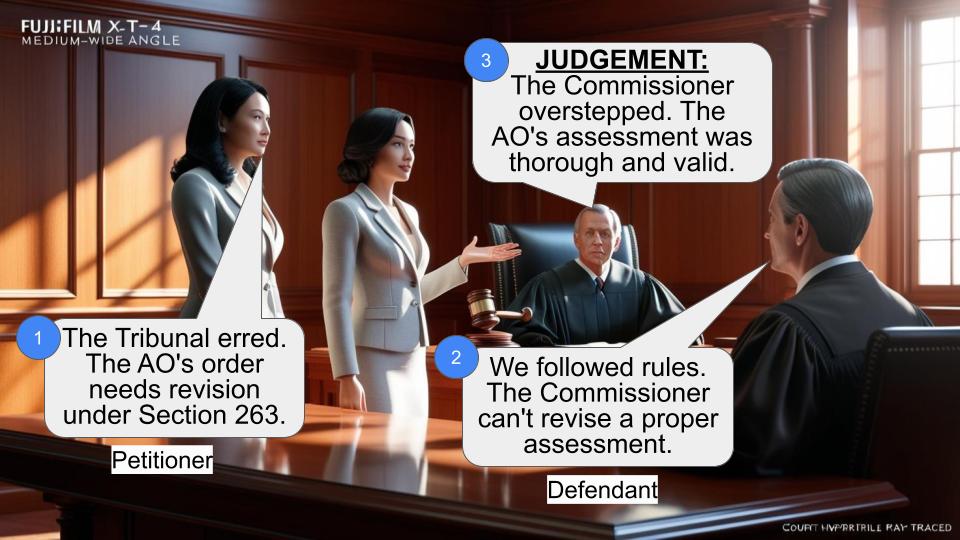
Tax Tribunal's Decision Upheld: Commissioner's Revision Order Quashed in Depreciation Dispute
Tax Tribunal's Decision Upheld: Commissioner's Revision Order Quashed in Depreciation Dispute
The Income Tax Department (the revenue) appealed against a decision made by the Income Tax Appellate Tribunal. The Tribunal had earlier quashed an order by the Commissioner of Income Tax, who had tried to revise an assessment related to depreciation on leasehold land. The High Court dismissed the revenue's appeal, siding with the taxpayer (Cyber Park Development & Constructions Ltd.).
Get the full picture - access the original judgement of the court order here
Case Name:
Commissioner of Income Tax Vs Cyber Park Development & Construction Ltd. (High Court of Karnataka)
ITA No.137 of 2014
Date: 5th October 2020
Key Takeaways:
1. The Commissioner's power to revise assessments under Section 263 (of Income Tax Act, 1961) is limited.
2. An assessment order isn't "erroneous" just because the Commissioner disagrees with it.
3. If the Assessing Officer has considered all materials and applied their mind, the Commissioner can't intervene.
4. The courts continue to uphold the principles laid down in the Malabar Industrial Co. Ltd. case regarding Section 263 (of Income Tax Act, 1961) revisions.
Issue:
The main question here was: Did the Income Tax Appellate Tribunal err in quashing the Commissioner's order under Section 263 (of Income Tax Act, 1961), which had revised the assessment of depreciation on leasehold land?
Facts:
1. Cyber Park Development & Constructions Ltd. is in the business of developing and maintaining infrastructure for software and related sectors.
2. For the 2007-08 assessment year, they declared an income of Rs.2,10,76,230.
3. They claimed depreciation of Rs.75,27,156 on leasehold land as an intangible asset at a rate of 25%.
4. The Commissioner of Income Tax, based on a Revenue Audit Objection, initiated proceedings under Section 263 (of Income Tax Act, 1961).
5. The Commissioner held that the Assessing Officer's order was erroneous and prejudicial to the revenue's interests.
6. The Tribunal quashed the Commissioner's order, saying the Assessing Officer had considered all materials and applied their mind.
7. The revenue (tax department) then appealed to the High Court.
Arguments:
Revenue's side: They argued that the Tribunal's order was contrary to law and wrongly relied on the Supreme Court's decision in the Malabar Industrial Company case.
Assessee's (taxpayer's) side: They supported the Tribunal's order, saying Section 263 (of Income Tax Act, 1961) wasn't applicable in this case as the Assessing Officer had made a proper assessment.
Key Legal Precedents:
1. MALABAR INDUSTRIAL CO. LTD. vs CIT (243 ITR 83):
This Supreme Court case established that for Section 263 (of Income Tax Act, 1961) to apply, the order must be both erroneous and prejudicial to the revenue's interests. It also clarified that if two views are possible and the Assessing Officer takes one, it can't be called erroneous.
2. CIT vs MAX INDIA LTD. (295 ITR 282):
This case reiterated the principles from the Malabar Industrial Co. Ltd. case.
3. ULTRATECH CEMENT LTD. AND ORS. vs STATE OF RAJASTHAN AND ORS. (Civil Appeal No. 2773/2020):
This recent case also upheld the same principles.
Judgement:
The High Court dismissed the revenue's appeal. They agreed with the Tribunal that:
1. The Assessing Officer had properly considered all materials and applied their mind.
2. The assessment order wasn't erroneous or prejudicial to the revenue's interests.
3. Therefore, the Commissioner's use of Section 263 (of Income Tax Act, 1961) wasn't justified.
FAQs:
1. Q: What's Section 263 (of Income Tax Act, 1961) about?
A: It gives the Commissioner power to revise orders that are erroneous and prejudicial to the revenue's interests.
2. Q: Can the Commissioner revise any assessment they disagree with?
A: No, they can only revise if the order is both erroneous and prejudicial to revenue interests.
3. Q: What's the significance of the Malabar Industrial Co. Ltd. case?
A: It set important guidelines for when Section 263 (of Income Tax Act, 1961) can be used, limiting the Commissioner's revision powers.
4. Q: Does this case change any existing laws?
A: Not really. It reinforces existing principles about the limits of the Commissioner's revision powers.
5. Q: What's the takeaway for taxpayers?
A: If your assessment was done thoroughly by the Assessing Officer, it's harder for the Commissioner to revise it later.

This appeal under Section 260A (of Income Tax Act, 1961) (hereinafter referred to as the Act for short) has been preferred by the revenue. The subject matter of the appeal pertains to the Assessment year 2007-08. The appeal was admitted by a bench of this Court vide order dated 09.03.2015 on the following substantial questions of law:
(i) Whether in the facts and circumstances of the case, the Tribunal is justified in law in condoning the delay of 360 days when it itself as held that the reasoning given by the assessee that it was not aware that an appeal ought to have been filed before the Tribunal delay notice was issued by the Commissioner of income tax for the assessment year 2009-10 was not acceptable as the notice under section 263 (of Income Tax Act, 1961) was issued on 13.10.2011 and the case was heard on extreme 16.11.2011 which was represented by the same counsel who had appeared before the Tribunal on an appeal against the order under section 263 (of Income Tax Act, 1961) surge assessment year 2006-07 which was disposed of by the tribunal on 28-12-2011?
(ii) Whether on the facts and in the circumstances of the assessee’s case, the Tribunal was justified in condoning the delay of 360 days by relying on the order of the Supreme Court in the case of MST Katiji and others reported in 167 ITR page 471, medicine of the High Court in CIT V/s ISRO satellite Centre in ITA number 532/Bang/2008 and that of the Tribunal in the case of Shakunatala Hegde v/s ACIT in ITA no.2785/Bang/2004 without appreciating that the circumstances were condoning the delay in cases relied upon by the tribunal or different and distinguishable from that of the present case?
(iii) Whether on the facts and in the circumstances of the assessee’s case, the Tribunal was justified, in crashing the order dated 16.11.2011 passed under section 263 (of Income Tax Act, 1961), without appreciating that the CIT had merely directed the assessing authority to examine the issue afresh as the authority had not examine the issue and applied his mind while accepting the claim of the assessee and without appreciating that the assessing officer had not recorded the finding on the matter of the climb and that the Supreme Court in the case of Malabar industrial Co V/s CIT reported in 243 ITR page 83, had held that an order passed without application of mind falls in the category of erroneous order?
(iv) Whether the Tribunal was justified, on the facts and in the circumstances of the case, in holding that Commissioner of income tax has no power to revise the assessment for the inadequacy of enquires by the assessing officer or insufficiency of material on record without appreciating that this Commissioner has not imposed his view on the assessing officer on the issue under consideration and that Commissioner of income tax had merely directed assessing officer to verify the claim in detail?
2. Facts leading to filing of the appeal briefly stated are that the assessee came to be involved in the business of development and maintenance in respect of infrastructure facilities for software and related sectors. The assessee had filed its return of income for the Assessment Year 2007-08 by declaring total income of Rs.2,10,76,230/-. The Commissioner of Income Tax in exercise of powers under Section 263 (of Income Tax Act, 1961) initiated proceedings on the ground that Revenue Audit Objection was raised in case of assessee with regard to depreciation of Rs.75,27,156/- on the lease hold land as intangible asset under the Act at the rate of 25%. The Commissioner by an order dated 26.11.2011 held that the order of assessment passed by the Assessing Officer was erroneous and was prejudicial to the interest of the revenue. The assessee assailed the aforesaid order in appeal before the Income Tax Appellate Tribunal (hereinafter referred to as 'the Tribunal' for short). The Tribunal by an order dated 30.10.2013 inter alia held that Assessing Officer had considered all the materials furnished by the assessee and after due application of mind had allowed depreciation on lease hold rights. Therefore, the order of the Assessing Officer could neither be termed as erroneous nor prejudicial to the interest of the revenue and therefore, the Commissioner of Income Tax was not justified in invoking the provisions of Section 263 (of Income Tax Act, 1961) in the fact situation of the case. In the aforesaid factual background, the revenue is in appeal before us.
3. Learned counsel for the revenue submitted that the impugned order passed by the Tribunal is contrary to law and grossly erred in placing reliance on decision of the Supreme Court in ‘MALABAR INDUSTRIAL COMPANY VS. CIT’, 243 ITR 83. On the other hand, learned counsel for the assessee has supported the order passed by the Tribunal and has submitted that the Tribunal has rightly quashed the order passed by the Commissioner of Income Tax, as provisions of Section 263 (of Income Tax Act, 1961) are not attracted in the fact situation of the case.
4. We have considered the submissions made by learned counsel for the parties and have perused the record. Before proceeding further, it is apposite to take note of the relevant extract of Section 263 (of Income Tax Act, 1961), which reads as under:
263. Revision of orders prejudicial to revenue(1) The Commissioner may call for and examine the record of any proceeding under this Act, and if he considers that any order passed therein by the Assessing Officer is erroneous in so far as it is prejudicial to the interests of the revenue, he, may, after giving the assessee an opportunity of being heard and after making or causing to be made such inquiry as he deems necessary, pass such order thereon as the circumstances of the case justify, including an order enhancing or modifying the assessment, or cancelling the assessment and directing a fresh assessment.
5. Thus, from close scrutiny of Section 263 (of Income Tax Act, 1961) it is evident that twin conditions are required to be satisfied for exercise of revisional jurisdiction under Section 263 (of Income Tax Act, 1961) firstly, the order of the Assessing Officer is erroneous and secondly, that it is prejudicial to the interest of the revenue on account of error in the order of assessment.
6. The aforesaid provision was considered by the Supreme Court in MALABAR INDUSTRIAL CO. LTD.I supra and it was held that the phrase ‘prejudicial to the interests of the revenue’ has to be read in conjunction with an erroneous order passed by the Assessing Officer and every loss of revenue as a consequence of the order of the Assessing Officer cannot be treated as prejudicial to the interest of revenue. It was further held that where two views are possible and the Income Tax Officer has taken one view with which the Commissioner does not agree, the order passed by the Assessing Officer cannot be treated as erroneous order prejudicial to the interest of the revenue. The principles laid down in the aforesaid decision were reiterated by the Supreme Court in ‘CIT VS. MAX INDIA LTD.,’ 295 ITR 282 (SC) and recently in ‘ULTRATECH CEMENT LTD. AND ORS. VS. STATE OF RAJASTHAN AND ORS.’, CIVIL APPEAL NO.2773/2020 DECIDED ON 17.07.2020.
7. In the backdrop of aforesaid well settled legal principles, we may examine the facts of the case in hand. The Tribunal has held that the Commissioner of Income Tax while exercising powers under Section 263 (of Income Tax Act, 1961) had relied on an order passed under Section 263 (of Income Tax Act, 1961) in respect of Assessment Year 2007-08.
The aforesaid order has been quashed by the Tribunal vide order dated 28.11.2011. It has further been held that the Assessing Officer after due application of mind and on proper consideration of the material available on record has allowed the claim for depreciation on lease hold rights. The order passed by the Assessing Officer can neither said to be erroneous nor prejudicial to the interest of the revenue. Therefore, the Tribunal has rightly quashed the order passed by the Commissioner of Income Tax.
In view of preceding analysis, the substantial questions of law are answered against the revenue and in favour of the assessee. In the result, the appeal fails and is hereby dismissed.
Sd/-
JUDGE
Sd/-
JUDGE
×
Similar Ripples
Questions
Tax Tribunal's Decision Upheld: Commissioner's Revision Order Quashed in Depreciation Dispute
Write your CommentSimilar Posts


Generic
- Reportdata/6174.pdf
