


TDS Deduction Dispute: Tribunal Favors Assessee Over Revenue


Full News
TDS Deduction Dispute: Tribunal Favors Assessee Over Revenue
TDS Deduction Dispute: Tribunal Favors Assessee Over Revenue
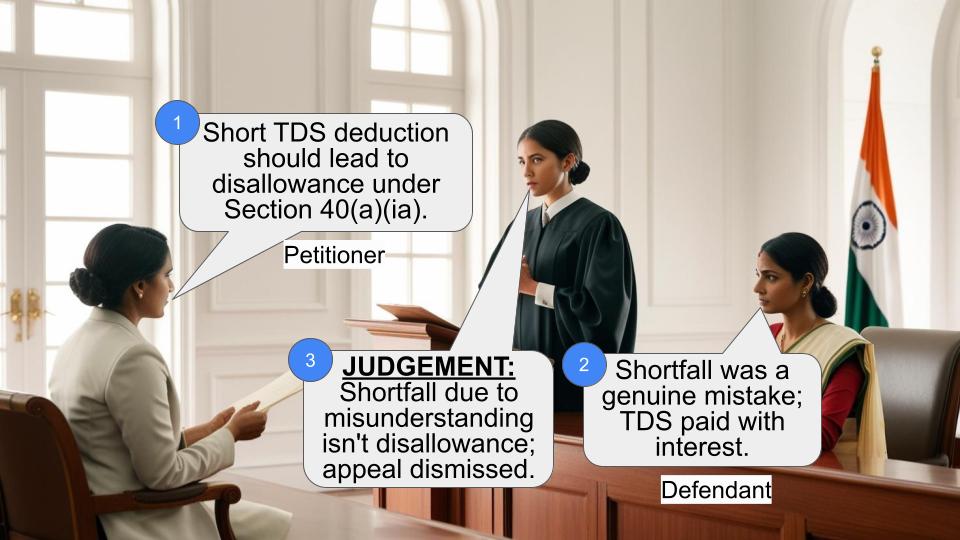
In this case, the Revenue appealed against a decision favoring the assessee, who had made a short deduction of tax at source. The central issue was whether the disallowance of expenditure under Section 40(a)(ia) (of Income Tax Act, 1961) was justified. The court upheld the Tribunal's decision, which relied on a precedent from the Calcutta High Court, ruling that a shortfall in TDS due to a bona fide misunderstanding does not warrant disallowance.
Get the full picture - access the original judgement of the court order here
Case Name:
Commissioner of Income Tax and Another vs. Kishore Rao and Others (HUF) (High Court of Karnataka)
ITA No. 660 of 2015
Date: 17th March 2016
Key Takeaways:
- The court emphasized that a shortfall in TDS due to a bona fide misunderstanding does not lead to disallowance under Section 40(a)(ia) (of Income Tax Act, 1961).
- The decision relied heavily on the precedent set by the Calcutta High Court in the case of S.K. Tekriwal.
- The ruling clarifies that the provisions of Section 40(a)(ia) (of Income Tax Act, 1961) apply only in cases of non-deduction, not short deduction.
Issue
Is the disallowance of expenditure under Section 40(a)(ia) (of Income Tax Act, 1961) justified when there is a shortfall in TDS due to a bona fide misunderstanding?
Facts
The assessee deducted TDS at 1% instead of the required 2% on certain payments. Upon realizing the mistake, the assessee paid the balance TDS with interest. The Revenue argued for disallowance of the expenditure under Section 40(a)(ia) (of Income Tax Act, 1961), while the assessee contended that the shortfall was due to a misunderstanding.
Arguments
- Revenue's Argument: The Revenue contended that the short deduction of TDS warranted disallowance under Section 40(a)(ia) (of Income Tax Act, 1961) as the deduction was not in accordance with the provisions.
- Assessee's Argument: The assessee argued that the shortfall was due to a bona fide misunderstanding and that the balance TDS was paid with interest, thus disallowance was not justified.
Key Legal Precedents
- S.K. Tekriwal Case: The Calcutta High Court held that a shortfall in TDS due to a misunderstanding does not lead to disallowance under Section 40(a)(ia) (of Income Tax Act, 1961) if the TDS is eventually paid.
- Section 40(a)(ia) (of Income Tax Act, 1961): This section deals with disallowance of expenditure for non-deduction of TDS.
Judgement
The court dismissed the Revenue's appeal, upholding the Tribunal's decision that no disallowance can be made under Section 40(a)(ia) (of Income Tax Act, 1961) for a shortfall in TDS due to a bona fide misunderstanding. The court found no substantial question of law in the Revenue's appeal.
FAQs
Q1: What does this judgment mean for taxpayers?
A1: It clarifies that a shortfall in TDS due to a genuine misunderstanding does not automatically lead to disallowance of expenditure under Section 40(a)(ia) (of Income Tax Act, 1961).
Q2: How does this affect the application of Section 40(a)(ia) (of Income Tax Act, 1961)?
A2: The judgment limits the application of Section 40(a)(ia) (of Income Tax Act, 1961) to cases of non-deduction, not short deduction, of TDS.
Q3: What was the role of the S.K. Tekriwal case in this judgment?
A3: The S.K. Tekriwal case was pivotal as it set a precedent that a shortfall due to misunderstanding does not warrant disallowance, which the court relied upon in this judgment.
Revenue has preferred the present appeal by raising the following substantial questions of law:
“Whether, on the facts and in the circumstances of the case, the Tribunal is
right in law in holding that disallowance of expenditure claimed by the assessee towards payments amounting to Rs.3,42,86,912/- under Section 40(a)(ia) (of Income Tax Act, 1961) is not proper by relying upon the decision which is not applicable to facts of the present case and when the ingredients of Section 194H (of Income Tax Act, 1961) and 40(a) (ia) are satisfied in the instant case?
2, We have heard Mr.Arvind, learned counsel appearing for appellant-Revenue.
3. The relevant discussion in the impugned order of the Tribunal on the aforesaid aspect is at paragraphs 5.3 to 5.3.3 which read as under:
“5.3.1 We have heard the rival contentions
on the ground at S.No.5 and perused and
carefully considered the material on record;
including the judicial pronouncements cited
and placed reliance upon. It is not in dispute
that the assessee had made short deduction
of tax at source @ 1% instead of 2% on certain
payments and failed to remit the said TDS
within the due date of filing the return of
income for Assessment Year 2010-11 under
Section 139(1) (of Income Tax Act, 1961). On examination by
the Assessing Officer, the assessee explained
that subsequently, on realisation that TDs on
the said payments were to be made @ 2%
thereon, instead of 1% as had been done by
the assessee, the balance TDS was paid on
31.1.2011 along with interest under Section
201(1A) of the Act. The Assessing Officer, on
examination of the assessee's claim, was of
the view that deduction of tax at a lower rate
cannot be taken as TDS made in accordance
with the provisions of Chapter XVII-B and,
following the decisions of the Chennai ITAT in
the case of Frontier Offshore Exploration (I)
Ltd. (supra) and Pixie Enterprises (supra),
held that even in case of short deduction, the
liability to deduct tax exists as on the date of
filing the return of income and therefore those
amounts which have not suffered TDS was
liable to disallowance under Section 40(a)(ia) (of Income Tax Act, 1961)
of the Act. On appeal, the learned CIT
(Appeals) upheld the decision of the
Assessing Officer.
5.3.2 According to the learned Authorised
Representative if, as in the case on hand,
there is any shortfall in deduction of tax at
source due to any difference in understanding
or opinion as to the taxability of any payment
or the nature of payments made under TDS
provisions, no disallowance can be made by
invoking the provisions of Section 40(a)(ia) (of Income Tax Act, 1961) of
the Act. We have had occasion to peruse the
decision of the Hon'ble High Court of Calcutta
in the case of S.K. Tekriwal (supra), wherein
their Lordships had considered the very same
issue of the applicability of the provisions of
Section 40(a)(ia) (of Income Tax Act, 1961) in a case where
there was short deduction of tax at source on
payments made to sub-contractors and find
that the facts of that case are similar to those
of the case on hand. In the cited case, the
Hon'ble Calcutta High Court has held that if
there is any shortfall in deduction of tax due
to difference in opinion or understanding as to
the taxability of any item or nature of
payments falling under various TDS
provisions, no disallowance can be made by
invoking the provisions of Section 40(a)(ia) (of Income Tax Act, 1961) of
the Act. We are of the considered view that
the cited case would cover the issue squarely
in favour of the assessee and against
Revenue. At paras 2 and 3 of its order, the
Hon'ble High Court of Calcutta has held as
under :-
“2. The reasoning appearing at paragraph 6
of the judgment and/or order under challenge
reads as follows:
“In the present case before us the assessee
has deducted tax under Section 194C(2) (of Income Tax Act, 1961) of
the Act being payments made to sub-
contractors and it is not a case of non-
deduction of tax or no deduction of tax as is
the import of section 40a(ia) (of Income Tax Act, 1961). But
the revenue’s contention is that the payments
are in the nature of machinery hire charges
falling under the head ‘rent’ and the previous
provisions of section 194I (of Income Tax Act, 1961) are
applicable. According to revenue, the
assessee has deducted tax @ 1% 2 under
Section 194C(2) (of Income Tax Act, 1961) as against the
actual deduction to be made at 10% under
Section 194I (of Income Tax Act, 1961), thereby lesser
deduction of tax. The revenue has made out a
case of lesser deduction of tax and that also
under different head and accordingly
disallowed the payments proportionately by
invoking the provisions of section 40(a)(ia) (of Income Tax Act, 1961) of
the Act. The ld. CIT, DR also argued that there
is no word like failure used in section 40(a)(ia) (of Income Tax Act, 1961)
of the Act and it referred to only non-
deduction of tax and disallowance of such
payments. According to him, it does not refer
to genuineness of the payment or otherwise
but addition under section 40(a)(ia) (of Income Tax Act, 1961)
can be made even though payments are
genuine but tax is not deducted as required
under section 40(a)(ia) (of Income Tax Act, 1961). We are of
the view that the conditions laid down under
section 40(a)(ia) (of Income Tax Act, 1961) for making addition
is that tax is deductible at source and such
tax has not been deducted. If both the
conditions are satisfied then such payment
can be disallowed under section 40(a)(ia) (of Income Tax Act, 1961) of
the Act but where tax is deducted by the
assessee, even under bonafide wrong
impression, under wrong provisions of TDS,
the provisions of section 40(a)(ia) (of Income Tax Act, 1961)
cannot be invoked.
Here in the present case before us, the
assessee has deducted tax under Section
194C(2) of the Act and not under Section 194I (of Income Tax Act, 1961)
of the Act and there is no allegation that this
TDS is not deposited with the Government
account. We are of the view that the
provisions of section 40(a)(ia) (of Income Tax Act, 1961) has
two limbs one is where, inter alia, assessee
has to deduct tax and the second where after
deducting tax, inter alia, the assessee has to
pay into Govt. Account. There is nothing in the
said section to treat, inter alia, the assessee
as defaulter where there is a shortfall in
deduction. With regard to the shortfall, it
cannot be assumed that there is a default as
the deduction is not as required by or under
the Act, but the facts is that this expression,
on which tax is deductible at source under
Chapter XVII-B and such tax has not been
deducted or, after deduction has not been
paid on or before the due date specified in
sub-section 3(1) (of Income Tax Act, 1961) of section 139 (of Income Tax Act, 1961). This section
40(a)(ia) of the Act refers only to the duty to
deduct tax and pay to government account. If
there is any shortfall due to any difference of
opinion as to the taxability of any item or the
nature of payments falling under various TDS
provisions, the assessee can be declared to
be an assessee in default under Section 201 (of Income Tax Act, 1961)
of the Act and no disallowance can be made
by invoking the provisions of section 40(a)(ia) (of Income Tax Act, 1961)
of the Act.
Accordingly, we confirm the order of CIT
(Appeals) allowing the claim of assessee and
this issue of revenue’s appeal is dismissed.”
3. We find no substantial question of law is
involved in this case and therefore, we refuse
to admit the appeal. Accordingly, the appeal
is dismissed.”
5.3.3 Respectfully following the decision of
the Hon’ble High Court of Calcutta in the case
of S.K. Tekriwal (supra), which is factually
similar to the case on hand, we hold that no
disallowance can be made by invoking the
provisions of Section 40(a)(ia) (of Income Tax Act, 1961) if
there was any shortfall in deduction of tax at
source due to any difference of understanding
or opinion as to the taxability of any item or
the nature of payments falling under various
TDS provisions and therefore reverse the
findings of the authorities below and allow
the assessee’s appeal in respect of Ground
No.5.”
The aforesaid shows that the Tribunal has gone by the
decision taken by the High Court of Calcutta and has
found that it was not a case of no deduction of TDS
whatsoever and therefore, the provisions of Section
40(a) and (ia) of the Act cannot be attracted and
resultantly the assessee’s appeal has been allowed.
4. However, Mr.Aravind, learned counsel
appearing for appellant contended that the decision of
Calcutta High Court in case of Commissioner of IT vs.
S.K.Tekriwal reported in (2014) 361 ITR 432(Cal.) is
wrongly applied by the Tribunal. The facts of the case
in the decision of Calcutta High Court were altogether
different. He submitted that, in the said case, the TDS
was deducted at a lesser percentage but the payment
was credited in the Revenue in time whereas, in the
present case, the TDS was deducted at a lesser rate but
no payment was credited with the revenue in time.
5. He submitted that, as per Scheme of Sec.40(a) (of Income Tax Act, 1961)
(ia) of the Act read with proviso, if no deduction is made,
the amount is disallowable as revenue expenditure and
if TDS is made succeeding year, it would be admissible
in that year and not the year in which the claim has
been made. In his submission, the decision of Calcutta
High Court in case of S.K.Tekriwal has not laid down
that, if the deduction is at a lesser percentage than
required, then expenses cannot be disallowed. In his
submission, the Tribunal has committed an error and
hence this Court may consider the matter.
6. In our view, as per the decision of the Calcutta
High Court, the view taken by the Tribunal is that
Section 40(a)(ia) (of Income Tax Act, 1961) may be invoked only in case
of there being an absence of deduction. Further, in case
of bona fide wrong impression, if the deduction is at a
lesser rate, the same cannot be a ground for
disallowance by invoking the provisions of Section
40(a)(ia).
7. Examining the matter, we find that there are
two angles to the matter: The first is, whether it was a
case of `no deduction’ or not in the present case. The
answer would be in the negative because, the deduction
was already made at the rate of 1%. The second angle
would be as to whether it was under a bona fide wrong
impression that only 1% was deducted instead of 2%.
The contention of the assessee was that, having realized
that deduction was 2% instead of 1%, the amount of
TDS has been paid with interest. It is also a matter of
fact that, two separate rate of deductions have been
provided for the same work of contractor, one is at the
rate of 1% if the contractor is individual or HUF,
whereas, it is 2% if the contractor is other than
individual or HUF. The Tribunal, in view of facts and
circumstances, found that, it is a bona fide wrong
impression.
8. As such, on the aspects of the bona fide wrong
impression keeping in view the contention of the
assessee that in the middle of year, there is change of
law about the deduction, as well as on the non-
availability of the provisions of Section 40(a)(ia) (of Income Tax Act, 1961), when
the issue is covered by the Calcutta High Court
Judgment in case of S.K.Tekriwal supra, we do not find
that any substantial question of law would arise for
consideration as sought to be canvassed.
Hence, the appeal is dismissed.
Sd/-
JUDGE
Sd/-
JUDGE
×
Similar Ripples
Questions
TDS Deduction Dispute: Tribunal Favors Assessee Over Revenue
Write your CommentSimilar Posts


Generic
- Reportdata/2996.pdf
