


Tribunal Quashes CIT's Order: Section 263 (of Income Tax Act, 1961) Conditions …


Full News
Tribunal Quashes CIT's Order: Section 263 (of Income Tax Act, 1961) Conditions Not Met
Tribunal Quashes CIT's Order: Section 263 (of Income Tax Act, 1961) Conditions Not Met
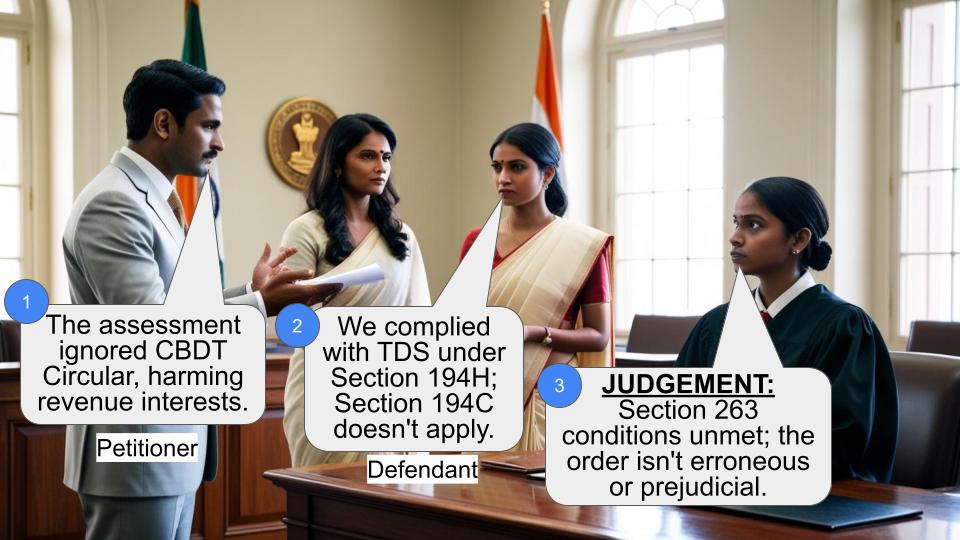
In the case involving the Commissioner of Income Tax and Hewlett-Packard India Sales Pvt. Ltd., the Tribunal ruled that the Commissioner had no jurisdiction to invoke Section 263 (of Income Tax Act, 1961). The Tribunal found that the necessary conditions for invoking this section—namely, that the order was erroneous and prejudicial to the interest of the revenue—were not satisfied.
Get the full picture - access the original judgement of the court order here
Case Name:
Commissioner of Income Tax vs. Hewlett-Packard India Sales Pvt. Ltd. (High Court of Karnataka)
ITA No. 342 of 2015
Date: 16th February 2016
Key Takeaways:
- The Tribunal emphasized the importance of satisfying both conditions under Section 263 (of Income Tax Act, 1961): the order must be erroneous and prejudicial to the revenue.
- The decision highlights the Tribunal's reliance on previous judgments, including those from the Calcutta High Court and the Apex Court, to support its conclusion.
- The case underscores the binding nature of CBDT Circulars and their interpretation by higher courts.
Issue
Did the Commissioner have the jurisdiction to invoke Section 263 (of Income Tax Act, 1961), given the conditions were not met?
Facts
Hewlett-Packard India Sales Pvt. Ltd. was assessed for the year 2007-08. The Commissioner sought to revise the assessment order under Section 263 (of Income Tax Act, 1961), arguing that the Assessing Officer failed to disallow certain expenditures as per the CBDT Circular No. 715. The Tribunal, however, found that the assessee had deducted TDS under Section 194H (of Income Tax Act, 1961), and Section 194C (of Income Tax Act, 1961) was not applicable.
Arguments
- Commissioner's Argument: The assessment order was erroneous and prejudicial to the revenue because it did not consider the CBDT Circular regarding TDS on advertisement contracts.
- Assessee's Argument: The assessee had complied with the TDS requirements under Section 194H (of Income Tax Act, 1961), and the provisions of Section 194C (of Income Tax Act, 1961) were not applicable.
Key Legal Precedents
- Calcutta High Court in S.K. Tekriwal’s Case: Addressed similar issues regarding Section 40(a)(ia) (of Income Tax Act, 1961) and was followed by the Tribunal.
- Apex Court in Hindustan Aeronautics Limited: Provided guidance on the binding nature of CBDT Circulars.
- Dhaanya Seeds Private Limited Case: A coordinate Bench decision that supported the Tribunal's conclusion.
Judgement
The Tribunal quashed the Commissioner's order under Section 263 (of Income Tax Act, 1961), ruling that the conditions for invoking this section were not met. The Tribunal found that the order was neither erroneous nor prejudicial to the revenue, as the assessee had complied with the relevant TDS provisions.
FAQs
Q1: What does Section 263 (of Income Tax Act, 1961) entail?
A1: Section 263 (of Income Tax Act, 1961) allows the Commissioner to revise an order if it is erroneous and prejudicial to the interest of the revenue.
Q2: Why was the Commissioner's order quashed?
A2: The Tribunal found that the necessary conditions for invoking Section 263 (of Income Tax Act, 1961) were not satisfied, as the order was not erroneous or prejudicial to the revenue.
Q3: What role did the CBDT Circular play in this case?
A3: The CBDT Circular was central to the Commissioner's argument, but the Tribunal found that the assessee had complied with the applicable TDS provisions, rendering the Circular's application moot in this context.

1. This appeal is by the revenue under Section 260 (of Income Tax Act, 1961) A of the Income Tax Act 1961 (the ‘Act’ for short) against the order passed by the Income Tax Appellate Tribunal, Bangalore Bench “A”, Bangalore relating to the assessment year 2007-08 by raising the following substantial questions of law:
“1. Whether the Tribunal was correct in quashing the order u/s.263 (of Income Tax Act, 1961) passed by the CIT without appreciating that the form 3CD report of the auditor had contended that the assessee has not considered CBDT’s Circular No.715 in respect of section 194C (of Income Tax Act, 1961) pertaining to deduction of TDS on advertisement contract an Rs.8,96,04,391/- should be disallowed as an expenditure from the P&L account as per provision of section 40(a)(ia) (of Income Tax Act, 1961) and brought to tax?
2. Whether the Tribunal is correct in quashing the
order u/s.263 (of Income Tax Act, 1961) passed by the CIT without
appreciating the fact that the omission on the part of
the assessing officer not to consider applicability of
the CBDT circular has made the assessment order
erroneous and prejudicial to the revenue and hence
the proceedings u/s.263 (of Income Tax Act, 1961) is valid and needs to be
upheld?”
2. Briefly stated the facts are that the assessee is in the
business of manufacturing and trading of computer accessories
and had filed its return of income for the assessment year 2007-08.
The assessments were concluded making a disallowance on
account of depreciation on intangible assets amounting to
Rs.1,21,10,326/- to the income declared by the assessee.
3. This order was taken up in revision by the CIT(LTU)
(hereinafter referred to as the ‘Commissioner’) on the ground that
the Assessing Officer has not disallowed the expenditure under
Section 40a(ia) (of Income Tax Act, 1961) as per the audit report submitted by the
statutory auditors in Form 3-CD wherein it was specifically made
clear that the assessee has not considered CBDT Circular No.715
in respect of Section 194C (of Income Tax Act, 1961) pertaininig to deduction of
TDS on advertisement contract with M/s TLG India Pvt. Ltd. After
hearing the parties, the Commissioner set-aside the assessment
order holding that the provisions of Section 40a(ia) (of Income Tax Act, 1961) is
applicable.
4. Being aggrieved by the said order, the assessee preferred
appeal before the Tribunal. The Tribunal having considered the
explanation furnished by the assessee before the Assessing Officer
which forms part of the assessment records, has come to a
conclusion that the assessee has deducted TDS under Section
194H of the Act and the provisions of Section 194C (of Income Tax Act, 1961) are
not applicable to the present case. On law, it has followed the
Judgment of the Calcutta High Court reported in 2014(36)ITR 432.
As regards the binding nature of the CBDT Circular, the Tribunal
has followed the Judgment of the Apex Court in Hindustan
Aeronautics Limited reported in 243 ITR 808. The Tribunal has
also followed a co-ordinate Bench decision of this Court in
Dhaanya seeds Private Limited reported in ITA
No.1523/Bang/2012 dated 27.09.2013. Thus, Tribunal having
considered the case on facts and law, has come to a conclusion
that the Commissioner had no jurisdiction to invoke the provisions
of Section 263 (of Income Tax Act, 1961) as the twin conditions which are
mandatorily required to be satisfied for invoking the provisions of
Section 263 (of Income Tax Act, 1961) i.e., (i) order to be revised is erroneous and
(ii) prejudicial to the interest of the revenue are not satisfied.
5. We have carefully considered the arguments addressed by
both the parties and perused the material on record in the light of
the Judgments referred to by the Tribunal in arriving at the
conclusion.
6. An identical question regarding Section 40(a)(ia) (of Income Tax Act, 1961)
was considered by the Calcutta High Court in S.K.Tekriwal’s case
(supra) and the findings given by the Calcutta High Court has been
followed by the Tribunal. Similarly, as regards the binding nature
of the CBDT, the Tribunal has followed the Judgment of the Apex
Court in HAL (supra). In view of both the decisions cited supra, no
substantial questions of law arises for our determination in this
appeal.
Accordingly, appeal stands dismissed.
Sd/-
JUDGE
Sd/-
JUDGE
×
Similar Ripples
Questions
Tribunal Quashes CIT's Order: Section 263 (of Income Tax Act, 1961) Conditions Not Met
Write your CommentSimilar Posts

Generic
- Reportdata/3082.pdf
