


Tribunal's Decision Overturned: ITAT Must Reconsider Tax Exemption Case







Full News
Tribunal's Decision Overturned: ITAT Must Reconsider Tax Exemption Case
Tribunal's Decision Overturned: ITAT Must Reconsider Tax Exemption Case
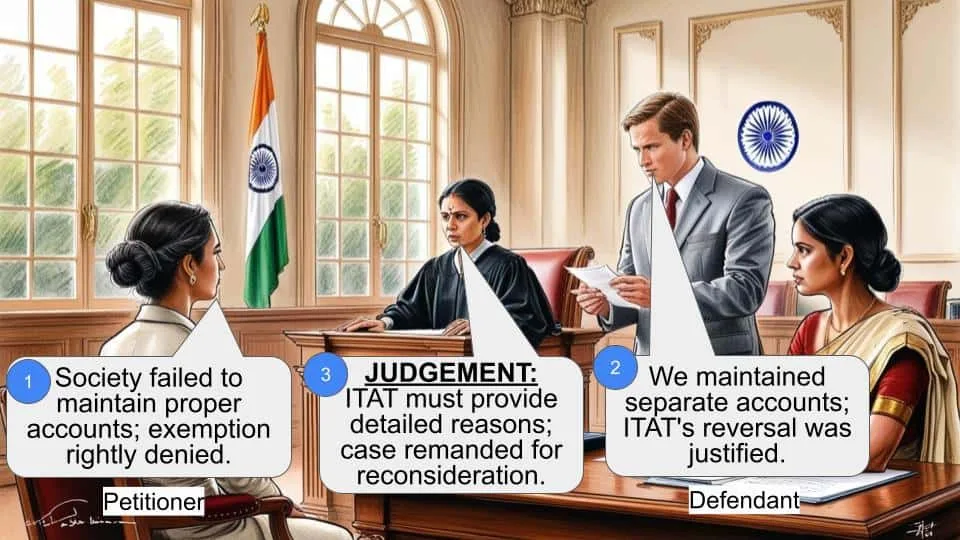
This case involves the Income Tax Appellate Tribunal (ITAT) and the Commissioner of Income Tax regarding the denial of a tax exemption under Section 80G (of Income Tax Act, 1961), to a society. The High Court found that the ITAT did not provide sufficient reasons for overturning the Commissioner's decision and has remanded the case back to the ITAT for reconsideration.
Get the full picture - access the original judgement of the court order here
Case Name:
Commissioner of Income Tax vs. Vijaya Mahantesh Vidyavardhak Sangha (High Court of Karnataka)
ITA No. 5023 of 2011
Date: 23rd July 2015
Key Takeaways:
- The High Court emphasized the necessity for appellate bodies to provide detailed reasons when reversing lower authority decisions.
- The case highlights the importance of maintaining proper accounts for organizations seeking tax exemptions.
- The decision underscores the role of the ITAT as the final fact-finding authority in tax matters.
Issue
Did the ITAT err in reversing the Commissioner's decision to deny tax exemption without providing adequate reasons?
Facts
- The respondent, a society, applied for renewal of tax exemption under Section 80G (of Income Tax Act, 1961).
- The Commissioner of Income Tax denied the application, citing improper maintenance of accounts.
- The ITAT reversed this decision, but the High Court found that the ITAT did not adequately address the factual issues raised by the Commissioner.
Arguments
- Commissioner of Income Tax: Argued that the society failed to maintain proper accounts, which is a requirement for tax exemption.
- Respondent Society: Claimed that they maintained separate accounts for the Vermiculture Project and that the ITAT's decision was correct.
Key Legal Precedents
- The case references the necessity for quasi-judicial authorities to provide cogent reasons when upholding or reversing lower authority decisions.
- The legal framework involves Section 80G (of Income Tax Act, 1961), which provides tax exemptions to certain organizations.
Judgement
The High Court set aside the ITAT's decision and remanded the case back to the ITAT for fresh consideration. The court emphasized that the ITAT must re-examine the case with detailed reasoning and factual analysis.
FAQs
Q1: Why was the ITAT's decision overturned?
A1: The High Court found that the ITAT did not provide sufficient reasons or factual analysis to support its decision to reverse the Commissioner's order.
Q2: What does this mean for the respondent society?
A2: The society's application for tax exemption will be reconsidered by the ITAT, which must now provide a detailed examination of the facts and reasons.
Q3: What is the significance of maintaining proper accounts?
A3: Proper accounting is crucial for organizations seeking tax exemptions, as it ensures transparency and compliance with legal requirements.

1. Revenue has preferred this appeal calling in question the order dated 9.5.2011 in ITA No.150/PNJ/2010 passed by the Income Tax Appellate Tribunal, Panaji Bench, Panaji (‘ITAT’ for short).
2. This appeal was admitted on 10.12.2012 to consider the following questions of law:-
1) Whether the Tribunal is correct in Law and Facts, holding that the respondent assessee society’s action in maintaining separate account in respect of vermicular project without bringing into society’s account which is mandatory in view of provisions of Section 11 (of Income Tax Act, 1961) that assessee should maintain books of account in respect of grants, income received by it and
its utilization?
2) Whether the Tribunal is correct in Law and facts, holding that the respondent asssessee is not required to take the grant of money received from the Govt. of India, in its books which is contrary to the provisions of Sec.80G(5)(iv) (of Income Tax Act, 1961), which require maintenance of
regular books of account in order to claim exemption under Sec.80G (of Income Tax Act, 1961)?
3) Whether the ITAT is correct in law and facts, holding
that the respondent assessee society has not committed any
fault of not accounting for such grant money as income of the
assessee and utilize the same to the extent of 85% which is
mandatory in view of provisions of Sec.11(2) (of Income Tax Act, 1961)
1961?
4) Whether the tribunal is correct in law and facts, in
holding that respondent assessee society cannot be punished for
the misappropriation of funds by the Chairman and the
Secretary of the society as the same would defeat the very
purpose and intention of the Legislature in bringing the
provisions of Sec.13 (of Income Tax Act, 1961)?
5) Whether the tribunal is correct in law and facts, in
relying upon the decision of Rajasthan High Court in the case
of CIT v. Cosmopolitan Education Society reported in 244
ITR 495 when the facts and circumstances were totally
different that of the case of the respondent in whose case has
reported various discrepancies and violations which indicate not
only the Chairman and Secretary but also the respondent
assessee has violated in discharging its duties and as such the
decision relied upon by the Tribunal is not applicable to the
facts of the case?
3. The facts leading to this case are that the respondent
filed an application for renewal of exemption under Section 80G (of Income Tax Act, 1961)
of the Income Tax Act, 1961 [‘Act’ for short] before the
Commissioner of Income Tax, Belgaum, who vide order dated
28.3.2010 rejected the said application. It was contended by the
respondent that it is running various educational institutions in
Bagalkot District. It had also founded a foundation namely., ‘S.S.
Kadapatti Agriculture and Rural Development Foundation’ to
undertake Vermiculture Project, which was sanctioned by
Government of India involving manufacture of organic manures.
In terms of the order passed by the Ministry of Rural
Development, the project was to be implemented by Vijay
Mahantesh Vidyavardhak Sangha and co-ordinated by Zilla
Panchayat, Bagalkot. Out of total sanctioned grant of Rs.4.26
Crores, first installment of Rs.1,29,74,000/- was sanctioned
during the year 2006-07. On these among other reasons,
respondent sought for renewal of exemption under Section 80G (of Income Tax Act, 1961).
The Commissioner has held in his order that receipt of a sum of
Rs.1,18,50,000/- from the Government towards Vermiculture
project during the year 2007-2008 and details of transactions with
regard to expenses of Rs.71,47,430/- said to have been incurred
were not reflecting in the books of accounts of the Society. The
accounts revealed only some of the advances given to the
Vermiculture Project and therefore the applicant was called upon
to explain. A Consultant on behalf of the respondent sought to
explain that the Society had spent a sum of Rs.61,30,812/-
towards capital expenditure and Rs.10,16,078/- on revenue
expenditure on Vermiculture Project. The Commissioner did not
accept the claim of the Society made through the Consultant. The
Commissioner also noted that certain advances were given to
outside institutions. On consideration of the material before him,
the Commissioner ultimately held that the respondent was not
eligible for consideration of the application for exemption under
Section 80G(5) (of Income Tax Act, 1961) and rejected the same as per Section 80G(5)(i) (of Income Tax Act, 1961) of
the Act. The said order passed by the Commissioner was
challenged by the assessee – respondent before the ITAT, Panaji,
which came to be allowed by the impugned order. Hence, this
appeal.
4. We have heard Sri Y.V. Raviraj, learned standing
Counsel for Income Tax Department and Sri Sangram S.
Kulkarni, learned Counsel for the respondent and perused the
records.
5. Learned Counsel for the Revenue mainly contends
that the exemption under Section 80G (of Income Tax Act, 1961) is extended to certain
institutions, which are doing youmen services. Such exemption is
subject to certain conditions, which inter alia include maintenance
of proper accounts.
6. Assailing the order of the ITAT, learned Counsel
submits that the Tribunal erred in reversing the order of the
Commissioner of Income Tax without there being any cogent
reasons to do so. He draws our attention to the reasoning of the
impugned order in paragraph – 16 of the impugned order,
wherein, the Tribunal has considered the merits of the case and
arrived at a conclusion that the dispute is only with regard to
some advances given to the Vermiculture Project by the Society
and the Society had treated the said project as a separate entity
and a separate account of the project was maintained. The
Tribunal, on this premise held that the project belonged to the
assessee – Society.
7. Learned Counsel for the Revenue submits that the
appellate authority has only recorded some of the contentions of
both parties and finally held that the Commissioner of Income
Tax has proceeded on a wrong premise to hold that financial help
rendered by the assessee was similar to loan. He contends that
the Tribunal has further held that such assumption by the
Commissioner was not sustainable on facts to deny the benefit of
registration to the respondent and allowed the appeal on such
erroneous assumptions. The learned standing Counsel, further
submits that the issue involved in the case is, that the respondent
– assessee had admittedly received large sums of money from the
Central Government for the Vermiculture Project which were not
reflecting in the Books of the respondent – Society. The
Commissioner of Income tax had meticulously gone into each
aspect of the matter and passed a detailed order. On the other
hand, the Tribunal has not re-examined the issue in detail with
reference to the factual matrices of the case insofar as the income,
expenditure and maintenance of the accounts by the respondent is
concerned, while reversing the findings recorded by the
Commissioner. The Tribunal ought to have re-examined the
matter afresh and passed the order with cogent reasons fully
backed by narration of facts of the case. Hence, the impugned
order is liable to be set aside.
8. Per contra, learned Counsel appearing for the
respondent while supporting the order of the Tribunal submits
that the respondent – assessee is carrying on youmen service and
submits that the impugned order does not suffer from any
illegality and prays for dismissal of the same.
9. We have given our anxious consideration to the
submission made at the bar and perused the records.
10. The principle ground upon which the Commissioner
rejected the application is that proper accounts were not
maintained by the respondent – assessee. The Commissioner has
laboured substantially in adverting to the various entries in the
Books to arrive at his conclusions.
11. Learned Counsel for the Revenue is right in his
submission that the paragraphs dealing with the merits of the case
in the impugned order passed by the Tribunal, do not advert to
any factual matrices of the case insofar as the figures reflecting
income and expenditure which were adverted to by the
Commissioner of Income Tax in extenso. The appellate authority
has reversed the findings of the Commissioner. However, the
impugned order is not supported by reasons and does not suggest
that the Tribunal had re-appreciated the facts with reference to
the various financial entries found in the order passed by the
Commissioner. Whenever an order is passed by a quasi – judicial
authorities either upholding or reversing a finding of lower
authority, the appellate order must necessarily record cogent
reasons with reference to facts and reasons contained in the order
assailed before appellate authority. On perusal of the order of the
Tribunal, we are of the considered view that the Tribunal has not
adverted to the various aspects of factual matrices, which resulted
in rejection of application by the Commissioner. Admittedly, the
Tribunal is the last fact-finding authority. The Commissioner
while rejecting the application has adverted to various aspects of
the matter to support his reasoning. They include receipt and
expenditure by the Trust and posting of entries in the books of
accounts of Trust. The whole intent and purpose of granting
exemption under section 80 (of Income Tax Act, 1961) to a Trust or an Organisation is to
facilitate the donors to get the benefit of tax exemption and at the
same time, the Trust or the organisation to get donations. Such a
Trust or Organisations which perform their duties to further their
aims and objects are duty bound to maintain proper accounts.
Admittedly, the applicant was enjoying the benefit of exemption
for the previous years. It has taken a definite stand that accounts
with regard to the project work is separately maintained. The
Commissioner has adverted to various aspects and rejected the
application. Therefore, the Tribunal ought to have considered each
and every aspect and examined as to whether or not the findings
recorded by the Commissioner are in accordance with law. In the
circumstances, we feel it appropriate that the matter must be
reconsidered by the Tribunal in the light of what is stated
hereinabove. Accordingly, we deem it appropriate to remand
the matter to the ITAT for re-consideration.
12. In the result, we proceed to pass the following:-
ORDER
(i) Appeal is allowed;
(ii) Order dated 9.5.2011 in ITA
No.150/PNJ/2010 passed by the Income Tax
Appellate Tribunal, Panaji Bench, Panaji, is set
aside; and
(iii) The matter is remitted back to the Income
Tax Appellate Tribunal, Panaji Bench, Panaji
for fresh consideration in accordance with
law.
No costs.
Sd/-
JUDGE
Sd/-
JUDGE
×
Similar Ripples
Questions
Tribunal's Decision Overturned: ITAT Must Reconsider Tax Exemption Case
Write your CommentSimilar Posts
Generic
- Reportdata/3594.pdf
