


Tribunal's Power to Allow Deductions: A Win for Taxpayers


Full News
Tribunal's Power to Allow Deductions: A Win for Taxpayers
Tribunal's Power to Allow Deductions: A Win for Taxpayers
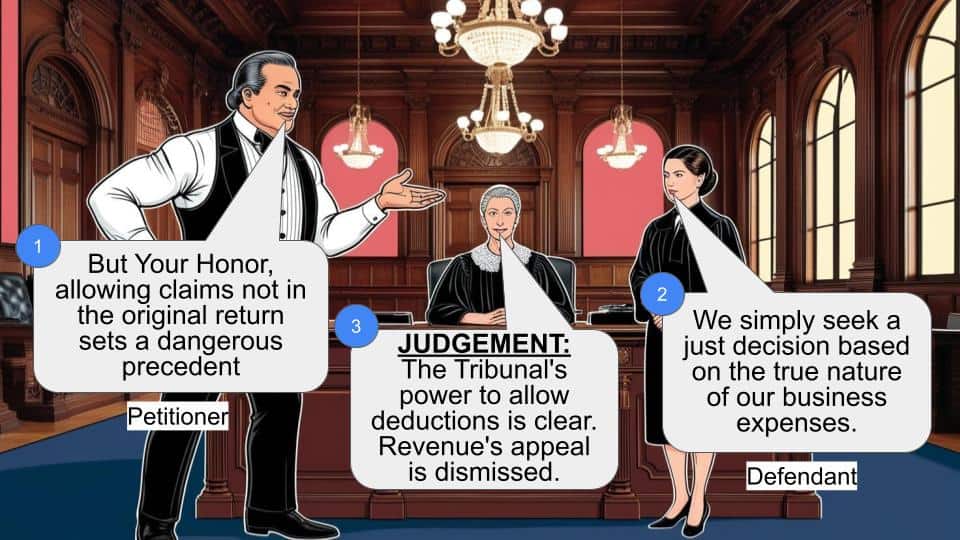
This case involves the Commissioner of Income Tax (Revenue) appealing against an order by the Income Tax Appellate Tribunal (Tribunal) that allowed a deduction for expenditure to Jai Parabolic Springs Ltd. (the assessee), even though the claim wasn't made in the original tax return. The High Court dismissed the Revenue's appeal, affirming the Tribunal's power to allow such deductions.
Get the full picture - access the original judgement of the court order here
Case Name:
Commissioner of Income Tax vs. Jai Parabolic Springs Ltd.(High Court of Delhi)
ITA No.798 /2007
Date: 7th April 2008
Key Takeaways:
1. The Tribunal has the power to allow deductions not claimed in the original tax return.
2. Revenue expenditure incurred wholly for business purposes must be allowed entirely in the year it's incurred.
3. The Tribunal can entertain additional grounds if they arise in the matter and are necessary for a just decision.
Issue:
Does the Income Tax Appellate Tribunal have the legal authority to allow a deduction for expenditure that wasn't claimed by the assessee in their original tax return?
Facts:
1. Jai Parabolic Springs Ltd. is engaged in manufacturing and marketing springs for the automobile industry.
2. For the assessment year 1990-91, the company filed a return declaring a net loss of Rs.4,40,36,000/-.
3. The company incurred Rs.19,48,125/- as customer introduction charges, which they initially spread over five years in their books.
4. In the original return, they claimed a deduction of Rs.3,89,625/- (1/5th of the total amount), which was allowed by the Assessing Officer.
5. During the appeal process, the company claimed the entire amount of Rs. 19,48,125/- as a deduction for the assessment year in question.
Arguments:
Revenue's Argument:
- The Tribunal erred in allowing a deduction not claimed in the original return.
- The Act doesn't allow for reopening of assessment to consider new claims.
- The Assessing Officer had already allowed part of the deduction (Rs.3,89,625/-) in line with the law.
Assessee's Argument:
- The entire expenditure was revenue in nature and should be allowed as a deduction in the year it was incurred.
- The Tribunal has the power to consider additional grounds for a just decision.
Key Legal Precedents:
1. National Thermal Power Co. Ltd. v. Commissioner of Income Tax [1998] 229 ITR 383 (SC):
The Supreme Court held that the Tribunal's power in dealing with appeals is expressed in the widest possible terms.
2. Gedore Tools Pvt. Ltd. v. Commissioner of Income Tax (1999) 238 ITR 268: This case followed the National Thermal Power Co. Ltd. decision.
3. Jute Corporation of India Ltd. v. Commissioner of Income Tax (1991) 187 ITR 688:
The Supreme Court observed that an appellate authority has all the powers of the original authority, subject to statutory limitations.
4. Goetze (India) Limited v. Commissioner of Income Tax (2006) 284 ITR 323 (SC):
This case clarified that the decision was limited to the power of the assessing authority and did not impinge on the power of the Tribunal.
5. Madras Industrial Investment Corporation Ltd. v. Commissioner of Income Tax (1997) 225 ITR 802 (SC):
The Supreme Court held that revenue expenditure incurred wholly for business purposes must be allowed entirely in the year it's incurred.
Judgement:
The High Court dismissed the Revenue's appeal, affirming the Tribunal's decision. Key points of the judgment include:
1. The Tribunal has the power to entertain additional grounds if they arise in the matter and are necessary for a just decision.
2. Revenue expenditure incurred wholly for business purposes must be allowed entirely in the year it's incurred, even if the assessee has spread it over several years in their books.
3. There is no prohibition on the Tribunal's powers to consider additional grounds that arise in the matter for a just decision.
FAQs:
Q1: Can a taxpayer claim a deduction that wasn't in their original tax return?
A1: Yes, but it depends on the stage of proceedings. While the Assessing Officer may not allow it, the Tribunal has the power to consider such claims.
Q2: Does spreading an expense over multiple years in the books affect its deductibility?
A2: No, if it's a revenue expenditure incurred wholly for business purposes, it should be allowed entirely in the year it's incurred, regardless of how it's treated in the books.
Q3: What powers does the Income Tax Appellate Tribunal have?
A3: The Tribunal has wide powers to pass orders as it thinks fit, including considering new grounds of appeal not raised earlier, if it's necessary for a just decision.
Q4: How does this judgment affect taxpayers?
A4: It's favorable for taxpayers as it allows for correction of genuine oversights or errors in tax returns during the appeal process, providing a safeguard against potential loss of legitimate deductions.
Q5: Does this mean taxpayers can be careless about their original returns?
A5: No, it's always best to file accurate and complete returns. This judgment provides a safety net but doesn't encourage negligence in initial filings.

The Revenue has filed this appeal under Section 260A (of Income Tax Act, 1961) (for short as „Act‟) against the order dated 8th November, 2006 passed by the Income Tax Appellate Tribunal (for short as „Tribunal‟), Delhi Bench „G‟ in ITA No.707/Del/2004 relevant for the assessment year 1990-91 vide which the appeal filed by the Revenue was dismissed.
2. The facts entailing the present appeal are that the assessee is engaged in the business of manufacture and marketing of springs and springs leaves required for the automobile industry. Return of income for the year under consideration was filed by the assessee on 30.12.90 declaring net loss at Rs. 4,40,36,000/-. Return was processed under section 143(1) (of Income Tax Act, 1961). Subsequently, notice under section 143(2) (of Income Tax Act, 1961) was issued. The loss under the normal provisions of the Act was computed at Rs. 4,27,63,353/- inter alia by making several additions/disallowances as enumerated in the order of assessment dated 19.03.93.
3. The Assessee has incurred Rs.19,48,125/- as expenditure on account of customer introduction charges which were debited as “Deferred Revenue Expenses” in the balance sheet. The expenditure was written off over a period of five years starting from the assessment year 1990-91 and accordingly, the assessee claimed reduction of Rs. 3,89,625/- in the return. The claim was allowed by the assessing Officer.
4. Being unsatisfied from the assessment framed, Assessee Company filed appeal before the Commissioner of Income Tax (Appeals) (for short as „CIT [A]‟). In the appeal before CIT (A), by way of additional ground, Assessee claimed the entire deferred revenue expenses of Rs. 19,48,125/- in the assessment year in appeal. The CIT (A) allowed the appeal.
5. The Revenue preferred further appeal before Tribunal. The Tribunal, in terms of its order dated 14.05.03 restored the matter to the file of Assessing Officer to consider and decide the issue after examining the details.
6. Thereafter, the Assessing Officer took up the issue pursuant to the directions of the Tribunal and passed an order under section 254 (of Income Tax Act, 1961) read with section 143(3) (of Income Tax Act, 1961) on 31.01.03 and he disallowed the claim of Rs. 15,58,5000/- (i.e. Rs.19,48,125/- minus Rs. 3,89,625) with the following observations:
“Since the claim for the deferred revenue expenditure of Rs. 15,58,500/- was not claimed by the assessee in its return of income for the assessment year 1990-91, the same is not allowed.”
7. Being aggrieved from the above assessment, the Assessee preferred an appeal before CIT (A). Appeal of the Assessee was allowed by inter alia holding that the Assessing Officer erred in disallowing the expenditure on the sole ground that no claim for deduction of the amount was made in the return of income.
8. Aggrieved thereby, the Revenue filed appeal before Tribunal. The appeal of the Revenue was dismissed and the order of the CIT (A) was confirmed by the Tribunal.
9. Aggrieved by the order of the Tribunal, the Revenue filed the present appeal before this Court.
10. Thus, the principal question that arises for determination in this appeal is “Whether the Tribunal was right in law in allowing relief of Rs. 15,58,500/- in the assessment year under consideration when no such claim was made by the assessee in the return of income?”
11. It is contended by the learned counsel for the Revenue that Tribunal has erred both in law and on facts in granting relief of Rs.15,58,500/- to the Assessee on account of expenditure claimed by the Assessee as „Deferred Revenue Expenditure‟ in the Audited Balance Sheet. As per the relevant statutory provisions no such claim can be allowed which has not been claimed in return of income. Further, particulars for the purpose of assessment have to be submitted before the completion of assessment proceedings and if the information is supplied subsequent to the completion of the assessment, it would mean that the Assessment order will have to be reopened and the Act does not contemplate such reopening of assessment. Furthermore, in the absence of any direction given by the Tribunal in the first round of proceedings to allow the entire claim, the Tribunal failed to appreciate that out of the entire Deferred Revenue Expenses an amount of Rs.3,89,625/- has already been allowed by the Assessing Officer and the remaining expenditure was treated by the Assessing Officer in consonance with the proper manner laid down under the law.
12. As clear from the above said facts, there is no dispute that customer introduction charges did not represent revenue expenditure. The principal ground taken by the Revenue in this appeal is that if no claim for deduction of the amount was made in the return of income then deduction would not be allowed.
13. Section 254 (of Income Tax Act, 1961) says that the Appellate Tribunal may, after giving both the parties to the appeal an opportunity of being heard, pass such orders thereon as it thinks fit.
14. Reference may be made to National Thermal Power Co. Ltd. v. Commissioner of Income Tax [1998] 229 ITR 383 (SC), where the Supreme Court observed that:-
“The power of the Tribunal in dealing with appeals is thus expressed in the widest possible terms. The purpose of the assessment proceedings before the taxing authorities is to assess correctly the tax liability of an assessee in accordance with law. We do not see any reason to restrict the power of the Tribunal under Section 254 (of Income Tax Act, 1961) only to decide the grounds which arise from the order of the Commissioner of Income-tax (Appeals). Both the assessees as well as the Department have a right to file an appeal/cross-objections before the Tribunal. We fail to see why the Tribunal should be prevented from considering questions of law arising in assessment proceedings although not raised earlier.”
15. Refrence may also be made to Gedore Tools Pvt. Ltd. v. Commissioner of Income Tax (1999) 238 ITR 268, wherein the Apex Court decision in National Thermal Power Co. Ltd. (supra) has been followed.
16. In the case of Jute Corporation of India Ltd. v. Commissioner of Income Tax (1991) 187 ITR 688, while dealing with the powers of the Appellate Assistant Commissioner, the Supreme Court observed that:-
“An appellate authority has all the powers which the original authority may have in deciding the question before it subject to the restrictions or limitations, if any, prescribed by the statutory provisions. In the absence of any statutory provision, the appellate authority is vested with all the plenary powers which the subordinate authority may have in the matter. There is no good reason to justify curtailment of the power of the Appellate Assistant Commissioner in entertaining an additional ground raised by the assessee in seeking modification of the order of assessment passed by the Income-tax Officer. This Court further observed that there may be several factors justifying the raising of a new plea in an appeal and each case has to be considered on its own facts. The Appellate Assistant Commissioner must be satisfied that the ground raised was bona fide and that the same could not have been raised earlier for good reasons. The Appellate Assistant Commissioner should exercise his discretion in permitting or not permitting the assessee to raise an additional ground in accordance with law and reason. The same observations would apply to appeals before the Tribunal also.”
17. In Goetze (India) Limited v. Commissioner of Income Tax (2006) 284 ITR 323 (SC) wherein deduction claimed by way of a letter before Assessing Officer, was disallowed on the ground that there was no provision under the Act to make amendment in the return without filing a revised return. Appeal to the Supreme Court, as the decision was upheld by the Tribunal and the High Court, was dismissed making clear that the decision was limited to the power of assessing authority to entertain claim for deduction otherwise than by revised return, and did not impinge on the power of Tribunal.
18. Further, revenue expenditure which is incurred wholly and exclusively for the purpose of business must be allowed in its entirety in the year in which it is incurred. It cannot be spread over a number of years even if the assessee has written it off in his books over a period of years. [ Reliance can be placed on Madras Industrial Investment Corporation Ltd. v. Commissioner of Income Tax (1997) 225 ITR 802 (SC)]
19. In view of the above discussion, it is very clear that there is no prohibition on the powers of the Tribunal to entertain an additional ground which according to the Tribunal arises in the matter and for the just decision of the case. Therefore, there is no infirmity in the order of the Tribunal.
20. Accordingly, the appeal of the Revenue is hereby dismissed.
V. B. GUPTA
(JUDGE)
MADAN B. LOKUR
(JUDGE)
×
Similar Ripples
Questions
Tribunal's Power to Allow Deductions: A Win for Taxpayers
Write your CommentSimilar Posts

Generic
- Reportdata/4680.pdf
