


Tribunal's Power to Recall Orders Limited, High Court Rules


Full News
Tribunal's Power to Recall Orders Limited, High Court Rules
Tribunal's Power to Recall Orders Limited, High Court Rules
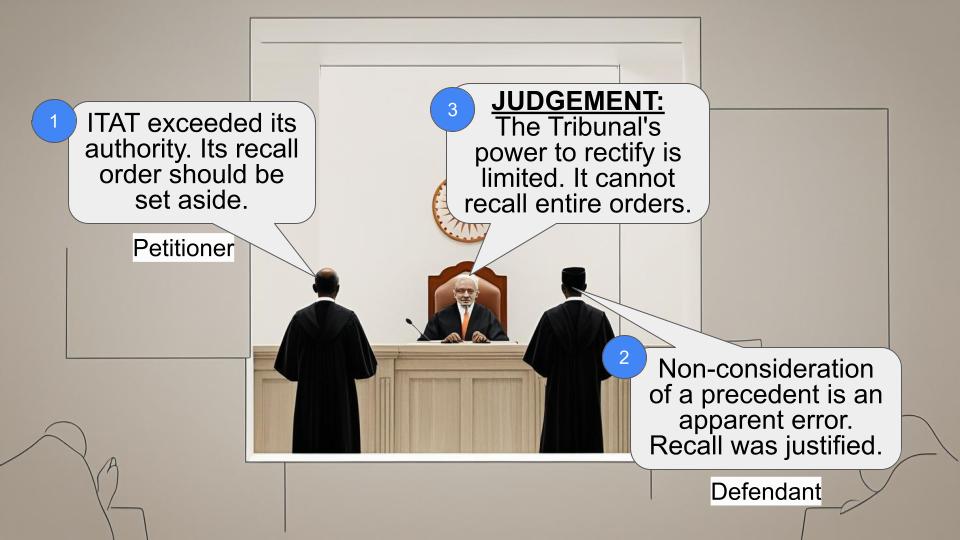
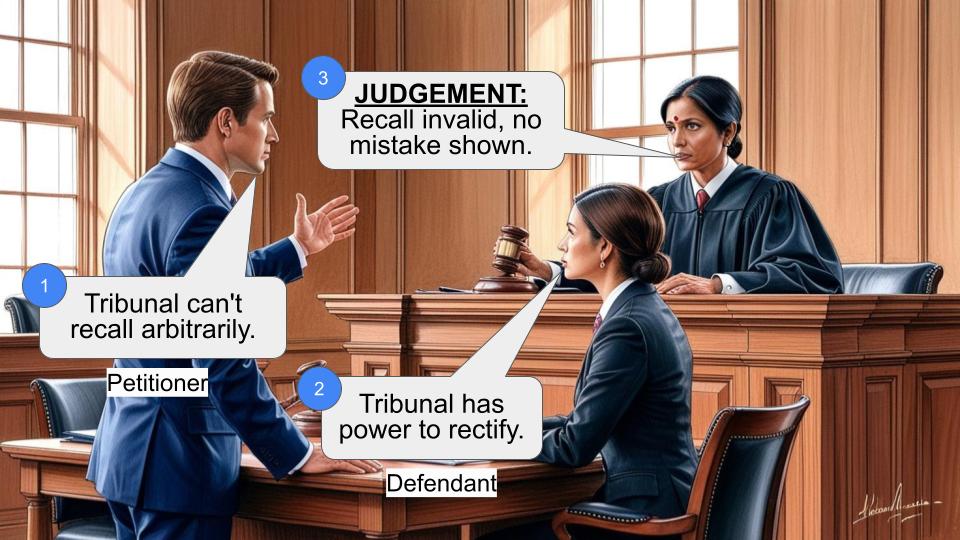
The case involves the Commissioner of Income Tax (petitioner) challenging an order by the Income Tax Appellate Tribunal (ITAT) that recalled its own previous order. The High Court ruled in favor of the petitioner, setting aside the ITAT's recall order.
Get the full picture - access the original judgement of the court order here
Case Name:
Commissioner of Income Tax Vs Ronak Parikh (Huf) (High Court of Bombay)
Writ Petition No.1813 of 2009
Date: 2nd March 2020
Key Takeaways:
1. The ITAT's power to rectify mistakes under Section 254(2) (of Income Tax Act, 1961) is limited to apparent errors.
2. Recalling an entire order is generally not within the ITAT's power under Section 254(2) (of Income Tax Act, 1961).
3. The court emphasized the distinction between rectification and review powers.
Issue:
Does the Income Tax Appellate Tribunal have the power to recall its entire order under the guise of rectifying a mistake apparent from the record?
Facts:
1. The ITAT passed an order on 30.04.2008 in an appeal related to the assessment year 1999-2000.
2. The assessee (Ronak Parikh HUF) filed a miscellaneous application for recall of this order.
3. On 05.01.2009, the ITAT allowed the application and recalled its earlier order for fresh hearing.
4. The Revenue (Income Tax Department) challenged this recall order in the High Court.
Arguments:
Revenue's Argument:
- The ITAT can only rectify apparent mistakes under Section 254(2) (of Income Tax Act, 1961) and cannot recall its entire order.
- No prejudice was caused to the assessee by the original order as it only remanded the matter back to the Assessing Officer.
Assessee's Argument:
- The ITAT has the power to recall its order in certain circumstances, as per Supreme Court decisions.
- Non-consideration of a Coordinate Bench decision was a mistake apparent from the record.
Key Legal Precedents:
1. Honda Siel Power Products Ltd. Vs. C.I.T., 295 ITR 466 (Supreme Court)
2. ACIT Vs. Saurashtra Kutch Stock Exchange Ltd., 305 ITR 227 (Supreme Court)
3. Lachman Dass Bhatia Hingwala (P.) Ltd. Vs. Asst. CIT (Delhi), 330 ITR 243 (Full Bench of Delhi High Court)
These cases discussed the scope of the ITAT's power under Section 254(2) (of Income Tax Act, 1961).
Judgement:
The High Court ruled in favor of the Revenue, setting aside the ITAT's recall order. Key points:
1. The ITAT's power under Section 254(2) (of Income Tax Act, 1961) is limited to rectifying apparent mistakes.
2. The ITAT incorrectly concluded that non-consideration of a Coordinate Bench decision was a mistake apparent from the record.
3. No prejudice was caused to the assessee by the original order as it only remanded the matter to the Assessing Officer.
FAQs:
Q1: What is Section 254(2) (of Income Tax Act, 1961)?
A1: It's a provision that allows the ITAT to rectify any mistake apparent from the record within six months of passing an order.
Q2: Can the ITAT recall its entire order under Section 254(2) (of Income Tax Act, 1961)?
A2: Generally, no. The power is limited to rectifying apparent mistakes, not reviewing the entire order.
Q3: What's the difference between rectification and review?
A3: Rectification is correcting an obvious error, while review involves re-examining the entire decision.
Q4: Does this judgment mean the ITAT can never recall its orders?
A4: Not necessarily. In exceptional cases where there's prejudice due to a manifest error, recall might be possible.
Q5: What's the practical impact of this judgment?
A5: It limits the ITAT's ability to recall orders, potentially reducing delays in tax proceedings.

1. Heard Mr. Chhotaray, learned standing counsel Revenue for the petitioner and Mr. Jhaveri, learned counsel for the respondent / assessee.
2. By filing this petition under Article 226 of the Constitution of India, petitioner seeks quashing of order dated 05.01.2009 passed by the Income Tax Appellate Tribunal, 'G' Bench, Mumbai (hereinafter referred to as the ‘Tribunal’) in M.A.No.420/Mum/2008 recalling its order dated 30.04.2008 passed in ITA No.2148/M/2004 for the assessment year 1999-2000 and directing hearing of the said appeal afresh.
3. Brief recital of the facts is considered necessary.
4. Respondent is HUF and an assessee under the Income Tax Act, 1961 (briefly 'the Act' hereinafter). It appears that search and seizure operation under Section 132 (of Income Tax Act, 1961) was carried out on 16.06.1998 in the residence-cum-office premises of Shri. Y. J. Chokshi and his associates - Shri. Rajendra C. Shah and Shri. Jayantilal M. Shah. In the course of the search proceeding, it was found that respondent / assessee had issued certain cheques after depositing cash received from the said persons. Assessee admitted and explained that he was a Hawala operator and accepted cash deposits in bank account while issuing cheques for the said amount to the party; in the process, he earned commission for carrying out such Hawala business.
5. Pursuant to the search operations, block assessment for the period 01.04.1988 to 16.06.1998 was carried out by the assessing authority under Section 158BD (of Income Tax Act, 1961). At the same time, for the assessment year 1999-2000, respondent - assessee filed return of income declaring total income of Rs.1,94,857.00. The return was processed under Section 143(3) (of Income Tax Act, 1961). Following the assessment proceedings, assessing officer passed assessment order dated 26.03.2002 under Section 143(3) (of Income Tax Act, 1961) adding an amount of Rs.72,89,385.00 to the income of the respondent /assessee as income from undisclosed sources.
6. Respondent assailed the said assessment order before the Commissioner of Income Tax (Appeals) - V, Mumbai, referred to hereinafter as the ‘first appellate authority’. In the appellate proceedings, the first appellate authority agreed with the explanations given by the respondent / assessee and by the appellate order dated 16.01.2004 held that he was not convinced with the reasons given by the assessing officer while making the addition and therefore, directed deletion of the said addition.
7. Aggrieved by the said order passed by the first appellate authority, Revenue carried the matter in appeal before the Tribunal. By the order dated 30.04.2008, Tribunal held that the first appellate authority had accepted the explanation given by the respondent / assessee without subjecting them to thorough verification. First appellate authority had erred in accepting the explanation of the respondent / assessee without any supporting evidence or document. However, Tribunal took the view that in the interest of justice, the matter should be restored back to the assessing officer to examine the issue afresh. Respondent / assessee was directed to furnish necessary evidence to prove the genuineness of cash credit to the satisfaction of the assessing officer. Consequently, order of the first appellate authority was set aside and the matter was restored to the file of the assessing officer for fresh consideration.
8. However, respondent - assessee filed an application dated 12.06.2008 before the Tribunal for recall of the order dated 30.04.2008. In the said application, it was contended that the addition made by the assessing officer in the block assessment was deleted by the first appellate authority which was affirmed by the Tribunal in further appeal by the Revenue. This order of the Co-ordinate Bench of the Tribunal was not considered by the Tribunal while passing the order dated 30.04.2008. Hence, prayer was made for recall of the said order.
9. The said miscellaneous application was registered as M.A.No.420 /Mumbai/2008. By order dated 05.01.2009, Tribunal allowed the miscellaneous application by recalling the order dated 30.04.2008 and for hearing the appeal afresh.
10. This order has been impugned by the Revenue in the present writ proceeding.
11. Mr. Chhotaray, learned standing counsel Revenue has referred to Section 254(2) (of Income Tax Act, 1961) and submits that under the said provision, Tribunal can only rectify a mistake which is apparent from the record. Tribunal has no power to recall its order in entirety. Recalling of an order in entirety is only provided under Rule 24 (of Income Tax Rules, 1962) of the Income Tax (Appellate Tribunal) Rules, 1963 which deals with a situation of ex- parte hearing for default of the appellant. In support of his contention, he has placed reliance on a Division Bench decision of the Delhi High Court in C.I.T. Vs. Income Tax Appellate Tribunal, 293 ITR 118 and a Division Bench decision of the Allahabad High Court in C.I.T. Vs. Kamal Bhai Ismailji, 288 ITR 297. His further contention is that no prejudice has been caused to the respondent / assessee by the order passed by the Tribunal in the quantum appeal in as much as Tribunal had only remanded the matter back to the assessing officer for a fresh decision giving liberty to the respondent / assessee to adduce evidence as well as to make submissions.
12. Per contra, learned counsel for the respondent at the outset submits that the Division Bench decision of the Delhi High Court in C.I.T. Vs. Income Tax Appellate Tribunal (supra) has been overruled by the Full Bench of the same High Court in Lachman Dass Bhatia Hingwala (P.) Ltd. Vs. Asst. CIT (Delhi), 330 ITR 243. In the said judgment, the Full Bench of the Delhi High Court has held that view taken in C.I.T. Vs. Income Tax Appellate Tribunal (supra) that under no circumstances a Tribunal can recall its order in entirety does not lay down the correct statement of law.
12.1. That apart, learned counsel has placed reliance on the decision of the Supreme Court in Honda Siel Power Products Ltd. Vs. C.I.T., 295 ITR 466 to contend that power of rectification under Section 254(2) (of Income Tax Act, 1961) is not to be confused with the power of review. This is a power vested with the Tribunal to ensure that no prejudice is caused to either of the parties appearing before the Tribunal by its decision passed on a mistake apparent from the record.
12.2. He has also referred to the decision of the Supreme Court in ACIT Vs. Saurashtra Kutch Stock Exchange Ltd., 305 ITR 227 to contend that in an appropriate case it is open to the Tribunal to recall its order in entirety in exercise of its power under Section 254(2) (of Income Tax Act, 1961). Referring to the Full Bench decision of the Delhi High Court, he submits that after an exhaustive analysis of the entire spectrum of the law on this aspect, the Full Bench had culled out 5 principles which clearly stipulates that decision of the Supreme Court in Honda Siel Power Products Ltd. (supra) is an authority for the proposition that Tribunal can recall its own order under certain circumstances and that there is no absolute prohibition to such recalling of order in entirety.
13. At this stage, we may also mention that learned counsel for the respondent had raised an issue of belated filing of the writ petition which he projected as a preliminary objection.
14. Submissions made by learned counsel for the parties have been considered. We have also perused the materials on record and applied our mind to the decisions cited at the Bar.
15. At the outset we may advert to the objection raised by learned counsel for the respondent - assessee about the alleged delay in filing of the writ petition.
15.1. We find that the impugned order was passed by the Tribunal on 05.01.2009. Writ petition came to be filed on 20.08.2009. It is trite that the law of limitation is not applicable to writ proceedings though limitation prescribed thereunder can in certain cases act as a guide to the writ Court. In the instant case, the writ petition has been filed within eight months of passing of the impugned order. In the facts and circumstances of the case, filing of the writ petition within eight months of the impugned order cannot be construed to be a belated filing. That apart, we find that by order dated 17.11.2009, this Court had admitted the writ petition for hearing by issuing Rule. Once a writ petition is admitted for hearing, it necessarily implies that the Court is satisfied about the timely filing of the writ petition and in such circumstances, the writ petition is required to be heard and decided on merit.
16. Having answered the preliminary objection as above, we may now deal with the issue in substance. Since Section 254(2) (of Income Tax Act, 1961) is central to the debate, the same is referred to and extracted hereunder for ready reference:
“254(2) The Appellate Tribunal may, at any time within six months from the end of the month in which the order was passed, with a view to rectifying any mistake apparent from the record, amend any order passed by it under sub-section (1), and shall make such amendment if the mistake is brought to its notice by the assessee or the Assessing Officer.”
17. Before dealing with the provision contained in sub-section (2) as extracted above, we may note that under sub-section (1), Tribunal is vested with the authority of passing such order on appeal filed before it after giving both the parties to the appeal an opportunity of being heard. Thus, order passed under sub-section (1) is the substantive order of the Tribunal.
18. If any of the parties to the appeal brings it to the notice of the Tribunal within the period prescribed in sub-section (2) that there was a mistake in the order passed by the Tribunal which is apparent from the record then the Tribunal may amend any order passed by it under sub- section (1) by making such amendment with a view to rectifying a mistake apparent from the record. The key expressions in sub-section (2) are ‘rectifying any mistake apparent from the record’ and ‘amend any order passed by it’.
18.1. In so far the expression ‘any mistake apparent from the record’ is concerned, it has been judicially held that for a mistake to be a mistake apparent from the record, no long-drawn hearing or argument is required. It is a mistake which is apparent from the face of the record.
18.2. A similar expression i.e., ‘error apparent on the face of the record’ appears in Order XLVII, Rule 1 (of Income Tax Rules, 1962) of the Civil Procedure Code, 1908 dealing with application for review of judgment. This expression ‘error apparent on the face of the record’ has received considerable judicial attention. It has been held that an error apparent on the face of the record must be such as can be seen by one who runs and reads, that is, an obvious and patent mistake which does not need a long drawn process of reasoning to discover; an error apparent on the face of the record must be such an error which must strike one on mere looking at the record and would not require any long drawn process of reasoning on points where there may conceivably be two opinions.
18.3. This provision was considered by the Supreme Court in Lily Thomas Vs. Union of India, (2000) 6 SCC 224. Referring to earlier decisions of the Supreme Court, it was held that error apparent on the face of the proceedings is an error which is based on clear ignorance or disregard of the provisions of law. Such error is an error which is a patent error and not a mere wrong decision. It should be something more than a mere error; it must be one which must be manifest on the face of the record.
18.4. Regarding the second expression i.e., ‘amend any order passed by it’, we may refer to the decision of the Supreme Court in Honda Siel Power Products Ltd. (supra). In that case, Supreme Court examined the scope of the power of rectification under Section 254(2) (of Income Tax Act, 1961). Supreme Court observed that the purpose behind enactment of Section 254(2) (of Income Tax Act, 1961) is based on the fundamental principle that no party appearing before the Tribunal, be it the assessee or the Revenue, should suffer on account of any mistake committed by the Tribunal. Clarifying the matter, Supreme Court held that this fundamental principle has nothing to do with the inherent power of the Tribunal or the power of review. This power is vested with the Tribunal to see that no prejudice is caused to either of the parties appearing before the Tribunal by its decision based on a mistake apparent from the record. In the facts and circumstances of that case, Supreme Court held that the Tribunal was justified in exercising its power under Section 254(2) (of Income Tax Act, 1961) in recalling its order and the High Court had erred in interfering with such decision of the Tribunal.
19. This position has also been reiterated by the Supreme Court in the later decision in Saurashtra Kutch Stock Exchange Ltd. (supra).
20. Before adverting to the Full Bench decision of the Delhi High Court, we may briefly glance at the provisions of Rule 24 (of Income Tax Rules, 1962) of the Income Tax (Appellate Tribunal) Rules, 1963. As per Rule 24 (of Income Tax Rules, 1962), if the appellant does not appear before the Tribunal on the date of hearing, Tribunal may dispose of the appeal on merit after hearing the respondent. However, as per the the proviso, if the appellant appears afterwards and satisfies the Tribunal that there was sufficient cause for non-appearance when the appeal was called for hearing, the Tribunal may set aside the ex-parte order and restore the appeal for hearing afresh.
21. The provisions contained in Rule 24 (of Income Tax Rules, 1962) as discussed above and that in Section 254(2) (of Income Tax Act, 1961) which we have also discussed in extensio operate in different fields. While Rule 24 (of Income Tax Rules, 1962) makes a provision for setting aside of an ex-parte order and for rehearing of the appeal, it is not so under Section 254(2) (of Income Tax Act, 1961) which only deals with a situation for rectification of a mistake which is apparent from the record.
22. In Kamal Bhai Ismailji (supra), Allahabad High Court took the view that even though the Tribunal has inherent power to recall an ex- parte order on sufficient cause being shown, it has no power to review its order; it is well settled that Tribunal has no inherent power to review. Power of review has to be expressly conferred by the statute. Only a power to rectify a mistake apparent from the record has been conferred on the Tribunal under Section 254(2) (of Income Tax Act, 1961).
23. The Division Bench decision of the Delhi High Court in C.I.T. Vs. Income Tax Appellate Tribunal (supra) having been overruled by the Full Bench, we may consider only the Full Bench decision of the Delhi High Court in Lachman Dass Bhatia Hingwala (P.) Ltd. (supra). After a thorough examination of various aspects, Full Bench of the Delhi High Court culled out the following propositions:
“(A) The decision rendered in Honda Siel Power Products Ltd. (supra) by the Apex Court is an authority for the proposition that the Income-tax Appellate Tribunal under certain circumstances can recall its own order and there is no absolute prohibition.
(B) In view of the law laid down in Honda Siel Power Products Ltd., (supra) by the Apex Court, the decisions rendered by this Court in K.L. Bhatia [1990] 182 ITR 361 (Delhi), Deeksha Suri [1998] 232 ITR 395, Karan and Co. [2002] 253 ITR 131 (Delhi), J.N. Sahni [2002] 257 ITR 16 (Delhi) and Smt. Baljeet Jolly [2001] 250 ITR 113 (Delhi) which lay down the principle that the tribunal under no circumstances can recall its order in entirety do not lay down the correct statement of law.
(C) Any other decision or authority which has been rendered by pressing reliance on K. L. Bhatia (supra) and the said line of decisions are also to be treated as not laying down the correct proposition of law that the tribunal has no power to recall an order passed by it in exercise of power under Section 254(2) (of Income Tax Act, 1961).
(D) The tribunal, while exercising the power of rectification under Section 254(2) (of Income Tax Act, 1961), can recall its order in entirety if it is satisfied that prejudice has resulted to the party which is attributable to the tribunal’s mistake, error or omission and which error is a manifest error and it has nothing to do with the doctrine or concept of inherent power of review.
(E) When the justification of an order passed by the tribunal recalling its own order is assailed in a writ petition, it is required to be tested on the anvil of law laid down by the Apex Court in Honda Siel Power Products Ltd., (supra) and Saurashtra Kutch Stock Exchange Ltd. (supra).”
24. If we carefully look at the conclusions culled out by the Delhi High Court, we find that the view taken by the Delhi High Court is that there is no absolute bar on the Tribunal for recalling its order in entirety. Tribunal while exercising power of rectification under Section 254(2) (of Income Tax Act, 1961) can recall its order in entirety if it is satisfied that prejudice has resulted to the parties by its order passed under Section 254(1) (of Income Tax Act, 1961) which is attributable to the Tribunal’s mistake, error or omission and which error is a manifest error and it has nothing to do with the doctrine or concept of inherent power of review.
25. Having noticed the legal provisions as above, we may now revert back to the relevant facts of the present case.
26. Referring to the order passed by the Tribunal dated 30.04.2008, we find that while the Tribunal had set aside the order passed by the first appellate authority, Tribunal restored the matter back to the assessing officer to examine the issue afresh. Respondent / assessee has been directed to furnish evidence to prove genuineness of cash credit to the satisfaction of the assessing officer. Paragraph 9 of the order reads as under:
“9. In view of these findings of the ACIT in the remand report it is not possible to understand how the CIT(A) has accepted the genuineness of the transactions. The burden lies on the assessee to prove that the deposits in the bank accounts are from real people and these transactions are genuine. As the primary responsibility is not discharged completely and as seen from the statements given in the paper book even the complete addresses were not furnished and as there is no one-to-one explanation with reference to the money receipts and cash deposits in the bank accounts, we are of the view that the CIT(A) has accepted the explanation given by the assessee without subjecting them to thorough verification. Even the Assessing Officer’s remand report also indicates that the assessee has not furnished the sources of deposits nor details of the source of deposits with any documentary proof. In view of this we are of the view that the CIT(A) has erred in accepting the explanation of the assessee without any supporting evidence or documents and on this matter, in the interest of justice, we restore the matter back to the Assessing Officer to examine the issue afresh. The assessee is directed to furnish the necessary evidences to prove the genuineness of cash credit to the satisfaction of the Assessing Officer. Order of the CIT(A) is set aside and the matter is restored to the Assessing Officer for fresh consideration.”
27. Careful reading of the order passed by the Tribunal, as extracted above, would go to show that the initial assessment order dated 26.03.2002 passed by the assessing officer has not attained finality. No doubt the order of the first appellate authority interfering with the order of assessment has been set aside, but the matter has been remanded back to the assessing officer for fresh consideration. It is open to such further order that the assessing officer may pass on the matter being restored back to him and after hearing the respondent / assessee, who has the liberty to make fresh submissions before the assessing officer.
28. We have carefully perused the miscellaneous application filed by the respondent / assessee before the Tribunal for recall of its order dated 30.04.2008. On minute scrutiny, we find that there was no reference to any provision of law under which it was filed. Be that as it may, we treat it to be an application under Section 254(2) (of Income Tax Act, 1961) and not an application under Rule 24 (of Income Tax Rules, 1962) of the Income Tax (Appellate Tribunal) Rules, 1963 since admittedly the order dated 30.04.2008 was not an ex-parte one.
28.1. That apart, we find that though the respondent / assessee has referred to the order passed by the first appellate authority as well as by the Tribunal in the block assessment, there is no specific averment that the said orders were brought to the notice of the Tribunal or argued before the Tribunal and that the Tribunal did not consider such argument of the respondent / assessee. All that is stated in the application is that the Tribunal did not refer to the order of its Co-ordinate Bench regarding the block assessment.
28.2. Moreover, we find that in paragraph 13 of the application, respondent / assessee had merely stated that a mistake had crept in the order of the Tribunal for not considering its own order passed by the Co- ordinate Bench. It was not the case of the respondent - assessee that it was a mistake apparent from the record which was required to be rectified. As discussed above, all mistakes cannot be rectified under Section 254(2) (of Income Tax Act, 1961). Only a mistake which is apparent from the record can be rectified under the said provision.
29. We may now refer to the impugned order dated 05.01.2009 passed by the Tribunal, relevant portion of which is extracted hereunder:
4. We have heard both the counsel of assessee and Revenue and considered the issue. It is true that the findings of the Coordinate Bench decision were not specifically discussed in the order. However, it is observed that the assessee’s block assessment was upto 16th June 1998 whereas the assessment involved is up to 31.03.1999 i.e., beyond the block period. It may be true that some of the findings given in the block assessment may be applicable to the facts in this case. However, the Bench was considering the order of the CIT (A) vis-a-vis the remand report and specifically enquired about the details stated in para 7, 8 & 9 of the order. Even though we are of the opinion that the decision was given correctly on the set of facts before considering the issue, since the Coordinate Bench decision was not mentioned or discussed in the order, in the interest of justice we are of the opinion that the order can be recalled and appeal may be restored so as to give a fresh opportunity to the assessee to explain the facts in detail. Miscellaneous Application is allowed and the Registry is directed to fix the appeals for hearing in the regular course.”
30. From the above, it is evident that even according to the Tribunal, the decision given by it in the appeal was correct but because the Co- ordinate Bench decision was not mentioned or discussed, the entire order was recalled and the appeal was directed to be heard afresh. When on the one hand the Tribunal says that its decision was correct, we fail to understand why and how the Tribunal had recalled the said correct order. Firstly, if the order was correct, there was no reason or necessity for recalling such correct order. Secondly, we find that the Tribunal had come to the conclusion that non-consideration of the Co-ordinate Bench decision was a mistake apparent from the record. As already pointed out above, there was no averment in the miscellaneous application by the respondent / assessee that it had pointed out or argued the Co-ordinate Bench decision relating to the block assessment during hearing of the appeal and that the Tribunal did not consider the same. Thirdly, we are of the view that having regard to the order passed by the Tribunal in the quantum appeal, no prejudice has been caused to the respondent / assessee. All that the Tribunal had done was to restore the matter to the file of the assessing officer for a fresh decision in accordance with law in which the respondent / assessee would have ample opportunity to place all the materials at its command before the assessing officer for consideration.
31. In the light of the discussions made above, we are of the view that the Tribunal was not justified in passing the impugned order dated 05.01.2009. Accordingly, the said order is hereby set aside and quashed. Rule is made absolute.
32. Writ petition is disposed of. No costs.
(MILIND N. JADHAV, J.) (UJJAL BHUYAN, J.)
×
Questions
Tribunal's Power to Recall Orders Limited, High Court Rules
Write your CommentSimilar Posts


Generic
- Reportdata/6016.pdf
