


Trust Registration Upheld: Court Dismisses Income Tax Appeal Against MHADA



Full News
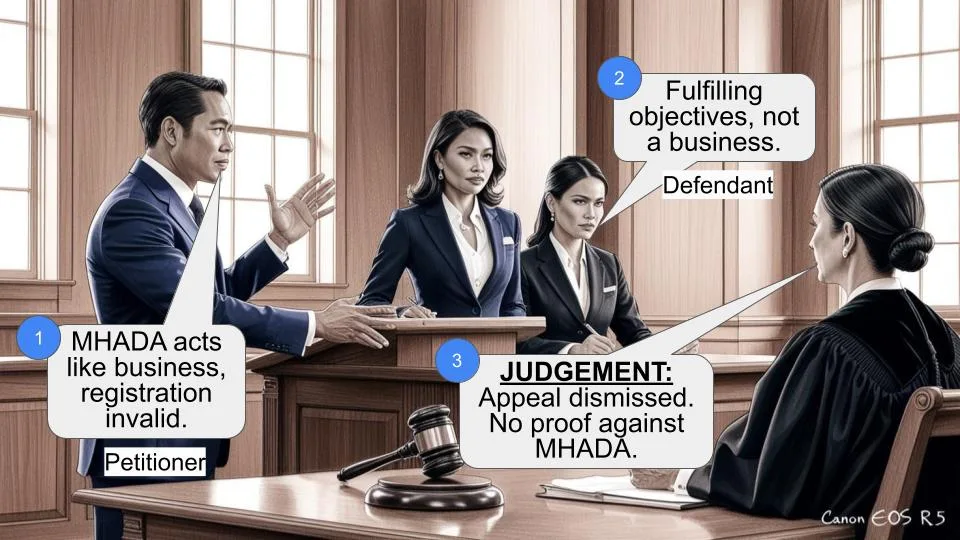
Trust Registration Upheld: Court Dismisses Income Tax Appeal Against MHADA
Trust Registration Upheld: Court Dismisses Income Tax Appeal Against MHADA
The Income Tax Department (the Revenue) appealed against an order by the Income Tax Appellate Tribunal (ITAT) that favored the Maharashtra Housing and Area Development Authority (MHADA). The Revenue wanted to cancel MHADA's registration as a charitable trust, but the court dismissed their appeal, effectively upholding MHADA's status. It's a win for MHADA.
Get the full picture - access the original judgement of the court order here
Case Name:
Director of Income Tax (Exemptions) Vs Maharashtra Housing and Area Development Authority (High Court of Bombay)
Income Tax Appeal No.2174 of 2013
Date: 18th April 2016
Key Takeaways:
1. The court emphasized that to cancel a trust's registration, there must be clear evidence that it's not genuine or not following its stated objectives.
2. The Revenue's argument about MHADA engaging in business-like activities wasn't enough to justify cancellation of its charitable status.
3. The court focused on the lack of material evidence against MHADA rather than delving into broader legal interpretations.
Issue:
The main question here was: Can the registration of a charitable trust (in this case, MHADA) be cancelled based on the argument that it's carrying out activities similar to trade or business?
Facts:
1. MHADA is registered as a charitable trust.
2. The Assistant Director of Income Tax suggested that MHADA was carrying out business-like activities with gross receipts exceeding Rs. 10 lakhs.
3. The Director of Income Tax (Exemption) issued a show cause notice to MHADA based on this suggestion.
4. MHADA's income included profits from housing sales and income from lease rents and tenancy deposits.
5. MHADA argued that its activities were in line with the Maharashtra Housing and Area Development Act, 1976, and it had no profit motive.
Arguments:
Revenue's side:
- They argued that MHADA was carrying out activities similar to trade or business.
- They pointed to MHADA's income from housing sales and rentals as evidence.
- They tried to use the proviso to Section 2(15) (of Income Tax Act, 1961) to support their case.
MHADA's side:
- They said their activities were in line with their founding act and had no profit motive.
- They argued that providing affordable housing isn't a business activity.
- They explained that their income was from fulfilling their charitable objectives, not from commercial activities.
Key Legal Precedents:
The judgment mentions an order passed by the Tribunal's Bench at Amritsar against the Jammu Development Authority, which was upheld by the High Court of Jammu and Kashmir (Jammu Development Authority Vs. Union of India & Anr., ITA No.164/2012). However, the court decided not to rely on this precedent for this case.
Judgement:
The court dismissed the Revenue's appeal, effectively siding with MHADA. Here's why:
1. The court found no evidence that MHADA was not a genuine trust or that it wasn't following its objectives.
2. The judges said there wasn't enough material to justify cancelling MHADA's registration under Section 12AA(3) (of Income Tax Act, 1961).
3. They felt the Tribunal (ITAT) should have allowed MHADA's appeal on these grounds alone, without getting into broader discussions about legal interpretations.
FAQs:
1. Q: Why did the court dismiss the Revenue's appeal?
A: The court found no concrete evidence that MHADA was operating against its charitable objectives or that it wasn't a genuine trust.
2. Q: Does this mean charitable trusts can engage in business-like activities?
A: Not necessarily. The court focused on the lack of evidence in this specific case rather than making a broad ruling on charitable trusts and business activities.
3. Q: What's the significance of Section 12AA(3) (of Income Tax Act, 1961) in this case?
A: This section allows for cancellation of a trust's registration, but the court found that the conditions for using this power weren't met in MHADA's case.
4. Q: Did the court make any new interpretations of tax law?
A: No, the court actually avoided making broader interpretations, focusing instead on the specific facts of this case.
5. Q: What does this mean for MHADA?
A: MHADA gets to keep its status as a charitable trust, which likely has significant tax implications for the organization.

1. This appeal of the Revenue challenges an order passed by the Income Tax Appellate Tribunal dated 2222013 in Income Tax Appeal No.435 of 2012. The Assessment Year is 2009-10.
2. Mr. Malhotra, appearing on behalf of the Revenue would submit that this appeal raises substantial questions of law and which have been formulated by the Revenue on page 6 and 7 of the paper book.
3. Mr. Malhotra sought to rely upon Section 12AA (of Income Tax Act, 1961) to submit that exercise of the power under subsection (3) thereof could be guided by the newly inserted proviso to Clause 15 of Section 2 of the Income Tax Act, 1961. Thus, endeavour is that the term "charitable purpose", as is defined in the Income Tax Act, includes what has been specified therein and inter alia the advancement of any other object of general public utility. The proviso and the first one to this would indicate that advancement of any other object of general public utility shall not be a charitable purpose, if it involves carrying of any activity in the nature of trade, commerce or business or any activity of rendering any service in relation to any trade, commerce or business, for a cess or fee or any other consideration, irrespective of the nature of use or application, or retention, of the income from such activity. Mr. Malhotra would submit that the moment this proviso is attracted, then the Commissioner can record a satisfaction that the activities of the Trust or institution are not genuine or are not being carried out in accordance with the object of the Trust or institution, as the case may be, and thereupon the registration can be cancelled.
4. We do not think any such larger question or controversy would arise in the facts of the present case. In the present case, even if the parties have placed before us a voluminous compilation and Mr. Malhotra sought to rely upon an order passed by the Tribunal's Bench at Amritsar against the Jammu Development Authority to submit that the said order was upheld by the Division Bench of the High Court of Jammu and Kashmir and which order of the Division Bench, dated 7112013 (Jammu Development Authority Vs. Union of India & Anr., ITA No.164/2012) has not been interfered by the Hon'ble Supreme Court of India, we do not feel that we should go this further. We do not decide any academic question or controversy but a susbstantial question of law and said to be arising between the parties from an adjudication undertaken by the authorities under the Income Tax Act.
5. In the present case, the order of the Director of Income Tax (Exemption) refers to a proposal received from the Assistant Director, Mumbai and which proposal stated that the assessee before us, namely, Maharashtra Housing and Area Development Authority (MHADA) has been carrying on activities in the nature of trade, commerce or business, etc., and gross receipts therefrom are in excess of Rs.10 lakhs. That is how the proviso to Section 2(15) (of Income Tax Act, 1961) would be attracted. This Assistant Director requested the Director, therefore, to consider withdrawal of registration, as granted to the assessee.
6. All that has been referred by the Director is the details of income in Income and Expenditure Account and profit of Rs.114.48 crores out of sale of housing and income by way of lease rent, tenancy deposits, etc.. Based on that a show cause notice was issued to the assessee and the assessee pointed out how its activities are in furtherance of the Maharashtra Housing and Area Development Act, 1976. It has no profit motive, far from indulging in any trade or commerce and as far as the activities alleged or the income generated, what has been pointed out is that MHADA gives houses to middleclass families at affordable rents. The income is on account of sale of housing stock and which is erroneously termed, according to MHADA, as coming from a systematic commerce and business activities.
7. We have referred to the order passed by the Director and impugned before the Tribunal in great detail with the assistance of Mr. Malhotra. We do not find anything in the matter referred by the Director which could be termed that the assessee was undertaking any activities which would demonstrate that it is not a genuine Trust or institution. We have also not found any material which would indicate that the assessee or its affairs are not being carried out in accordance with the object of the Trust or institution. If these are two aspects referred to in subsection (3) of Section 12AA (of Income Tax Act, 1961) and the materials in that behalf were completely lacking, then, we do not find any reason for the Director to exercise the power which he purported to exercise in the present case. On this short ground alone the assessee's appeal should have been allowed by the Tribunal. Though the Tribunal has discussed the ambit and scope of the proviso to Clause 15 of Section 2 (of Income Tax Act, 1961) and subsection (3) of Section 12AA (of Income Tax Act, 1961), we do not find that in the facts and circumstances of the present case, any such discussion was necessary and warranted, once the appeal could have been allowed on the above short ground. With this conclusion, we uphold the order of the Tribunal. We need not assign any other reason nor examine the contentions raised before us in further details. The questions, as are posed by Mr. Malhotra and in the backdrop of these proceedings can be decided in a proper case. With these observations, the appeal fails and it is dismissed.
(DR. SHALINI PHANSALKAR JOSHI, J.) (S.C. DHARMADHIKARI, J.)
×
Questions
Trust Registration Upheld: Court Dismisses Income Tax Appeal Against MHADA
Write your CommentSimilar Posts
Generic
- Reportdata/2906.pdf
