


Trust’s Building Use Not a Violation: High Court Clears Natya Sankalpaa




Full News
Trust’s Building Use Not a Violation: High Court Clears Natya Sankalpaa
Trust’s Building Use Not a Violation: High Court Clears Natya Sankalpaa
The case involves Natya Sankalpaa, a trust formed to promote Indian classical dance, and the Director of Income Tax (Exemptions). The dispute centered around whether the trust violated Section 13(1) (of Income Tax Act, 1961)© of the Income Tax Act by constructing a building on land owned by a trustee without paying rent. The High Court ruled in favor of the trust, stating that there was no misuse of income for the trustee’s benefit.
Get the full picture - access the original judgement of the court order here
Case Name:
Natya Sankalpaa vs. Director of Income Tax (Exemptions) (High Court of Madras)
Tax Case Appeal No: 1040 of 2014
Date: 17th June 2015
Key Takeaways:
- The High Court found no violation of Section 13(1) (of Income Tax Act, 1961)© as the trust’s actions did not benefit the trustee directly or indirectly.
- The agreement that the trustee would compensate the trust for the building if vacated was crucial in the court’s decision.
- The ruling emphasizes the importance of agreements in determining the application of trust income.
Issue
Did the construction of a building by Natya Sankalpaa on land owned by a trustee, without paying rent, constitute a violation of Section 13(1) (of Income Tax Act, 1961)© of the Income Tax Act?
Facts
- Natya Sankalpaa, a trust promoting Bharatanatyam, was formed by Smt. Urmila Sathyanarayanan.
- The land for the building was owned by her husband, Sri A.D. Sathyanarayanan, a trustee.
- The trust used its funds to construct a building on this land without paying rent or fees.
- An agreement stated that if the trust vacated the building, the trustee would compensate the trust for the building’s value.
Arguments
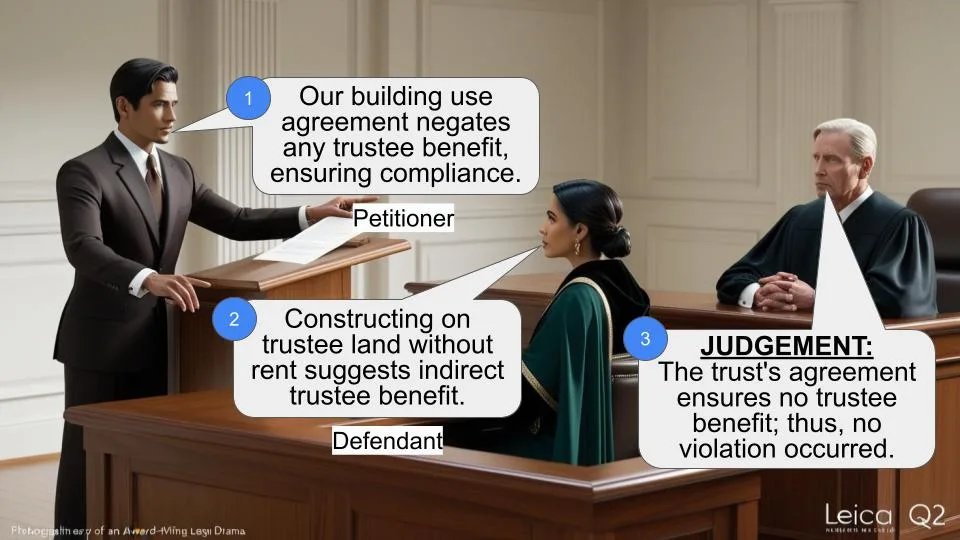
- Trust’s Argument: The trust argued that no income was derived by the trustee from the trust’s activities, and the building was not for the trustee’s benefit. The agreement ensured compensation for the building, negating any benefit to the trustee.
- Department’s Argument: The department claimed that using trust funds to construct a building on a trustee’s land indirectly benefited the trustee, violating Section 13(1) (of Income Tax Act, 1961)©.
Key Legal Precedents
- Section 13(1) (of Income Tax Act, 1961)© of the Income Tax Act: This section prohibits the use of trust income for the benefit of certain persons, including trustees. The court examined whether the trust’s actions fell under this provision.
Judgement
The High Court ruled in favor of Natya Sankalpaa, stating that the trust’s construction of the building did not constitute a violation of Section 13(1) (of Income Tax Act, 1961)©. The court emphasized that the agreement for compensation upon vacating the building ensured no benefit to the trustee. The appeal was allowed, and the trust’s exemption under Section 11 (of Income Tax Act, 1961) was upheld.
FAQs
Q1: Why was the trust not found in violation of Section 13(1) (of Income Tax Act, 1961)©?
A1: The court found that the trust’s actions did not directly or indirectly benefit the trustee, especially given the agreement for compensation.
Q2: What role did the agreement play in the court’s decision?
A2: The agreement was crucial as it stipulated that the trustee would compensate the trust for the building, ensuring no benefit was derived by the trustee.
Q3: What does this decision mean for other trusts?
A3: This decision highlights the importance of clear agreements and the careful application of trust income to avoid potential violations of tax laws.

1. The appellant assessee Trust was formed by Smt. Urmila Sathyanarayanan for promoting Bharatanatyam and other forms of Indian Classical Dance. The other Trustee of the Assessee Trust is Sri. A.D. Sathyanarayanan, husband of Smt. Urmila Sathyanarayanan. The land in question belong to Sri. A.D. Sathyanarayanan as an individual and in order to extend his goodwill for the benefit of his wife's endeavour to promote the classical dance, he permitted the Trust to construct a building by utilising the funds of the Trust for the purpose of promoting Bharatanatiyam and other Indian Classical dances.
2. The assessee trust is registered under Section 12 (of Income Tax Act, 1961) AA of the Income Tax Act, 1961, (hereinafter referred to as the Act) on 23.12.1997. The Assessing Officer, while completing the assessment in the year 2009-2010, denied exemption under Section 11 (of Income Tax Act, 1961), as claimed by the assessee, stating that the income of the assessee Trust fell within the ambit of amended provisions of Section 2(15) (of Income Tax Act, 1961) and that the assessee trust has violated the provisions of Section 13(1)(c) (of Income Tax Act, 1961). On a challenge made to the assessing order, the Commissioner allowed the appeal in favour of the Trust. The Tribunal reversed the said finding. Hence, the present appeal by the assessee.
3. The finding of the Tribunal is that,
“ 6. Even though the trust is not paying any rent or compensation to the trustee for the land used by the assessee trust which was belonging to one of the trustees, since the assessee trust is using its income for construction of the building on the land belonging to one of the trustees
amount to applying the income of the trust for the benefit of the trustee whic is certainloy falls under Section 13(1)(c) (of Income Tax Act, 1961). The trustee is certainly the beneficiary as on the date of construction of the building. As long as the trustee is holding the property and the trust is using the
said property by putting up building /structure for conducting dance classes, trustee is enjoying the benefit indirectly though not directly. Therefore, benefit to the trustee cannot be completely ruled out.”
4. In this appeal, we are now concerned with the issue relating to the denial of benefit on account of the alleged violation of Section 13(1) (of Income Tax Act, 1961)
(c) of the Act.
5. It is the specific case of the appellant that there is an agreement
dated 13.02.2013 whereby as and when the Trust decides not to use the
premises which has been constructed for the aforesaid purpose, the
individual Sri. A.D. Sathyanarayanan would pay the trust the value of the
building so constructed. There is no rent or fee or such other claim by
the said individual on the trust for the utilisation of the land on which the building is constructed by the Trust. According to the assessee no income is derived to the individual Sri. A.D. Sathyanarayanan as a Trustee. It is the further contention of the learned counsel for the assessee that the property is also not built for the benefit of the individual
Sri. A.D. Sathyanarayanan who happens to be one of the trustee.
Therefore, the contention of the Department that there is violation of
Section 13(1)(C) (of Income Tax Act, 1961) is not justifiable.
6. We are unable to countenance the finding of the Tribunal that
the present act would fall under the definition of the term “Trustee”
enjoying the benefit directly or indirectly because the land in question has
been parted away by the individual to the Trust. The trust has put up the
construction with a clause that it shall return back the building to the
individual and receive the compensation for the value of the building so
put up. It is not the case of the Department that such part of the income
or any part of the property of the trust or the institution is directly or
indirectly used or built for the benefit of the persons referred to in sub
section (1) (c) (3) of Section 13 (of Income Tax Act, 1961) which
reads as follows :
“SECTION 13
(1) (c) in the case of a trust for charitable or religious
purposes or a charitable or religious institution, any income
thereof-
(i) if such trust or institution has been created or
established after the commencement of this Act and under the
terms of the trust or the rules governing the institution, any
part of such income enures, or
(ii) if any part of such income or any property of the
trust or institution (whenever created or established) is during
the previous year used or applied, directly or indirectly for the benefit of any person referred to in sub-section (3);
(3) The persons referred to in caluse (c) of sub-section
(1) and sub-section (2) are the following namely :-
(cc) any trustee of the trust or manager (by whatever
name called) of the institution ; ”
7. The fact that the Trust, during the assessment year in issue,
constructed the building in question and spent amounts for the entire
construction is not in dispute. The fact that the Trust has not paid any
amount as rent, licence fee, lease fee or such other fee to the individual
Sri.A.D.Sathyarayanan is also not in dispute. The issue that is raised by
the Department is that while accepting that the Trust has not paid any
rent or any compensation to the trustee for the land used by the assessee
trust which belongs to one of the trustees, the income for construction of
the building on the land belonging to one of the trustee would amount to
income for the benefit of the trustee which will fall under Section 13 (of Income Tax Act, 1961)
(1)(c) of the Act unmindful of the agreement which states that in the
event of the trust vacating the building in future, the trustee shall
compensate the trust for the value for the building in question. De hors
this agrement, there is nothing to show that there was any manner of use
of application of the income or property of the Trust to the person set out
in sub section 13(1)(3)(c) (of Income Tax Act, 1961). It is only when there is an
application of income or any part of the property or building directly or
indirectly put to use for the benefit of person referred to above, the
provision will get attracted we do not find such application in the facts of
the present case. We are in agreement with the decision arrived at
by the Commissioner Appeals on this point.
8. Yet another plea raised by Mr.J. Narayanaswamy learned
Standing Counsel appearing for the Department is that the acquisition of
ownership of the building to the trustee itself is a benefit in the form of
right and therefore, it deemed to be an application of fund of the trust for
the benefit of the trustee. That contention is replied by Mr. N.V. Balaji,
learned counsel appearing for the appellant / assessee stating that there
is no vesting of the property on the trustee per se because, as per the
agreement, on surrender of the building the trustee will have to pay
compensation and, therefore, the question of application of funds for the
benefit of the trustee does not arise. The definition of “Beneficial Owner”
in terms of Black Law Dictionary, relied upon by the counsel for the
department, will not further the case of the department because as the
definition of “ Owner ” also has a restrictive meaning as in this case. We
extract the said portion hereunder :
“ Owner. The person in whom is vested the ownership,
dominion, or title of property, proprietor. He who has
dominion of a thing, real or personal, corporeal or incorporeal,
which he has a right to enjoy and do with as he pleases, even
to spoil or destroy it, as far as the law permits, unless he be
prevented by some agreement or covenant which restrains his
right. ”
9. In the result, the tax case appeal is allowed. No costs.
R. Sudhakar, J.
and
K.B.K. Vasuki, J.
×
Similar Ripples
Questions
Trust’s Building Use Not a Violation: High Court Clears Natya Sankalpaa
Write your CommentSimilar Posts
Generic
- Reportdata/3682.pdf
