


Trust’s Business Clause Doesn’t Bar Educational Exemption




Full News
Trust’s Business Clause Doesn’t Bar Educational Exemption
Trust’s Business Clause Doesn’t Bar Educational Exemption
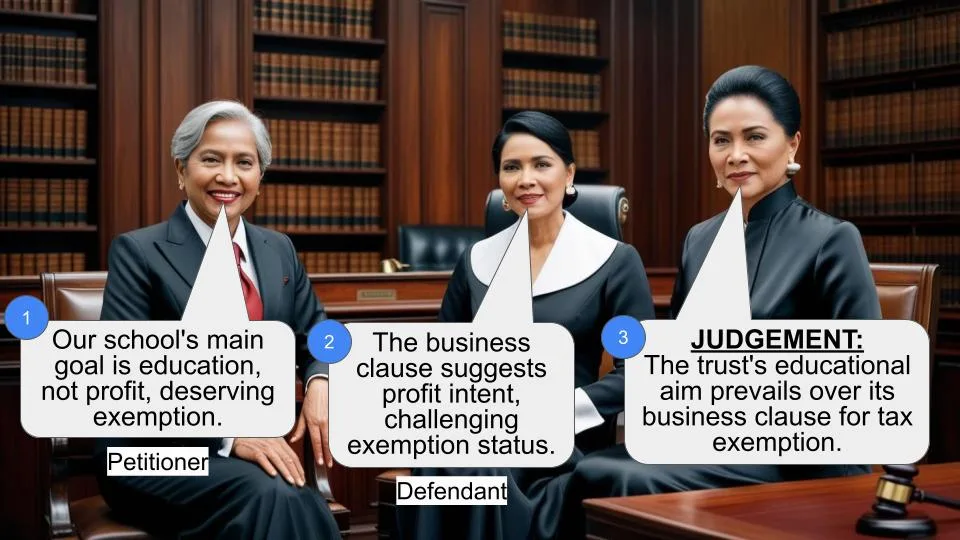
The case involves HARF Charitable Trust and the Chief Commissioner of Income Tax. The dispute centers on whether the Trust should be denied tax exemption under Section 10(23C)(vi) (of Income Tax Act, 1961) due to a clause in its deed allowing business activities. The court ruled in favor of the Trust, stating that the mere presence of a business clause does not disqualify it from being considered for educational purposes exemption.
Get the full picture - access the original judgement of the court order here
Case Name:
Harf Charitable Trust (Regd.) Vs Chief Commissioner of Income Tax & Another (High Court of Punjab & Haryana)
CWP No. 24895 of 2014
Date: 6th July 2015
Key Takeaways:
- The court emphasized the “predominant object test,” which assesses whether the main purpose of an institution is educational, not profit-making.
- A clause allowing business activities in a trust deed does not automatically disqualify a trust from tax exemption if the primary purpose is educational.
- The court quashed the rejection of the Trust’s application for exemption and ordered a fresh decision considering the predominant object of the Trust.
Issue
Does the presence of a business clause in a trust deed disqualify a trust from tax exemption under Section 10(23C)(vi) (of Income Tax Act, 1961) if its primary purpose is educational?
Facts
- HARF Charitable Trust operates a school and sought tax exemption under Section 10(23C)(vi) (of Income Tax Act, 1961).
- The Chief Commissioner of Income Tax rejected the application, citing a clause in the trust deed that allowed the Trust to engage in business activities.
- The Trust argued that its primary purpose was educational, and the business clause was not its main objective.
Arguments
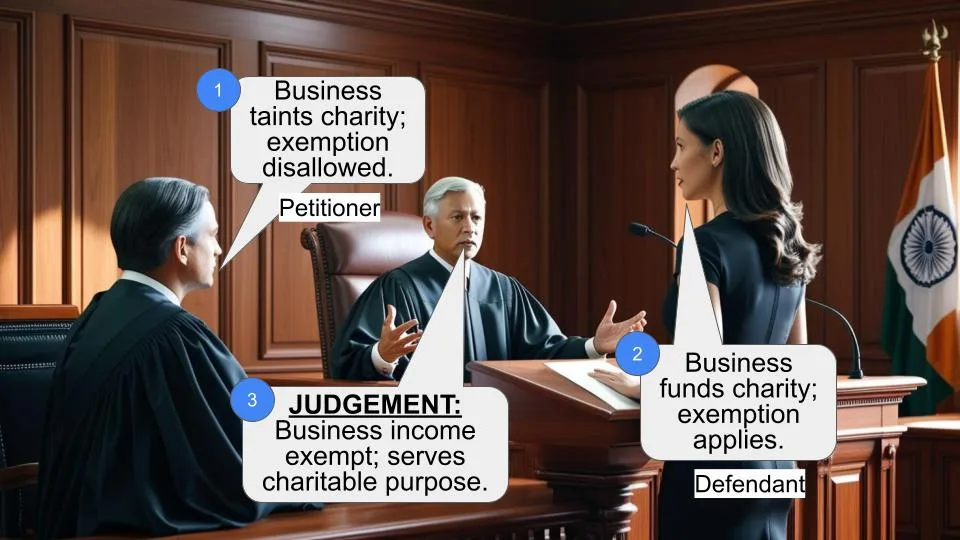
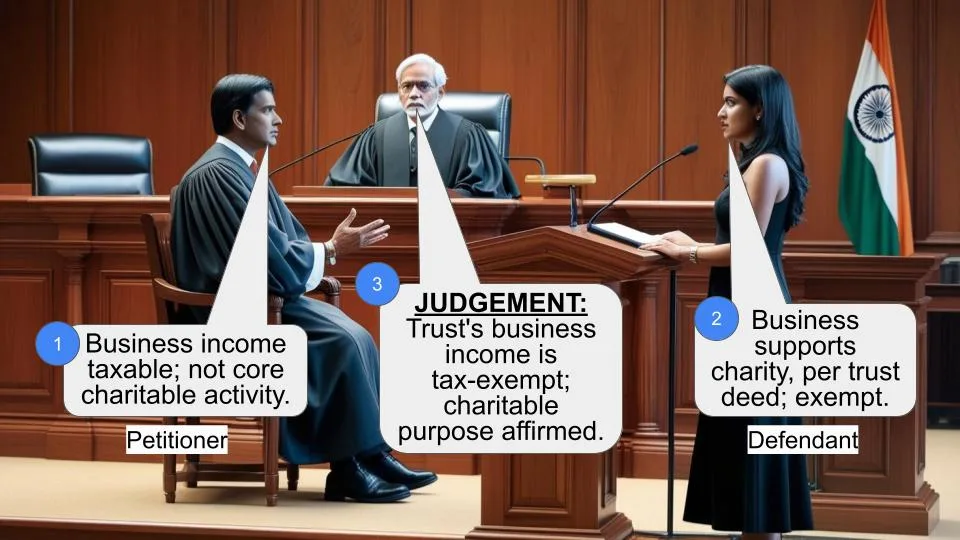
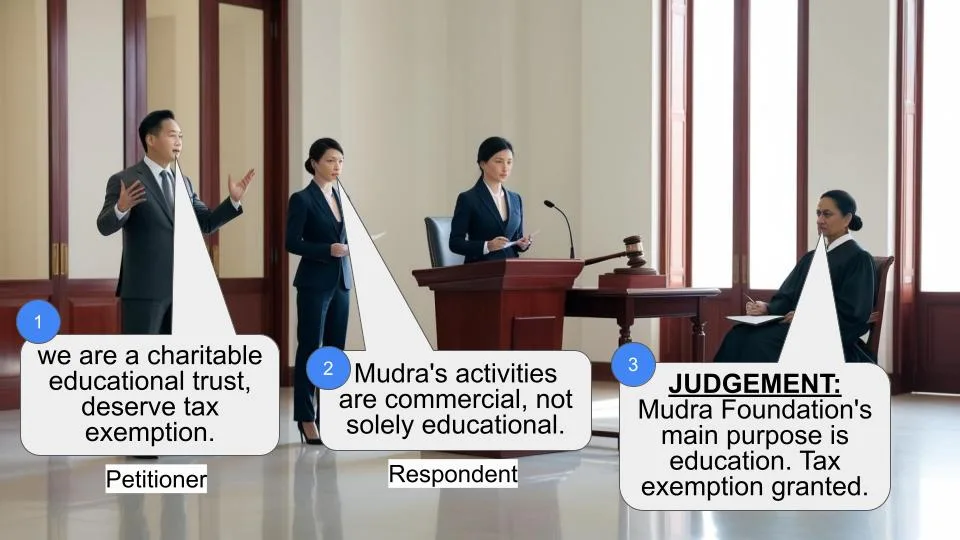
- Trust’s Argument: The Trust maintained that its primary purpose was educational, and the business clause was not intended to override this. They also pointed out that the objectionable clause had been removed.
- Commissioner’s Argument: The Commissioner argued that the presence of a business clause indicated an intention to engage in profit-making activities, which disqualified the Trust from exemption.
Key Legal Precedents
- Pine Grove International Charitable Trust vs Union of India: This case was referenced to support the argument that a trust can still qualify for exemption if its predominant purpose is educational, even if it generates surplus income.
- Queen’s Educational Society vs CIT: The Supreme Court’s decision in this case was cited to emphasize that the predominant object test should be applied.
Judgement
The court ruled in favor of HARF Charitable Trust, stating that the mere presence of a business clause does not disqualify the Trust from exemption if its primary purpose is educational. The court quashed the rejection of the Trust’s application and ordered the competent authority to reconsider the application, focusing on the Trust’s predominant object.
FAQs
Q1: Does a trust lose its educational status if it makes a profit?
A1: No, as long as the predominant purpose is educational, making a profit does not change its status.
Q2: What is the predominant object test?
A2: It’s a legal test to determine if the main purpose of an institution is educational rather than profit-making.
Q3: Can a trust with a business clause still get tax exemption?
A3: Yes, if the primary purpose of the trust is educational, a business clause does not automatically disqualify it from exemption.

1. Challenge in the present writ petition is to the order dated 17.09.2012 (Annexure P-5) passed by the Chief Commissioner of Income Tax-respondent no. 1 wherein, the application of the petitioner for grant of approval for exemption under Section 10(23C)(vi) (of Income Tax Act, 1961), 1961 (in short 'the Act') has been rejected.
The predominant reason which weighed with respondent no. 1-
The Chief Commissioner of Income Tax, Ludhiana was that the petitioner-
Trust had an intention to carry out business activity which was not
permissible for charitable organizations. The trustees were in place for the
whole duration of their life and it gave the organization a look and character of a private body rather than a charitable organization and the objectives were not related to the promotion of education and the educational trust did not exist solely for educational purposes.
The petitioner's case is that the Trust is registered under the
Societies Registration Act, 1860 and is a public charitable trust and running a school in the name of Sohrab Public School, Nabha Raod, Malerkotla
solely for educational purposes and is being regularly assessed to income
tax. An application was submitted in Form 56D under Section 10(23C)(vi) (of Income Tax Act, 1961)
of the Act read with Rule 2CA (of Income Tax Rules, 1962) seeking exemption from payment of income
tax as per requirements and it also filed the audited balance sheets for the
last 3 years plus the trust deed. Certain information was asked for and a
detailed reply was filed clarifying each and every issue and an opportunity
of hearing was afforded by respondent no. 1, who rejected the claim on
untenable grounds.
In the written statement filed on behalf of the respondents, plea
taken was that the education institution is to exist “solely for educational
purposes” and if the institution existed for other purposes, the exemption
could not be granted and reliance was placed upon the provisions of Section
10(23C)(vi) of the Act and the observations made by the Division Bench of
this Court in Pine Grove International Charitable Trust vs. Union of India
and others, (2010) 327 ITR 73 (P & H). The said order was accordingly
justified that even if one of the objects enables the institute to undertake
commercial activities, entitlement for approval under the provisions of the
Act would not be there.
The petitioner-Trust also filed replication that a supplementary
trust deed had been executed and the objecting words “and any other
business as decided by the trustees” had been deleted. The said fact had
also been noticed in a subsequent assessment made on 21.12.2012
(Annexure P-9).
Counsel for the petitioner has thus submitted that merely
because there was a clause in the trust deed which provided that the Trust
could carry on other business would not mean that there was an absolute bar
for consideration of the benefit under Section 10(23C)(vi) (of Income Tax Act, 1961) once
the predominant purpose and objects of the trust were charitable in nature.
It is accordingly submitted that in view of the observations of the Division
Bench in Pine Grove's case (supra), which had been further upheld by the
Apex Court in Queen's Educational Society vs. CIT, (2015) 372 ITR 699,
the respondent no. 1 was not justified in rejecting the case.
Counsel for the Department, on the other hand, contended that
the order was justified and within the ambit of the provisions of the Act and once the Trust was having other objectives which were not related to the
charitable purposes, no fault could be found in the decision of respondent
no. 1. The objectionable clause which was part of the trust deed was clause
(i) which provided that one of the objects of the trust was “to carry on other business as decided by the trustees”. On the strength of the said clause, as noticed above, the impugned order has been passed against the petitioner-trust on the strength of the provisions that the trust did not exist solely for educational purposes.
To appreciate the controversy in question, it would be
necessary to examine the provisions of Section 10(23C)(vi) (of Income Tax Act, 1961)
which provides that in computing the total income of the previous year of
any person, income falling within any of the specified clauses is not to be
included which is received on behalf of any educational institution existing
solely for educational purposes and not for purposes of profit than those
mentioned in sub-clause (iiiab) or sub-clause (iiiad) of Section 10(23C) (of Income Tax Act, 1961) of
the Act. The relevant provisions read thus:-
“10. In computing the total income of a
previous year of any person, any income falling within
any of the following clauses shall not be included-
(23C) any income received by any person on behalf of-
(iiiab) any university or other educational
institution existing solely for educational purposes and
not for purposes of profit , which is wholly or
substantially financed by the Government; or
(iiiad) any university or other educational
institution existing solely for educational purposes and
not for purposes of profit if the aggregate annual
receipts of such university or educational institution do
not exceed the amount of annual receipts as may be
prescribed; or
(vi) any university or other educational
institution existing solely for educational purposes and
not for purposes of profit,other than those mentioned in
subclause(iiiab) of sub-clause(iiiad) and which may be
approved by the prescribed authority;”
The said provisions were discussed in a threadbare manner by
the Division Bench of this Court in Pine Grove's case (supra) wherein,
exemption granted had been withdrawn on the ground that the educational
institutions being run were for generating profits and did not exist solely for educational purpose. While issuing show cause notice, the authorities had placed reliance upon the judgment of the Uttrakhand High Court in CIT vs. Queen's Educational Society, (2009) 318 ITR 160. The Division Bench
framed the following substantial questions of law:-
“(A) Whether an educational institution would
cease to exist 'solely' for educational purposes and not
for purposes of profit merely because it has generated
surplus income over a period of 4/5 years after meeting
its expenditure?
(B) Whether the amount spent on
acquiring/constructing capital assets wholly and
exclusively becomes part of the total income or it
becomes entitled to exemption under Section 10(23C) (of Income Tax Act, 1961)
(vi)of the Act?
(C) Whether an institution registered as a
Society under the Societies Registration Act,1860,loses
its character as an educational institution, eligible to
apply for exemption under Section 10(23C)(vi) (of Income Tax Act, 1961)of the
Act?”
Question no. (A) as to whether the education institution cease
to exist solely for educational purposes was answered in favour of the
institutions by holding that the predominant object of the activity is to be
taken into consideration. Reliance was placed upon the judgments of the
Apex Court in Aditanar Educational Institution vs. Additional
Commissioner of Income Tax, 1997 (224) ITR 310; American Hotel and
Lodging Association Educational Institute v. CBDT, (2008) 301 ITR 86;
CIT (Addl.) vs. Surat Art Silk Cloth Manufacturers Association, 1980
(121) ITR 1 (SC) and the view in Queen's Educational Society's case
(supra) was specifically not accepted. It was held that where the
educational institutions which are registered, the society would retain their character as such and they would be eligible to apply for exemption. The relevant observations read thus:-
“(1) It is obligatory on the part of the Chief
Commissioner of Income Tax or the Director, which are
the prescribed authorities, to comply with proviso
thirteen (un-numbered). Accordingly, it has to be
ascertained whether the educational institution has
been applying its profit wholly and exclusively to the
object for which the institution is established. Merely
because an institution has earned profit would not be
deciding factor to conclude that the educational
institution exists for profit.
(2) The provisions of Section 10(23C)(vi) (of Income Tax Act, 1961) of the
Act are analogues to the erstwhile Section 10(22) (of Income Tax Act, 1961) of the
Act, as has been laid down by Hon’ble the Supreme
Court in the case of American Hotel and Lodging
Association (supra). To decide the entitlement of an
institution for exemption under Section 10(23C)(vi) (of Income Tax Act, 1961) of
the Act, the test of predominant object of the activity
has to be applied by posing the question whether it
exists solely for education and not to earn profit [See 5-
Judges Constitution Bench judgment in the case of
Surat Art Silk Cloth Manufacturers Association
(supra)]. It has to be borne in mind that merely because
profits have resulted from the activity of imparting
education would not result in change of character of
the institution that it exists solely for educational
purpose. A workable solution has been provided by
Hon’ble the Supreme Court in para 33 of its judgment
in American Hotel and Lodging Association’s case
(supra). Thus, on an application made by an institution,
the prescribed authority can grant approval subject to
such terms and conditions as it may deems fit provided
that they are not in conflict with the provisions of the
Act. The parameters of earning profit beyond 15% and
its investment wholly for educational purposes may be
expressly stipulated as per the statutory requirement.
Thereafter the Assessing Authority may ensure
compliance of those conditions. The cases where
exemption has been granted earlier and the
assessments are complete with the finding that there is
no contravention of the statutory provisions, need not
be reopened. However, after grant of approval if it
comes to the notice of the prescribed authority that the
conditions on which approval was given, have been
violated or the circumstances mentioned in 13th proviso
exists, then by following the procedure envisaged in 13th
proviso, the prescribed authority can withdraw the
approval.
(3) The capital expenditure wholly and
exclusively to the objects of education is entitled to
exemption and would not constitute part of the total
income.
(4) The educational institutions, which are
registered as a Society, would continue to retain their
character as such and would be eligible to apply for
exemption under Section 10(23C)(vi) (of Income Tax Act, 1961). [See
para 8.7 of the judgment – Aditanar Educational
Institution case (supra)].
Accordingly, the orders passed withdrawing the exemptions
were quashed with liberty to pass fresh orders.
The said view has been specifically approved by the Apex
Court in Queen's Educational Society's case (supra) and the judgment of the
Uttrakhand High Court has been reversed.
The Apex Court has accordingly discussed the predominant
objects of the educational institution and whether it exists solely for
educational purposes and not for the purposes of profit. Accordingly,
conclusion was arrived at that merely because some profit arises from the
activity which was the predominant object, it would not mean that the
charitable character of the purpose of setting of the institution would be lost.
The predominant object test was to applied which was the promotion of
education and the principles were laid down as under:-
“(1) Where an educational institution carries
on the activity of education primarily for educating
persons, the fact that it makes a surplus does not lead
to the conclusion that it ceases to exist solely for
educational purposes and becomes an institution for the
purpose of making profit.
(2) The predominant object test must be
applied - the purpose of education should not be
submerged by a profit making motive.
(3) A distinction must be drawn between the
making of a surplus and an institution being carried on
"for profit". No inference arises that merely because
imparting education results in making a profit, it
becomes an activity for profit.
(4) If after meeting expenditure, a surplus
arises incidentally from the activity carried on by the
educational institution, it will not be cease to be one
existing solely for educational purposes.
(5) The ultimate test is whether on an overall
view of the matter in the concerned assessment year the
object is to make profit as opposed to educating
persons.”
It is also pertinent to note that while relying upon the earlier
judgments of the Apex Court namely American Hotel and Lodging
Association (supra) and keeping in view the provisos of the sections in
mind especially 13th proviso which provided that after giving a reasonable
opportunity, the approval granted to the trust could be withdrawn if it is
found that the activities are not genuine or in accordance with any of the
conditions, there could be a conditional approval subject to the monitoring.
The relevant observations read thus:-
“25. We approve the judgments of the Punjab
and Haryana, Delhi and Bombay High Courts. Since
we have set aside the judgment of the Uttarakhand
High Court and since the Chief CIT's orders cancelling
exemption which were set aside by the Punjab and
Haryana High Court were passed almost solely upon
the law declared by the Uttarakhand High Court, it is
clear that these orders cannot stand. Consequently,
Revenue's appeals from the Punjab and Haryana High
Court's judgment dated 29.1.2010 and the judgments
following it are dismissed. We reiterate that the correct
tests which have been culled out in the three Supreme
Court judgments stated above, namely, Surat Art Silk
Cloth, Aditanar, and American Hotel and Lodging,
would all apply to determine whether an educational
institution exists solely for educational purposes and
not for purposes of profit. In addition, we hasten to add
that the 13th proviso to Section 10(23C) (of Income Tax Act, 1961) is of great
importance in that assessing authorities must
continuously monitor from assessment year to
assessment year whether such institutions continue to
apply their income and invest or deposit their funds in
accordance with the law laid down. Further, it is of
great importance that the activities of such institutions
be looked at carefully. If they are not genuine, or are
not being carried out in accordance with all or any of
the conditions subject to which approval has been
given, such approval and exemption must forthwith be
withdrawn. All these cases are disposed of making it
clear that revenue is at liberty to pass fresh orders if
such necessity is felt after taking into consideration the
various provisions of law contained in Section 10(23C) (of Income Tax Act, 1961)
read with Section 11 (of Income Tax Act, 1961).”
In the present case, under the second proviso, the authority was
to call for documents including audited annual accounts from the trust and
in order to satisfy itself about the genuineness of the activities of the trust, the inquiries had to be made. The objects of the petitioner-trust read thus:-
“2. OBJECTS OF THE TRUST
(a) To spread education and for achieving the
said object to establish, maintain, run, develop and
improve, extend, grant donations in cash and kind and
assist in the establishment, running, development,
improvement and extension of schools, colleges,
workshop, industrial and technical schools, institutions
for the promotion of agriculture, hostels for the benefit
of needy students, maintain agriculture farms for the
benefit of the poor.
(b) To establish, maintain or acquire library
or libraries for the benefit of the students community.
(c) To institute and award scholarships in
India for the study, research and apprenticeship for all
or any of the aforesaid educational purpose.
(d) To establish, maintain, run, develop,
improve, extend, grant donations for and to aid and
assist in the establishment maintenance, running,
development, improvement and extension of hospitals,
clinics, XRay plants, dispensaries, maternity houses,
recreating centres and all similar institutions as will
afford treatment to alleviate human sufferings.
(e) To conduct feeding to poor generally give
food and raiment to the poor, needy and disabled
persons and to afford relief to people in distress due to
natural calamities, accident, earthquake, flood,
famine,. Epidemic orphanages and welfare
institutions.
(f) To carry on community development
programmes for the upliftment of the economically
weaker sections of the society and construct and
develop community centres or halls for carrying on
such activities.
(g) To provide food, shelter, clothing, medical
care and education for the needy.
(h) To provide assistant to best players and
also to promote various sports by organizing
tournaments in the interest of the Public.
(i) To carry out other business as decided by
the Trustees.”
It is not disputed that the school as such is also affiliated with
the Central Board of Secondary Education, New Delhi and has also been
granted registration under Section 12-A (of Income Tax Act, 1961) w.e.f. 15.07.1997. Merely because
one of the clauses of the trust deed provided that the trust would carry on
other business as decided by the trustees would not per se dis-entitle it from being considered for registration under Section 10(23C)(vi) (of Income Tax Act, 1961). The reasoning that the Trust had intentions to carry out the business and the said institute was not existing solely for educational purposes would amount to giving a very narrow meaning to the section and the predominant object test was to be applied. As noticed above, it was not that respondent no. 1 came to the conclusion that the Trust was doing some other business and the said business was generating substantial amounts which would over ride the main objects of the trust which have been reproduced above which pertain mainly to the cause of education. Keeping in view the principles which have been discussed regarding the words 'solely for educational purposes and of generating profit', we are of the opinion that in the absence of any such finding that the trust was doing business, the application could not have been rejected only on this ground that one of the clauses in the objects provided such right to the trust. The prescribed authority could have made it conditional by holding that if any such business is carried out, the registration granted is liable to be cancelled. The principles laid down by the Apex Court in American Hotel and Lodging Association's case (supra) can thus be also applied in the circumstances. The said principles read thus:-
“33. Having analysed the provisos to Section 10 (of Income Tax Act, 1961)
(23C)(vi) one finds that there is a difference between
stipulation of conditions and compliance thereof. The
threshold conditions are actual existence of an
educational institution and approval of the prescribed
authority for which every applicant has to move an
application in the standardized form in terms of the
first proviso. It is only if the pre-requisite condition of
actual existence of the educational institution is
fulfilled that the question of compliance of
requirements in the provisos would arise. We find merit
in the contention advanced on behalf of the appellant
that the third proviso contains monitoring
conditions/requirements like application, accumulation,
deployment of income in specified assets whose
compliance depends on events that have not taken place
on the date of the application for initial approval.
34. To make the section with the proviso
workable we are of the view that the Monitoring
Conditions in the third proviso like
application/utilization of income, pattern of investments
to be made etc. could be stipulated as conditions by the
PA subject to which approval could be granted. For
example, in marginal cases like the present case, where
appellant-Institute was given exemption up to financial
year ending 31.3.1998 (assessment year 1998-99) and
where an application is made on 7.4.1999, within seven
days of the new dispensation coming into force, the PA
can grant approval subject to such terms and
conditions as it deems fit provided they are not in
conflict with the provisions of the 1961 Act (including
the abovementioned monitoring conditions). While
imposing stipulations subject to which approval is
granted, the PA may insist on certain percentage of
accounting Income to be utilized/applied for imparting
education in India. While making such stipulations, the
PA has to examine the activities in India which the
applicant has undertaken in its Constitution, MoUs.
and Agreement with Government of India/National
Council. In this case, broadly the activities undertaken
by the appellant are - conducting classical education
by providing course materials, designing courses,
conducting exams, granting diplomas, supervising
exams, all under the terms of an Agreement entered
into with Institutions of the Government of India.
Similarly, the PA may grant approvals on such terms
and conditions as it deems fit in case where the Institute
applies for initial approval for the first time. The PA
must give an opportunity to the applicant-institute to
comply with the monitoring conditions which have been
stipulated for the first time by the third proviso.
Therefore, cases where earlier the applicant has
obtained exemption(s), as in this case, need not be re-
opened on the ground that the third proviso has not
been complied with. However, after grant of approval,
if it is brought to the notice of the PA that conditions on
which approval was given are breached or that
circumstances mentioned in the thirteenth proviso
exists then the PA can withdraw the approval earlier
given by following the procedure mentioned in that
proviso. The view we have taken, namely, that the PA
can stipulate conditions subject to which approval may
be granted finds support from sub-clause (ii)(B) in the
thirteenth proviso.”
Accordingly, we are of the view that the impugned order cannot
be justified solely on the ground that in view of a clause which provided
that the Trust could run a business, it would be debarred as such from
registration on the ground that it was not existing solely for educational
purposes. That merely a conferment of power to do business would not
debar the right for consideration to the trust without any finding being
recorded that the predominant object of the Trust was to do business. Thus,
respondent no. 1 misdirected itself by rejecting the application on this
ground without coming to any conclusion that the trust was carrying on any
other activity as per clause (i). It is also a matter of fact, as noticed, now that the trust has already also deleted the objectionable clause and which has also been noticed in the subsequent assessment made in the assessment order dated 21.12.2012 for the year 2010-11.
Accordingly, the writ petition is allowed and the impugned
order dated 17.09.2012 (Annexure P-5) is quashed. The competent
authority shall decide the said application afresh keeping in view the
observations made hereinabove.
(S.J. VAZIFDAR)
ACTING CHIEF JUSTICE
(G.S. SANDHAWALIA)
JUDGE
06.07.2015
×
Similar Ripples
Questions
Trust’s Business Clause Doesn’t Bar Educational Exemption
Write your CommentSimilar Posts
Generic
- Reportdata/3644.pdf
