Full News

Unregistered Sale Agreement Fails to Block Bank Auction, Rajasthan High Court Rules
Unregistered Sale Agreement Fails to Block Bank Auction, Rajasthan High Court Rules
This case involves Dr. Girish Chandra Chaturvedy, who tried to stop Canara Bank from auctioning certain plots in Jaipur that he claimed to own based on an agreement to sell and an arbitration award. The court ultimately sided with the bank, holding that an unregistered agreement to sell does not confer ownership, and the bank’s auction of the mortgaged property was valid.
Get the full picture - access the original judgement of the court order here
Case Name
Dr. Girish Chandra Chaturvedy v. Canara Bank & Ors.(High Court of Judicature for Rajasthan, Jaipur Bench)
S.B. Civil Writ Petition No.3479/2015
Date: 28th January 2025
Key Takeaways
- Unregistered Agreements Don’t Transfer Ownership: The court reaffirmed that an unregistered agreement to sell does not create any legal interest or ownership in immovable property.
- Bank’s Rights Over Mortgaged Property Prevail: If a property is mortgaged to a bank and the borrower defaults, the bank can auction the property to recover its dues, even if there’s an agreement to sell with a third party.
- Arbitration Awards Don’t Bind Non-Parties: An arbitration award between the seller and a buyer does not affect the bank’s rights if the bank was not a party to the arbitration.
- Strict Compliance Needed for Setting Aside Auctions: Applications to set aside an auction sale must strictly comply with procedural requirements, including timely deposits and proof of substantial injury.
Issue
Does an unregistered agreement to sell, or an arbitration award based on it, prevent a bank from auctioning mortgaged property to recover its dues?
Facts
- Parties: Dr. Girish Chandra Chaturvedy (petitioner) vs. Canara Bank, Punsumi Devices (borrower), and others.
- Background: In 1993, Dr. Chaturvedy entered into an agreement to buy certain plots from the Bhargava family (the borrowers). The borrowers had already mortgaged these plots to Canara Bank to secure a loan.
- Default: The borrowers defaulted on their loan. Canara Bank obtained a recovery certificate from the Debts Recovery Tribunal (DRT) in 2002 and initiated auction proceedings.
- Objections: Dr. Chaturvedy objected to the auction, claiming ownership based on the agreement to sell and an arbitration award in his favor. His objections were rejected by the Recovery Officer, DRT, and Debts Recovery Appellate Tribunal (DRAT).
- Sale Deed: After the auction, the borrowers executed a registered sale deed in favor of Dr. Chaturvedy in 2004.
- Court Proceedings: Dr. Chaturvedy filed writ petitions seeking to quash the auction and to get possession of the plots.
Arguments
Petitioner (Dr. Chaturvedy)
- Claimed ownership of the plots based on the agreement to sell and the arbitration award.
- Argued that the Recovery Officer (RO) did not properly investigate his objections under Rule 11 of the Second Schedule to the Income Tax Act, 1961.
- Claimed procedural irregularities in the auction and discrepancies in the area of the plots.
- Asserted that after the arbitration award, the bank could not auction the plots.
Respondents (Canara Bank & Others)
- Argued that the agreement to sell was unregistered and did not confer ownership.
- Emphasized that the property was validly mortgaged and the bank’s rights as a secured creditor took precedence.
- Pointed out that the petitioner did not comply with the requirements for setting aside the auction (such as making necessary deposits).
- Noted that the arbitration award did not bind the bank, as it was not a party to those proceedings.
Key Legal Precedents & Provisions
- Section 54 (of Income Tax Act, 1961), Transfer of Property Act, 1882: Sale of immovable property worth more than Rs. 100 can only be made by a registered instrument.
- Order 21 Rules 89 & 90, CPC: Procedures for setting aside sales in execution of decrees.
- Section 29 (of Income Tax Act, 1961), Recovery of Debts and Bankruptcy Act, 1993: Applies certain provisions of the Income Tax Act to debt recovery.
- Rule 11 (of Income Tax Rules, 1962), 60, 61, Second Schedule, Income Tax Act, 1961: Procedures for investigating objections and setting aside sales.
- Supreme Court Precedents:
- Suraj Lamp Industries § Ltd. v. State of Haryana & Anr. [(2012) 1 SCC 656]: An agreement to sell does not create any interest in property.
- Indian Overseas Bank v. M.A.S. Subramanian & Ors. (Civil Appeal Nos.282-283/2025): Agreement for sale does not transfer title.
- Sanjay Sharma v. Kotak Mahindra Bank Ltd. & Ors. (Civil Appeal No.14282/2024): Registration of sale deed is essential for transfer of ownership.
- Cheran Properties Limited v. Kasturi and Sons Limited and Ors. [(2018) 16 SCC 413]: Arbitration awards bind only parties and those claiming under them.
Judgement
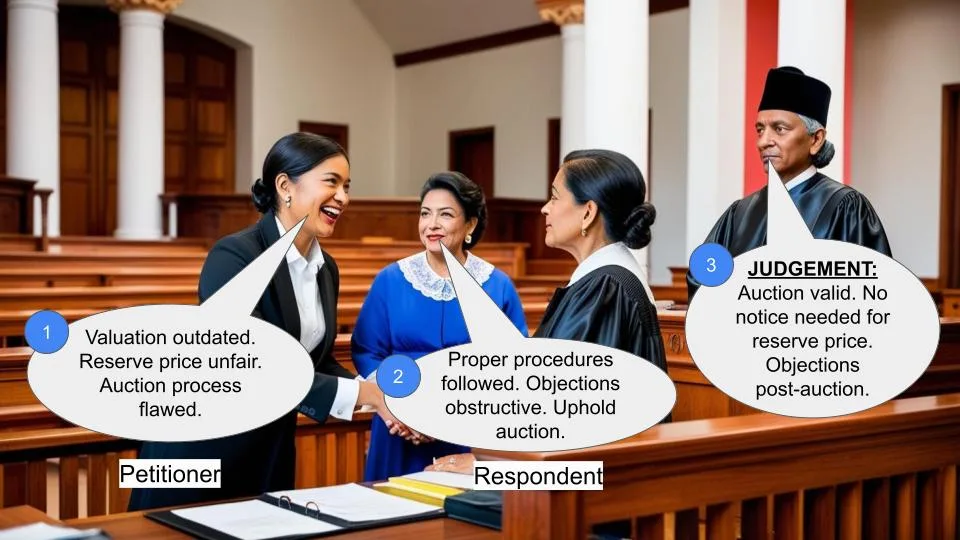
- Petitioner’s Claims Rejected: The court held that Dr. Chaturvedy could not claim ownership based on an unregistered agreement to sell. The subsequent registered sale deed (executed after the auction) did not help his case.
- Bank’s Auction Upheld: The bank’s right to auction the mortgaged property was upheld, as the mortgage was valid and unchallenged.
- No Procedural Lapse: The court found no procedural irregularity in the auction process or in the handling of objections.
- Arbitration Award Not Binding on Bank: The arbitration award between the petitioner and the borrowers did not affect the bank’s rights, as the bank was not a party to the arbitration.
- Writ Petitions Dismissed: The court dismissed the writ petitions and upheld the auction and sale of the plots to recover the bank’s dues.
FAQs
Q1: Can an unregistered agreement to sell block a bank from auctioning mortgaged property?
A: No. An unregistered agreement to sell does not create any legal interest or ownership in the property and cannot prevent a bank from auctioning mortgaged property to recover its dues.
Q2: Does an arbitration award between a buyer and seller affect the bank’s rights?
A: No. If the bank was not a party to the arbitration, the award does not bind the bank or affect its rights over the mortgaged property.
Q3: What must a person do to set aside an auction sale?
A: The person must comply with strict procedural requirements, including making timely deposits as specified under Rule 60 (of Income Tax Rules, 1962) and 61 of the Second Schedule to the Income Tax Act, 1961, and must show substantial injury if claiming irregularity.
Q4: What is the effect of a registered sale deed executed after an auction?
A: If the property has already been auctioned and sold to recover dues, a subsequent sale deed in favor of another party does not affect the auction purchaser’s rights.
Q5: What is the main legal principle from this case?
A: Only a registered sale deed transfers ownership of immovable property. Agreements to sell, even if followed by arbitration awards, do not confer ownership or block a bank’s rights as a secured creditor.
×