


Bank Auction Upheld: Court Dismisses Debtor's Valuation Objections



Full News
Bank Auction Upheld: Court Dismisses Debtor's Valuation Objections
Bank Auction Upheld: Court Dismisses Debtor's Valuation Objections
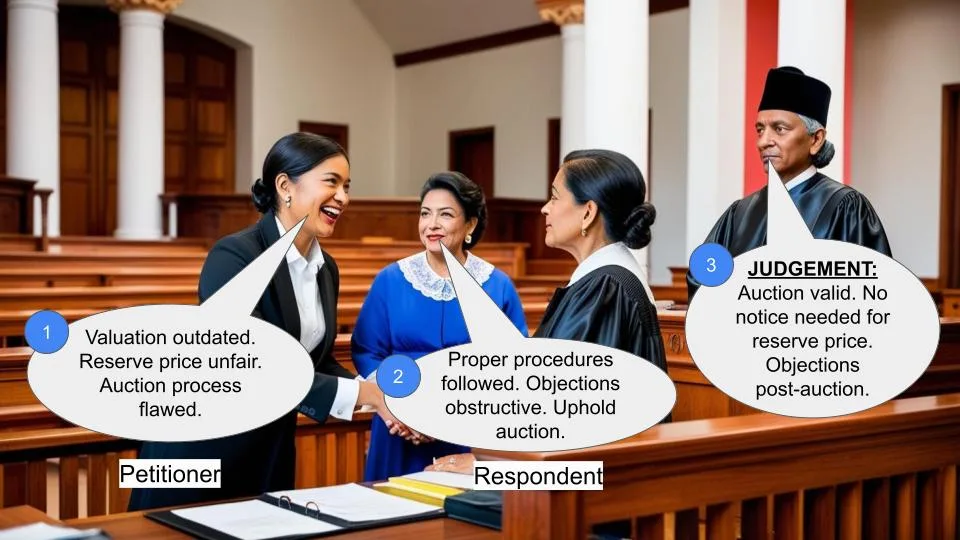
Centauto Automotives Private Limited challenged auction proceedings by Union Bank of India for recovery of debt. The court dismissed the petition, upholding decisions of lower tribunals that deferred consideration of the debtor's objections regarding property valuation until after the auction.
Get the full picture - access the original judgement of the court order here.
Case Name:
Centauto Automotives Private Limited vs Union Bank of India (High Court of Madhya Pradesh)
Writ Petition No. 4186/2004
Key Takeaways:
1. Debtors are not entitled to notice before reserve price determination in auctions.
2. Objections to property valuation can be considered after the auction but before sale confirmation.
3. Courts are reluctant to interfere with auction processes if proper procedures are followed.
Issue:
Whether the auction process conducted by the bank was valid despite the debtor's objections regarding property valuation and reserve price determination?
Facts:
1. Union Bank of India initiated auction proceedings against Centauto Automotives to recover debt .
2. The debtor objected to the valuation of properties and reserve price determination .
3. The Recovery Officer deferred consideration of these objections until after the auction .
4. The Debt Recovery Tribunal and Appellate Tribunal upheld the Recovery Officer's decision .
5. The debtor filed a writ petition challenging these decisions .
Arguments:
Petitioner (Centauto Automotives):
1. The properties were not properly valued and the reserve price was based on an outdated 2002 valuation report .
2. The Recovery Officer should have decided objections before proceeding with the auction .
3. There was formation of a cartel by auction participants .
4. The petitioner was not given prior notice before the reserve price was fixed, violating Rule 53 of the Income Tax Act .
Respondent (Union Bank of India):
1. The appeal against the Recovery Officer's order was premature as objections were still pending .
2. The valuation report was from an approved valuer and considered the rise in property prices due to Raipur becoming the state capital .
3. The petitioner's objections were filed at the last minute to obstruct the auction process .
4. The auction was conducted in accordance with rules and established procedures .
Key Legal Precedents:
1. Samir K. Shah and Another v. Union of India and Others:
The Supreme Court held that there is no requirement to give notice or opportunity to the debtor before determining the reserve price in auctions .
2. Ram Kishun & Ors. v. State of U.P. & Ors.:
The Supreme Court emphasized that financial institutions should not behave arbitrarily in disposing of secured assets, even when recovering public money .
Judgement:
1. The court dismissed the petition, finding no merit in the debtor's arguments .
2. It upheld the decisions of lower tribunals to defer consideration of valuation objections until after the auction .
3. The court rejected the argument that the auction process was vitiated due to lack of notice before reserve price determination, citing the Samir K. Shah case .
4. The Recovery Officer was directed to consider the pending objections regarding property valuation on their own merits .
5. The petitioner was ordered to pay costs of Rs. 25,000 to the respondent bank .
FAQs:
Q1: Does a debtor have the right to be notified before the reserve price is set for an auction?
A1: No, according to the Supreme Court in Samir K. Shah v. Union of India, there is no requirement to give notice or opportunity to the debtor before determining the reserve price.
Q2: Can a debtor object to the valuation of properties in an auction?
A2: Yes, but these objections can be considered by the Recovery Officer after the auction but before the confirmation of sale.
Q3: What happens if a debtor believes the auction process was unfair?
A3: The debtor can file objections with the Recovery Officer and appeal to higher tribunals if unsatisfied. However, courts are generally reluctant to interfere if proper procedures were followed.
Q4: Can an entire auction be invalidated due to valuation disputes?
A4: Not necessarily. As seen in this case, the auction can proceed while objections to valuation are considered separately.
Q5: What factors are considered when determining property valuation for auctions?
A5: Factors may include reports from approved valuers, market conditions, and significant events affecting property prices (like Raipur becoming a state capital in this case).

1. This petition filed under Article 226 of the Constitution of India takes exception to the order passed by the Debts Recovery Appellate Tribunal (hereinafter referred to as “Appellate Tribunal”) dated 08.10.2004 (Annexure-P/1), as also by the Debts Recovery Tribunal (hereinafter referred to “Tribunal”) dated 12.03.2004 (Annexure-P/3) and of the Recovery Officer dated 12.01.2004 (Annexure-P/2). The petitioner by amending the petition has asked for further appropriate writ or direction in relation to the order dated 28.10.2004 passed by the Recovery Officer in O.A. Execution No.14/2002.
2. Briefly stated, the petitioner is a Certificated Debtor. For recovering the amount from the petitioner, the Recovery Officer issued a public auction notice dated 15.11.2003, which was published on 10.12.2003 in the local newspapers. The auction notice refers to four properties, which were ordered to be sold in auction. Out of that, only two properties are situated at Raipur (State of Chhattisgarh) and were made subject matter of objection filed by the petitioner regarding valuation thereof. From the objection filed by the petitioner, essentially, two points can be discerned. Firstly, that the properties were not properly valued and; secondly, the reserve price mentioned in the auction notice in respect of the said properties were based on valuation report of year 2002, which according to the petitioner, could not have been made the basis for determining the reserve price. This objection was considered by the Recovery Officer and has been answered as follows:-
3. Against this decision, the petitioner carried the matter before the Debts Recovery Tribunal raising diverse pleas – firstly, that the valuation of the properties in question was not correct. Secondly, the same was based on valuation report of year 2002. Thirdly, the Recovery Officer was obliged to decide the objections taken by the petitioner, inter alia, non-compliance of Rule 53 of Schedule-II of the Income Tax Act, 1962 (for brevity “Income Tax Act”) before proceeding with the auction process. Further, the Recovery Officer overlooked the formation of cartel by the participants during the auction. The Recovery Officer did not apply his mind and failed to stop the auction process in spite of such illegal activities and instead hastened the process within two minutes. The actual value of the properties was much more than the price offered during the auction. The Bank would be the looser - because of less amount recovered in the auction process. The petitioner made an offer before the Debts Recovery Tribunal that he would bear the expenditure incurred by the Bank for putting the properties to re-auction, if the sale was to be cancelled. The auction proceedings were in violation of principles of natural justice.
4. These contentions were refuted by the Bank firstly on the ground that the remedy of appeal against the order of Recovery Officer was pre mature. In that, the objection taken by the petitioner about the valuation of the properties was still undecided and pending for adjudication before the Recovery Officer. That the petitioner would get opportunity to apply for setting aside the auction sale under Rule 60 of Schedule-II of the Income Tax Act. Further, the petitioner has not disclosed all the material and relevant facts. The valuation report obtained by the Bank was from an approved Valuer. As the State of Chhattisgarh was established w.e.f. 01.11.2000 and Raipur was notified as the State Capital, there was spurt in the property price in Raipur. This was taken into account while fixing the reserve price and during the auction. It was contended on behalf of the Bank that the valuation certificate obtained by the petitioner from Pilliwar was incorrect. Infact, said Pilliwar was earlier in the panel of respondent-Bank, but, due to his bad reputation, no work was entrusted to him and the process to remove him from the panel of Bank approved valuers was in progress. The Bank contended that as the auction sale was fixed for 13.01.2004, no fault can be found with the view taken by the Recovery Officer to defer the consideration of objection regarding valuation of the properties, keeping in mind that the petitioner had approached only at the eleventh hour with the said objection (as objection was filed on 4.1.2004 before the Recovery Officer, though the auction notice was notified for 13.01.2004 and order of the Recovery Officer to auction the suit properties was passed on 15.11.2003). The attempt of the petitioner was to interdict the auction process and for which reason, had also issued a press note to create confusion. The petitioner tried his best to obstruct the auction sale. Notably, contended the Bank that the Recovery Officer gave full opportunity to the petitioner including to participate in the auction sale. The petitioner did not avail of the said opportunity or to offer higher price; and he was not ready to pay amount to the Bank as per the valuation report (as mentioned in valuation report relied by the petitioner) or 20% more than the auction price. Only then the Bank would have considered his request to set aside the auction sale.
5. After considering the rival contentions, the Debts Recovery Tribunal formulated only one issue for consideration - as to whether the order passed by the Recovery Officer dated 12.01.2004 was liable to be set aside. The Tribunal then proceeded to examine the matter in the context of the said issue for consideration. The Tribunal in paragraph 8 found that the valuation report of the Bank prepared in the year 2002 cannot be said to be on the lower side considering the fact that the State of Chhattisgarh was established on 01.11.2000. In paragraph 9 of the judgment, the Tribunal then considered the reasons why the reserve price for the concerned properties was fixed and found that the approach of the Bank in that behalf was correct. In paragraph 10 of the judgment, the Tribunal found that there may be several factors that would weigh with the bidders to bid low or high price for a particular property and in the absence of any material about the nexus between the officials involved in the bid and the purchasers, the allegation of the petitioner that particular property could have fetched more price, must be discarded as baseless and without any substance. In paragraph 11, the Tribunal then proceeded to consider the objection of the petitioner about the non-compliance of procedure stipulated in Rule 53 (of Income Tax Rules, 1962), in the context of the fact that the reserve price was fixed by the Bank on the basis of valuation report of 2002. The Tribunal found that the petitioner did not file any valuation report of his own prior to issuance of auction proclamation, for which no infirmity can be found with the auction process in question merely because of fixing of reserve price on the basis of valuation report of 2002. The Tribunal also considered the grievance of the petitioner about the formation of cartel and rejected the same since the auction was an open auction and was done in the presence of the petitioner. The Tribunal held that auction proceedings were conducted in accordance with the Rules and established procedure. The Tribunal also recorded the offer given by the respondent-Bank that, if the petitioner is still interested in getting the sale set aside, is free to pay the amount as per the petitioner’s valuation report of Shri Pilliwar or 20% over and above the auction price. The petitioner, however, did not consent to that offer as well. Nevertheless, the Recovery Officer deferred the consideration of objection regarding valuation and for which reason, no fault can be found with that approach of the Recovery Officer. The Tribunal in pagaraph 12 of the judgment reiterated the position that the objection regarding correct valuation of the properties can still be considered by the Recovery Officer, which has been kept open. The Tribunal noted that the petitioner was not ready to get that objection decided before confirmation of sale as per Rule 60 of Schedule-II of the Income Tax Act. The Tribunal, thus, concluded that the appeal preferred by the petitioner was pre mature and dismissed the same being devoid of merits. The Tribunal has directed the Recovery Officer to dispose of the objections preferred by the petitioner without being influenced by the observations made in its judgment dated 12.03.2004.
6. Although, the Tribunal kept all the issues open, the petitioner still approached the Debts Recovery Appellate Tribunal. The pleas taken before the Tribunal and the objection before the Recovery Officer were reiterated by the petitioner even before the Appellate Tribunal. No other contention can be discerned from the judgment of the Appellate Tribunal. The Bank resisted the appeal on the same grounds and more particularly, because the appeal was pre mature - as the objection regarding proper valuation of the properties was yet to be adjudicated by the Recovery Officer and would be available to the petitioner before confirmation of sale. The Appellate Tribunal once again considered those points and has reiterated the opinion of the Tribunal and of the Recovery Officer. Leaving all questions regarding the said objection open, the appeal preferred by the petitioner came to be dismissed. The Appellate Tribunal also noted about the unwillingness of the petitioner to avail the offer given by the respondent-Bank and observed that the petitioner was indulging in dilatory tactics. Against these concurrent decisions, the present writ petition has been filed.
7. Although diverse grounds have been raised in the writ petition, during the arguments learned counsel for the petitioner confined to only two points. The first contention is that the petitioner was not given prior notice before the reserve price was fixed by the respondent-Bank in respect of the suit properties. That entailed in infraction of Rule 53 of the Income Tax Act. The second contention raised is again reiteration of ground taken in the objection filed before the Recovery Officer. In that, the valuation of the suit properties was not correct. Further, the reserve price was erroneously fixed on the basis of valuation report obtained by the respondent-Bank in the year 2002, though the auction was to be held on 13.01.2004.
8. The respondent-Bank has opposed this writ petition. Preliminary objection regarding the jurisdiction of Madhya Pradesh High Court has been raised on the ground that the suit properties are situated in the State of Chhattisgarh and also the Debts Recovery Appellate Tribunal, which decided the appeal by the impugned judgment is at Allahabad (State of Uttar Pradesh). On merits, the respondent-Bank has reiterated the arguments, as were canvassed before the Recovery Officer and upto the Appellate Tribunal – qua the objection of correct valuation of the property. As regards the first point argued by the counsel for the petitioner in this writ petition, it is submitted that this plea was not taken before the Recovery Officer or for that matter before the Tribunal or the Appellate Tribunal; and, therefore, should not be permitted for the first time before this Court. Besides, reliance is placed on the decision of the Supreme Court in Samir K. Shah and Another v. Union of India and Others, to buttress the argument that the petitioner was not entitled to notice or opportunity before determining the reserve price of the properties.
9. The Counsel appearing for the private respondent has adopted the arguments of the respondent-Bank, but, further submits that said respondent has acted upon the auction notice not only by participating in the auction process, but has also invested huge amount. Further, there is no merit in the objection taken by the petitioner.
10. Having considered the rival contentions, we may first take-up the preliminary objection regarding the maintainability of this writ petition. Indeed, the suit properties put-up for auction are situated in the State of Chhattisgarh. The auction notice in respect of those properties and also bidding was held in the State of Chhattisgarh. However, part of the cause of action for filing this writ petition has arisen within the jurisdiction of this Court as the petitioner had filed appeal bearing Appeal No.01-2004 before the Debts Recovery Tribunal at Jabalpur. The counsel for the respondent-Bank, therefore, did not pursue this objection further.
11. Accordingly, the matter proceeded on merits. As regards merits – from the factual narration, it is evident that right from the Recovery Officer till the Appellate Tribunal, every Forum has observed that the objection regarding correct valuation of the suit properties raised by the petitioner would be adjudicated by the Recovery Officer at the appropriate stage. This view taken by the Recovery Officer and as affirmed by the Tribunal as well as Appellate Tribunal commends to us. We hold that no other opinion is possible. The Appellate Tribunal has restated the clarification noted by the Recovery Officer and the Tribunal that all aspects with regard to the objection regarding improper valuation of the suit properties will be considered on its own merits by the Recovery Officer.
12. The question is: whether the petitioner is right in contending that the entire auction process has vitiated due to non-compliance of Rule 53 (of Income Tax Rules, 1962) and in particular, not giving notice or opportunity to it, before determining the reserve price. This plea has been rightly countered by the respondents by relying on the exposition in the case of Samir K. Shah (supra). In para 10 and 11, the Supreme Court observed thus:-
“10. The Rules do not require the grant of any opportunity to the debtor of being heard before the valuation is made and the reserve price fixed. The debtor is entitled to notice only for the drawing up of the proclamation sale. Presumably, the intention is to keep the debtor informed of the steps taken by the creditor to realise a fair value of the debtor’s property. There is no requirement for the creditor to consider any alternative valuation filed at the instance of the debtor. The reference to the decision of this Court in Desh Bandhu Gupta v. N.L. Anand and Rajinder Singh by the appellant, is inapt. The decision relates to a sale in execution of a decree under Order 21 Rule 66 of the Code of Civil Procedure which expressly requires that the sale proclamation shall include the estimate of the value of the property if any given by either or both of the parties. It was in that context that this Court had said;(SCCp.132)
“It is very salutary that a person’s property cannot be sold without his being told that it is being so sold and given an opportunity to offer his estimate as he is the person who intimately knew the value of his property and prevailing in the locality though exaggeration may at times be possible.”
11. There is no corresponding provision in Rule 52 (of Income Tax Rules, 1962) or 53 of the Schedule to the Income Tax Act, 1961 or in any other provision which has been incorporated into the Act by Section 29 (of Income Tax Act, 1961). It cannot, therefore, be said that Regulation 60 is violative of Section 29 (of Income Tax Act, 1961).” (emphasis supplied)
13. In the light of the decision of the Supreme Court and the unambiguous opinion that there is no requirement of giving opportunity to the Debtor before the valuation is made and the reserve price is fixed or to consider the alternative valuation filed at the instance of the Debtor, this grievance of the petitioner about denial of opportunity due to non-issuance of notice or not deciding the objection taken in that behalf, cannot be taken forward. As a consequence of that finding, the argument of the petitioner that entire auction process is vitiated on that count, will have to be stated to be rejected. Notably, the petitioner has not taken this specific plea before the Recovery Officer or the Tribunal as well as the Appellate Tribunal. In any case, this contention does not deserve any further consideration.
14. Reverting to the argument of the petitioner about the incorrect valuation of the suit properties – that issue will have to 15 W.P. No.4186/2004 be considered by the Recovery Officer on its own merits and in accordance with law. Whether the sale should be confirmed, set aside or otherwise, would depend on the opinion of the Recovery Officer to be given after considering the said objection. Although the Recovery Officer will have to consider the said objections afresh, as observed by the Tribunal as well as the Appellate Tribunal, that, however, does not mean that the factual narrations mentioned hitherto and available from the record would get effaced. The same, nevertheless, will have to be reckoned for deciding the matter in issue before the Recovery Officer, to form an independent opinion on that basis as well. Besides this, nothing more is required to be said at the instance of this petitioner.
15. As no other contention has been raised and arises for our consideration, the petition must fail. However, we must advert to the decision of the Supreme Court cited by the petitioner in the case of Ram Kishun & Ors. v. State of U.P. & Ors. in particular, observations found in paragraphs 8, 9, 12, 17 and 19 thereof. The Supreme Court considered the argument of the appellant that no recovery could have been made from the appellant (guarantor), as Debtor has had huge movable/ immovable property and other livestocks which could satisfy the demand of bank loan. Besides, there were two guarantors and the appellant’s father was not the only guarantor. In this factual background, it was contended that the entire liability of remaining unpaid amount could not have been fastened upon the appellant. Further objection was taken on behalf of the appellant that the properties of the appellant were worth Rs.2 lac which had been sold in auction at a throw-away price of Rs.25,000/- only, that too, without following the procedure prescribed by law. For recovery of balance amount of loan, only a part of suit land could be sold. The Supreme Court no doubt referred to the provisions of the Act and the Rules and in paragraph 8 observed that merely because the recovery is in respect of public money, it should not mean that financial institutions which are concerned only with the recovery of their loans, may be permitted to behave like property dealers and be permitted to dispose of the secured assets in any unreasonable or arbitrary manner, in flagrant violation of the statutory provisions. This question does not arise for consideration in the present petition, especially when, the petitioner’s objection regarding incorrect valuation of the suit properties is still pending before the Recovery Officer.
16. The argument proceeded that right to hold property to be enjoyed by the petitioner is a constitutional right as observed in para 9 of the same judgment. Indeed, right to hold property is a constitutional right as well as a human right, but that is not an absolute right. The properties so held will be subject to the procedure established by law. In the present case, the auction has been conducted by following due process and as per Rules. Hence, even this observation will be of no avail to the petitioner. Much emphasis was placed on the dictum in paragraphs 12, 17 and 19, to contend that the valuation of the suit properties was incorrect. Once again those observations need not detain us from answering the present petition, which is directed against the decision of the Recovery Officer, who has deferred the consideration of that objection and is yet to adjudicate the same.
17. Suffice it to observe that the Recovery Officer may have to consider all matters, which are germane for deciding the objection filed by the petitioner – which is still pending for adjudication.
18. For the reasons mentioned hitherto, the petition is dismissed being devoid of merits with cost quantified at Rs.25,000/- to be paid to the respondent-Bank, in the facts of the present case.
(A.M. Khanwilkar) (Sanjay Yadav)
Chief Justice Judge shukla
×
Questions
Bank Auction Upheld: Court Dismisses Debtor's Valuation Objections
Write your CommentSimilar Posts
Generic
- Reportdata/3367.pdf
