


"Yum! Restaurants Subsidiary Loses Appeal Over Tax Exemption Claim - High Court…



"Yum! Restaurants Subsidiary Loses Appeal Over Tax Exemption Claim - High Court Upholds Taxability on Excess Income".
"Yum! Restaurants Subsidiary Loses Appeal Over Tax Exemption Claim - High Court Upholds Taxability on Excess Income".

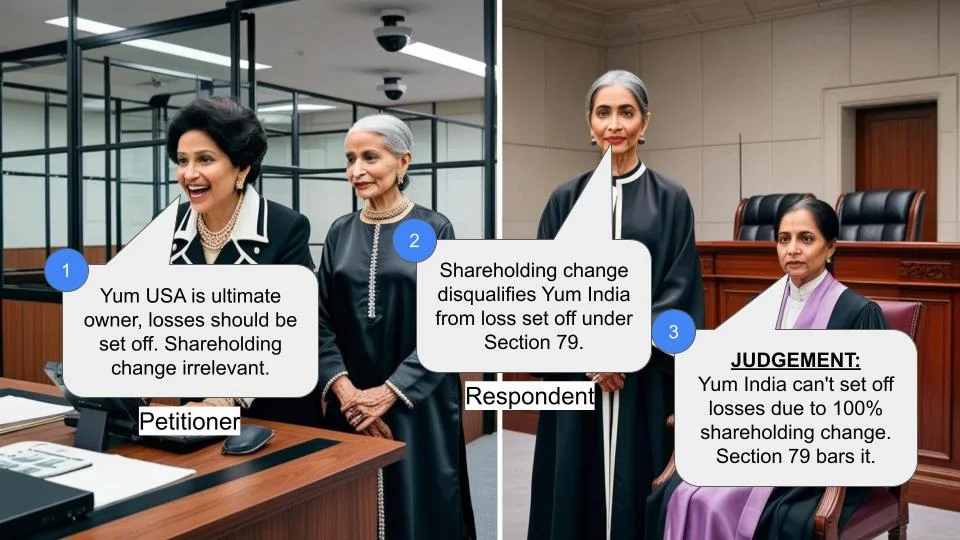
 The document discusses a case where a company operating as a franchisee claims exemption from tax liability based on the doctrine of mutuality. It argues that the surplus funds left after operations for a given year are subject to the approval of the Board of Directors and are not an entitlement or right of the franchisees. This point is contested, as it is understood that any surplus should reduce the burden of contribution for the franchisees in the subsequent year, which is not the case here.
The document further examines a Tripartite Agreement, stating that the parent company (YRIPL) could potentially profit from the surplus funds, which contradicts the principle of mutuality. It notes that the parent company does not contribute to the common pool, yet profits from the franchisees' contributions, which is seen as a violation of the essence of mutuality.
The document also notes that the company has no specific obligation to use the contributions for the benefit of the franchisees, as per clause 8.1 of the Tripartite Agreement. It is argued that this violates the fundamental principles of a mutual concern.
The argument that YRIPL does not need to contribute because it doesn't operate any restaurants directly is dismissed, as it receives a fixed percentage of royalties from the franchisees' sales.
The document concludes that the company has failed to prove its operations are based on mutuality and thus is not exempt from tax liability. It also allows the company to pursue a rectification application, which is currently pending before the Tribunal.
The document discusses a case where a company operating as a franchisee claims exemption from tax liability based on the doctrine of mutuality. It argues that the surplus funds left after operations for a given year are subject to the approval of the Board of Directors and are not an entitlement or right of the franchisees. This point is contested, as it is understood that any surplus should reduce the burden of contribution for the franchisees in the subsequent year, which is not the case here.
The document further examines a Tripartite Agreement, stating that the parent company (YRIPL) could potentially profit from the surplus funds, which contradicts the principle of mutuality. It notes that the parent company does not contribute to the common pool, yet profits from the franchisees' contributions, which is seen as a violation of the essence of mutuality.
The document also notes that the company has no specific obligation to use the contributions for the benefit of the franchisees, as per clause 8.1 of the Tripartite Agreement. It is argued that this violates the fundamental principles of a mutual concern.
The argument that YRIPL does not need to contribute because it doesn't operate any restaurants directly is dismissed, as it receives a fixed percentage of royalties from the franchisees' sales.
The document concludes that the company has failed to prove its operations are based on mutuality and thus is not exempt from tax liability. It also allows the company to pursue a rectification application, which is currently pending before the Tribunal.


This case pertains to an appeal involving the concept of "mutuality" in relation to Yum! Restaurants (Marketing) Private Limited (YRMPL), a fully owned subsidiary of Yum! Restaurants (India) Pvt. Ltd. (YRIPL). YRMPL was created for the purpose of Advertising, Marketing and Promotion (AMP activities) on behalf of YRIPL and its franchisees.
The controversy is around the taxability of Rs. 44,44,002/-, being the excess of income over expenditure for the Assessment Year 200102, which was decided in favor of the Revenue by the High Court of Delhi. The Assessing Officer, Commissioner of Income Tax (Appeals), and the Income Tax Appellate Tribunal all refused to recognize YRMPL as a mutual concern, and thus denied any exemption from taxability.
YRMPL was incorporated by YRIPL after receiving approval from the Secretariat for Industrial Assistance (SIA) to economize the cost of advertising and promotion for the franchisees. According to the approval, YRMPL was supposed to operate on a non-profit basis, following the principles of mutuality.
However, in the assessment year under consideration, YRMPL filed its returns stating the income to be "Nil" under the pretext of the mutual character of the company. This claim was not accepted by the Assessing Officer, who noted that YRIPL was under no legal obligation to pay any amount of contribution to YRMPL.
The imposition of liability by the Assessing Officer was upheld by the C.I.T. (A), who found commerciality in the activities undertaken by YRMPL. The Tribunal further confirmed the liability, finding that the essential ingredients of the doctrine of mutuality were missing. In particular, it noted that contributions were also received from entities like Pepsi Foods Ltd. and YRIPL, who were neither beneficiaries nor had a right to receive the surplus.
This decision was affirmed by the High Court, thereby continuing to refuse the recognition of YRMPL as a mutual concern and denying any tax exemption.
This legal document pertains to a case where the principle of mutuality, which states that a man cannot do business with himself and any excess of income over expenditure isn't taxable, is scrutinized. The case in question involves a company, identified as the assessee, which argues that it operates on a no-profit basis, only for the benefit of its contributors. However, authorities question this principle's application in this case due to the presence of commercial elements and the involvement of contributors, such as Pepsi Food Ltd and parent company YRIPL, who aren't obligated to contribute and don't directly benefit from the company's activities.
The case raises two legal questions: whether the assessee company qualifies as a mutual concern, and whether the excess of income over expenditure in the company is not taxable.
The assessee argues that the principle of mutuality merely requires an identity between contributors and beneficiaries, and does not necessitate that each member should contribute to the common fund or derive benefits in the same manner or to the same extent.
On the other hand, the respondent contends that once a non-member contributes to the common fund created for the benefit of contributors, commerciality begins, and mutuality ceases.
The judgement delves into the origins and specifics of the doctrine of mutuality, such as the condition of identity between contributors and recipients, the treatment of the company as a mere entity for the convenience of members, and the impossibility of contributors deriving profits from their own contributions. The court agrees to examine these conditions in the context of the case at hand.
The judgement underscores the requirement of common and complete identity between the contributors and participators for the principle of mutuality to hold. Any external commercial intervention in the transaction could defeat the concept of conducting business with oneself and make any profits or gains accruable under tax liability.
In this legal case, Pepsi Foods Ltd. contributes to a common fund but is not considered a beneficiary because it is not a member of the mutual concern as per the Tripartite Agreement and the terms of SIA approval. This agreement permits only 'franchisees' to become members, and Pepsi Foods Ltd. is not a franchisee, therefore it cannot participate in the surplus or receive back the surplus.
The Tripartite Agreement requires the assessee company to establish a separate Brand Fund for each franchisee. However, no Brand Fund has been created for Pepsi Foods Ltd., meaning it cannot be a part of the mutual arrangement or qualify as a beneficiary. The definition clause of the Tripartite Agreement stipulates that for any amount received by the assessee company to be treated as an advertising contribution, it must be paid by a franchisee as part of a pre-existing franchise agreement. In this case, there is no such agreement between Tricon or TRIM and Pepsi Foods Ltd., and therefore, the amounts received from Pepsi Foods Ltd. cannot be viewed as advertising contributions.
The court highlights that the assessee company is collecting money from both members and non-members, violating the principle of mutuality. The company's claim that Pepsi Foods Ltd. benefits from the mutual operations due to its exclusive contracts with the franchisees is dismissed because the fundamental principle of mutuality is missing. Even if Pepsi Foods Ltd. does gain any indirect benefits, it cannot be attributed to its membership in the mutual concern, thus breaking the chain of mutuality.
Despite the failure of the first test, the court decides to examine the other two conditions for the existence of mutuality, namely impossibility of profits and obedience to the mandate. The court finds that Pepsi Foods Ltd.'s contributions contravene these principles, tainting the operations of the assessee company with commerciality.
The court also scrutinizes the actual functional framework of the assessee company, finding that YRIPL and the franchisees are under different obligations. Contrary to the terms of SIA approval, the Tripartite Agreement allows YRIPL discretion in contributing to the common pool, thus violating the essence of a mutual concern. The court affirms that in a mutual concern, all members must have mutual control without the risk of prejudicial power by one member over the others. An arrangement where one member has absolute discretion over others, in terms of both contribution and management, is contrary to the concept of mutuality.
The court rejects the appellant's argument that not every member of the mutual concern needs to contribute to the common pool, stating that there is a crucial difference between the absence of obligation and the presence of overriding discretion, the latter of which cannot be sustained in a mutual concern.
Finally, the court notes that in a mutual concern, contributors to the common fund should either acquire a right to participate in the surplus or an entitlement to get back their respective contributions. In the current scenario, the Tripartite Agreement provides for the retention or refund of any surplus left in the Brand Funds, but this is subject to the approval of its Board of Directors.
In this legal case, the central issue is whether a particular company, named the assessee, should be exempt from certain tax liabilities due to its status as a mutual concern. The company operates under a franchise model, collecting contributions from franchisees to a common pool, which is then used for advertising, marketing, and promotional activities.
Despite this setup, several clauses in their tripartite agreement are found to violate the principles of mutuality, making the company ineligible for the tax exemption. For instance, franchisees don't have the right to claim a refund of their contributions. Also, any surplus from the contributions may not reduce the franchisees' liabilities in the following year, and the parent company (YRIPL) could potentially benefit from these surplus funds. This is against the third test of mutuality, which requires that operations should not produce profits.
The company further violates the principle of mutuality by having no obligation to spend the contributions specifically for the benefit of the franchisees. Additionally, the company was established to manage the business on behalf of the parent company, YRIPL, further reinforcing the non-mutual nature of the company.
The court also refutes the company's comparison of its operations to those of social clubs, stating that the company's commercial activities, contributions from non-members, and the unequal power dynamics between the parent company and franchisees make the comparison unsuitable.
As for the claim that the company was acting under a trust for the contributors, the court points out that the company's obligation to use the contributions for marketing activities only applies after the income has already reached the company. This, according to legal precedents, makes the contributions taxable.
Finally, the court allows the company to pursue a rectification application regarding the question of diversion by overriding title. This decision doesn't express any opinion on the viability of such an application, leaving it open for further examination. The court upholds the original judgment that the company should not be exempt from the tax liabilities.

1. The moot question involved in the present appeal bears
upon the applicability of the doctrine of mutuality qua the
assessee company, a fully owned subsidiary of Yum! Restaurants
(India) Pvt. Ltd. (for short, “YRIPL”), formerly known as Tricon
Restaurants India Pvt. Ltd., incorporated for undertaking the
activities relating to Advertising, Marketing and Promotion (for
short, “AMP activities”) for and on behalf of YRIPL and its
franchisees.
2. This appeal assails the final judgment and order dated
1.4.2009 passed by the High Court of Delhi at New Delhi (for
short, “the High Court”) in I.T.A. No. 1433 of 2008 wherein the
question of taxability of Rs. 44,44,002/ (Rupees forty four lakhs
forty four thousand two only), being the excess of income over
expenditure for the Assessment Year 200102, was settled in
favour of the Revenue and against the assessee, thereby
confirming the orders of the Income Tax Appellate Tribunal (for
short, “the Tribunal”), Commissioner of Income Tax (Appeals) [for
short, the “CIT(A)”] and the Assessing Officer. The preceding
forums, without any exception, have returned consistent verdicts
refusing to acknowledge the assessee company as a mutual
concern and denying any exemption from taxability.
3. The appellant company Yum! Restaurants (Marketing)
Private Limited (for short, “YRMPL” or “assessee company” or
“assessee”) was incorporated by YRIPL as its fully owned
subsidiary after having obtained approval from the Secretariat for
Industrial Assistance (for short “SIA”) for the purpose of
economisation of the cost of advertising and promotion of the
franchisees as per their needs. The approval was granted subject
to certain conditions as regards the functioning of assessee,
whereby it was obligated to operate on a nonprofit basis on the
principles of mutuality. The relevant clauses of the approval
granted by the SIA for the aforementioned operations read thus:
“3.It is noted that the broad framework within which
such subsidiary shall be managed and operated in India
is as follows:
The franchises and Tricon India will both make
contribution of a fixed percentage of their respective
revenues (net of taxes) to the proposed New Company
on regular basis;
The proposed New Company would be a non-profit
enterprise governed by the principles of mutuality. No
part of the contributions or other income shall enure
to the benefit of any individual contributor;
The contributors will be optimally used by the
proposed new Company to economise the cost of
advertising and promotion cater to the specific needs
of franchisees to concentrate on restaurant operations
and management;
The management of the proposed New Company
shall vest with Tricon India and application of
contributions will be decided by Tricon India in
consultation with the franchisee;
The approval is subject to the condition that the step
down subsidiary would be a nonprofit enterprise and
would not be allowed to repatriate dividends.”
4. In furtherance of the approval, the assessee entered into a
Tripartite Operating Agreement (for short, the “Tripartite
Agreement”) with YRIPL and its franchisees, wherein the assessee
company received fixed contributions to the extent of 5 per cent
of gross sales for the proper conduct of the advertising,
marketing and promotional activities for the mutual benefit of the
parent company and the franchisees. The terms of the Tripartite
Agreement, to the extent relevant for the consideration of the
present case, are produced thus:
“2.2 TRIM will establish and operate Brand Funds in
respect of each Brand for the purpose of allocating and
using the Advertising Contribution received from
franchisee and other franchisee of Tricon operating
Restaurants under the Brands. TRIM will allocate the
advertising contribution received from the Franchisees
including Franchisee for each Restaurant to the
respective Brand funds established for that brand. It is
agreed between the Parties that the advertising
contribution paid into a brand fund will be used for the
AMP Activities relating to that brand.
3. FRANCHISEE ADVERTISING CONTRIBUTIONS
3.1 As and from the Effect Date, Franchisee will pay
the Advertising Contribution of 5% of Revenues for a
particular month into the Bank account of the Brand
Fund established by TRIM by the 10th day of the
following month. Details of the bank account, of each
Brand Fund set up by TRIM will notified to Franchisee by
TRIM from time to time. Notwithstanding the aforesaid,
the executive committee of any Brand (constituted under
Article 7 of this Agreement) may, by a three fourth
majority, which shall be binding on all franchisees of
Tricon including the Franchisee, require the franchisee to
pay the advertising Contribution in advance. For the
avoidance of doubt it is clarified and agreed that while
recommending advance payment of Advertising
Contribution the chairman will not have a casting vote.
Franchise will spend an additional 1% of Revenues, in the
manner directed by Tricon and/or TRIM in writing from
time to time, on such local store marketing, advertising,
promotional and research expenditure proposed by
Franchisee and approved in advance by Tricon and/or
TRIM during the relevant Accounting Period, in
accordance with the requirements and guidelines set out
in the Manuals, provided that if Franchisee fails to spend
the full amount as directed by Tricon and/or TRIM
franchisee will pay the unspent amount to TRIM within
the period specified in a written demand from TRIM. Upon
receipt of the unspent amount TRIM will spend the
amount on regional and/or national advertising,
promotions or research expenditure conducted by TRIM
in its discretion.
4.1 Tricon may at the request of TRIM, but
subject to Tricon’s sole and absolute discretion pay to
TRIM any such amount(s) as it may deem appropriate
to support the AMP [sic] activities during any
Accounting Period for the avoidance of doubt, it is
clarified and agreed between the Parties that Tricon
shall have no obligation to pay any such amounts if it
chooses not to do so.
8.4 In the event there is any surplus left over in any
of the Brand Funds at the end of an accounting period,
TRIM shall be entitled to retain the surplus to be spent on
AMP activities during the following accounting period.
Alternatively, TRIM may, subject to the approval of its
Board of Directors refund the surplus amounts to the
franchisees including Franchisee in the same proportion
as the actual advertising contribution made by each
franchisee including franchisee in that accounting period.
On the other hand, if there is a deficit in any of the brand
funds at the end of an accounting period, the deficit will
be carried forward to the next accounting period and be
met out of the advertising contribution paid by the
franchisees including franchisee for that accounting
period. For the avoidance of doubt, it is agreed between
the parties that Tricon and/or TRIM shall not be obliged
to fund the deficit.
8.5 It is clearly understood and agreed between the
parties that the only objective of TRIM is to coordinate the
marketing activities of the brands including the mutual
benefit of the franchisees including the Franchisee. It is
envisaged that no profits will be earned and no dividends
will be declared by TRIM.”
(emphasis supplied)
5. For the Assessment Year under consideration, the assessee
filed its returns stating the income to be “Nil” under the pretext of
the mutual character of the company. The same was not
accepted by the Assessing Officer, who observed thus:
“VI.7.3 As per the SIA letter dated 05.10.1998 Assessee
Company along with the franchisees were to contribute a
fix percentage of its revenue to YRMPL. However as per
clause 4.1 of Tripartite operating agreement submitted by
YRMPL, the assessee company had its sole absolute
discretion to pay to YRMPL any amount as it may deem
appropriate and that YRIPL shall have no obligation to
pay any such amounts if it chooses not to do so. This
clearly shows that YRIPL was under no legal obligation to
pay any amount of contribution as per its own version
reflected from tripartite agreement.”
6. The imposition of liability by the Assessing Officer was
upheld by the C.I.T. (A) on the ground of taint of commerciality in
the activities undertaken by the assessee company, wherein it
was observed thus:
“1.14.The AMP activity is quite a critical component of
running a successful business venture, it is intrinsically
linked to sales and profit of the franchisees the
contributors. Accordingly it cannot be said that such
activity is immune from the taint of commerciality. Unlike
in the cases of a club, the appellant Co. is not existing for
any social inter course nor is it for cultural activities
where the idea of profit or trade does not exist. What is
essential is that there should not be any dealing with
outside body which results in a benefit which promotes
some commercial/business venture. There should not be
any profit earning motive in any transaction directly or
indirectly. In fact in the appellant’s case the essence of
mutuality also appears to be missing in that there is no
instance or scope of say trading between persons
associating together. Thus though the form taken up to
conduct its revenue activity undoubtedly resemble a
mutual concern but the contributions made on the other
hand are undeniably for business considerations. In my
opinion, taking an overall view of the intent and motive of
the appellant company to form a ‘mutual concern’ it can
be concluded that the underlying purpose was solely for
commercial consideration. Therefore in view of the above
as demonstrated by the appellant Co. the excess of
receipts over the expenditure i.e. the surplus in my
opinion would be income liable to tax....”
7. The liability was further confirmed by the Tribunal, wherein
the essential ingredients of the doctrine of mutuality were found
to be missing. It observed thus:
“11. Firstly the Government order sanctioning setting
up of the wholly owned subsidiary prescribes that the
approval is subject to the condition that such subsidiary
would be a non-profit enterprise and is also not entitled
to repatriate dividends. The main object of the assessee
company reveals that it is to carry out advertising,
marketing and promotion for brands owned by its parent
company. The main plank of the assessee’s arguments is
that the principles of mutuality will apply and hence the
income cannot be taxed. Time and again various courts
have held that where there is complete identity between
the contributors and the participators or the
beneficiaries, only then such principles can be applied.
However, in the present case it is seen that apart
from contributions is also received from M/s Pepsi
Foods Ltd. and YRIPL. Pepsi Foods Ltd. is neither a
franchisee nor a beneficiary. Similarly some
contribution is also received from YRIPL which YRIPL
is not under any obligation to pay. Thus it can be said
that essential requirement that of the contributors to
the common fund are either to participate in the
surplus or they are beneficiaries of the contribution is
missing. Through the common AMP activities no
benefit accrues to Pepsi Food Ltd. or YRIPL.
Accordingly the principles of mutuality cannot be
applied. It is a different facts that the assessee was
established with the object not to make profit but it is
also a fact that there is a surplus in the hands of the
assessee which arose due to contribution from certain
persons who were neither the benficiaries nor have right
to receive the surplus....”
(emphasis supplied)
8. The consistent line of opinion recorded by the
aforementioned three forums was further approved in appeal by
the High Court vide impugned judgment, by observing thus:
“8. The principle of mutuality as enunciated by the
Courts in various cases is applicable to a situation where
the income of the mutual concern is the contributions
received from its contributors. The expenses incurred by
the mutual concerns are incurred from such
contributions and hence on the principle that no man can
do business with himself, the excess of income over
expenditure is not amenable to tax. However, in the
present case the authorities below have returned a
finding of fact that the fund as contributors such as Pepsi
Food Ltd which do not benefit from the APM Activities.
Moreover, the principle of mutuality is applicable to those
entities whose activities are not tinged with commercial
purpose. As a matter of fact in the instant case the parent
company i.e., YRIPL which has also contributed to the
brand fund is under the agreement under no obligation to
do so. The contributions of YRIPL are at its own
discretion. Thus, looking at the facts obtaining in the
present case, it is quite clear that the principle of
mutuality would not be applicable to the instant case....”
9. On cogitating over the rival submissions, we reckon that the
following questions of law would arise for our consideration in the
present case:
(i) Whether the assessee company would qualify as a
mutual concern in the eyes of law, thereby exempting
subject transactions from tax liability?
(ii) Whether the excess of income over expenditure in the
hands of the assessee company is not taxable?
10. The appellant/assessee has contended that the sole
objective of the assessee company was to carry on the earmarked
activities on a noprofit basis and to operate strictly for the
benefit of the contributors to the mutual concern. It has further
been contended that the assessee company levies no charge on
the franchisees for carrying out the operations. While assailing
the observations made in the impugned judgment, holding that
Pepsi Foods Ltd. and YRIPL are not beneficiaries of the concern,
the assessee company has urged that YRIPL is the parent
company of the assessee and earns fixed percentage from the
franchisees by way of royalty. Therefore, it benefits directly from
enhanced sales as increased sales would translate into increased
royalties. A similar argument has been advanced as regards Pepsi
Foods Ltd. It is stated that under a marketing agreement, the
franchisees are bound to serve Pepsi drinks at their outlets and
thus, an increase in the sales at KFC and Pizza Hut outlets as a
result of AMP activities would lead to a corresponding increase in
the sales of Pepsi. To add weight to this argument, it has been
brought to our notice that Pepsi was also advertised by the
franchisees in their advertising and promotional material, along
with Pizza Hut and KFC, and copy of the said material has been
placed on record.
11. As regards the doctrine of mutuality, it is urged by the
assessee company that the doctrine merely requires an identity
between the contributors and beneficiaries and it does not
contemplate that each member should contribute to the common
fund or that the benefits must be derived by the beneficiaries in
the same manner or to the same extent. Reliance has been placed
by the appellant upon reported decisions to draw a parallel
between the functioning of the assessee company and clubs to
support the presence of mutuality.
12. The Revenue/respondent has countered the submissions
made by the assessee company by submitting that the moment a
nonmember joins the common pool of funds created for the
benefit of the contributors, the taint of commerciality begins and
mutuality ceases to exist in the eyes of law. It has been
submitted that the assessee company operated in contravention
of the SIA approval as contributions were received from Pepsi,
despite it not being a member of the brand fund. To buttress this
submission, it is urged that once the basic purpose of benefiting
the actual contributors is lost, mutuality stands wiped out.
13. We have heard Mr. Balbir Singh, learned senior counsel for
the appellant and Mr. V. Shekhar, learned senior counsel for the
respondent.
Re: Question (i):
14. The doctrine of mutuality traces its origin from the basic
principle that a man cannot engage into a business with himself.
For that reason, it is deemed in law that if the identity of the
seller and the buyer; or the vendor and the consumer; or the
contributor and the participator is marked by oneness, then a
profit motive cannot be attached to such a venture. Thus, for the
lack of a profit motive, the excess of income over the expenditure
or the “surplus” remaining in the hands of such a venture cannot
be regarded as “income” taxable under the Income Tax Act, 1961
(for short, “the 1961 Act”). What is taxable under the 1961 Act is
“income” or “profits” or “gains” as they accrue to a person in his
dealings with other party or parties that do not share the same
identity with the assessee. For income, there is an underlying
exchange of a commercial nature between two different entities.
In Commissioner of Income Tax, Bihar v. Bankipur Club
Ltd., this court observed on the nature of liability under the
1961 Act thus:
“6. Under the Income Tax Act (hereinafter referred to
as “the Act”) what is taxed is, the "income, profits or gains
earned or "arising", "accruing" to a person". The question
is whether in the case of members’ clubs a species of
mutual undertaking in rendering various services to its
members which result in a surplus, the club can be said
to "have earned income or profits" In order to answer the
question, it is necessary to have a background of the law
relating to "mutual trading" or "mutual undertaking" and
a "members club".”
15. The law regarding the tenets of mutuality is no more res
integra. It has been settled in a catena of judicial
pronouncements and academic works across multiple
jurisdictions. In Bangalore Club v. Commissioner of Income
Tax & Anr., this Court authoritatively quoted one of the earliest
judicial pronouncements in New York Life Insurance Co. v.
Styles (Surveyor of Taxes) thus:
“When a number of individuals agree to contribute funds
for a common purpose. . . and stipulate that their
contributions, so far as not required for that purpose,
shall be repaid to them. I cannot conceive why they
should be regarded as traders, or why contributions
returned to them should be regarded as profits.”
The proposition of law is restated in Bankipur Club (supra) and
Bangalore Club (supra) by placing reliance upon the following
extract from Simon’s Taxes:
“... it is settled law that if the persons carrying on a trade
do so in such a way that they and the customers are the
same persons, no profits or gains are yielded by the trade
for tax purposes and therefore no assessment in respect
of the trade can be made. Any surplus resulting from this
form of trading represents only the extent to which the
contributions of the participators have proved to be in
excess of requirements. Such a surplus is regarded as
their own money and returnable to them. In order that
this exempting element of mutuality should exist it is
essential that the profits should be capable of coming
back at some time and in some form to the persons to
whom the goods were sold or the services rendered..."
16. In order to undertake the examination of mutuality, we
gainfully advert to The English and Scottish Joint Co-
operative Wholesale Society Ltd. v. Commissioner of
Agricultural IncomeTax, Assam, which has been quoted with
approval by this Court in Commissioner of Income Tax,
Bombay City v. Royal Western India Turf Club Ltd.6
and Bangalore Club (supra). The aforestated stream of judicial
pronouncements expound three conditions/tests to prove the
existence of mutuality:
4 Simon’s Taxes, Volume B, 3rd Edition, Pgs. 159, 167
(i) Identity of the contributors to the fund and the
recipients from the fund;
(ii) Treatment of the company, though incorporated as a
mere entity for the convenience of the members and policy
holders, in other words, as an instrument obedient to their
mandate, and;
(iii) Impossibility that contributors should derive profits
from contributions made by themselves to a fund which
could only be expended or returned to themselves.
Whereas the legal position on what amounts to a mutual concern
stands fairly settled, the factual determination of the same on a
case to case basis poses a complex issue that requires deeper
examination. Such examination ought to be conducted in the
light of the tests enunciated above.
Common Identity
17. The first element involves the test of commonality of identity
between the members or participators in the mutual concern and
the beneficiaries thereof. Succinctly put, this limb of the three-
pronged test requires that no person ought to contribute to the
common fund without having the entitlement to participate as a
beneficiary in the surplus thereof. Conversely, no person ought
to participate as a beneficiary without first having been a
contributor or a member of the class of contributors to the
common fund. Common identity, as it occurs in the present
context, signifies that the class of members should stay intact as
the transaction progresses from the stage of contributions to that
of returns/surplus. It must manifest uniformity in the class of
participants in the transaction. The moment such a transaction
opens itself to nonmembers, either in the contribution or the
surplus, the uniformity of identity is impaired and the
transaction assumes the taint of a commercial transaction. The
emphasis on the words member and nonmember is of import
because the doctrine of mutuality does not prohibit the inclusion
or exclusion of new members. What is prohibited is the infusion
of a participant in the transaction who does not become a
‘member’ of the common fund, at par with other members, and
yet participates either in the contribution or surplus without
subjecting itself to mutual rights and obligations. The principle of
common identity prohibits any onedimensional alteration in the
nature of participation in the mutual fund as the transaction
fructifies. Any such alteration would lead to the nonuniform
participation of an external element or entity in the transaction,
thereby opening the scope for a manifest or latent profitbased
dealing in the transaction with parties outside the closed circuit
of members. It would be amenable to income tax as per Section
2(24) of the 1961 Act.
Completeness of Identity
18. Coterminous with the requirement of common identity, as
discussed above, the law also contemplates a completeness of
identity between the contributors and participators. The theory of
completeness of identity presupposes the contributors and
participators to be two separate classes, but there is oneness or
equality in the matter of sharing of surplus/profits. This is to
ensure that there is no interference of any alien commercial
entity in the transaction. With the interference of any alien entity,
the idea of conducting business with oneself is defeated and any
profits or gains accruing therefrom become subject to tax
liability. This proposition of law is succinctly predicated in
British Tax Encyclopaedia, which reads thus:
“.For this doctrine to apply it is essential that all the
contributors to the common fund are entitled to
participate in the surplus and that all the participators in
the surplus are contributors, so that there is complete
identity between contributors and participators. This
means identity as a class, so that at any given moment of
time the persons who are contributing are identical with
the persons entitled to participate; it does not matter that
the class may be diminished by persons going out of the
scheme or increased by others coming in”
It is pertinent to note that in order to determine the breach in
mutuality, the court is well within its powers to go beyond the
periphery of the concern and undertake an examination akin to
the lifting of the veil in order to discern the real nature thereof.
19. In the present case, it is indisputable that Pepsi Foods Ltd.
is a contributor to the common pool of funds. However, it does
not participate in the surplus as a beneficiary for at least two
reasons first, Pepsi is not a member of the purported mutual
concern as the Tripartite Agreement as well as the terms of SIA
approval permit only ‘franchisees’ to become members of the
mutual concern. Notably, Pepsi Foods Ltd. is not a franchisee
and thus, it cannot participate in the surplus. Second, Pepsi does
not enjoy any right of participation in the surplus or any right to
receive back the surplus which are mandatory ingredients to
sustain the principle of mutuality.
20. We find it noteworthy that the Tripartite Agreement requires
the assessee company to constitute a separate Brand Fund for
each franchisee as stated in clause 2.2 of the said agreement,
which reads thus:
“2.2 TRIM will establish and operate Brand Funds in
respect of each Brand, for the purpose of allocating and
using the Advertising Contribution received from
franchisee and other franchisee of Tricon operating
Restaurants under the Brands TRIM will allocate the
advertising contribution received from the franchisees
including Franchisee for each Restaurant to the Parties
that the Advertising Contribution paid into a Brand Fund
will be used for the AMP Activities relating to that Brand.”
(emphasis supplied)
Since no Brand Fund, as contemplated above, has been
constituted for Pepsi Foods Ltd., it does not become a part of the
purported Tripartite mutual arrangement so as to qualify as a
beneficiary of the mutual operations. The definition clause of the
Tripartite Agreement adds weight to this finding. “Advertising
Contribution”, as defined in the definition clause means,
“the advertising contributions which Franchisee has
agreed to pay to Tricon pursuant to [sic] the Franchisee
Agreements.”
Furthermore, “Franchise Agreements”, as defined in the
definition clause, means agreements executed between Tricon
and Franchisee. As a corollary, what follows is that for any
amount received by the assessee company to be treated as an
advertising contribution, it must be paid by a franchisee, that too
in the aftermath of a prior franchisee agreement to that effect. In
the light of the prevailing relationship, there is no such
franchisee agreement between Tricon or TRIM and Pepsi Foods
Ltd. and therefore, the amounts received from Pepsi Foods Ltd.
cannot be viewed as advertising contributions “from a member of
the mutual undertaking” as such.
21. In the present case, therefore, the assessee company is
realising money both from the members as well as nonmembers
in the course of the same activity carried on by it. This court, in
Royal Western India Turf Club Ltd. (supra) has categorically
held such operations to be antithetical to mutuality. We deem it
apposite to take note of the dictum in Bankipur Club (supra),
wherein this principle has been restated thus:
“22. if the object of the assessee company claiming to
be a “mutual concern” or “club”, is to carry on a
particular business and the money is realised both from
the members and from nonmembers, for the same
consideration by giving the same or similar facilities to all
alike in respect of the one and the same business carried
on by it, the dealings as a whole disclose the same profit-
earning motive and are alike tainted with commerciality...
and the resultant surplus is profitincome liable to tax...”
22. The contention of the assessee company that Pepsi Foods
Ltd., in fact, does benefit from the mutual operations by virtue of
its exclusive contracts with the franchisees is tenuous, as the
very basis of mutuality is missing as far as Pepsi Foods Ltd. is
concerned, as discussed hitherto. Even if any remote or indirect
benefit is being reaped by Pepsi Foods Ltd., the same cannot be
said to be in lieu of it being a member of the purported mutual
concern and therefore, cannot be used to fill the missing links in
the chain of mutuality. Concededly, the surplus of a mutual
operation is meant to be utilised by the members of the mutual
concern as members enjoy a proximate connection with the
mutual operation. Nonmembers, including Pepsi Foods Ltd.,
stand on a different footing and have no proximate connection
with the affairs of the mutual concern. The exclusive contract
between the franchisees and Pepsi Foods Ltd. stands on an
independent footing and YRIPL as well as the assessee company
are not responsible for implementation of this contract.
Resultantly, the first limb of the threepronged test stands
severed.
Non-profiteering and Obedience to Mandate
23. Whereas the doctrine of mutuality stands debunked with
the failure of the first test, let us, nonetheless, examine the other
two tests in the present factual scenario. Indubitably, the receipt
of money from an outside entity without affording it the right to
have a share in the surplus does not only subjugate the first test
of common identity, but also contravenes the other two
conditions for the existence of mutuality i.e. impossibility of
profits and obedience to the mandate. The mandate of the
assessee company was laid down in the SIA approval wherein the
twin conditions of mutuality and nonprofiteering were
envisioned as the sine qua non for the functioning of the assessee
company. The contributions made by Pepsi Foods Ltd. tainted the
operations of the assessee company with commerciality and
concomitantly contravened the prerequisites of mutuality and
non-profiteering.
24. The mutuality and nonprofiteering character of a concern
are to be determined in light of its actual working structure and
the factum of corporation or incorporation or the form in which it
is clothed is immaterial. It is, therefore, imperative to examine
the actual functional framework of the assessee company in light
of the status of YRIPL (parent company) visavis other
members/franchisees. As per the terms of the SIA approval,
YRIPL and franchisees were equally obligated to make
contribution of a fixed percentage to the assessee company. This
requirement was incorporated as a precondition for the grant of
permission to operate as a mutual concern. Clause 3 of the
approval letter reads thus:
“The franchises and Tricon Indian will both make
contribution of a fixed percentage of their respective
revenues (net of taxes) to the proposed New Company on
regular basis:”
However, drifting from this mandate, the Tripartite Agreement
made it discretionary upon YRIPL to contribute to the common
pool, thereby putting it at a higher pedestal than the franchisees.
Clause 4.1 of the Tripartite Agreement reads thus:
“4.1 Tricon may at the request of TRIM, but subject to Tricon sole and absolute discretion pay to TRIM any such amount(s) as it may deem appropriate to support the VVIP activities during the Accounting Period for the avoidance of doubt, it is clarified and agreed between the Parties that Tricon shall have no obligation to pay any such amounts if it chooses not to do so.”
(emphasis supplied)
Thus, clause 4.1 is not in confirmity with the terms of approval. Furthermore, it is noteworthy that the management of the assessee company was under full and absolute control of its parent company YRIPL. Be it also noted that the participation of the franchisees in the management of the assessee company was again subject to approval by YRIPL, which falls within its sole discretion. Clause 7.1 of the Tripartite Agreement reads thus:
“7.1 The management and operations of TRIM will be carried out by its Board of Directors in accordance with the Articles of Association of TRIM, the terms of which shall be read as a part of this Agreement. The Board of Directors of TRIM will be nominated by Tricon from time to time in accordance with the Articles of Association of TRIM. The Board of Directors of TRIM shall consist of a minimum number of five directors. Out of the five directors Tricon may, in its absolute and sole discretion, nominate one representative each of two franchisees (to be selected by Tricon on a rational basis) to be appointed as directors on the Board of Directors of TRIM such nominees to hold office for a period of one year from the date of their appointment. In the event the representative of the Franchisee is nominated to the Board of Directors of TRIM. Franchisee agrees and undertakes to cause such representative to (i) accept such appointment as and when the same is made; and (ii) to resign from the post of Director on the expiry of one year from the date of appointment or earlier, if so requested by Tricon.”
(emphasis supplied)
25. The net effect of the aforequoted clauses is to render the preconditions for the grant of approval, as otiose. It also becomes amply clear that YRIPL and the franchisees stand on two substantially different footings. For, the franchisees are obligated to contribute a fixed percentage for the conduct of AMP activities whereas YRIPL is under no such obligation in utter violation of the terms of SIA approval. Moreover, even upon request for the grant of funds by the assessee company, YRIPL is not bound to accede to the request and enjoys a “sole and absolute” discretion to decide against such request. That members of a financial concern exercise mutual control over its management without the scope of prejudicial exercise of power by one class of members over the others is the quintessence for the existence of a mutual concern. The word “mutual” offers guidance to this effect. Literally understood, the word “mutual” points towards reciprocity and a mutual arrangement is one in which the members/parties have reciprocal rights or understanding or arrangement. An arrangement wherein one member is subjected to the absolute discretion of another, in such a manner that the entire liability may fall upon one whereas benefits are reaped by all, is antithesis to the mutual character in the eyes of law.
26. The contention advanced by the appellant that it is not mandatory for every member of the mutual concern to contribute to the common pool fails to advance the case of the appellant. It is no doubt true that every member of the mutual concern might not be required to contribute to the common pool at all times. However, it does not mean that one member cannot be made to contribute under any pretext whatsoever. For, that would amount to the grant of an overriding position to a member in the mutual agreement, extending upto even overruling the requests for contribution from other members for mutual necessity. It is this allpervasive overriding position of one member over the others that negates the effect of mutuality. There is a fine line of distinction between absence of obligation and presence of overriding discretion. In the present case, YRIPL enjoys the latter at the detriment of the franchisees of the purported undertaking, both in matters of contribution and management. In a mutual concern, it is no doubt true that an obligation to pay may or may not be there, but in the same breath, it is equally true that an overriding discretion of one member over others cannot be sustained, in order to preserve the real essence of mutuality wherein members contribute for the mutual benefit of all and not of one at the cost of others.
27. More importantly, an examination of the judicial decisions relied upon by the parties brings out the settled legal position that in order to qualify as a mutual concern, the contributors to the common fund either acquire a right to participate in the surplus or an entitlement to get back the remaining proportion of their respective contributions. In the present scheme of things, clause 8.4 provides that,
“8.4 In the event there is any surplus left over in any of the Brand Funds at the end of an Accounting Period. TRIM shall be entitled to retain the surplus to be spent on AMP activities during the following Accounting Period. Alternatively, TRIM may, subject to the approval of its Board of Directors, refund the surplus amounts to the franchisees including Franchisee in the same proportion as the actual Advertising Contribution made by each franchisee including Franchisee in that Accounting Period.”
(emphasis supplied)
28. Contrary to the abovestated legal position, clause 8.4 makes it clear that the franchisees do not enjoy any “entitlement” or “right” on the surplus remaining after the operations have been carried out for a given assessment year. The clause provides that the assessee company may refund the surplus subject to the approval of its Board of Directors. It implies that the franchisees/contributors cannot claim a refund of their remaining amount as a matter of right. Be it noted that the raison d’etre behind the refund of surplus to the contributors or mandatory utilisation of the same in the subsequent assessment year is to reduce their burden of contribution in the next year proportionate to the surplus remaining from the previous year.
Thus, the fulfilment of this condition becomes essential. In the present case, even if any surplus is remaining in a given assessment year, it is unlikely to reduce the liability of the franchisees in the following year as their liability to the extent of 5 per cent is fixed and nonnegotiable, irrespective of whether any funds are surplus in the previous year. The only entity that could derive any benefit from the surplus funds is YRIPL, i.e. the parent company. This is antithetical to the third test of mutuality.
29. Be that as it may, the dispensation predicated in the Tripartite Agreement may entail in a situation where YRIPL would not contribute even a single penny to the common pool and yet be able to derive profits in the form of royalties out of the purported mutual operations, created from the fixed 5 per cent contribution made by the franchisees. This would be nothing short of derivation of gains/profits out of inputs supplied by others. That cannot be countenanced as being violative of the basic essence of mutuality. The doctrine of mutuality, in principle, entails that there should not be any profit earning motive, either directly or indirectly. The third test of mutuality, quoted above, requires that the purported mutual operations must be marked by an impossibility of profits and this crucial test is also not fulfilled in the present case.
30. Furthermore, the exemption granted to a mutual concern is premised on the assumption that the concern is being run for the mutual benefit of the contributors and the contributions made by the members ought to be directed in that direction. Contrary to this fundamental tenet, clause 8.1 of the Tripartite Agreement relieves the assessee company from any specific obligation of spending the amounts received by way of contributions for the benefit of the contributors. It explicates that the assessee company does not hold such amount under any implied trust for the franchisees, and reads thus:
“8.1 Notwithstanding the foregoing, any amount paid by Franchisee to TRIM will not be required to be spent for the specific benefit, either direct or indirect, of Franchisee or the Business and no express or implied trust will be created in respect of such amount. Additionally, Franchisee will not have any claim or action against Tricon and/or TRIM in connection with the level of success of any such advertising, marketing, promotion, research or test.”
31. A priori, it must follow that the assessee company had acted in contravention of the terms of approval. Notably, the SIA approval or Government approval was not only a binding document but also a conditional document with a defined set of preconditions for the functioning of the assessee company as a mutual concern. The SIA approval categorically reads that the grant of approval is subject to the terms and conditions specified therein and any contravention thereof would be infraction of the mandate of the government approval.
32. The appellant had urged that no fixed percentage of contribution could be imputed upon YRIPL as it does not operate any restaurant directly and thus, the actual volume of sales cannot be determined. At the very outset, this argument holds no water as YRIPL receives fixed percentage of royalty from the franchisees on the sales. We say so because if the franchisees could be obligated with a fixed percentage of contribution, 5 per cent in the present case, it is unfathomable as to why the same obligation ought not to apply to YRIPL.
33. Be it noted that the text of the Tripartite Agreement points towards the true intent of the formation of the assessee company as a step down subsidiary. For, clause C predicates thus:
“C. TRIM has been established as a wholly owned step down subsidiary Tricon to manage of the retail restaurant business, the advertising medial and promotion at regional level and national level of KFC. Pizza Hut and other brands currently owned or acquired in future by Tricon and on its parents and of its associate company.”
In the absence of any ambiguity, the terms of a contract are to be understood in their ordinary and natural sense, thus revealing the true intent of the contracting parties. The aforequoted clause clearly points towards the fact that the assessee company was formed to manage business on behalf of the holding company. In its true form, it was not contemplated as a nonbusiness concern because operations integral to the functioning of a business were entrusted to it.
34. The doctrine of mutuality bestows a special status to qualify for exemption from tax liability. It is a settled proposition of law that exemptions are to be put to strict interpretation. The appellant having failed to fulfil the stipulations and to prove the existence of mutuality, the question of extending exemption from tax liability to the appellant, that too at the cost of public exchequer, does not arise. Taking any other view would entail in stretching the limits of construction. In The Law of Taxation by Thomas M. Cooley, the rule regarding strict construction of exemptions is succinctly summarised thus:
“672. Strict construction Rule stated. An intention on the part of the legislature to grant an exemption from the taxing power of the state will never be implied from language which will admit of any other reasonable construction. Such an intention must be expressed in clear and unmistakable terms, or must appear by necessary implication from the language used, for it is a well settled principle that, when a special privilege or exemption is claimed under a statute, charter or act of incorporation, it is to be construed strictly against the property owner and in favour of the public. This principle applies with peculiar force to a claim of exemption from taxation. Exemptions are never presumed, the burden is on a claimant to establish clearly his right to exemption, and an alleged grant of exemption will be strictly construed and cannot be made out by inference or implication but must be beyond reasonable doubt.
Moreover, if an exemption is found to exist, it must not be enlarged by construction, since the reasonable presumption is that the state has granted in express terms all it intended to grant at all, and that unless the privilege is limited to the very terms of the statute the favour would be extended beyond what was meant...”
35. The assessee company has relied upon reported decisions to establish a parallel between the operations carried out by itself and clubs. Upon closer scrutiny, however, we find that the authorities cited by the appellant do not advance its case because of the structural differences between the operations carried out by the purported mutual concern (assessee company) and clubs.
In the case of clubs, the operations are exempted from taxability because of the underlying notion that they operate for the common benefit of the members wishing to enter into a social exchange with no commercial intent. Further, all the members of the club not only have a common identity in the concern but also stand on an equal footing in terms of their rights and liabilities towards the club or the mutual undertaking. Such clubs are a means of social intercourse, as rightly observed by CIT (A) in the present case, and are not formed for the facilitation of any commercial activity. On the contrary, the purported mutual concern in the present case undertakes a commercial venture wherein contributions are accepted both from the members as well as nonmembers, as discussed earlier. Moreover, one member is vested with a myriad set of powers to control the functioning and interests of other members (franchisees), even to their detriment. Such an assimilation cannot be termed as a case of ordinary social intercourse devoid of commerciality.
Re: question No. (ii):
36. Once it is conclusively determined that the assessee company had not operated as a mutual concern, there would be no question of extending exemption from tax liability. Be that as it may, to support an alternative claim for exemption, the assessee company took a plea in the written submissions that it was acting under a Trust for the contributors, and was under an overriding obligation to spend the amounts received for advertising, marketing and promotional activities. It is urged that once the incoming amount is earmarked for an obligation, it does not become “income” in the hands of the assessee as no occasion for the application of such income arises.
37. In the written submissions, the assessee company has
contended thus:
“The Hon’ble High Court further erred in not adjudicating the specific ground raised by the Appellant that the contributions received by the Appellant cannot be said to be its income because the Appellant merely holds them as a trustee and also under an overriding obligation to spend such contributions received for AMP activities.”
38. The law on what amounts to a case of diversion before accrual and what amounts to application post accrual is well settled and can be summarised by making reference to Dalmia Cement Ltd., Rajasthan v. Commissioner of Income Tax, New Delhi, wherein the following extract of The Commissioner of Income Tax, Bombay City II v. Sitaldas Tirathdas10 was quoted with approval:
“16... In our opinion, the true test is whether the amount sought to be deducted, in truth, never reached the assessee as his income. Obligations, no doubt, there are in every case, but it is the nature of the obligation which is the decisive fact. There is a difference between an amount which a person is obliged to apply out of his income and an amount which by the nature of the obligation cannot be said to be a part of the income of the assessee. Whereby the obligation income is diverted before it reaches the assessee, it is deductible; but where the income is required to be applied to discharge an obligation after such income reaches the assessee, the same consequence, in law, does not follow. It is the first kind of payment which can truly be excused and not the second. The second payment is merely an obligation to pay another portion of one's own income, which has been received and is since applied. The first is a case in which the income never reaches the assessee, who even if he were to collect it, does so, not as part of his income, but for and on behalf of the person to whom it is payable...”
Furthermore, in Associated Power Co. Ltd. v. Commissioner of Income Tax11, this Court again observed thus:
“13. The application of the doctrine of diversion of income by reason of an overriding title is quite inapposite. The doctrine applies when, by reason of an overriding title or obligation, income is diverted and never reaches the person in whose hands it is sought to be assessed...”
Similarly, in The Commissioner of Income Tax, Kerala, Ernakulam v. The Travancore Sugars & Chemical Ltd.12, this Court restated thus:
“22... It is thus clear that where by the obligation income is diverted before it reaches the assessee, it is deductible. But, where the income is required to be applied to discharge an obligation after such income reaches the assessee it is merely a case of application of income to satisfy an obligation of payment and is therefore not deductible.”
39. The CIT (A), while rejecting this ground, relied upon Sitaldas Tirathdas (supra), and observed thus:
“... Where an assessee applies an income to discharge an obligation after the income reaches the hands of the assessee, it would be an application of income and this would resulting taxation of such income in the hands of the appellant.”
40. We note that the same ground was also pressed in appeal before the Tribunal which finds mention in the Tribunal’s order dated 31.01.2008 in the following words:
“(b) In failing to consider and appreciate that the amount received by the appellant from the franchisees towards advertising contributions are diverted at source by overriding title for being spent on advertisement ..”
However, the Tribunal did not record any observation addressing this ground in the abovesaid order. It has been brought to our notice that the assessee company has made an application under section 254(2) of the Income Tax Act, 1961 for rectification of the Tribunal’s order citing an error apparent on the face of the record. The said application is stated to be pending.
41. Considering the fact that the question of diversion by overriding title was neither framed nor agitated in the appeal memo before the High Court or before this Court (except a brief mention in the written submissions), coupled with the fact that neither the Tribunal nor the High Court has dealt with that plea and that the rectification application raising that ground is still undecided and stated to be pending before the Tribunal, we deem it appropriate to leave it open to the appellant to pursue the rectification application, if so advised. We may not be understood to have expressed any opinion either way as regards the tenability of the said application or otherwise.
42. In view of the aforestated terms, the questions posed for our consideration stand answered against the appellant (assessee company) and in favour of the Revenue and the appeal stands disposed of upholding the impugned judgment with liberty to the appellant to pursue remedy of rectification, as per law. There shall be no order as to costs. Pending interlocutory applications, if any, shall also stand disposed of.
(A.M. Khanwilkar)
(Dinesh Maheshwari)
New Delhi;
April 24, 2020.
×
Similar Ripples
Questions
"Yum! Restaurants Subsidiary Loses Appeal Over Tax Exemption Claim - High Court Upholds Taxability on Excess Income".
Write your CommentSimilar Posts

Generic
- Reportdata/2504_thSP3h5.pdf
