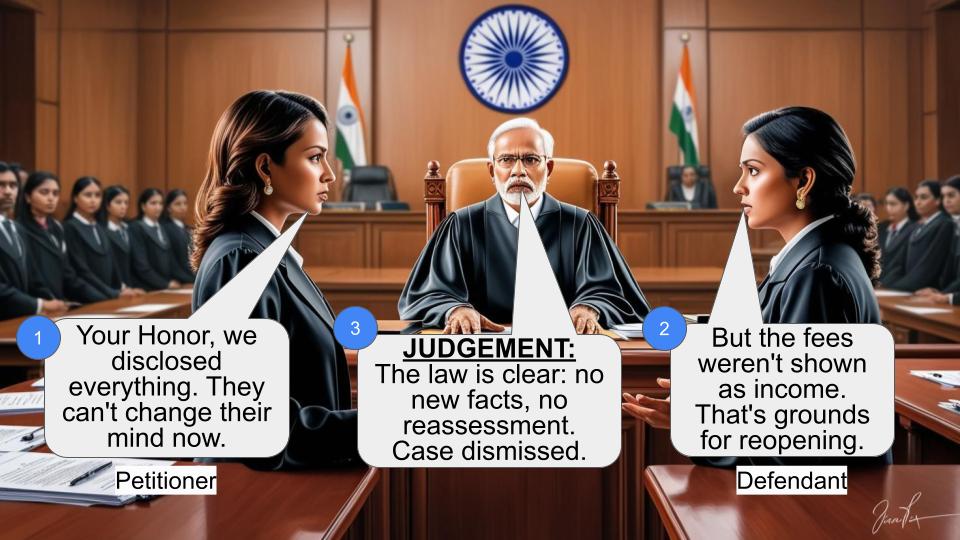
Court Rules in Favor of Assessee on Section 32AB (of Income Tax Act, 1961) Dedu…




Full News

Court Rules in Favor of Assessee on Section 32AB (of Income Tax Act, 1961) Deduction Calculation
Court Rules in Favor of Assessee on Section 32AB (of Income Tax Act, 1961) Deduction Calculation
This case involves a dispute between Harsiddh Specific Family Trust (the assessee) and the Income Tax Department regarding the calculation of deduction under Section 32AB (of Income Tax Act, 1961) for the Assessment Year 1988-89. The High Court ruled in favor of the assessee, allowing deduction based on profits of the eligible business unit rather than the entire business.
Get the full picture - access the original judgement of the court order here
Case Name:
Harsiddh Specific Family Trust vs Assistant Commissioner of Income Tax (High Court of Gujarat)
Tax Appeal No. 173 of 2002
Date: 7th November 2016
Key Takeaways:
1. For Assessment Year 1988-89, deduction under Section 32AB (of Income Tax Act, 1961) should be calculated based on profits of eligible business only.
2. The court's decision aligns with previous rulings by Delhi and Bombay High Courts.
3. The amendment deleting the word 'eligible' from Section 32AB (of Income Tax Act, 1961) came into effect from 1.4.1991, after the relevant assessment year.
Issue:
Was the Income Tax Appellate Tribunal (ITAT) correct in holding that the deduction under Section 32AB (of Income Tax Act, 1961) is allowable with reference to the profits of the business as a whole and not in respect of the profit of any particular unit?
Facts:
1. The assessee, Harsiddh Specific Family Trust, filed a return for Assessment Year 1988-89.
2. They claimed a deduction of Rs.2.5 crores under Section 32AB (of Income Tax Act, 1961) based on profits from Patel Detergents (Manufacturing Division).
3. The Assessing Officer initially allowed the deduction as claimed.
4. Later, a reassessment was initiated, reducing the deduction to Rs. 2,14,24,749/-.
5. The CIT(A) and ITAT confirmed the reduced deduction amount.
Arguments:
Assessee's Argument:
- Deduction should be calculated based on profits of the eligible business (Patel Detergents) only.
- The amendment deleting 'eligible' from Section 32AB (of Income Tax Act, 1961) came into effect after the relevant assessment year.
Department's Argument:
- Deduction should be calculated based on the profits of the entire business.
- The assessee cannot take contradictory stands on different aspects of the assessment.
Key Legal Precedents:
1. Commissioner of Income Tax v. Kelvinator of India Ltd. [2015] 60 Taxmann.com 78 (Delhi)
2. CIT v. Pudumjee Agro Industries Ltd. [(2006) 285 ITR 301/150 Taxman 137 (Bombay)]
Both these cases held that for assessment years prior to the amendment, only profits of eligible business should be considered for Section 32AB (of Income Tax Act, 1961) deduction.
Judgement:
The High Court ruled in favor of the assessee, holding that:
1. For Assessment Year 1988-89, the assessee is entitled to deduction under Section 32AB (of Income Tax Act, 1961) equal to 20% of the profits of Patel Detergents (Manufacturing Division).
2. The ITAT erred in holding that the deduction is allowable with reference to the profit of the business as a whole.
3. The impugned judgment of ITAT is quashed and set aside.
FAQs:
1. Q: What was the main point of contention in this case?
A: The main issue was whether the deduction under Section 32AB (of Income Tax Act, 1961) should be calculated based on the profits of the eligible business unit or the entire business of the assessee.
2. Q: Why did the court rule in favor of the assessee?
A: The court considered the provisions of Section 32AB (of Income Tax Act, 1961) as they existed in Assessment Year 1988-89, before the amendment that deleted the word 'eligible'. At that time, only profits from eligible business were to be considered for the deduction.
3. Q: What impact does this judgment have?
A: This judgment clarifies the interpretation of Section 32AB (of Income Tax Act, 1961) for assessment years prior to 1991-92, potentially affecting similar cases from that period.
4. Q: How does this ruling align with other High Court decisions?
A: This ruling is consistent with decisions from the Delhi and Bombay High Courts on the same issue, strengthening the legal precedent.
5. Q: What changed in Section 32AB (of Income Tax Act, 1961) after this assessment year?
A: The word 'eligible' was deleted from Section 32AB (of Income Tax Act, 1961) by the Finance Act, 1989, with effect from 1.4.1991, changing how the deduction is calculated for subsequent years.

1. Feeling aggrieved and dissatisfied with the impugned judgment and order passed by the Income Tax Appellate Tribunal, Ahmedabad Bench `C' (for short “ITAT”) in ITA No.2187/Ahd/1994 for Assessment Year 198889 by which the learned Tribunal has confirmed the orders passed by the Assessing Officer as well as the Commissioner of Income Tax (Appeals) (for short “CIT(A)”) with respect to the deduction under Section 32AB (of Income Tax Act, 1961) (for short “the Act”) by holding that the deduction under Section 32AB (of Income Tax Act, 1961) is allowable with reference to the profits of the business as a whole and not in respect of the profit of any particular unit, the assessee has preferred the present appeal.
2. At the outset, it is required to be noted that initially the assessee proposed the following substantial questions of law:
“(i) Whether, in the facts and circumstances of the case, the ITAT was right in law in holding that the action of the respondent in reopening the assessment of the appellant was neither barred by limitation nor without jurisdiction?
(ii) Whether, in the facts and circumstances of the case, the ITAT was right in law in holding that the proviso to S.147 of the Act puts an embargo qua initiation of the reassessment proceedings only and does not put any restriction qua completion of the reassessment proceedings?
(iii) Whether, in the facts and circumstances of the case, the ITAT was right in law in holding that there was no change of opinion on the part of the respondent in spite of the fact that the original assessment was framed u/s 143(3) (of Income Tax Act, 1961) and after applying his mind, the respondent consciously and deliberately granted deduction u/s 32AB (of Income Tax Act, 1961) which was sought to be withdrawn in the reassessment proceedings?
(iv) Whether, in the facts and circumstances of the case, the ITAT was right in law in holding that the deduction u/s 32AB (of Income Tax Act, 1961) is allowable with reference to the profits of the business as a whole and not in respect of the profit of any particular unit?”
3. However, while admitting the present appeal, the Division Bench of this Court framed only one substantial question of law, namely, whether in the facts and circumstances of the case, the ITAT was right in law in holding that the deduction u/s. 32AB (of Income Tax Act, 1961) is allowable with reference to the profits of the business as a whole and not in respect of the profit of any particular unit?. It appears that thereafter the assessee preferred O.J. Civil Application No.619 of 2014 with a request to formulate/frame other proposed substantial questions of law namely with respect to the initiation of reassessment proceedings more particularly proposed initial substantial questions of law No.1, 2 and 3. The Division Bench of this Court vide order dated 11.11.2014 allowed the said application and permitted the applicant to raise the initial proposed substantial questions of law No.1, 2 and 3 as additional questions of law, however, subject to the rights of the department to object the new ground and even ground of limitation.
4. Mr. S.N. Soparkar, learned counsel appearing on behalf of the assessee and Mr. M.R.Bhatt, learned counsel appearing on behalf of the department did make elaborate submissions on the initial proposed substantial questions of law No.1, 2 and 3 as well as on merits of the deduction under Section 32AB (of Income Tax Act, 1961). After making elaborate submissions, Mr. S.N.Soparkar, learned counsel appearing on behalf of the assessee has stated at the Bar that, after considering the submissions on merits of deduction under Section 32AB (of Income Tax Act, 1961), if this Court holds in favour of the assessee in that case the assessee does not press the initial proposed substantial questions of law No.1, 2 and 3. Therefore we propose to consider the matter on merits first i.e. with respect to the deduction claimed by the assessee under Section 32AB (of Income Tax Act, 1961) and whether the deduction under Section 32AB (of Income Tax Act, 1961) is allowable with reference to the profits of the business as a whole and not in respect of profit of any particular unit.
5. The facts leading to the present tax appeal in nutshell are as under:
5.1 That the assessee is a family trust. The assessee filed a return of income on 1st August, 1988, showing income of Rs.6,09,56,580/. A revised return had been filed by the assessee on 15.11.1988 declaring income of Rs.6,09,62,050/. The assessee claimed deduction under Section 32AB (of Income Tax Act, 1961) for Rs.2.5 crores on the basis of the deposit made with IDBI as provided under Section 32AB (of Income Tax Act, 1961). The audit certificate under Section 32AB (of Income Tax Act, 1961) had been attached to the return of income. Certain queries were also raised by the Assessing Officer including the query with respect to the deduction claimed under Section 32AB (of Income Tax Act, 1961), which came to be ensured by the assessee. That original assessment under Section 143(3) (of Income Tax Act, 1961) read with Section 164 (of Income Tax Act, 1961) was passed by the Assessing Officer on 27.3.1991 at an income of Rs.15,34,36,930/. This included income of Patel Detergents (Manufacturing Division) of Rs.15,19,84,289/ and other income of the assessee (trust) of Rs.14,52,638/. At this stage it is required to be noted that the assessee claimed deduction of Rs.2,03,05,962/ which were disallowed by the Assessing Officer.
However, so far as the deduction claimed under Section 32AB (of Income Tax Act, 1961) is concerned, the Assessing Officer allowed the said deduction as claimed. At this stage it is required to be noted that the appellant – trust being a proprietor of Patel Detergents (Manufacturing Division) has calculated 20% of the profit as per the books of accounts of Patel Detergents (Manufacturing Division) are claiming the deduction under Section 32AB (of Income Tax Act, 1961). Against disallowance of the expenses of Rs.2,03,05,962/ passed by the Assessing Officer, the assessee appealed to the CIT(A) and the CIT(A) vide order dated 14.11.1992 partly allowed the appeal of the assessee, as a result of which, the income of the assessee was reduced to Rs.11,99,00,05,570/. The relief allowed to the assessee included the deduction on account of interest of Rs.1,99,12,300/ being interest paid by the assessee trust to its beneficiaries.
5.2 Subsequently, a notice under Section 148 (of Income Tax Act, 1961) was issued on 19.3.1993 and served upon the assessee on the same day, which was within four years from the end of the assessment year under appeal. The reasons recorded for issuance of notice under Section 148 (of Income Tax Act, 1961) reads as under:
“It is noticed that assessee in its return of income has claimed deduction u/s.32AB (of Income Tax Act, 1961), Rs.2,50,00,000/ and the same has been allowed also, while passing order u/s.143(3) (of Income Tax Act, 1961) dt.27.3.91. However, after further verification it is noticed that assessee has not considered interest expenses of Harsiddh Specific Family Trust as well as other expenses amounting to Rs.2,03,05,962/ for working out profit of eligible business of the assessee though the expenses have been claimed as business expenses. Thus, due to this profit of assessee for working out deduction u/s.32AB (of Income Tax Act, 1961), as per provision of section 32AB (of Income Tax Act, 1961) has been inflated by Rs.2,03,05,962/ and due to this excess deduction claimed and allowed u/s.32AB (of Income Tax Act, 1961) is Rs.35,75,251/, the working of which is as under:
Profit of Patel Detergent on which deduction worked out Rs.12,74,29,709
Less: Expenses of Harsiddh Spe.F.T.
Rs. 2,03,05,962 Rs.10,71,23,747
Maximum deduction allowable u/s.32AB (of Income Tax Act, 1961)
Rs. 2,14,24,749
Deduction allowed u/s.32AB (of Income Tax Act, 1961) Rs. 2,50,00,000 Excess allowed Rs. 35,75,251
In the light of the above facts, I have reason to believe that income chargeable to tax to the tune of Rs.35,75,251/ has escaped assessment. Accordingly, the case is reopened u/s.147 (of Income Tax Act, 1961) and notice u/s.148 (of Income Tax Act, 1961) is being issued.”
5.3 The assessee vide letter dated 28th June, 1993, objected to the proposed reassessment on the ground that the action under Section 147 (of Income Tax Act, 1961) was barred by limitation as four years had expired from the end of the assessment year and that the assessee had disclosed fully and truly all material facts necessary for the assessment. The assessee also claimed that the deduction under Section 32AB (of Income Tax Act, 1961) was claimed on the basis of audit report and that the Assessing Officer while making the assessment under Section 143(3) (of Income Tax Act, 1961) had allowed the deduction accordingly.
5.4 However the Assessing Officer passed the reassessment order by observing that the reassessment is not barred by limitation. On merits, the Assessing Officer held that the deduction under Section 32AB (of Income Tax Act, 1961) was to be restricted to 20% of the profits of business or profession and not in respect of profits of any one undertaking. The Assessing Officer also observed and held that, for computation of deduction, the income from profits and gains are taken into account as a whole. The Assessing Officer accordingly calculated the deduction under Section 32AB (of Income Tax Act, 1961) at Rs.2,14,24,749/ as against Rs.2,50,00,000/ allowed in the original assessment and the excess deduction of Rs.35,75,251/ came to be withdrawn.
5.5 Feeling aggrieved and dissatisfied with the assessment/reassessment order passed by the Assessing Officer, the assessee appealed to the CIT(A). The CIT(A) confirmed the deduction under Section 32AB (of Income Tax Act, 1961) at Rs.2,14,24,749/.
5.6 Feeling aggrieved and dissatisfied with the order passed by the CIT(A) confirming the calculation of the deduction made under Section 32AB (of Income Tax Act, 1961) at Rs.2,14,24,749/, the assessee preferred further appeal before the Income Tax Appellate Tribunal, and by impugned judgment and order, the Income Tax Appellate Tribunal has dismissed the said appeal preferred by the assessee and confirmed the calculation of the deduction made under Section 32AB (of Income Tax Act, 1961) by the Assessing Officer.
5.7 Feeling aggrieved and dissatisfied with the impugned judgment and order passed by the ITAT in holding that Section 32AB (of Income Tax Act, 1961) is allowable with reference to the profits of the business as a whole and not in respect of profit of any particular unit, the assessee preferred present appeal raising the following substantial questions of law.
“(i) Whether, in the facts and circumstances of the case, the ITAT was right in law in holding that the action of the respondent in reopening the assessment of the appellant was neither barred by limitation nor without jurisdiction?
(iii) Whether, in the facts and circumstances of the case, the ITAT was right in law in holding that the proviso to S.147 of the Act puts an embargo qua initiation of the reassessment proceedings only and does not put any restriction qua completion of the reassessment proceedings?
(iii) Whether, in the facts and circumstances of the case, the ITAT was right in law in holding that there was no change of opinion on the part of the respondent in spite of the fact that the original assessment was framed u/s 143(3) (of Income Tax Act, 1961) and after applying his mind, the respondent consciously and deliberately granted deduction u/s 32AB (of Income Tax Act, 1961) which was sought to be withdrawn in the reassessment proceedings?
(iv) Whether, in the facts and circumstances of the case, the ITAT was right in law in holding that the deduction u/s 32AB (of Income Tax Act, 1961) is allowable with reference to the profits of the business as a whole and not in respect of the profit of any particular unit?”
6. Mr.S.N.Soparkar, learned counsel appearing on behalf of the assessee has vehemently submitted that the learned ITAT has materially erred in holding that the deduction under Section 32AB (of Income Tax Act, 1961) is allowable with reference to the profits of the business (of the assessee trust) as a whole and not in respect of the profit of any particular unit i.e. in the present case Patel Detergents (Manufacturing Division).
6.1 It is further submitted by Mr.Soparkar, learned counsel for the assessee that, while holding the aforesaid, the learned Tribunal has materially erred in considering the decision of the Gauhati High Court in the case of Commissioner of Income Tax vs. Dinjoye Tea Estate (P) Ltd., [1997 (Vol.224) 263], which has no application at all to the facts of the case on hand. It is submitted that in the case before the Gauhati High Court the facts were altogether different. It is submitted that in the case before the Gauhati High Court the question was whether the interest and dividend is to be included in income for the purpose of calculating the deduction under Section 32AB (of Income Tax Act, 1961) or not. It is submitted that therefore the learned Tribunal has wrongly considered and relied upon the decision of the Gauhati High Court in the case of Dinjoye Tea Estate (P.) Ltd. (supra).
6.2 Mr.Soparkar, learned counsel appearing on behalf of the assessee has heavily relied upon the decision of Delhi High Court in the case of Commissioner of Income Tax v. Kelvinator of India Ltd. [[2015] 60 Taxmann.com 78 (Delhi)]. It is submitted that identical question came to be considered by the Delhi High Court, and considering the provisions of Section 32AB (of Income Tax Act, 1961) prevailing at the relevant time i.e. prevailing prior to 1.4.1991, the Delhi High Court has specifically observed and held that the assessee is eligible to get the deduction under Section 32AB (of Income Tax Act, 1961) of 20% of the profits of the eligible business or profession, increases and decreases permitted, did not contemplate the loss of another eligible unit. It is submitted that, while holding so, the Delhi High Court has relied upon the decision of Bombay High Court in the case of CIT v. Pudumjee Agro Industries Ltd. [(2006) 285 ITR 301/150 Taxman 137 (Bombay)]. Therefore it is vehemently submitted by Mr. Soparkar, learned counsel appearing on behalf of the assessee that the question of law framed in the present case is squarely answered in favour of the assessee by the aforesaid two decisions of Delhi High Court as well as Bombay High Court.
6.3 It is further submitted by Mr. Soparkar, learned counsel appearing on behalf of the assessee that even the aforesaid would be supported by the definition `eligible business or profession' as per subsec.2 (of Income Tax Act, 1961) of Section 32AB (of Income Tax Act, 1961) which was prevailing at the relevant time.
6.4 It is further submitted by Mr.Soparkar, learned counsel for the assessee that subsequently on and from 1.4.1991 the word `eligible' has been deleted from Section 32AB(b) (ii) (of Income Tax Act, 1961). It is submitted that therefore on and from 1.4.1991 for the purpose of deduction under Section 32AB (of Income Tax Act, 1961), a sum equal to 20% of the profits of the business or profession of the assessee as a whole can be considered. It is submitted that in the present case the relevant assessment year is 198889 i.e. prior to 1.4.1991. It is submitted that, if the view taken by the Tribunal is accepted, in that case, there was no purpose for amending Section 32AB (of Income Tax Act, 1961) by deleting the word `eligible'. It is submitted that therefore for the purpose of considering the deduction under Section 32AB (of Income Tax Act, 1961) prevailing at the relevant time, and as claimed by the assessee, the assessee shall be entitled to deduction under Section 32AB (of Income Tax Act, 1961) equal to 20% of the profits of eligible business i.e. in the present case, the profit of Patel Detergents (Manufacturing Division).
6.5 Making the above submissions, it is requested to allow the present appeal and answer the question framed in favour of the assessee and against the revenue.
7. Mr. M.R.Bhatt, learned counsel appearing on behalf of the department has tried to oppose the present appeal by submitting that, on one hand, the assessee got the benefit of the order passed by the CIT(A) (against the original assessment order) and the income of the assessee was reduced to Rs.11,99,00,05,570/ which include, for the purpose of getting deduction under Section 32AB (of Income Tax Act, 1961), the assessee would claim the deduction under Section 32AB (of Income Tax Act, 1961) at Rs.2.50 crores and not on the reduced amount i.e. Rs.2,03,05,962/. It is submitted that therefore the assessee cannot be permitted to take contradictory stand. It is submitted that therefore if the loss of other units are considered, in that case the assessee shall be entitled to deduction under Section 32AB (of Income Tax Act, 1961) at Rs.2,14,24,749/ only. Thus the assessee was allowed Rs.35,75,251/ in excess, as deduction under Section 32AB (of Income Tax Act, 1961). Making the above submissions, it is requested to dismiss the appeal.
8. Heard the learned counsels for the respective parties at length.
9. The short question which is posed for consideration before this Court is whether the learned ITAT was justified in confirming the deduction under Section 32AB (of Income Tax Act, 1961) calculated by the Assessing Officer confirmed by the CIT(A) considering the profits of the business of the assessee as a whole and not in respect of the profit of Patel Detergents (Manufacturing Division). The assessee claimed deduction of Rs.2.50 crores under Section 32AB (of Income Tax Act, 1961) being 20% of the profits of the business i.e. profit of Patel Detergents (Manufacturing Division). However, according to the department, for the purpose of calculation of deduction under Section 32AB (of Income Tax Act, 1961), the profits of the business of the assessee as a whole and not in respect of profit of any particular unit (Patel Detergents (Manufacturing Division)) is required to be considered.
10. For the aforesaid, Section 32AB (of Income Tax Act, 1961) which was prevailing at the relevant time is required to be considered which reads as under:
“32AB.Investment deposit account: (1) Subject to the other provisions of this section, where an assessee, whose total income includes income chargeable to tax under the head “profits and gains of business or profession”, has, out of such income,
(a) deposited any amount in an account (hereafter in this section referred to as deposit account) maintained by him with the Development Bank before the expiry of six months from the end of the previous year or before furnishing the return of his income, whichever is earlier; or
(b) utilised any amount during the previous year for the purchase of any new ship, new aircraft, new machinery or plant, without depositing any amount in the deposit account under clause (a), in accordance with, and for the purposes specified in a scheme (hereafter in this section referred to as the scheme) to be framed by the Central Government, or if the assessee is carrying on the business of growing and manufacturing tea in India, to be approved in this behalf by the Tea Board, the assessee shall be allowed a deduction (such deduction being allowed before the loss, if any, brought forward from earlier years is set off under section 72 (of Income Tax Act, 1961)) of
(i) a sum equal to the amount, or the aggregate of the amounts, so deposited and any amount so utilised; or
(ii) a sum equal to twenty per cent, of the profits of eligible business or profession as computed in the accounts of the assessee audited in accordance with subsection (5), whichever is less:
Provided that where such assessee is a firm, or any association of persons or any body of individuals, the deduction under this section shall not be allowed in the computation of the income of any partner, or, as the case may be, any member, of such firm, association of persons or body of individuals.
(2) For the purposes of this section, (i) `eligible business or profession' shall mean business or profession, other than (a) the business of construction, manufacture or production of any article or thing specified in the list in the Eleventh Schedule carried on by an industrial undertaking, which is not a smallscale industrial undertaking as defined in section 80HHA (of Income Tax Act, 1961);
(b) the business of leasing or hiring of machinery or plant to an industrial undertaking, other than a smallscale industrial undertaking as defined in section 80HHA (of Income Tax Act, 1961), engaged in the business of construction, manufacture or production of any article or thing specified in the list in the Eleventh Schedule;
(ii) “new ship” or “new aircraft” includes a ship or aircraft which before the date of acquisition by the assessee was used by any other person, if it was not at any time previous to the date of such acquisition owned by any person resident in India;
(iii) “new machinery or plant” includes machinery or plant which before the installation by the assessee was used outside India by any other person, if the following conditions are fulfilled, namely:
(a) such machinery or plant was not, at any time previous to the date of such installation by the assessee, used in India;
(b) such machinery or plant is imported into India from any country outside India; and
(c) no deduction on account of depreciation in respect of such machinery or plant has been allowed or is allowable under this Act in computing the total income of any person for any period prior to the date of the installation of the machinery or plant by the assessee;
(iv) “Tea Board” means the Tea Board established under section 4 of the Tea Act, 1953 (29 of 1953).
(3) The profits of eligible business or profession of an assessee for the purposes of subsection(1) shall, (a) in a case where separate accounts in respect of such eligible business or profession are maintained, be an amount arrived at after deducting an amount equal to the depreciation computed in accordance with the provisions of sub- section (1) of section 32 (of Income Tax Act, 1961) from the amounts of profits computed in accordance with the provisions of subsection (1) of section 32 (of Income Tax Act, 1961) from the amounts of profits computed in accordance with the requirements of Parts II and III of the Sixth Schedule to the Companies Act, 1956 (1 of 1956), as increased by the aggregate of
(i) the amount of depreciation;
(ii)the amount of incometax paid or payable, and provision therefor;
(iii) the amount of surtax paid or payable under the Companies (Profits) Surtax Act, 964 (7 of 1964);
(iv)the amounts carried to any reserves, by whatever names called;
(v) the amount or amounts set aside to provisions made for meeting liabilities other than ascertained liabilities;
(vi)the amount by way of provision for losses of subsidiary companies; and
(vii) the amount or amounts of dividends paid or proposed; if any debited to the profit and loss account; and as reduced by any amount or amounts withdrawn from reserves or provisions, if such amounts are credited to the profit and loss account; and
(b) in a case where such separate accounts are not maintained or are not available, be such amount which bears to the total profits of the business or profession of the assessee after following depreciation in accordance with the provisions of sub- section (1) of section 32 (of Income Tax Act, 1961), the same proportion as the total sales, turnover or gross receipts of the eligible business or profession bear to the total sales, turnover or gross receipts of the business or profession carried on by the assessee. (5) The deduction under subsection (1) shall not be admissible unless the accounts of the business or profession of the assessee for the previous year relevant to the assessment year for which the deduction is claimed have been audited by an accountant as defined in the Explanation below subsection (2) of section 288 (of Income Tax Act, 1961) and the assessee furnishes, along with his return of income, the report of such audit in the prescribed form duly signed and verified by such accountant:
Provided that in a case where the assessee is required by or under any other law to get his accounts audited, it shall be sufficient compliance with the provisions of this sub- section if such assessee gets the accounts of such business or profession audited under such law and furnishes the report of the audit as required under such other law and a further report in the form prescribed under this sub- section.”
11. At this stage it is required to be noted that Section 32AB (of Income Tax Act, 1961) has been amended and the word `eligible' has been deleted by Finance Act, 1989, with effect from 1.4.1991. In the present case, the dispute is with respect to Assessment Year 198889. Therefore, considering the provisions of Section 32AB (of Income Tax Act, 1961) prevailing at the relevant time, assessee is entitled to the deduction under Section 32AB (of Income Tax Act, 1961) equal to 20% of the profit from `eligible business or profession'. Therefore, it cannot be disputed that the profits of Patel Detergents (Manufacturing Division) can be said to be profits of `eligible business'. On and after the amendment in Section 32AB (of Income Tax Act, 1961) and after deletion of the word `eligible', for the purpose of computation of the deduction under Section 32AB (of Income Tax Act, 1961), the profits of the business of the assessee as a whole is required to be considered. Under the circumstances, considering the provisions of Section 32AB (of Income Tax Act, 1961) prevailing for the year under consideration i.e. Assessment Year 198889 the assessee shall be entitled to the deduction under Section 32AB (of Income Tax Act, 1961) equal to 20% of the profits of Patel Detergents (Manufacturing Division) being the profits of `eligible business', and therefore, the Tribunal has committed a grave error in holding that the deduction under Section 32AB (of Income Tax Act, 1961) is allowable with reference to the profit of the business as a whole and not in respect of the profit of any particular unit.
12. The view we are taking is supported by the decisions of the Delhi High Court as well as the Bombay High Court. In the case of Commissioner of Incometax v. Kelvinator of India Limited (supra), after following the decision of Bombay High Court in the case of Pudumjee Agro Industries Ltd. (supra), it is held by the Delhi High Court that for the assessment year prior to the amendment in Section 32AB (of Income Tax Act, 1961) by which the word `eligible' is deleted, only profits of the eligible business can be taken into consideration for computing the deduction under Section 32AB (of Income Tax Act, 1961) and aggregation will not be permissible.
13. In view of the above and for the reasons stated above, the present appeal succeeds and is allowed. The impugned judgment and order passed by the learned ITAT confirming the calculation made by the Assessing Officer confirmed by the learned CIT(A) with respect to the deduction under Section 32AB (of Income Tax Act, 1961) by holding that the deduction under Section 32AB (of Income Tax Act, 1961) is allowable with reference to the profit of the business as a whole and not in respect of profit of any particular unit is hereby quashed and set aside and it is held that the assessee shall be entitled to the deduction under Section 32AB (of Income Tax Act, 1961) with reference to the profits of Patel Detergents (Manufacturing Division) as claimed and granted by the Assessing Officer while passing the original order of assessment. The question of law is accordingly held in favour of the assessee and against the revenue. In the facts and circumstances of the case, there shall be no order as to costs.
(M.R.SHAH, J.)
(B.N. KARIA, J.)
×