


High Court Upholds ITAT's Decision on Section 80IB(10) (of Income Tax Act, 1961…


Full News

High Court Upholds ITAT's Decision on Section 80IB(10) (of Income Tax Act, 1961) Deduction, Dismisses Revenue's Appeal
High Court Upholds ITAT's Decision on Section 80IB(10) (of Income Tax Act, 1961) Deduction, Dismisses Revenue…
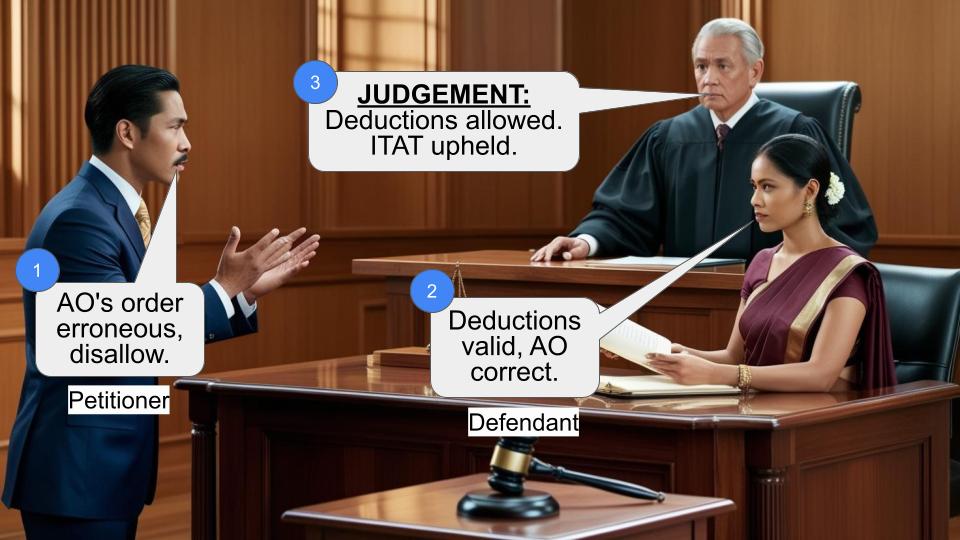
The case involves the Commissioner of Income Tax (CIT) challenging the Income Tax Appellate Tribunal's (ITAT) decision to allow Fortaleza Developers to claim a deduction under Section 80IB(10) (of Income Tax Act, 1961). The High Court upheld the ITAT's decision, stating that the Tribunal's conclusions were neither perverse nor legally erroneous, and dismissed the appeal.
Get the full picture - access the original judgement of the court order here.
Case Name:
Commissioner of Income Tax vs. Fortaleza Developers (High Court of Bombay)
Income Tax Appeal No.1041 of 2013
Key Takeaways
- The High Court upheld the ITAT's decision, allowing the assessee to claim a deduction under Section 80IB(10) (of Income Tax Act, 1961).
- The court found that the ITAT's interpretation of the AOP agreement and the allocation of revenue was correct.
- The court ruled that the CIT could not invoke Section 263 (of Income Tax Act, 1961) to reopen the case as the ITAT's conclusions were not erroneous.
- The decision reinforces the principle that the interpretation of contractual clauses by the parties involved should not be substituted by the Assessing Officer's reasoning.
Issue
Can the Commissioner of Income Tax invoke Section 263 (of Income Tax Act, 1961) to reopen the assessment order when the ITAT's conclusions are neither perverse nor legally erroneous?
Facts
- The assessee, an Association of Persons (AOP) consisting of M/s Raviraj Kothari and Co. (RRK) and M/s Sanand Properties Pvt. Ltd. (SPPL), filed a return of income for the assessment year 2007-08.
- The Assessing Officer disallowed the deduction claimed under Section 80IB(10) (of Income Tax Act, 1961), leading to an appeal by the assessee.
- The Commissioner of Income Tax (Appeals) allowed the deduction, which was upheld by the ITAT.
- The CIT issued a notice under Section 263 (of Income Tax Act, 1961), arguing that the allocation of revenue was incorrect and provided undue benefit to the assessee.
- The ITAT quashed the CIT's order, leading to the current appeal by the Revenue.
Arguments
- Revenue's Argument:
The CIT argued that the allocation of revenue between the AOP members was incorrect and that the assessee was not entitled to the deduction under Section 80IB(10) (of Income Tax Act, 1961).
- Assessee's Argument:
The assessee contended that they had complied with all conditions of Section 80IB(10) (of Income Tax Act, 1961) and that the allocation of revenue was in accordance with the AOP agreement.
Key Legal Precedents
- The court referred to the doctrine of merger and previous cases where Section 263 (of Income Tax Act, 1961) was invoked, such as the case of K. Sera Sera Productions Limited, to support its decision.
Judgement
The High Court dismissed the Revenue's appeal, upholding the ITAT's decision. The court found that the ITAT's conclusions were neither perverse nor legally erroneous and that the CIT could not invoke Section 263 (of Income Tax Act, 1961) to reopen the case. The court also noted that the interpretation of the AOP agreement by the assessee was correct and that the allocation of revenue was in order.
FAQs
Q1: What is Section 80IB(10) (of Income Tax Act, 1961)?
A1: Section 80IB(10) (of Income Tax Act, 1961) provides deductions for profits and gains from certain housing projects, subject to specific conditions.
Q2: What is Section 263 (of Income Tax Act, 1961)?
A2: Section 263 (of Income Tax Act, 1961) allows the Commissioner of Income Tax to revise any order passed by the Assessing Officer if it is erroneous and prejudicial to the interests of the revenue.
Q3: What does the doctrine of merger imply in this context?
A3: The doctrine of merger implies that once an appellate authority has passed an order, the original order merges with the appellate order, and the original order cannot be revised under Section 263 (of Income Tax Act, 1961).
Q4: Why was the Revenue's appeal dismissed?
A4: The appeal was dismissed because the High Court found that the ITAT's conclusions were neither perverse nor legally erroneous, and the CIT could not invoke Section 263 (of Income Tax Act, 1961) to reopen the case.
Q5: What was the main contention of the assessee?
A5: The assessee contended that they had complied with all conditions of Section 80IB(10) (of Income Tax Act, 1961) and that the allocation of revenue was in accordance with the AOP agreement.

1] By this Appeal, the following six questions of law are proposed by the Revenue:
(a) Whether on the facts and in the circumstances of the case and in law, the Tribunal was correct in holding that the issue of incorrect allocation of revenue has merged in the Commissioner of Income Tax (Appeals) order even though this issue was neither examined by the Assessing Officer nor was before Commissioner of Income Tax?
(b) Whether on the facts and in the circumstances of the case and in law, the Tribunal was correct in interpreting clause 7 of the AOP agreement dated 24th March, 2003 with respect to the method of allocation of revenue between member of AOP?
(c) Whether on the facts and in the circumstances of the case and in law, the Tribunal was correct in accepting the calculation of eligible quantum of deduction under section 80IB(10) (of Income Tax Act, 1961)?
(d) Whether on the facts and in the circumstances of the case and in law, the Tribunal was correct in allowing deduction u/s. 80IB(10) (of Income Tax Act, 1961) on the share of M/s. Sanand Properties Pvt. Ltd. (one of the member of AOP) in view of clause 7 of AOP agreement dated 29th April, 2003?
(e) Whether on the facts and in the circumstances of the case and in law, the Tribunal was correct in holding that the power u/s. 263 (of Income Tax Act, 1961) was wrongly invoked?
2] The Assessee is in an Association of persons being promoters and builders which was constituted by an agreement dated 29th April, 2003 between M/s. Raviraj Kothari and Co., a partnership firm (“RRK”) and M/s. Sanand Properties Pvt. Ltd. (“SPPL”). They have filed a return of income for the assessment year 200708 showing a total income of Rs.4,13,610/ after claiming deduction of Rs.14,54,47,283/ under section 80IB(10) (of Income Tax Act, 1961). The Assessing Officer completed the assessment under section 143(3) (of Income Tax Act, 1961) and computed the total income at Rs.14,63,04,860/ after disallowing deduction claimed under section 80IB(10) (of Income Tax Act, 1961).
3] The Assessee filed an Appeal before the Commissioner of Income Tax (Appeals) who held that the Assessee had fulfilled all the conditions laid down in section 80IB(10) (of Income Tax Act, 1961) and directed the Assessing Officer to allow the claim for deduction.
4] This order of the CIT (Appeals) was challenged in the Appellate Tribunal by the Revenue which Appeal came to be dismissed. Meanwhile, during the pendency of the Appeal before the Tribunal, the Commissioner of Income Tax issued a notice under section 263 (of Income Tax Act, 1961) asking the Assessee to show cause as to why the assessment order should not be set aside. According to the Commissioner in accordance with clause (7) of the AOP agreement, SPPL was to receive 35% of the sale proceeds of the project and out of the balance 65%, all the expenditure of the AOP was to be met, after which the net balance constituted the share of income of RRK.
5] The notice under section 263 (of Income Tax Act, 1961) specified that the manner of allocation of revenue provided the Assessee with undue benefit by way of a higher claim of deduction under section 80IB(10) (of Income Tax Act, 1961) contrary to clause (7) of the AOP agreement. It was contended that the share of Revenue pertaining SPPL was not eligible for deduction under section 80IB(10) (of Income Tax Act, 1961).
6] After considering the written submissions of the Assessee and other material on record, the CIT (Appeals) set aside the assessment order and directed the Assessing Officer to recompute the income on the basis of clause (7) of the AOP agreement. The Assessee challenged this order passed under section 263 (of Income Tax Act, 1961) before the Appellate Tribunal. The Tribunal held that on merits as well as on the issue of merger, the power under section 263 (of Income Tax Act, 1961) has been wrongly invoked and, therefore, quashed the order passed by the CIT (Appeals).
7] In its order dated 12th October, 2012, the Appellate Tribunal dealt with the contents of the AOP agreement and in particular clause (7) of the agreement which is reproduced at page 7 of the order of the Appellate Tribunal. The relevant extract of clause (7) is reproduced below under the heading SHARING OF REVENUE AND INCOME:
“Out of the aforesaid amounts received from the purchasers of the housing units (representing the gross sale proceeds of the units inclusive of the value of land) SPPL shall be entitled to, as its share of revenue/income, an amounting comprising of 35% of such receipts. It is hereby agreed and understood between the parties hereto, that SPPL may actually withdraw such share of revenue/income to which it is entitled as per the understanding between the parties from time to time. Out of the balance 65% of the aforesaid receipts representing the gross sale proceeds, all required and relevant expenditure for the purpose of the business of the AOP shall be met with and whatever net balance remains thereafter, shall be determined as the share of revenue/income of RKC. RKC will be at liberty to actually withdraw its share of revenue/income as worked out herein above from time to time.”
8] After considering this clause, the Tribunal proceeded to reproduce the working of the profit and distribution between the two members of the AOP. The Tribunal, then, proceeded to consider the fact that the main case of the Assessee was that the Commissioner of Income Tax (Appeals) is factually wrong in stating that the account of the Assessee has not been prepared in accordance with clause (7) of the agreement. The clause (7) of the agreement as well as the manner in which the Assessee has distributed the revenue are already reproduced in the order and according to the Tribunal, a plain reading of clause (7) would reveal that out of the amount received from purchasers of the housing units, SPPL shall be entitled as its share of revenue/income comprising of 35% of the receipts and from the balance 65%, all the expenses for the purpose of business of the AOP was to be met with and the the remaining amount would be the share of income of RRK.
9] Having considered the views of the Commissioner of Income Tax (Appeals) and in the light of material before it, the Tribunal concluded that the CIT's interpretation of clause (7) was incorrect. According to the Tribunal, the quantum of deduction under section 80IB(10) (of Income Tax Act, 1961) will depend upon the income earned from the project in question. The quantum of deduction will not depend on the mode of distribution of shares amongst members of the AOP as income of AOP is taxable at the maximum marginal rate. It is also observed by the Tribunal that the allowability or otherwise of deduction under section 80IB(10) (of Income Tax Act, 1961) is not dependent upon the manner in which the profit has been distributed amongst the members of the AOP but depended upon the income earned from an eligible project and the fulfillment of the conditions laid down in the section and also the deductions available to an undertaking and not to the individual constituent of an undertaking.
10] The Tribunal was clearly of the view that the Commissioner of Income Tax had erred in his order. The learned CIT was debarred from exercising jurisdiction under section 263 (of Income Tax Act, 1961) since the subject matter of the Appeal was deduction under section 80IB(10) (of Income Tax Act, 1961). On the issue of merger, the Tribunal held that the power under section 263 (of Income Tax Act, 1961) has been incorrectly invoked. The assessment order passed by the Assessing Officer was neither erroneous nor prejudicial to the interest of the Revenue. The impugned order of the Commissioner of Income Tax was, therefore, quashed and set aside by the Tribunal.
11] This Court in Income Tax Appeal No.1027/2013, The Commissioner of Income Tax (Appeals) V/s. K. Sera Sera Productions Limited (see order dated 18th March, 2015) had occasion to consider a similar set of facts where section 263 (of Income Tax Act, 1961) and the issue of merger were invoked. In that case, the Assessee had sold its share of theatrical rights to one M/s. RGV Enterprises for Rs.25 lakhs and on the showing of the Revenue, the Revisional Authority issued a show cause notice by invoking powers under section 263 (of Income Tax Act, 1961) because the Assessee which was engaged in the business of production and the financing and distribution of cinematographic films, had filed a return of income on 10th September, 2009 declaring income at Rs.87,64,620/. An Assessment order under section 148(3) (of Income Tax Act, 1961) read with section 153A (of Income Tax Act, 1961) was passed by the Assessing Officer on 31st December, 2009 assessing income of the Assessee at Rs.14,37,20,890/. The Assessee claimed to have incurred expenses of Rs.6,99,73,052/ for production of a film and claimed that it has earned income of Rs.11,25,00,000/ from the film. Later on, however, the Assessee claimed before the Assessing Officer that this was not income from the production of the film, but this was a sum received as share application money from various persons.
12] The Assessing Officer did not accept this contention and considered income at Rs.11,25,00,000/. The Revisional Authority was aware of the fact that the Assessee had preferred an Appeal before the Commissioner of Income Tax (Appeals), the First Appellate Authority while dealing with the ground that the claim of the Assessee’s cannot be sustained. In that case, the doctrine of merger was invoked by the Tribunal while upholding the objection raised by the Assessee. The conclusion of the Tribunal was based on the factual material.
13] We have heard Mr. Malhotra, the learned counsel for the Appellant and Mr. Mistri, the learned Senior Counsel, appearing for the Respondent at a considerable length. Mr. Malhotra submitted that the interpretation placed by the Assessing Officer and computing total income of Rs.14,63,04,860/ was correct. He further submitted that disallowance of deduction claimed under section 80IB(10) (of Income Tax Act, 1961) was justifiable and considered that the Respondent shall not entitled to claim benefits of said section 80IB(10) (of Income Tax Act, 1961) on account of the manner in which clause 7 of the AOP agreement has been worded. According to him, the manner in which the AOP agreement was worded by the Assessee, disentitled the Assessee to claim benefit of section 80IB(10) (of Income Tax Act, 1961). Mr. Mistri, on the other hand, faulted the reasoning of the Assessing Officer and supported the order of the Tribunal. He submitted that the Assessee had complied with all the conditions of section 80IB(10) (of Income Tax Act, 1961) and, therefore, entitled to claim deduction. Moreover, he submitted that the interpretation of clause 7 of the AOP Agreement by the Assessing Officer was incorrect and the correct interpretation of the said clause 7 entitled SPPL a constituent of the Assessee to appropriate 35% sale proceeds as provided under said clause before deduction of cost of the project. According to Mr. Mistri, after SPPL appropriates its share of 35% of the sale proceeds, the balance 65% would be used by the Assessee to pay overall cost including cost of development and all the expenses for the project. Only thereafter the residual amount could be appropriated by RRK.
14] Having considering the various submissions, we are clearly of the view that the contract between the two parties was self explanatory and the interpretation placed by the Assessee on clause 7 and claiming deduction under section 80IB(10) (of Income Tax Act, 1961) is in order. The interpretation of one of the Assessing Officer could not have substituted the parties interpretation of the relevant clause 7 of the AOP agreement with his own reasoning and that too to the detriment of the Assessee.
15] The facts in the present case also reveal that the conclusions arrived at by the Tribunal vide order dated 12th October, 2012 are neither perverse nor giving rise to any error of law apparent on the face of the record. The issue cannot be reopened in the manner sought to be done in the present case and section 263 (of Income Tax Act, 1961) could not be resorted to for the purpose. The order of the Assessing Officer had obviously merged with the order of the First Appellate Authority. Accordingly, we find that the subject Appeal does not raise any substantial question of law. The Appeal is, therefore, dismissed. There will be no orders as to costs.
(A. K. MENON, J.) (S. C. DHARMADHIKARI, J.)
×
Similar Ripples
Questions
High Court Upholds ITAT's Decision on Section 80IB(10) (of Income Tax Act, 1961) Deduction, Dismisses Revenue's Appeal
Write your CommentSimilar Posts


Generic
- Reportdata/3870.pdf
