


Court upholds tax additions due to assessee's failure to provide evidence


Full News

Court upholds tax additions due to assessee's failure to provide evidence
Court upholds tax additions due to assessee's failure to provide evidence
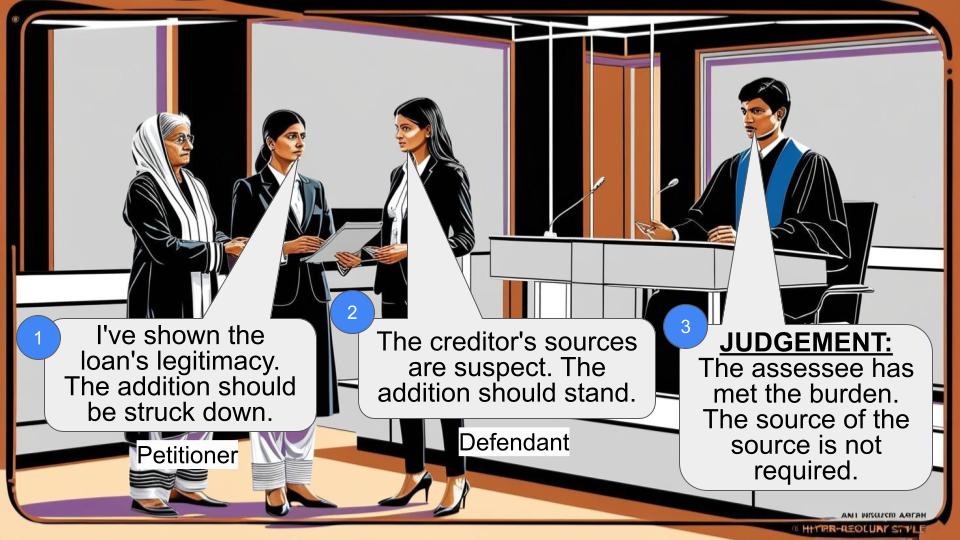
A chartered accountant (the assessee) appealed against tax additions made by the Income Tax Department. The court sided with the tax authorities, saying the assessee didn't provide enough evidence to support his claims for deductions and income sources. It's a classic case of "if you can't prove it, you can't claim it" in the world of taxes.
Get the full picture - access the original judgement of the court order here
Case Name:
KAMAL KUMAR AGRAWAL VS PRINCIPAL COMMISSIONER OF INCOME TAX
Key Takeaways:
1. The burden of proof is on the taxpayer to support their claims with evidence.
2. Timely submission of evidence is crucial; late submissions may not be considered.
3. Even professionals like chartered accountants are not exempt from providing proper documentation.
4. The Income Tax Appellate Tribunal's decisions are given significant weight by higher courts.
Issue:
The main question here is: Was the Income Tax Appellate Tribunal (ITAT) correct in upholding the tax additions because the assessee didn't submit evidence to support his claims for deductions and income sources?
Facts:
Alright, let's break this down:
1. The assessee, Kamal Kumar Agrawal, is a chartered accountant (which is pretty ironic, given the situation).
2. He filed a tax return showing an income of Rs. 3,01,370/-.
3. The case was selected for scrutiny, and the Income Tax Department made several additions to his taxable income.
4. These additions included:
- Rs. 5,94,630/- for operating expenses
- Rs. 1,50,000/- for agricultural income (treated as other sources)
- Rs. 1,90,600/- for unexplained cash deposits in the bank
5. The total taxable income was assessed at Rs. 14,32,810/-.
6. The assessee appealed to the Commissioner of Income Tax (Appeals), who dismissed the appeal.
7. He then appealed to the Income Tax Appellate Tribunal (ITAT), which also dismissed the appeal.
8. Finally, he approached the High Court under section 260-A (of Income Tax Act, 1961), 1961.
Arguments:
The assessee's main argument was that he had submitted written submissions and additional evidence to the CIT(A) and ITAT. He claimed that the ITAT wasn't justified in dismissing his appeal.
The Revenue (tax department) argued that they followed due process, gave the assessee multiple opportunities to provide evidence, but he failed to comply with the notices issued.
Key Legal Precedents:
Interestingly, this case doesn't cite specific legal precedents. Instead, it focuses on the application of sections of the Income Tax Act, 1961, particularly:
- Section 143(2) (of Income Tax Act, 1961) for scrutiny notice
- Section 142(1) (of Income Tax Act, 1961) for inquiry before assessment
- Section 271(1)(b) (of Income Tax Act, 1961) for penalty for failure to comply with notices
- Section 57(iii) (of Income Tax Act, 1961) for deductions in respect of income from other sources
- Section 260-A (of Income Tax Act, 1961) for appeal to High Court
Judgement:
The High Court sided with the tax authorities. They found that:
1. The ITAT was correct in concluding that the assessee didn't submit sufficient evidence to support his claims.
2. The ITAT's decision was legally and judicially justified.
3. The assessee's failure to provide timely evidence at lower levels of appeal was a significant factor.
4. The late submission of salary certificates (dated after the assessment order) didn't help the assessee's case.
The court dismissed the appeal, effectively upholding the additional tax liability.
FAQs:
1. Q: Why was the assessee's profession as a chartered accountant significant?
A: It highlighted that even tax professionals are expected to follow proper documentation and evidence submission procedures.
2. Q: Why weren't the salary certificates accepted as evidence?
A: They were dated after the assessment order was passed, making them irrelevant to the original assessment period.
3. Q: What lesson can taxpayers learn from this case?
A: Always keep proper documentation and respond promptly to tax notices with relevant evidence.
4. Q: Can the assessee appeal this decision further?
A: Potentially, but given the consistent decisions at multiple levels, success might be unlikely without new evidence.
5. Q: How important is the timing of evidence submission in tax cases?
A: It's crucial. This case shows that late submissions, even at appellate stages, may not be considered or may carry less weight.

This appeal under section 260 (of Income Tax Act, 1961), was admitted on 09.10.2018. by an earlier Division Bench of this Court on questions no. 1 and 2 as framed in the memorandum of appeal. For convenience, the two questions are reproduced hereinbelow:-
(1) “Whether, on the facts and circumstances of the case, Hon'ble ITAT was legally correct in its view that the assessee did not submit evidence or material at all before the lower Income Tax authorities in support of its claims for the deductions relating to, operating expenses, the cash deposit in bank and agricultural income.
(2) Whether on the facts and circumstances of the case and keeping in view the fact that the assessee had, in fact, submitted written submissions dated 31.01.2017 before the CIT(A) alongwith additional evidences which were admitted by the CIT(A) and further evidence, viz. Confirmatory letter of salary paid during the relevant period submitted before the ITAT, was the ITAT legally and judicially justified in its findings that the assessee did not explain the operating expenses, the agricultural income or the deposit in bank accounts, and thereby in dismissing the assessee's appeal.”
Before we proceed to deal with the two questions, we need to consider the facts of the instant case, which have been recorded in the assessment order dated 05.01.2016. For convenience, the assessment order is reproduced hereinbelow in its entirety:-
“In this case return has been filed on 30.3.2014 showing an income of Rs. 3,01,370/- accordingly the case was processed U/s 143(1) (of Income Tax Act, 1961) on 22.06.2014. The case was selected under CASS for scrutiny. A notice U/s 143(2) (of Income Tax Act, 1961) issued on 05.09.2014 and duly served by speed post as well as by inspector of this ward. Notice U/s 142(1) (of Income Tax Act, 1961) issued on 09.04.2015 and 29.04.2015 fixing 16.04.2015 and 11.05.2015 but no compliance was made by the assessee. A show cause notice U/s 271(1)(b) (of Income Tax Act, 1961) issued on 22.05.2015 for 28.05.2015. On 27.05.2015 an application for adjournment received. The case was adjourned to 15.06.2015. On the day Shri K. K. Agarwal, C.A. attended and filed reply with computation of income, copy of bank accounts etc. The source of income is income from remuneration, interest from firm and income from other sources. A notice U/s 142(1) (of Income Tax Act, 1961) issued on 24.06.2015 for 02.07.2015. An application for adjournment filed by the assessee on 01.07.2015. Case adjourned for 17.07.2015 but no compliance was made.
Notice U/s 271(1)(b) (of Income Tax Act, 1961) issued for 18.08.2015 but the fate is same. A penalty for Rs. 10000/- has been imposed vide order dated 28.08.2015 and duly served by speed post. Notice U/s 142(1) (of Income Tax Act, 1961) issued on 07.09.2015, 29.09.2015, 05.10.2015 for 14.09.2015, 07.10.2015 and 16.10.2015 but no compliance was made as required vide notices. A show cause notice issued on 15.10.2015 for 21.10.2015 and 09.11.2015 but the fate is same. As the assessee has failed to make compliance of the notices and furnish details as required.
Therefore the assessment is completed as under:-
Income as per return --- 3,01,370/-
Addition (due to non – submission of evidences)
1. Deduction claimed as Operating expenses U/s 57 (of Income Tax Act, 1961) : 5,94,630/-
2. Deduction claimed as Tution fee : 45,080/-
3. Deduction claimed U/s 80QQB (of Income Tax Act, 1961) : 1,50,500/-
4. Agricultural Income : 1,50,000/-
(Treated as other sources income)
5 Cash deposited in Bank (not explained) : 1,90,600/-
11,30,810/- 11,30,810/-
Total Taxable Income -- 14,32,810/-
Assessment is completed on an income of Rs. 14,32,810/-. Issue challan and notice of demand. Charge interest U/s 234A (of Income Tax Act, 1961), 234B (of Income Tax Act, 1961) & 234C (of Income Tax Act, 1961) as per rule. As the assessee furnished inaccurate particulars of his income hence penalty proceedings is being initiated separately. Notice U/s. 271 (of Income Tax Act, 1961) (1) (c) issued.”
It appears from the above assessment order that the Revenue followed due process of law to its hilt and in spite of granting the assessee several opportunities, he miserably failed to comply with the notices issued by the concerned authorities. As such, the assessment was completed in the manner as stated in the order reproduced hereinabove. The assessee, thereafter, preferred a statutory appeal before the Commissioner of Income Tax (Appeals)-I, who passed an order on 28.03.2017. For convenience, paragraph 9 of the order passed by the Commissioner of Income Tax (Appeals)-I, is reproduced hereinbelow:-
“I have considered the appellant's submission, the A.O.'s remand report and the facts available in the assessment order.
I find that the appellant has disclosed his income from lecturership, etc. under the head of 'income from other sources', and in his return of income claimed deduction of operating expenses of Rs. 5,94,630/- under the provisions of section 57(iii) (of Income Tax Act, 1961). A break-up of the operating expenses has been furnished by him during the appeal proceedings but he has not been able to provide evidences in support of the said expenses. The A.O. has confirmed the above finding after examining the appellant's submission and its annexures. He has commented that deduction of operating expenses of Rs. 5,94,630/- under section 57(iii) (of Income Tax Act, 1961) is not allowable to the appellant. This finding has not been rebutted by the appellant. In the remand report, the A.O. has also given a finding that the appellant has not been able to provide any evidences during the remand proceedings in support of his explanation about the cash deposit of Rs. 1,90,000/-, as well as about the agricultural income of Rs. 1,50,000/- disclosed by him in the return of income. This finding, too, has not been rebutted by the appellant.
Under the above circumstances, I am inclined to believe that deduction of the operating expenses of Rs. 5,94,630/- cannot be allowed to the appellant under the provisions of section 57(iii) (of Income Tax Act, 1961) because adequate evidences for the same have not been provided by the appellant and also because the nexus between these expenses and the income from other sources declared by the appellant in the return of income, has not been proved by him. I also hold that the other two additions of Rs. 1,50,000/- by treating the declared agricultural income as income from other sources, and that of Rs. 1,90,600/-, being cash deposited in the appellant's bank account, are correctly made by the A.O.
Grounds no.2, 3 and 4 are accordingly dismissed.”
Upon dismissal of the appeal, the assessee went up before the learned Income Tax Appellate Tribunal, Agra Bench, which, upon considering the entire gamut of the case, proceeded to pass a judgment and order dated 12.03.2018. It is this judgment and order dated 12.03.2018, passed by the learned Income Tax Appellate Tribunal, Agra Bench, which brings the assessee before us in the instant appeal preferred by him under section 260-A (of Income Tax Act, 1961), 1961.
The learned Income Tax Appellate Tribunal, Agra Bench, while considering the facts and circumstances of the instant case, took notice of the additional evidence submitted by the assessee such as salary certificates from his employees. It may not be out of place to mention, at this juncture, that the appellant before us is a Chartered Accountant, as submitted by the learned advocate for the appellant. Notwithstanding the fact that he is a Chartered Accountant, the salary certificates submitted by him as additional evidence before the learned Tribunal were dated 27.09.2017., i.e. post passing of the order of assessment. It is in the backdrop of this fact situation, that the learned Income Tax Appellate Tribunal, Agra Bench did not find any error in the order of the learned Commissioner of Income Tax (Appeals)-I. Relevant portion of the judgment and order dated 12.03.2018. rendered by the learned Income Tax Appellate Tribunal, Agra Bench, is reproduced hereinbelow:-
5 “Before this Bench, the assessee has filed by way of additional evidences, salary Certificates from his employees. These Certificates, however, are dated 27.09.2017, i.e., post the passing of the impugned order. They, thus, do not serve the purpose of the assessee.
6. We do not find any error in the order of the ld. CIT(A). The assessee has remained unable to explain the operating expenses claimed at Rs.5,94,630/-. The break-up furnished before the Authorities below has not been supported by any evidence.
7. Apropos the cash deposit of Rs.1,90,000/- also, no evidence has been furnished. So far as regards the agricultural income of Rs. 1,50,000/-, the position remains much the same, as qua this claim also, no evidence has been filed. So much so, that even in the written submissions filed before the ld. CIT(A), as reproduced hereinabove, no grievance in this regard was raised by the assessee. The ld. CIT(A) has duly taken into consideration the break-up of the operating expenses.
8. In view of the above, finding no merit therein, the grievance sought to be raised by the assessee by way of ground no.1, ground no.1 is rejected. Ground No.2 was not pressed. Even if it had been otherwise, sending the matter back would have not served any purpose.”
Now to answer the two questions we do not find that in the facts and circumstances of the instant case as stated hereinbefore, the learned Income Tax Appellate Tribunal, Agra Bench, was not legally correct in its view that the assessee did not submit evidence or material at all before the lower Income Tax authorities in support of its claims for the deductions relating to, operating expenses, the cash deposit in bank and agricultural income.
We are also of the view that the learned Income Tax Appellate Tribunal, Agra Bench, was legally and judicially justified in its findings after taking note of all materials that were placed before it by the assessee. The judgment and order dated 12.03.2018, passed by the learned Income Tax Appellate Tribunal, Agra Bench, therefore, does not warrant any interference and the two questions are answered in favour of the Revenue, accordingly.
The appeal stands disposed of accordingly.
Order Date :- 14.1.2020
Pravin / Neeraj
(Biswanath Somadder,J.)
(Ajay Bhanot,J.)
×
Similar Ripples
Questions
Court upholds tax additions due to assessee's failure to provide evidence
Write your CommentSimilar Posts


Generic
- Reportdata/5302.pdf
