


Court Sets Aside Tax Assessment, Orders Fresh Examination of Co-op Society's In…


Full News
Court Sets Aside Tax Assessment, Orders Fresh Examination of Co-op Society's Interest Income
Court Sets Aside Tax Assessment, Orders Fresh Examination of Co-op Society's Interest Income
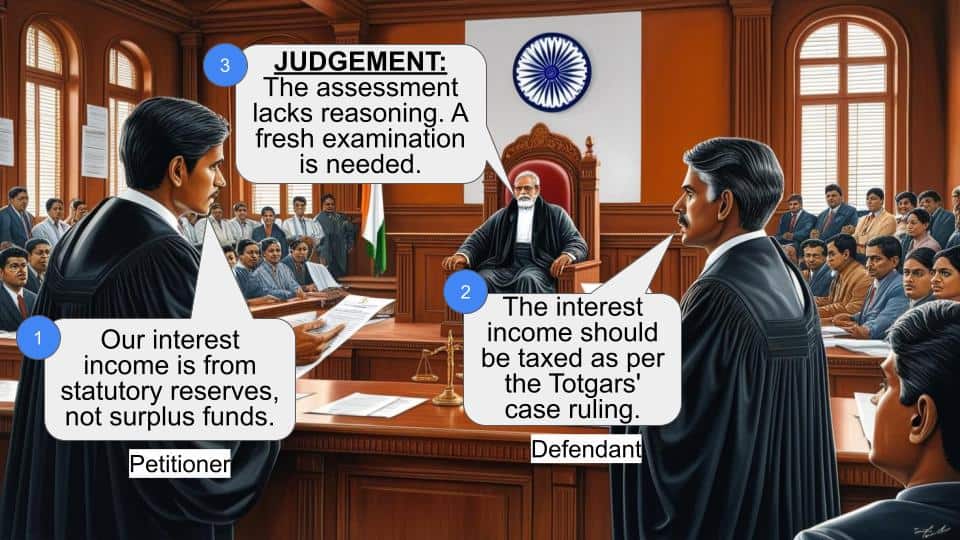
This case is about a Primary Agricultural Co-operative Credit Society challenging a tax assessment order. The main issue was whether the interest income from their investments should be taxed or not. The court decided to set aside the original assessment and ordered a fresh examination of the matter.
Get the full picture - access the original judgement of the court order here
Case Name:
K.628 Keeranatham Primay Agricultrual Cooperative Credit Society Ltd. Vs Income Tax Officer (High Court of Madras)
Writ Petition No.5552 of 2020 and WMP. Nos.6500 & 6502 of 2020
Date: 3rd March 2020
Key Takeaways:
1. The court found the tax assessment order to be non-speaking and passed without proper consideration of the society's arguments.
2. The distinction between 'surplus funds' and 'statutory reserves' is crucial in determining the taxability of interest income for co-operative societies.
3. The court emphasized the importance of considering relevant Supreme Court judgments and the specific nature of co-operative societies when making tax assessments.
Issue:
The main question here is: Should the interest income earned by the Primary Agricultural Co-operative Credit Society from its investments be taxed under the Income Tax Act, or is it eligible for deduction under Section 80P (of Income Tax Act, 1961)?
Facts:
The Income Tax Officer issued an assessment order for the Assessment Year 2012-13 on December 17, 2019. The officer decided to tax the interest income earned by the society from its investments. The society wasn't happy with this and filed a writ petition challenging the order. They argued that this income shouldn't be taxed because it came from statutory reserves, not surplus funds.
Arguments:
The society's main points were:
1. The investments weren't surplus funds but statutory reserves required by law.
2. The interest from these reserves should be eligible for deduction under Section 80P (of Income Tax Act, 1961).
3. They cited the Supreme Court case of COMMISSIONER OF INCOME TAX vs. NAWANSHAHAR CENTRAL COOPERATIVE BANK LTD to support their argument.
4. If the interest had to be taxed, they said it should be netted against the interest they paid on loans.
The tax department, on the other hand, relied on the Supreme Court judgment in Totgars' Cooperative Sale Society Limited V. ITO, Karnataka (322 ITR 283) to justify taxing the interest income.
Key Legal Precedents:
1. COMMISSIONER OF INCOME TAX vs. NAWANSHAHAR CENTRAL COOPERATIVE BANK LTD (Civil Appeal Nos.2499 2500 of 2005)
2. Totgars' Cooperative Sale Society Limited V. ITO, Karnataka (322 ITR 283)
3. Citizen Co-operative Society Limited V. Assistant Commissioner of Income-Tax, Circle -9 (1), Hyderabad (397 ITR 1)
Judgement:
The court wasn't happy with how the tax officer handled the case. They said the assessment order was "non-speaking" and passed without properly considering the society's arguments. So, they decided to set aside the assessment order and send the case back for a fresh examination.
The court ordered:
1. The assessment order is set aside.
2. The society should appear before the Assessing Officer on March 20, 2020, for a fresh hearing.
3. The Assessing Officer should consider all the arguments and relevant Supreme Court judgments before making a new decision.
4. The new assessment should be completed within six weeks of the hearing.
FAQs:
Q1: What does "non-speaking order" mean?
A1: It means the order doesn't explain the reasons for the decision properly. The court wants tax officers to give clear explanations for their decisions.
Q2: Why is the distinction between 'surplus funds' and 'statutory reserves' important?
A2: It can affect whether the interest income is taxable. Statutory reserves are required by law and might be treated differently from surplus funds for tax purposes.
Q3: Does this judgment mean the society won't have to pay tax on the interest income?
A3: Not necessarily. The court just ordered a fresh examination. The final decision will depend on the new assessment.
Q4: What should other co-operative societies learn from this case?
A4: They should be prepared to argue their case clearly, citing relevant laws and judgments, especially when it comes to the nature of their funds and investments.

Mr. A.P. Srinivas, learned Senior Standing Counsel accepts notice for the respondent.
2. By consent expressed by both learned counsel, the Writ Petition is finally disposed even at the stage of admission.
3. Since the issue arising out of impugned assessment dated 17.12.2019 for AY 2012-13 in terms of the Income Tax Act, 1961 ('Act') has been considered and decided by me in a batch of writ petitions filed by several Primary Agricultural Co-operative Societies, in K.2058, Saravanmpatti Primary Agricultural Co-operative Credit Society Ltd., Vs. The Income Tax Officer (W.P.Nos.17 of 2020 etc. batch dated 31.01.2020) and both learned counsel concur on the position that the aforesaid order is directly applicable to the present case, the said order is applied in the present case as well. Relevant portions of the order in the aforesaid batch of Writ Petitions are extracted below:
'3. The petitioners responded to the queries raised by the Officer. One of the issues that arose for consideration was the eligibility to exemption claimed on the interest income received by the petitioner from deposits/investment of funds in banks. Such income, according to the Officer, was ineligible for deduction under Section 80P (of Income Tax Act, 1961), since it did not form part of the operational income of the petitioner/assessee and was liable to be taxed in terms of Section 56 (of Income Tax Act, 1961). The Officer relied on the judgment of the Supreme Court in the case of Totgars' Cooperative Sale Society Limited V. ITO, Karnataka (322 ITR 283).
4. The petitioners were put to notice of the proposal to bring to tax the interest receipts under the head 'other sources'. The petitioners sought to distinguish the judgment in the case of Totgars (supra) on the grounds that Totgars was a Society engaged in sales, whereas, the petitioner was a Primary Agricultural Cooperative Credit Society. That apart, the funds that were deposited giving rise to the interest income did not constitute a surplus, but a mandatory statutory reserve.
5. Reliance was placed on a judgment of the Supreme Court in Commissioner of Income Tax, Jalandhar V. Nawanshahar Central Cooperative Bank Limited ((2007) 15 SCC 611) wherein the Bench has observed that the deposit effected was in the nature of a statutory reserve. According to the petitioners, such statutory reserve would not fall within the ambit of ‘surplus funds’ and the judgment in the case of Totgars (supra) was inapplicable to their cases.
6. In addition, the petitioner also stated that the total amount invested, Rs.15,51,18,027/- in the case of K.2058 Saravanampatti Primary Agricultural Cooperative Credit Society Limited, petitioner in W.P.No.17 of 2020, (whose facts are taken to be illustrative of the facts in other Writ Petitions as well on the basis of the submissions of both learned counsel to the effect that the facts and legalities in all writ petitions are similar excepting for the figures involved), comprised significantly of external borrowings. In this case, a sum of Rs.12,57,23,490/- had been borrowed from the Coimbatore District Central Cooperative Bank. It is not elaborated as to why this borrowal was effected. Perhaps, it was the mandate of the statutory reserve that compelled the petitioner to effect the borrowing to maintain such reserve.
7. It was also the contention of the petitioners before the Assessing Officer that if at all interest earned was to be brought to tax, then, alternatively, interest paid on the loan should be deducted from interest received or in other words, there should be a netting of the interest paid and received and only the resultant figure be brought to tax.
8. The Assessing Authority however rejected the submissions cursorily stating in a single line that ‘statutory reserve can also be considered as surplus funds of the assessee’. The judgement of the Supreme Court in the case of Nawanshahar (supra) has not been considered or discussed and neither has the plea of the petitioner for netting of interest paid and earned.
9. In Nawanshahar (supra), the Supreme Court considered the question of whether investments made by a banking concern are part of the business of banking. The conclusion was that the income arising from investments would be attributable to the business of the bank and fall under the head 'profits and gains of business', deductible under Section 80P(2)(a)(i) (of Income Tax Act, 1961). The earlier view in Bihar Coop. BankLtd. V. CIT ((1960) 39 ITR 114, CIT V. Karnataka State Coop. Apex Bank ((2001) 7 SCC 654) and CIT V. Ramanathapuram Distt. Coop.Central Bank Ltd. ((2009) 17 SCC 620) was followed.
10. At paragraph 4 of the short judgment, the Bench has stated that the principle in those cases would cover a situation where a Co-operative Bank carrying on the business of banking is statutorily required to place a part of its funds in approved securities.
11. The distinction I note, at first blush, is that this judgment has been rendered in the case of a Co-operative Bank, whereas, the petitioners before me are Co-operative Societies. The Supreme Court in Citizen Co- operative Society Limited V. Assistant Commissioner of Income-Tax, Circle -9 (1), Hyderabad (397 ITR 1) has noted the distinction between a Co-operative Bank that would be governed by the provisions of the Banking Regulation Act, 1949, where its operations would include engagement of the members of the general public, and a co-operative Society, whose operations would be confined to its members.
12. This is the distinction between the two kinds of co-operative societies as set out under Section 80P(2)(a)(i) (of Income Tax Act, 1961), that is, those carrying on the business of banking and those providing credit facilities to its members.
However, a common mandate in both cases, though arising under different enactments, is for such entity to place a part of its funds in/with specific facilities/entities.
13. One of the petitioners before me (Kalikkanaickenpalayam Primary Agricultural Cooperative Credit Society Ltd.in W.P.No.29 of 2020) has specifically raised before the Assessing Authority the argument that the Tamil Nadu Co-operative Societies Act, 1983 (in short 'TNCS Act') mandates Co- operative Societies to place a portion of their funds as a statutory reserve with a District Co-operative Bank. The argument appears to be that the statutory reserve forms part of and is an essential feature of the operations and any interest generated therefrom would be operational income entitled to deduction under Section 80P (of Income Tax Act, 1961).
14. The respondent officer has relied on a more recent judgment of the Supreme Court in Totgars' (supra), where the Bench was concerned with surplus funds which the assessee had invested in short term deposits with banks and Government facilities. The question referred for decision was as follows:
'Whether, on the facts and in the circumstances of the case, the Tribunal was right in law in holding that the income by way of interest on deposits held with scheduled banks, bonds and other securities was chargeable to tax under section 56 (of Income Tax Act, 1961) under the head `Income from other sources' without allowing any deduction in respect of cost of funds and proportionate administrative and other expenses under section 57 (of Income Tax Act, 1961)?'
15. Thus the issue before the Court in Totgars (supra) was on the classification of interest generated by deposits held with scheduled banks, bonds and other securities without providing for a deduction in respect of cost of funds and proportionate administrative and other expenses under Section 57 (of Income Tax Act, 1961). The question of interest generated from deposits made by reason of a statutory mandate was raised and finds reference in the narration of the petitioners' submissions, the Court has, at para 8 of the report (ITR) stated that 'At the outset, an important circumstance needs to be highlighted. In the present case, the interest held not eligible for deduction under Section 80P(2)(a)(i) (of Income Tax Act, 1961) is not the interest received from the members for providing credit facilities to them. What is sought to be taxed under Section 56 (of Income Tax Act, 1961) is the interest income arising on the surplus invested in short- term deposits and securities which surplus was not required for business purposes. Assessee(s) markets the produce of its members whose sale proceeds at times were retained by it. In this case, we are concerned with the tax treatment of such amount. Since the fund created by such retention was not required immediately for business purposes, it was invested in specified securities. The question, before us, is - whether interest on such deposits/securities, which strictly speaking accrues to the members' account, could be taxed as business income under Section 28 (of Income Tax Act, 1961)? In our view, such interest income would come in the category of "Income from other sources",.
16. The revenue has filed counters in a few writ petitions objecting to the maintainability of writs sought and again relying on the judgement of the Supreme Court in the case of Totgars (supra). Additionally, Mr.Jayapratap points out that the issue in regard to the classification and taxability of interest income has not been specifically raised in the affidavit filed in support of the Writ Petitions. Upon perusal, the affidavits appear to be a cut and paste exercise from Writ Petitions filed by other Co-operative Societies challenging orders of assessment rejecting claims for exemption on the ground of mutuality. Though there is one general ground raised in regard to availability/entitlement to deduction under Section 80P (of Income Tax Act, 1961) itself, 'The respondent failed to consider that the cooperative societies are entitled to seeking deduction u/s.80(P) (of Income Tax Act, 1961), but the same was not considered by the respondent’, all other grounds revolve only around the aspect of mutuality and are entirely irrelevant to the issue arising from the present impugned order. No specific ground has been raised on the classification of interest income and whether the same would fall within the ambit of income from business or other sources.
17. However, the petitioners have responded to the show cause notice issued by the officer raising this issue and their response has been extracted in the orders of assessment, as follows:
'The Supreme Court judgment in Togars Cooperative Sale Society Ltd no applicable to our society as the above society is a sale society and ours is Primary Agricultural Co-operative Credit Society. The former is dealing sale of goods and ours is dealing in credit facility extended to the members.
Also, as per section 80P (of Income Tax Act, 1961)2a, profits and gains attributable to the business of the society and the word attributable is having elaborate meaning as derived in Commissioner of Income-tax vs. Nawanshahar Central Co-operative bank Ltd. Civil Appeal Nos.2499, 2500 of 2005 8th April 2005.
So, the funds deposited is not a surplus fund as decided in Totgars Co-operative Sale Society Ltd., but a statutory reserve maintained as decided in Commissioner of Income tax Vs. Nanshahar Central Cooperative Bank Ltd.
The amount in investments is Rs.15,51,18,027/- out of this Rs.12,57,23,490/0 was borrowed from Coimbatore District Central Co-operative Bank. if interest earned is taxed the interest paid to such loans are deducted form the interest on other sources.
So, kindly drop the proceeding by taxing the interest income and accept the returned income'
Received you show cause notice and noted the contents. In this regard we wish to submit the following for your consideration. The Supreme Court judgement in Totgars Cooperative Sale Society Ltd., not applicable to our society as the above society is a sale society and ours is Primary Agricultural Cooperative Credit Society. The former is dealing sale of goods and ours is dealing in credit facility extended to the members. Major difference in both former is dealing sale of something and ours is dealing in money, when money involved in the bank or credit society, definitely a reserve must be maintained for easy liquidation purpose in case of emergency.
Also, as per section 80P (of Income Tax Act, 1961)2A, profits and gains attributable to the business of the society and the word attributable is having elaborate meaning as derived in the COMMISSIONER OF INCOME TAX vs. NAWANSHAHAR CENTRAL COOPERATIVE BANK LTD Civil Appeal Nos.2499 2500 of 2005 8th April, 2005, 2007 208 CTR SC 438:2007 289 ITR 6 SC:2007 160 TAXMAN 48 Also it is to be noted that every Cooperative Society is to be maintained a statutory reserve of 25 percent of the total deposits including savings bank account and current account balances with District Central Cooperative banks to provide proper liquidity to the societies.
So, the funds deposited is not a surplus fund as decided in Totgars Cooperative Sale Society Ltd., but a statutory reserve maintained as decided in COMMISSIONER OF INCOME TAX vs. NAWANSHAHAR CENTRAL COOPERATIVE BANK LTD.
The following cases are also to be considered by the Honorable Supreme Court of India in the case of interest received on deposits etc.,
Supreme Court of India Commissioner Of Income-Tax vs Ramanathapuram Distt. Co-Op. on 30 October, 2001 Equivalent citations: 2002 255 ITR 423 SC Bench: S Bharucha, Y Sabharwal, B Kumar ORDER
1. The High Court has answered against the Revenue, the following question :
"Whether, on the facts and in the circumstances of the case, the Appellate Tribunal was correct in law in holding that the interest on securities, subsidies received from the Government and dividend business income of the assesse entitled to deduction under Section 80P(2)(a)(i) (of Income Tax Act, 1961) ?"
2. The very question was considered by this court in CIT v. Karnataka State Co-operative Apex Bank [2001] 251 ITR 194 and the conclusion was reiterated in Mehsana District Central Co-operative Bank Ltd. v. ITO .
3. It is now contended on behalf of the Revenue that the decision of this court in United Commercial Bank Ltd. v. CIT [1957] 32 ITR 688 was not considered.
4. We do not think that it is open to the Revenue to urge, through different counsel, the same thing again and again. We are satisfied that the answer to the question has been correctly given in the decisions aforementioned and in the order under appeal.
5. The civil appeals are dismissed with costs. Also the jurisdictional Madras High Court also looking into the Totgars case and allowed the interest received is allowed under section 80P (of Income Tax Act, 1961) in case of Madras High Court
The Commissioner Of Income Tax vs M/S. Veerakeralam Primary . on 5 July, 2016
IN THE HIGH COURT OF JUDICATURE AT MADRAS Dated: 05.07.2016 CORAM :
THE HONOURABLE MR. JUSTICE S.MANIKUMAR and THE HONOURABLE MR. JUSTICE D.KRISHNAKUMAR Tax Case Appeal Nos.735, 755 of 2014 and 460 of 2015 The Commissioner of Income Tax, 63, Race Course Road Coimbatore. .. Appellant in all the above appeals Vs M/s. Veerakeralam Primary Agricultural Co-operative Credit Society No.17, Peria Thottam Colony Veerakeralam Coimbatore 641 007.
So, on the basis of the above kindly drop the proceedings by taxing the interest income and accept the returned income.’
18. Though all petitioners have not replied identically to the notices issued by the officer, the above replies are illustrative of the stands adopted by the petitioners at the time of assessment and crystallize the arguments of the petitioners’ to the effect that (i) the investments in question do not comprise surplus funds (ii) that the investments constitute a statutory reserve as mandated by the TNCS Act (iii) the interest generated therefrom was eligible for deduction in the light of Nawanshahar (supra) (iv) at worst the interest received should be netted with interest paid. These arguments ought to have been at least, considered, by the Assessing Authority in deciding the issue but have unfortunately been brushed aside despite being noted in the order itself.
19. In my considered view, this amounts to a fatal flaw as it renders the impugned order entirely non-speaking and passed without application of mind. If the affidavits of the petitioners’ are looked upon as mechanical and filed in haste and without application of mind, equally so are the impugned orders of assessment that simply rely on Totgars (supra) without discussing the arguments put forth by the petitioners. For this reason the arguments of the revenue based on the lack of pleadings in the affidavit is rejected. I am of the considered view that in a case such as the present, the petitioners should not suffer for lacunae in drafting particularly when the stand of the petitioners is very clear from the materials on record. Thus, to balance the convenience of both parties and in the interests of justice, this issue is set aside for denovo and fresh examination and conclusion by the respondent.
20. I make it clear that I have expressed no opinion on the merits of the matter and all that is stated above is only to crystallize the arguments of both sides, as available on record. The officers are at liberty to decide and conclude the issue on merits in any manner as they may think fit, but only after proper discussion. An order of assessment passed by a quasi judicial officer that decides an important question of law, raises a significant demand and has far reaching consequences has to speak for itself and take into account, and meet, the arguments raised by an assessee. Mere reliance on a judgement without reference to the facts involved in both cases, those in the case relied upon and those in the case of the assessee in question, would not justify the conclusion arrived at.
21. For these reasons, the assessments impugned in W.P.Nos.17, 20, 22, 23, 26, 29, 1150, 1155 and 1161 of 2020 are set aside and the matter is remanded to the file of the Assessing Officer for de novo consideration. The petitioners are directed to appear before their respective Assessing Officer on 14.02.2020 at 10.30 a.m. without expecting any further notice in this regard.
The petitioners will be heard specifically on the question of classification of interest generated by investments made for the purpose of statutory reserve and the judgments of the Supreme Court in Nawanshahar and Totgars' (supra) as well as other relevant case law shall be taken into account by the Assessing Officer in framing assessments by way of speaking and detailed orders. This exercise shall be completed within a period of six (6) weeks from date of conclusion of personal hearing '
3. In the light of the aforesaid, the impugned order which relates to this issue is set aside. The petitioner is permitted to appear before the Assessing Officer on Friday the 20 th of March, 2020 at 10.30. a.m. without expecting any further notice in this regard. My direction as set out in paragraph No.21 extracted above will apply equally in this case as well .
4. The Writ Petition is allowed in the aforesaid terms. No costs. Connected Miscellaneous Petitions are closed.
03.03.2020
×
Similar Ripples
Questions
Court Sets Aside Tax Assessment, Orders Fresh Examination of Co-op Society's Interest Income
Write your CommentSimilar Posts


Generic
- Reportdata/6010.pdf
