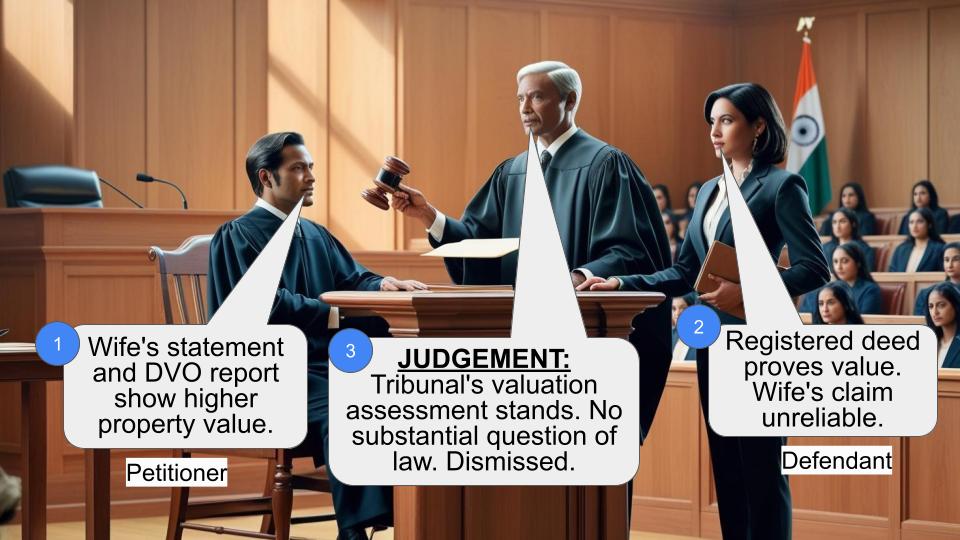
Court Upholds Deemed Dividend Addition, Rejects Assessee's Property Sale Explan…


Full News

Court Upholds Deemed Dividend Addition, Rejects Assessee's Property Sale Explanation
Court Upholds Deemed Dividend Addition, Rejects Assessee's Property Sale Explanation
This case involves an appeal by an assessee (taxpayer) against an order of the Income Tax Appellate Tribunal (ITAT). The ITAT had upheld an addition made by the Assessing Officer (AO) under Section 2(22)(e) (of Income Tax Act, 1961), treating certain transactions as deemed dividend. The assessee's explanation that the transactions were related to a property sale agreement was rejected by the ITAT and subsequently by the High Court.
Get the full picture - access the original judgement of the court order here
Case Name:
Vikram Krishnan Vs Principal Commissioner of Income Tax (High Court of Delhi)
ITA 217/2019
Date: 6th March 2019
Key Takeaways:
1. The court emphasized the importance of genuine commercial transactions in tax matters.
2. The judgment highlights the scrutiny applied to transactions between closely held companies and their directors/substantial shareholders.
3. The case underscores the significance of maintaining proper documentation and providing credible explanations for financial transactions.
Issue:
Was the ITAT correct in upholding the addition made under Section 2(22)(e) (of Income Tax Act, 1961), treating the transactions as deemed dividend, despite the assessee's claim that they were related to a property sale agreement?
Facts:
1. The assessee was an individual deriving income from various sources and was a director and 50% shareholder in a closely held company, M/s Charu Home Products (P) Ltd.
2. For the Assessment Year 2010-11, the AO made an addition of ₹1,01,36,328/- under Section 2(22)(e) (of Income Tax Act, 1961).
3. The assessee claimed that the transactions were related to an agreement to sell his property to the company for ₹8 crores, with an advance of ₹1.8 crores received.
4. The assessee provided an agreement to sell dated 8/6/2009 and a cancellation deed dated 1/8/2009 as evidence.
5. The deal allegedly fell through, and the assessee claimed to have refunded the advance over a period of six months ending in March 2010.
Arguments:
Assessee's Arguments:
1. The transactions were part of a genuine business deal for selling property to the company.
2. The agreement was cancelled when the company couldn't arrange the full funds.
3. The advance was refunded, proving it wasn't a loan or deemed dividend.
Revenue's Arguments:
1. The assessee didn't provide this explanation during the initial assessment proceedings.
2. The timing and nature of the transactions were suspicious.
3. There was a lack of evidence supporting the assessee's claims about the property sale attempt.
Key Legal Precedents:
The judgment doesn't explicitly cite specific case laws, but it mentions that according to prevailing law, the general approach of the Revenue is to exclude genuine commercial transactions from the purview of Section 2(22)(e) (of Income Tax Act, 1961).
Judgement:
1. The High Court dismissed the assessee's appeal, agreeing with the ITAT's decision.
2. The court found that the ITAT's conclusion was based on an independent analysis of facts and was a possible view given the circumstances.
3. The court held that accepting one view of facts over another doesn't constitute a substantial question of law under Section 260A (of Income Tax Act, 1961), unless the view is wholly unreasonable.
FAQs:
1. Q: What is a "deemed dividend" under Section 2(22)(e) (of Income Tax Act, 1961)?
A: A deemed dividend is a concept where certain payments or loans by a company to its shareholders are treated as dividends for tax purposes, even if not formally declared as such.
2. Q: Why did the court reject the assessee's explanation about the property sale agreement?
A: The court found several inconsistencies in the assessee's story, including the timing of transactions, lack of evidence about efforts to sell the property, and the delayed refund of the advance.
3. Q: What impact does this judgment have on similar cases?
A: This judgment emphasizes the need for taxpayers to provide credible explanations and evidence for transactions that could potentially be treated as deemed dividends, especially in cases involving closely held companies and their directors/substantial shareholders.
4. Q: Can the assessee appeal this decision further?
A: The judgment doesn't mention further appeal options, but generally, decisions of High Courts can be appealed to the Supreme Court if there's a substantial question of law involved.
5. Q: What lesson can taxpayers learn from this case?
A: Taxpayers should maintain proper documentation for all significant financial transactions, especially those involving related parties, and be prepared to provide credible explanations during tax assessments.

1. The assessee is aggrieved by an order of the ITAT, which upheld the AO’s determination with respect to the addition made in this case for A.Y.2010-11 under Section 2(22)(e) (of Income Tax Act, 1961).
2. It is urged that the ITAT fell into error in not noticing the true nature of the transaction for refund of the advance amounts received by the assessee from the vendee company of which, he was a director.
3. The assessee, an individual deriving income from salary, house property, capital gain and interest from certain banks etc. was a director in a closely held company M/s Charu Home Products (P) Ltd; and was also a shareholder to the extent he also held 50% of its shares. The assessee declared ₹50,32,223/- in the income returned by him which was subjected to scrutiny assessment under Section 143(3) (of Income Tax Act, 1961). During the course of assessment proceedings, the AO issued a Show Cause Notice as to why the addition ought not to be made with respect to the sum of ₹ 1,01,36,328/- under Section 2(22)(e) (of Income Tax Act, 1961). Apart from denying the general applicability of that provision, the assessee did not produce any material in support of its contentions. On the addition being made and the same brought to tax, the assesse preferred an appeal; the CIT(A) elicited no less than three remand reports. In the course of these remand proceedings, the assessee furnished agreements to sell that he had entered into with the company [vendee i.e. Charu Home Products (P) Ltd], other materials in the form of cancellation deed and copies of bank statement etc. were also furnished. The assessee contended that his property was sought to be sold to the company [of which he was the director and substantial shareholder] but the deal misfired and did not materialise.
4. According to the original agreement to sell the property, the parties had fixed the consideration payable to the assessee by his company at ₹8 crores. However, the advance made was to the tune of ₹ 1.8 crores. The cancellation deed in this case was executed between the parties on 01.08.2009, however, the amounts paid to the assessee by the company were refunded by him over a period of merely six months ending in March, 2010. The CIT(A) was satisfied with the explanation and held that the amounts could not be brought to tax under Section 2(22)(e) (of Income Tax Act, 1961).
5. The CIT(A) was of the opinion that there was no reason to disbelieve the assessee’s explanation, having regard to the overall circumstances of the case. The ITAT, to whom the Revenue appealed, agreed with the view of the AO and set aside the CIT(A) orders.
6. Mr. Krishnan, learned counsel for the assessee contended that the ITAT’s order is erroneous because it disbelieved the assessee’s submissions principally on the ground that no explanation was given during the course of assessment proceedings. It was urged that once the Rule 46A (of Income Tax Rules, 1962) application was allowed and additional material was brought on record, which was subject to no less than three remands, after which the CIT(A) by a detailed order accepted the assessee’s explanation, the ITAT ought not to have interfered with the exercise of discretion in the course of his justified jurisdiction by the CIT(A). The ITAT elaborately noted the sequence of events as well as the nature of the documents presented during the course of proceedings. It also noticed that according to the prevailing law, the general approach of the Revenue is to exclude a genuine commercial transaction. from the purview of Section 2(22)(e) (of Income Tax Act, 1961). However, having regard to the overall circumstances of the case the ITAT disbelieved the assessee’s explanation stating as follows:-
“10. We have carefully considered the rival contentions and perused the order of the Lower Authorities. The assessee has received sums from M/s Charu Home Products Pvt. Ltd. from 8/6/2009 to 27/7/2009 to the extent of Rs. 18154741/- as the assessee is holding more than 50% shares and the Company has reserve and surpluses as on 1/4/2009 of Rs. 10136328/-, the Ld. Assessing Officer issued show cause notice to the assessee that why the above amount should not be taxed u/s 2(22)(e) (of Income Tax Act, 1961) as deemed dividend. Before the A.O the assessee did not submit that the above transaction is a business transaction and, therefore, the Ld. A.O taxed the above sum as deemed dividend. Before the Ld. CIT(A), the assessee submitted one agreement to sale dated 8/6/2009 and another cancellation deed of the same agreement dated 1/8/2009 for a property owned by the assessee to state that the above transaction is a business transaction and the sum is business advance, hence provision of section 2(22)(e) (of Income Tax Act, 1961) does not apply. It was stated that sum has been received by the assessee in terms of Agreement to sell dated 8th June 2009 between the assessee and the Company for purchase of property at 41, Sector 15, Noida. Such Agreement to sell dated 8th June 2009 for an agreed sale consideration of Rs. 8 crores. On 8/6/2009, the assessee entered into a deed of cancellation stating that buyer could not arrange Rs. 6.1 Crores for purchase of the property and hence the Agreement to sell original entered between the assessee and the Company stood cancelled. The assessee stated that the above sum of advance of Rs. 1.81 crores is, therefore, a business advance to which the provisions of deemed dividend does not apply. During the course of remand proceedings, the assessee was summoned and asked that the property was a leasehold property and was to be used for the development. The Company could not raise the funds from the banks, which resulted into cancellation of the agreements. The assessee could not explain being the Director that which bank was approached and what efforts were made.
Even the assessee himself could not show which bank was approached. No documentary evidence could be produced before the A.O. Further, the property was leasehold property what efforts were made by the assessee Director to sell the property and transfer lease rights; he submitted that as the property could not be sold he did not do and efforts for lease. On many other question, he expressed his ignorance about the efforts, bank approached, etc. The assessee was also asked that the money was received by him from the Company and cancellation deed was entered into on 1/8/2009 why payments could not be returned by the assessee up to 31/3/2010 completely. To this, the assessee merely stated that 96 lakhs were paid back in the months of August and October 2009 and the balance sum was paid on 30th March 2010 and 31st March 2010. The Agreement clause did not also have any forfeiture clause and further despite having the right of enforcement, the assessee did not make any effort. On analysis of the loan transaction between the assessee and the company, from the copy of the account at Page No. 2 of the Assessment Order it is apparent that assessee started receiving loans from the company from 8/6/2009 from the Company. The assessee tried to justify that there was an agreement to sell the property to the Company. The moment, the assessee repaid the sum in part there was a Deed of Cancellation of Agreement to Sale. It is apparent that the assessee also received on 3/7/2009 a sum of Rs. 308000 and on 27/7/2009 a sum of Rs. 70,000/- only. It is also interesting to note that on 22/7/2009 the assessee was paid Rs. 46.50 lacs by the Company and on 27/7/2009 assessee was also paid Rs. 70,000/- and within 4 days the Company came to know that it is not in a position to raise the further sum of ₹ 6.1 Crores. No evidence or explanation is forthcoming on this point form assessee. The repayment of the sum was also made on 30/3/2010 of Rs. 78 lacs after 8 months of the cancellation deed, which should have been otherwise repaid immediately. There is no claim of interest by the company or any efforts to recover the above sum from the director. Not all these facts inspire any confidence that Agreement to sell, subsequent cancellation entered into within merely one, and half months by the assessee and the Company is a business transaction. The LD AO in remand report has specifically stated that the documents produced shows lack of genuineness.
It is also apparent that there is no whisper before the Assessing Officer about any such transaction of the Agreement to sell by the assessee. These entire documents have come as additional evidence before the CIT(A), which were examined by the dl AO and raised serious doubt after examining the assessee on oath. It is also interesting to note that the deed of cancellation was made on stamp paper dated 27th July 2009 where as on 22nd July 2009, the assessee was paid 46.50 lacs and even on 27th July 2009, the assessee was made paid 70,000/- towards the purchase of the property. It is surprising that on the one side on the same date, the Agreement to sell is being cancelled. The assessee being a Director of the Company was also not aware that how Rs. 8 crore could be arranged by the Company for the payment of above land. The assessee could not show what efforts were made by the Company and which bankers were approached for the loan. Therefore, in view of the above peculiar facts it is apparent that Agreement to Sell dated 8/6/2009 and cancellation of such deed by Agreement dated 1/8/2009 for the purchase of property is merely cover up and a camouflage for giving loan to the assessee by the above Company to avoid contravention of the provision of Section 2(22)(e) (of Income Tax Act, 1961). Assessee also failed to give the adequate evidence and cogent, reliable, and credible evidences about the transaction. The ld. CIT(A) has completely brushed aside finding of the A.O. in remand report and the statement of the assessee and further has not applied his mind to find out the true nature of the transaction. ”
7. This Court is of the opinion that the ITAT’s decision is based upon an independent analysis of the facts. No doubt it differed from the CIT(A)’s view. At the same time all its findings are based upon appreciation of material facts. Its conclusion are a possible view that can be taken by the Tribunal based upon the circumstances. The acceptance of one view on facts as against another, unless it showed to be wholly unreasonable, cannot be subject matter of an appeal under Section 260A (of Income Tax Act, 1961).
8. Consequently, no substantial question of law arises. The appeal is therefore, dismissed.
S. RAVINDRA BHAT,J.
PRATEEK JALAN,J.
MARCH 06, 2019
×