Capital Gains or Business Income? Court Remands Case for Re-evaluation


Full News

Capital Gains or Business Income? Court Remands Case for Re-evaluation
Capital Gains or Business Income? Court Remands Case for Re-evaluation
In the case of Amjad Ahmedbhai Sheikh vs. Assistant Commissioner of Income Tax, the court examined whether the sale of land by the appellant should be treated as capital gains or business income. The Income Tax Appellate Tribunal had previously classified it as business income, but the court has now remanded the case for reconsideration, emphasizing the need to consider the treatment of a similar transaction by a co-owner.
Get the full picture - access the original judgement of the court order here
Case Name:
Amjad Ahmedbhai Sheikh Vs. Assistant Commissioner of Income Tax (High Court of Bombay)
Income Tax Appeal No. 51 of 2018
Date: 17th March 2021
Key Takeaways:
- The court highlighted the importance of consistent treatment of similar transactions for co-owners.
- The case underscores the distinction between capital gains and business income in tax law.
- The decision emphasizes the need for thorough consideration of all relevant evidence, including the treatment of similar transactions by co-owners.
Issue:
Should the sale transaction of land by the appellant be treated as capital gains or business income for tax purposes?
Facts:
- The appellant, Amjad Ahmedbhai Sheikh, along with a co-owner, purchased agricultural land, converted it for non-agricultural use, and sold it as plots.
- The appellant declared the income from the sale as capital gains, but the Assessing Officer treated it as business income.
- The co-owner’s similar transaction was accepted as capital gains by the Revenue.
Arguments:
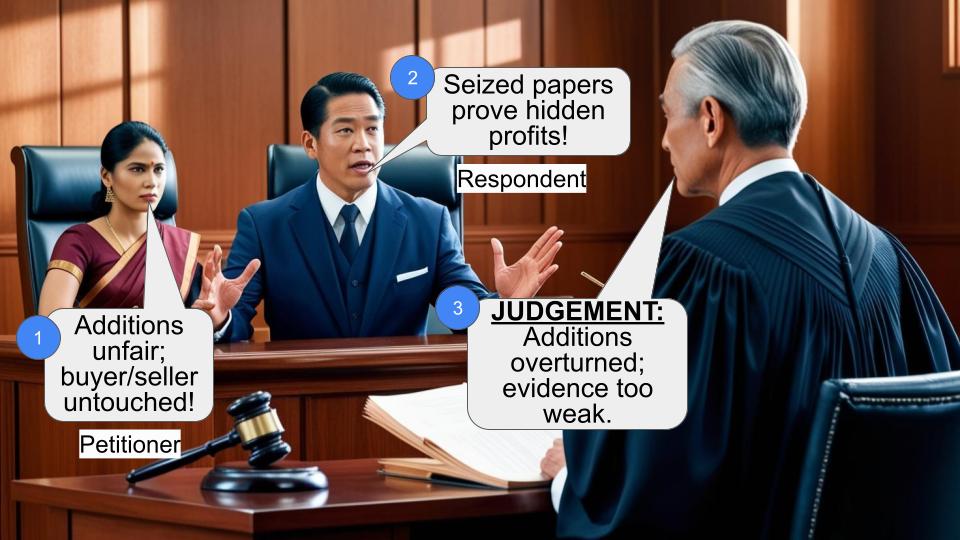
- Appellant’s Argument: The appellant argued that since the co-owner’s transaction was treated as capital gains, the same treatment should apply to his transaction. He contended that the sale was not an adventure in the nature of trade.
- Respondent’s Argument: The respondent maintained that the appellant’s activities were commercial in nature, justifying the classification as business income. They argued that the co-owner’s case was different due to his business background.
Key Legal Precedents:
The case involved the interpretation of Section 54F (of Income Tax Act, 1961) and Section 50C (of Income Tax Act, 1961), which deal with capital gains and the valuation of immovable property for tax purposes.
Judgement:
The court set aside the order of the Income Tax Appellate Tribunal and remanded the case for reconsideration. It instructed the Tribunal to consider the assessment order of the co-owner and allow the appellant to present additional evidence. The court emphasized the need for consistent treatment of similar transactions.
FAQs:
Q1. Why was the case remanded?
A1. The case was remanded because the court found that the Tribunal did not consider the co-owner’s assessment order, which treated the transaction as capital gains.
Q2. What is the significance of this case?
A2. The case highlights the importance of consistent tax treatment for similar transactions and the distinction between capital gains and business income.
Q3. What does this mean for the appellant?
A3. The appellant has another opportunity to argue that his transaction should be treated as capital gains, potentially reducing his tax liability.

Heard. ADMIT on the following substantial question of law:
“The Revenue having accepted the sale transaction entered into by the appellant and Shri narendra Parikh jointly as capital gain in the case of the co-owner, whether the Tribunal was justified in treating the said transaction as business income insofar as the appellant is concerned?”
Learned counsel Shri Anand Parchure waives notice for the respondent.
2. In this appeal filed under Section 260A (of Income Tax Act, 1961) of the Income Tax, 1961 (for short, ‘the said Act’), the order dated 23.11.2017 passed by the Income Tax Appellate Tribunal is under challenge. The facts relevant for adjudication of the present appeal are that for the assessment year 2010-11 the appellant-assessee filed his return and declared a total income of Rs.27,43,007/-. In the revised return of income, the assessee claimed deduction of Rs.80,000/- under Section 54F of the Income Tax Act, 1961 on long term capital gain. The assessment was completed under Section 143(3) of the Income Tax Act, 1961 on 28.03.2013. The Assessing Officer however disallowed the claim for exemption under Section 54F (of Income Tax Act, 1961) and treated the entire sale consideration of immovable property of Rs.1,01,74,000/- as business income. After deducting the cost price, the net profit was treated as income from business. The assessee challenged the said order before the Commissioner of Income Tax (Appeals) but the treatment of capital gains as business income was upheld. Further appeal was carried before the Income Tax Appellate Tribunal which observed that the assessee had sold four plots to different parties during the relevant period and thus concluded that the intention of the assessee was to exploit the commercial potential of the land. On that count the appeal came to be dismissed. This order is the subject matter of challenge in the present appeal.
3. Shri S.N. Bhattad, learned counsel for the assessee sumitted that by virtue of two sale-deeds dated 20.02.2004 and 13.04.2004 the assessee along with one Shri Narendra Kanhaiyalal Parikh had jointly purchased agricultural lands. The said lands were then sought to be converted for non-agricultural use. The said lands were then converted into various plots and plot nos.1 and 2 were sold on 09.12.2009 for a consideration of Rs.2,43,52,000/- in which the share of the assessee was Rs.91,01,000/-. Another plot was further sold on 01.02.2010. It was his contention that the co-owner while filing his income tax return had sought benefit of capital gains on account of sale of the land. The Deputy Commissioner of Income Tax was pleased to grant such benefit under Section 50C of the Income Tax Act, 1961 and capital gain was calculated accordingly.
This order passed by the Deputy Commissioner of Income Tax was accepted by the Revenue and it is thus submitted that since in the case of the co-owner of the same land income from the same transaction that was jointly entered into was considered as capital gain, the Revenue was not justified in treating the sale transaction in a different manner insofar as the assessee was concerned. The income of the assessee from the same transaction could not be treated as business income and the benefit of capital gains ought to have been granted to the assessee. C.A.T. No.9/2021 has been filed seeking to place on record additional evidence and the nature of the assessment order passed in the case of Shri Narendra Kanhaiyalal Parikh. It is urged that this assessment order deserves to be taken into consideration while answering the substantial question of law as framed.
4. Shri Anand Parchure, learned counsel for the respondent opposed aforesaid submissions. According to him the assessee was rightly held not eligible for claiming the benefit of capital gains in view of the fact that he had engaged in various activities that had a character of an adventure in the nature of trade. The case of the co-owner was distinguishable as the said assessee was in the business of cement and retail lime powder. Hence, it was submitted that the additional evidence sought to be brought on record was not relevant and the Income Tax Appellate Tribunal having rightly adjudicated the appeal as preferred, no interference with the impugned order was called for.
5. We have heard the learned counsel for the parties and we have given due consideration to their respective submissions. Perusal of the impugned order indicates reference to the joint purchase by the assessee and Shri Narendra Kanhaiyalal Parikh of parcels of land from Kahsra No.70. The manner in which the lands were jointly purchased and were thereafter converted for non-agricultural use and plots therein were further sold have been taken into consideration. Since the Tribunal found that the assessee had sold four plots to different parties in the said assessment year, it concluded that in the light of the nature of business of the assessee and development activity carried on it was clear that the assessee intended to exploit the commercial potential of the land. It is undisputed that the assessment order dated 30.03.2013 in the case of Shri Narendra Kanhaiyalal Parikh, co-owner of the said lands along with the assessee permitted the said co-owner to take into account full value of the sale consideration for the purposes of Section 50C of the Income Tax Act, 1961 for computing capital gains. This assessment order however was not placed before the Income Tax Appellate Tribunal by the assessee. According to the assessee, he was not aware of the passing of the said assessment order and it is for that purpose that the application to bring on record additional evidence has been filed in the present proceedings.
6. We find that the assessee and Shri Narendra Kanhaiyalal Parikh were joint purchasers of agricultural land by virtue of sale-deeds dated 23.03.2004 and 29.04.2004. After converting the same for non- agricultural use, various plots came to be sold. Prima-facie we find that as the co-owner has been granted benefit of capital gains with regard to the same transaction which assessment order has been accepted by the Revenue, said aspect deserves to be taken into consideration while adjudicating the claim of the assessee for seeking benefit of capital gains. The said assessment order dated 30.03.2013 was in existence when the Tribunal decided the appeal. The same was however not brought on record by the assessee. In the peculiar facts of the present case as it is found that co-owner of the same land has been granted benefit of capital gains we find that the effect of the assessment order passed in the case of the co-owner deserves to be considered by the Income Tax Appellate Tribunal. For the said purpose, a re-consideration of the proceedings by the Income Tax Appellate Tribunal would be necessitated.
7. Accordingly, the substantial question of law as framed is answered by holding that the effect of the sale transaction of the co- owner being extended the benefit of capital gains deserves to be considered by the Income Tax Appellate Tribunal as income from the same transaction has been treated as business income insofar as the assessee is concerned. In that view of the matter the following order is passed:
The order passed by the Income Tax Appellate Tribunal, Nagpur Bench, Nagpur on 23.11.2017 is set aside. The proceedings are remanded to the Tribunal to re-consider the appeal with a liberty to the assessee to raise additional grounds in support thereof. The assessee is at liberty to place on record the assessment order dated 30.03.2013 passed by the Assessing Officer in the case of Shri Narendra Kanhaiyalal Parikh for its due consideration by the Income Tax Appellate Tribunal without going into the question of limitation. The appeal shall be decided on its own merits without being influenced by any observations made in this judgment. The appeal be preferably decided within a period of three months from the date of its first hearing.
The appeal is allowed in aforesaid terms and disposed of.
×